A few years into my banking career, I realized something that changed everything.
And that is the key to being good with money isn't about being a numbers person.
It's not about spreadsheets or stock tips or reading the Financial Times every morning.
It's actually about understanding a few core principles that nobody ever teaches us.
Once you know them, everything starts to make sense.
If you're new here, hi, I'm Nisha.
I spent nine years in banking and trained as a chartered accountant.
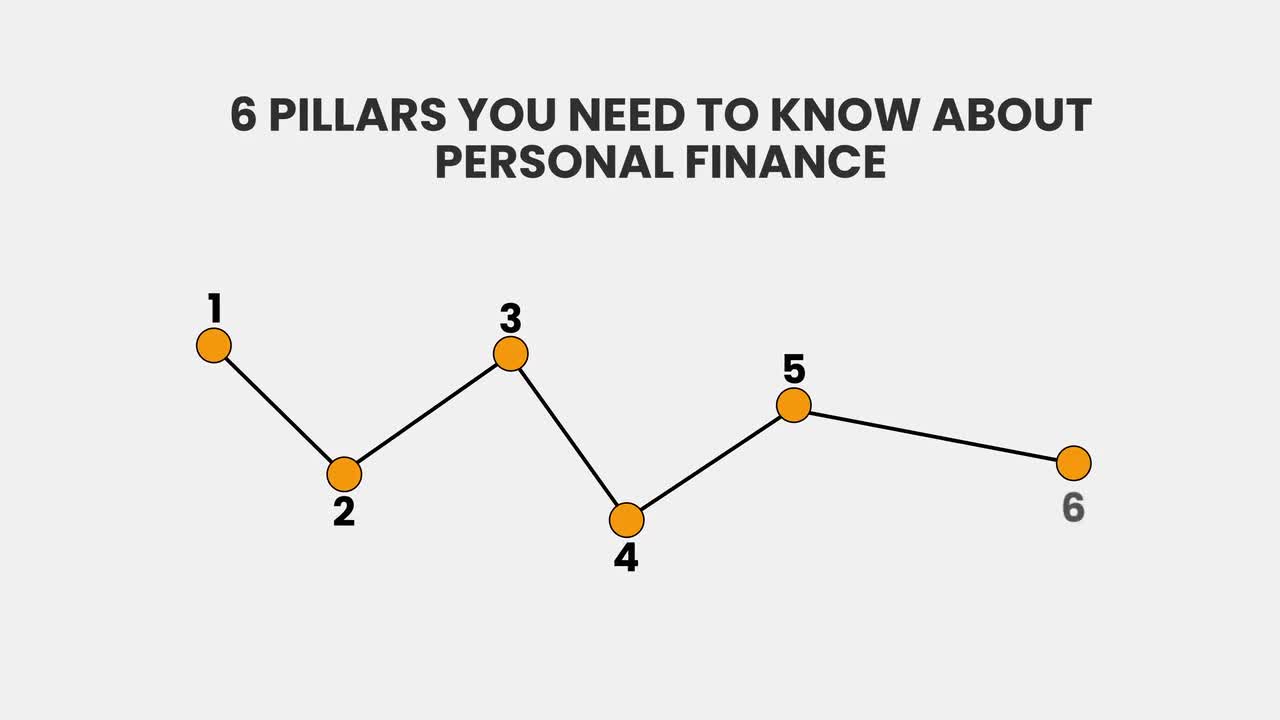
And the six pillars I'm about to share with you.
They're more valuable than most of what I've learned during that time.
And they cover almost everything that you need to know about personal finance.
Let's dive in.
Number one, the silent tax.
When I first started to take my own personal finances seriously, I did what I thought you were supposed to do.
I opened a savings account, I set up an automatic transfer, and I felt really good about it.
I felt good about that money, that it was going up every single month and that my finances were sorted.
What I didn't realize was that, whilst that pallet was sitting there looking perfectly fine, something else was actually eating into it, and that is inflation.
Inflation is the rate at which prices rise over time.
And that means that say, a hundred dollars or a hundred pounds today will buy you less next year than it does right now.
So if inflation is currently at 3 and your savings account is paying you 01, you're not making 01.
You're losing the difference.
You're losing 2.9% every single year.
If you had 10000 sitting in a low-interest savings account for 10 years, with inflation running at its long-term average, you could lose the equivalent of thousands in purchasing power without even touching a penny.
So step one, really, really simple.
Make sure any cash that you're holding into in any bank account is sitting in a high-interest savings account, not a regular one.
The difference in interest rate can be significant and most people are just leaving that money on the table.
But here's the thing even a good savings account, it doesn't stop the leak or grow your money.
Which leads me to point number two.
And before i get into that, if you want to take everything you learned from this video and actually apply it to your own finances, side by side with me, i have a completely free investing workshop coming up.
You can find all the details on nishame forward slash, invest or click the link in the description.
So number two the two buckets.
Here's something I wish someone had explained to me earlier.
Saving and investing, they're not the same thing.
I used to use the words interchangeably.
So I'll say things like oh, I'm saving for retirement, without realizing that actually I'm describing two completely different actions.
Saving is putting money aside in cash.
It is safe, it's accessible and it's essentially for your emergency fund, for short-term goals, for peace of mind or for anything that you need that money for in the next five years.
Investing is different.
Investing is putting your money into assets like shares funds, property that have the potential to grow over time.
It's not safe.
In the same way, the value can go down, but over the long term this is how wealth is actually built.
So think of it this way.
Saving is the foundation of a house.
It's stable.
It is necessary.
You can't skip it.
The investing is how you actually build the thing.
If all you ever do is pour concrete, you'll have a very solid slab and nowhere to live.
So if you'd put 1000 into even the best savings account 10 years ago, you'd have around 1270 today.
If you put that same 1,000 into a global index fund, you'd have close to 3,000.
If you put it into the S&P 500, Nearly 3,800.
This is based on real data.
Almost four times what you started with.
That's the difference between the two buckets.
Saving preserves your money kind of just about.
Investing grows that you need both.
But most people stay in the saving mode long after they should have started investing.
They wait until they understand it better.
They wait until they have more spare time.
They wait until they have more spare money.
They wait until the time is right.
The problem is and this is what I got wrong for years it's not just about whether you invest.
It's also about when you invest.
Which leads me to point number three, and that is the eighth wonder.
Albert Einstein allegedly called compound interest the eighth wonder of the world.
Whether he actually said it or not, the idea is right and it's one of the most important concepts in all of personal finance.
So how does it work?
You invest 1000, it grows at 8, which is the long-term stock market average, and it grows that in year one for illustrative purposes.
So now you have 1,080.
In year two.
You don't just earn 8 in your original 1000, you earn 8 on 1080, then eight percent on that, and then eight percent on that, and your returns start generating their own returns.
At first it looks like nothing is happening.
The gains are very, very small.
You check your account and you think is this even worth it?
And then, given enough time, it becomes almost incomprehensible.
In fact, This is how Warren Buffett built his wealth.
He started investing at 11 years old.
He's widely considered the greatest investor who has ever lived.
And yet roughly 97% of his entire net worth was built after his 65th birthday.
So it wasn't because he got better at investing in his old age, but because compounding had finally had enough time to do what compounding does.
It's like watching grass grow.
Nothing seems to be happening.
Then one day you realize that you might need to mow the lawn.
I didn't start investing until my mid twenties.
And I wish I started sooner, because the single most important variable isn't actually about how much money you have to invest, it's how long your money has to grow.
So a 25 year old investing 200 a month will almost always end up with more than a 35 year old investing 400 a month.
Time beats money almost every single time.
So if you've been waiting for the right moment, This is it.
Start small if you have to, but just start.
Again, if you don't know where to start, you can sign up to my free investing workshop, nishame forward, slash invest, where I'll teach you everything that you need to know.
Moving on to number four, and that is the wrong scorecard.
About five years ago, someone asked me in a conversation how I was doing financially.
And without thinking, I told them my salary.
And it wasn't until later that I realized that was completely the wrong approach and the wrong answer, because your income tells you nothing about how much money is coming in.
It tells you nothing about whether you're good with money.
It tells you nothing about whether you're actually building wealth was in banking.
I saw this all the time people earning 30000 who are accumulating assets every single month, building something real, and people earning over 150000 who are completely living paycheck to paycheck, because every single penny of it went straight to their lifestyle that they had created for themselves.
So the number that actually matters it is your net worth, your assets minus your liabilities, what you own minus what you owe.
That is the real picture.
Your assets are things like your savings, your investments, your property.
Your liabilities are your debts, things like credit cards, loans.
Subtract one from the other and that's where you actually stand.
To be honest, the first time I calculated mine, it was so confronting.
It forces you to look at the full picture rather than just the number that lands into your account every month.
But once I knew it, everything changed, because now I was tracking the right thing, not trying to earn more, but trying to grow the gap between what I owed and what I owed.
Number five, the wait.
For a long time, I thought debt was bad.
And honestly, I think a lot of people feel the same way or think the same way.
The word debt carries so much shame that most people never learn how it actually works or how to use it in a way that benefits them.
Here's the thing.
There are two completely different types of debt.
And knowing the difference changes everything.
Bad debt is the weight that drags you down.
High interest consumer debt, credit cards, payday loans, buy now, pay later.
Debt you've taken on to buy things that don't go up in value.
So things like clothes, holidays, takeaways, cars.
If you're paying 20% on a credit card, that debt is costing you more than almost any investment.
In fact, more than any investment will ever make.
It's not even a maybe, it's an absolute.
There is no investment that will pay more than that.
So that has to go first.
But good debt, that's different.
Good debt is borrowing at a low rate to acquire something that either holds its value or grows.
So a mortgage on a property, a business loan, even a student loan, arguably in some cases where the cost of borrowing is low and the return on that qualification is high.
Wealthy people use debt deliberately and strategically.
They borrow cheap and then they invest it difference.
The goal isn't to be debt free.
The goal is to understand the difference between good debt and bad debt and lower your bad debt and use good debt more intentionally.
So look at every debt you have and ask yourself two questions what is the interest rate?
What did i use for it?
Anything above eight percent, that isn't building you an asset.
That's the weight to drop first.
Everything else.
Understand it manager, and don't feel bad about it.
Number six the tax gap.
Do you remember the first time you got a proper pay slip?
I mean, i do.
I done the maths in my head, added up my hours multiplied by my hourly rate, and this was when i was in retail and i had the number i was expecting, and then the pay slip arrived and the reality was completely different.
That was my introduction to tax.
And honestly, I didn't really understand it for years after that.
I just saw the number leave every month.
I went slightly and moved on.
But here's the thing not understanding how tax works means you're probably either overpaying or you're missing out on completely legal ways to keep more of what you earn.
So here's how income tax actually works in the UK.
You don't pay tax on everything.
The first 12,570, that is completely tax-free.
That's your personal allowance.
After that, you pay 20% on earnings up to 50,270.
Then you pay 40% for earnings above that.
So say if you earn 40,000, you're not paying 20% of all of it.
You're not paying anything on the first 12 570 and then you're just paying 20 on the rest the difference between 12 570 and 40 000 and i actually didn't realize this until i got my first job.
But here's where it gets more interesting.
There are legal ways to reduce the amount of tax you pay, and most people aren't using them.
So your workplace retirement is one of the most powerful.
So every pound or dollar depending on where you are you put into your retirement or your workplace retirement account reduces your taxable income.
So in the UK if you're a basic rate taxpayer, the government tops up every 80 pounds.
You contribute with 20 pounds.
That's an instant 25% return before your money has even been invested.
If your employer matches contributions on top of that and you're not taking full advantage, you are literally leaving free money on the table.
Then there's the tax-free accounts as well.
Again, in the UK, you have 20,000 pounds a year that you can invest completely tax-free.
No capital gains when it grows, no income tax when you take it out.
And honestly, most people aren't using anywhere near that full allowance.
You don't need an accountant to start.
You just need to know things like this exist, and they exist in almost every single country.
So that is it.
Those are the six pillars that cover almost everything you need to know about personal finance how your money loses value it grows, how time magnifies it, how to measure it, how to manage risk, how to optimize it.
The rest is just details.
If you want to know more about any of these topics that we've gone through in this video, you could always subscribe to my channel.
We're always talking about the newest things on personal finance and self-development, and you could also binge watch loads of my other videos on the channel, which covers each of these in more detail as well.
Thank you so much for watching and see you next week.