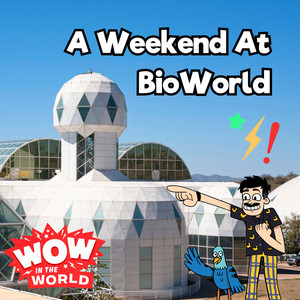
Grownups, Wondery Plus subscribers can listen to Wow in the World early and ad-free right now.
Join Wondery Plus in the Wondery app or Wondery Kids Plus on Apple Podcasts.
Hey, Wowzer fams. Mindy and Guy Raz here.
And before we start the show, did you hear that we are on YouTube?
That's right, Mindy. Wowzer fams, you can find full episodes of Wow in the World and more of your favorite Tinkercast podcasts on our YouTube channel, WowTube.
Plus, on WowTube, you can also watch me explode some watermelons and test out Bonker Ball's experiments in the Laboratory of Bad Ideas.
Or you can dance along with Dennis for music videos featuring music from WeWow on the weekend.
There is so much in store made just for you on WowTube.
Visit Tinkercast.com slash YouTube to watch now.
That's Tinkercast.com slash YouTube. Hey, grown-ups!
If you've got Pokémon fans in your life, and maybe you even grew up as one yourself, check out the Pokémon Trading Card Game.
It's a great way to experience the world of Pokémon for enthusiasts of all ages.
Every card has an awesome illustration on it with either a Pokémon, trainer, item, or stadium.
And with several different art styles and artists, you'll want to catch them all.
See how your cards stack up against others in easy-to-learn Pokémon battles. or just collect and trade them.
There's no right or wrong way to enjoy the Pokemon Trading Card Game.
And now, you can collect the newest cards from the Black Bolt and White Flare Expansion Pack.
For info on the latest expansions, game rules, and more, visit tcg.pokemon.com.
Hey, grownups. Back to school might look a little different if you're a homeschool family.
So let IXL help you craft the perfect homeschool curriculum for your kids.
IXL is an award-winning online learning platform that fits seamlessly into homeschooling.
And it's especially helpful this time of year.
It offers interactive practice across math, language arts, science, and social studies for every grade from pre-K through 12th.
IXL adapts to your child's learning level and gives them the right challenge at the right time.
At Tinkercast, we love when technology can assist in learning.
So we really like that IXL not only offers exercises and activities that adjust to kids' learning levels, but also provides robust data and support tools for parents to make informed decisions.
Make an impact on your child's learning.
Get IXL now. And Wow in the World listeners can get an exclusive 20% off IXL membership when they sign up today at ixl.com slash wow.
Visit iXL.com slash wow to get the most effective learning program out there at the best price.
I don't know what you've been told, but we're in a golden age.
So many discoveries that are jumping off the page.
Why we Whoa-ho-ho-ho! You're listening to Mongo and the Big Two!
Buzzer! In the morning on KWOW. All right, folks, we're back with a chance for you and five of your closest friends to win a trip to BioWorld.
BioWorld. Whoa, BioWorld. Is that anything like biomimicry world?
No, Bongo. BioWorld is a three-acre, 90-foot-tall greenhouse research facility in the middle of the desert.
Ouch! Sounds hot! Yeah, it is. Listeners, to win this relaxing weekend away for six people at BioWorld, all you gotta do is win our game called Name That Sound Effect!
Woo-hoo-hoo! That's right. Name that sound effect.
We play a sound effect. All you gotta do is name it.
All right. Let's head to the phone lines to hear from our first contestant.
Hello, caller. You are on the air. Shh, shh.
Everyone, quiet down. I made it through.
Whoa. Sounds like we got a crew. Welcome to the show, everyone.
Thanks, Bongo. You know, I'm a long-time listener, third-time caller.
I'm here, too. Get it. I'm here. Okay, Mindy, are you ready to name that sound effect?
Big Toot, I was born ready. Oh, you were.
All righty, here's your first sound effect.
Take a listen. That's easy. It's a gauge three semi-conducting copper spring.
It's the same one that I use in my shrink wand.
That is correct. We also would have accepted just spring.
Yes! Okay, now it's time for sound effect number two.
Take a listen. Randy, I know, that's Niagara Falls.
Tell them it's Niagara Falls. Well, I'm hearing Niagara Falls.
Is that your final answer? What? No, no, no.
That bongo is the sound of a Flush-O-Matic 2000 with built-in grime detection and van scrubbing mechanics.
Uh, you don't have to be so specific. You can just say toilet flush.
Okay. Sorry. Okay, you're just one guess away from winning that beautiful weekend escape to Bioworld.
Here comes the third sound effect. Take a listen.
Uh, I don't know that one. Oh, Mindy, I know it.
Oh, hold on, hold on. Guy Raz knows it. Let me pass him the phone here.
Here, Guy Raz, take this. All right, Guy Raz, for all the marbles, name that sound effect.
Oh, well, Mr. Toot, if I'm not mistaken, I believe that's the sound of a classic Gardner three-notch sprinkler system.
I have the same irrigation system set up in my micro-garden.
Whoa! We have a winner! Yes! Once again, way more specific than we needed, but a whiz win.
Congratulations, Mindy. You have just won a state at BioWorld.
BioWorld. A state-of-the-art research facility designed to replicate all of Earth's biomes.
What? What are biomes? I don't know. Okay, coming up next after the break on K-W-O-W, are you smarter than a house cat?
The show where house cats rule and house humans rule.
We did it. We won the tickets. And we all helped equally.
That's smart. It's a good thing we won those tickets, Mindy.
It would have been really awkward turning up to BioWorld without a reservation.
Tell me about it. Are we there yet? Not much longer now, Grandma G-Force.
Where are you taking me again? BioWorld.
What a world. Bioworld. It's one of the largest running science experiments in the world.
And that's where we're staying this weekend?
You know it. In a science experiment? Yup.
Huh. Well, what kind of science experiment?
It's sort of like a massive greenhouse. Like the one you have in your garden?
Well, yeah, but the one in my backyard is only about the size of a parking space.
This greenhouse takes up more than three acres and is over 90 feet tall.
Whoa, that's like twice the size of the White House in Washington, D.C.
Oh, wow. That seems too big. But it's for science, Dennis.
I said it's too big. BioWorld is actually a life-size replica of a research facility in Arizona called Biosphere 2.
Yeah, it's filled with all sorts of plants and is completely sealed off from the rest of the world.
So let me get this straight. Our plan for this weekend is to sit down and watch a bunch of plants grow?
No. Because before they started performing all those plant experiments in Biosphere 2, they performed a different kind of experiment.
One with humans. Yay, humans! And that's the one that we're going to try to replicate or redo at BioWorld.
Neat. You got time for a story, Guy Raz?
One second here, Mindy. Let me check my GPS.
You are approximately one story time away from your destination.
Perfect. Story time! Long, long ago, in a mystical time called the 90s...
Researchers and scientists were about to embark on one of the most audacious science experiments of all time.
Hey there, look at me. I'm a researcher ready to kick this experiment's butt.
Well, nice to meet you, fellow researcher.
I'm also here to kick experimental butt.
Me too! Now where's that experimental butt everyone keeps talking about?
I want to kick it! They would be locked inside a huge, 136,000 square foot, airtight greenhouse called Biosphere 2.
It was full of plants and animals and everything else someone might need to be cut off from the rest of the world.
Ooh, this place is nice! But these researchers weren't going for just one weekend like us.
They were going for a whole two years. Two years?
Do we have any snacks? No. Luckily, they didn't need to bring any food with them, as most of their food, 83% of it, was grown right there in the biosphere.
Oh, ew. What do we got? All right, let's see here.
We got banana trees, papaya trees, sweet potatoes, beets, peanuts, rice, and wheat.
Okay, yeah, that's enough snacks. Close the door.
Uh, we got enough air in here, right? We'll be fine.
And because of all these plants, they didn't need any air from the outside either.
The crew would breathe in oxygen and breathe out carbon dioxide.
And the plants, in turn, would breathe in the carbon dioxide and breathe out oxygen.
In a closed loop, just like a giant terrarium.
Exact Doritos, Guy Raz. It was the perfect plan, until... something went horribly wrong.
The alarm that tells us when something is going horribly wrong!
Oh no! Yeah, whatever. Only a few months into the experiment, the researchers had a big problem from some very small visitors.
Is that bacteria in our soil? I have bacteria in here.
Somehow, some bacteria had snuck its way into the biosphere and started wreaking havoc on their crops.
Not the crops. I was going to eat those.
Is that your stomach? Yeah, that bacteria ate all my food.
And not only that, but this bacteria was oxygen hungry, meaning that it was sucking up all of the oxygen that the plants were giving off before the researchers and scientists got a chance to breathe it.
Is it just me? Or is it getting harder to breathe in here?
This made simple tasks like standing up and walking around much, much more difficult.
Huh? I pooped? What do you mean you pooped?
You only moved about ten feet today. All in a day's work.
So what happened, Mindy? Well, these researchers had to get extra oxygen pumped into the biosphere, and they had to raid their emergency food supplies.
Tom, slow down. These rations are for emergencies only.
Well, my tummy says it is an emergency. Oh, shit.
And the next two years weren't much easier.
We're talking lots of hiccups along the way.
But on September 26, 1993, the researchers emerged from the biosphere back into the real world.
Ah, fresh air. It's good to be back, baby.
Yeah, I remember the 90s. Mutton chops, pickling your own vegetables.
I used to wax my handlebar mustache from sunup to sundown.
Fingerling, they're talking about the 1990s, not the 1890s.
So was I, dude. Why would anyone want to lock themselves in a greenhouse for two whole years?
Well, Dennis, uh... This kind of research is actually vital for the future of space travel.
Some of the people that are involved in these kinds of experiments call themselves analog astronauts.
Wait a minute. Does that mean we're going to be analog astronauts?
For this weekend, we are. Yay! your destination.
Look, everyone, we're here. Wow. Whatever.
Now, where do we park this ice cream truck?
Oh, over there. Look, ice cream truck parking.
Perfect. Ah! Everyone still in one piece?
Yes. Great, then let's get this weekend started.
All right. Locking up the ice cream truck.
OK, follow me, everyone. The entrance is over this way.
Everyone ready to play some make believe?
Make believe? What? I didn't know we have to make anything.
Because, Reggie, that's basically what analog astronauts do.
They play make-believe. Really? Yeah. One of the main reasons why scientists take part in these sorts of experiments is because in the future, when we set up habitats on the moon or on other planets, we'll have to do exactly this.
We'll have to live in airtight, self-sustaining greenhouses.
So the scientists pretend to be astronauts on other planets so that when we go there for real, we know what to do?
You got it. And that's what we're doing this weekend?
Pretending to be astronauts? Exactly. Well, I'm going to be Sally Ride, the first woman in space.
Ooh, I'm going to be Buzz Aldrin, the first guy to pee on the moon.
Aw. I want to be Buzz Aldrin. Tommy, you can't just say you're Buzz Aldrin and then you're Buzz Aldrin.
Why does everyone want to be Buzz Aldrin?
Shh, someone's coming. Uh, hello. Hi, we're here for the BioWorld experience.
Yeah, we have a winning reservation from Bongo and the Big Toot.
I don't know who that is. What? The reservation should be under Mindy.
Okay, let me check here. Oh, there it is.
The competition winners. Congratulations.
Thank you. Of course. Let me show you to the crew quarters.
Follow me. Don't mind if I do. Don't mind if I don't.
Okay, I just have to quickly scan and decontaminate you.
Who you gonna contaminate? And there we go.
Wow! Welcome to BioWorld. Get a load of this place, Mindy.
And these ceilings must be 90 feet tall.
Yeah, it's like two and a half telephone poles tall.
Yeah, they fit an entire rainforest in here.
That's right. And not just a rainforest.
BioWorld is divided into six different areas.
Right now, we are in the rainforest area, complete with ocean and coral reef system.
Whoa! Over to our left, you can see signs heading towards our mangrove wetlands ecosystem, and beyond that is the fog desert ecosystem.
Ooh, frog desert. Now that I gotta see. Not right now, Thomas Fingerling.
We have to go to our living quarters. You may address me as Buzz Aldrin.
Okay. To get to the crew quarters, we need to pass through one more area of BioWorld.
Follow me right this way. This is the agricultural area.
Look at all them crops. That's right. This is where you'll be getting most of your food during your stay.
What was that? Everybody look out. There's a wild space creature on the loose.
Actually, no. That was one of the 38 chickens we have here at BioWorld.
I want to ride it. Hey, chicky, chicky, chicky, chicky.
Please don't ride the chickens. Boo. We also have goats and pigs here in BioWorld, just like they did in the original Biosphere 2.
Neat. Can I ride them? Please don't. Well, that's not a no.
Okay. And just through here is the crew quarters.
Here we go. This is the human habitat, complete with workshops, laboratories, and of course, living quarters.
Okay, well, that's the end of the tour. Let me know if you need anything.
Bye-bye. This place is just as amazing as I'd hoped it would be, Guy Raz.
I know, right? I mean, do you think that they'll use our experience here as research for a future space mission?
I mean, maybe, but you know it's not just us going through this whole sealed away from the rest of the world experience.
Wait, we're not going to be sharing this biosphere with other contest winners, are we, Mindy?
Oh, no, no. We got this place all to ourselves.
Phew. But NASA has a bunch of different experiments running just like this one, where a group of scientists seal themselves off from the rest of the world and pretend to be astronauts.
Ah! What was that? Uh, I think it's that phone there, Mindy.
What do I do? Oh, we'll answer it. Ah, ring-a-ding-dindy, you've reached Mindy.
Whoa-ho-ho-ho! Yeah, that's right. You answered our random phone call on the fourth ring.
So, you know what that means. A free weekend getaway at BioWorld.
Hey, Roz, we want another weekend here at BioWorld.
Are we their only listeners? Maybe we should get through this weekend first, Mindy?
We'll take it. Excellent! Okay, coming up next on K-W-O-W, the latest track from everyone's favorite vertical transport theme band, The Elevates.
Hey, at least it's not all that bad. Turn it up, Mindy!
All right. Oh, boy. Woo-hoo-hoo! Wow in the World will be right back.
Grownups, this message is for you. Hey, grownups, as your family gears up to go back to school, make sure that you're preparing both minds and bodies.
Try Oli, the number one kids supplement brand that makes your family's health and wellness a breeze.
Oli offers a range of vitamins and supplements for kids and adults, so you can trust them for your whole family's needs.
Kids Multi Plus Probiotic is a tasty essential that kids love, and Kids Sleep offers gentle supports to help them rest.
And for the parents, Oli has your back too.
Try multivitamins for immune support and more and sleep gummies to help you get your best rest.
Shop at Oli.com or retailers nationwide.
These statements have not been evaluated by the Food and Drug Administration.
This product is not intended to diagnose, treat, cure, or prevent any disease.
Hey, grownups, if you're planning on taking a family trip to Orlando this summer to be transported to magical universes, well, you should know there's one portal you don't want to miss.
Your portal to the original universe, Kennedy Space Center Visitor Complex. where they have flying dragons too.
It's about science, where no spells are required.
Walk beneath a towering Falcon 9 booster, touch a real moon rock, and come face-to-face with Space Shuttle Atlantis.
Plus, take a behind-the-gates bus tour for an exclusive look at NASA's legendary launch sites and the future of space exploration.
Visitors also have the chance to meet an astronaut, talk about a core memory in the making, and get this...
Our friends at Kennedy Space Center have offered our listeners $7 off admission.
Just use code WOW at checkout. With missions to Mars, rocket launches, and deep space exploration, no trip to Orlando is complete without landing at Kennedy Space Center Visitor Complex.
Discover something real. Parents, discover a fun and easy-to-learn game that bridges generations.
The Pokémon Company International brings the excitement of the Pokémon trading card game to families everywhere.
The Black Bolt and White Flare expansion features stunning artwork of beloved Pokémon from the Unova region, making collecting a visual delight.
Whether you're rekindling childhood memories or introducing your kids to a new passion, the Pokémon Trading Card Game offers endless entertainment.
With various art styles and a diverse range of Pokémon to collect, there's something for everyone.
Ready to start your family's Pokémon Trading Card Game journey?
Visit tcg.pokemon.com to learn more about the engaging and exciting world of Pokémon.
That's it! Back to the show! World in the World Hi, thanks for calling Wow in the World.
After the beep, get ready to record. Hi, I'm India Guy-Ross.
My name is Benjamin. I am five and a half years old.
I live in Pennington, New Jersey. And my Wow in the World is that the world record-breaking elephant tusk was more than 11 feet tall.
I love you, Cheryl. Bye. Hi, Mindy and girls.
My name is Maddie, and I'm from Kirkland, Washington, and I'm five years old.
My wow in the world is that the world has grown from one billion people to seven billion people in only 200 years.
Bye, Mindy and girls. Love your show. Say hi to Reggie for me.
Hi, Mindy and Guy Ross. My name is Finley.
I'm 10 years old and I live in Raleigh, North Carolina.
My wow in the world, since I love cats, is that snow leopards can't roar.
Wow. Say hi to Reggie for me. Bye. Hi, Mindy and Guy Ross.
My name is Ella and I am seven years old and I live in Michigan.
My wow in the world is that if you put Saturn in a giant pool, it would float.
But if you put Earth and the moon in a giant pool, they would think.
Bye, Mindy and Guy Raz. I love your show.
Hi, Mindy and Guy Raz. My name is Seamus.
I live in Wallingford, PA. My wow in the world is that it takes four GPS satellites to get your GPS working.
Bye. I love your show. Hi, I live in Fort Collins, Colorado.
My wow in the world is prehistoric dragonflies wingspan were two and a half feet long.
Say hi to Reg for me. Bye. I'm Minion Gairos.
My name is Julian, and I live in Glen Falls, New York.
My wow in the world is that an ostrich's eye is bigger than its brain.
Bye. Love your show. Hello, my name is Max, and I'm seven, and I live in Northern California.
My wow in the world is that certain types of bamboo can grow 36 inches in 24 hours.
Thank you. I love your show. Bye. Hi, Mindy and Guy Ross.
My name is Lucy. I'm from Venice, California.
My wow is that peanut butter can get turned into diamonds.
Thanks for listening. I love your show. Say hi to Reggie for me.
Bye. Grownups, if you like Wow in the World, you can listen early and ad-free right now on Wondery Plus.
Join Wondery Plus in the Wondery app or on Wondery Kids Plus on Apple Podcasts.
Prime members can listen ad-free on Amazon Music.
And before you go, tell us about yourself by filling out a short survey at wondery.com slash survey.
Wow in the World is written by Mindy Thomas and Tom Van Kalken with help from me, Guy Raz.
Original sound design and music editing is done by Tyler Thole with help from our supervising producer, Jed Anderson.
You can also hear Jed Anderson in the voices of Dennis, Thomas Fingerling, Reggie, and many of the other silly characters that you hear on our show.
And Lizzie Freilich can also be heard as some of the silly characters on our show.
Jessica Bode keeps our facts straight as our fact checker.
And Meredith Halpern-Ranzer powers the wow at Tinkercast.
Our theme song was composed and performed by three-time Grammy nominees, the Pop-Ups.
Find them at thepopups.com. Special thanks to Kit Ballinger, Rebecca Caban, Dr. Natasha Crandall, Kenny Curtis, Kristen Yang, Thuy Mac, Erica Medina, Henry Moskal, Jodi Nussbaum, Ali Paksima, Linda Rothenberg, Steph Sosa, Joanna Weber, Anna Zagorski, all of the other tinkerers at Tinkercast HQ.
And to keep the wow rolling after you finish this episode, visit us at Tinkercast.com.
There you can become a member of the World Organization of Wowzers to get year-round mailings and weekly activities, shop our wow shop, get tickets for upcoming events, find our best-selling books, and learn about some of the other amazing podcasts from Tinkercast.
Grownups, you can follow Wow in the World on Facebook, Instagram, and Twitter at Wow in the World.
And our email address is hello at Tinkercast.com.
And if you're a kid with a big wow to share with us, call us at 1-888-7WOW-WOW for a chance to be featured at the end of our show or an upcoming episode of To What's in a Wow.
Thanks again for listening. We're here every Monday.
Or you can check out Two What's in a Wow every Friday right here in the Wow in the World podcast feed.
And don't forget, we wow on the weekend with Dennis Saturday and Sunday.
Keep on wowing! Wow in the World was made by Tinkercast and sent to you by Wondery.