I'm Aisha Roscoe, and this is a Sunday Story from Up First, where we go beyond the news to bring you one big story.
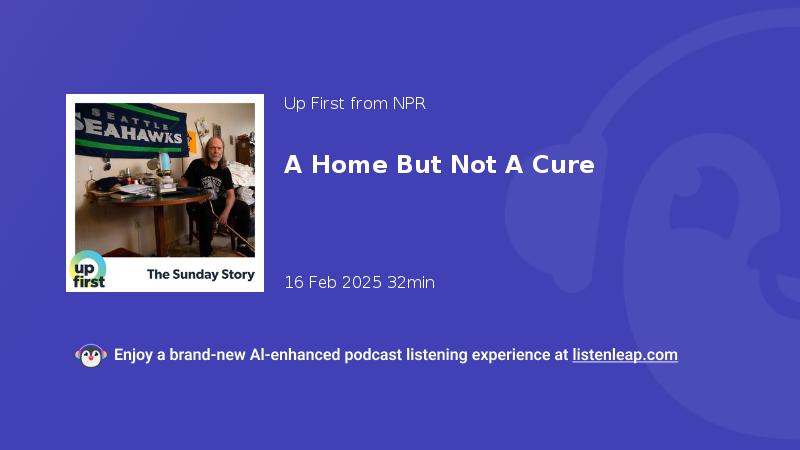
Not long ago, reporter Will James walked into an apartment building in Seattle and met a tenant named Kenny Taylor.
Oh, thanks so much.
Oh, this is cool. Yeah, this is great.
This building, the Union Hotel, is the first in Seattle to operate under a philosophy called Housing First.
And Kenny was one of the original tenants who moved in 30 years ago.
He came here straight off the streets.
I was homeless for about five years before I moved in here.
I slept in doorways, I slept on the street, I slept in tents, I slept at the missions and stuff like that.
It's not fun. Being homeless is not fun at all.
When Kenny moved into his apartment in the 1990s, Housing First was an experiment.
And nobody knew how it was going to turn out.
But now, 30 years later, Housing First is the central strategy the federal government uses to combat homelessness.
So is it working, and is it working like it's supposed to?
When Housing First was introduced, the idea was to take some of the most vulnerable people living on the streets and move them immediately into their own permanent subsidized apartments.
A lot of these people had serious mental illnesses and addictions.
The plan was to get them a home first and then worry about treating those problems later.
Housing first started as a fringe idea, but eventually evidence started piling up that this worked to resolve many of the most stubborn cases of chronic homelessness.
When people got housing under this approach, they usually stayed housed for years, like Kenny.
This is my home. I'm going to keep my home as long as I pay my rent.
I just feel happy here.
I wouldn't trade it for nothing in the world.
But with homelessness now at record levels, conservative think tanks and activists have set their sights on the philosophy of Housing First.
They're pushing for more programs that require treatment and sobriety before housing, and Project 2025 calls for ending support of it all together.
After a break, reporter Will James joins me to talk about the future of Housing First and whether it's time for a course correction and how the U .S.
handles one of its most persistent problems.
This message comes from Warby Parker.
If you wear glasses, you know how hard it is to find the perfect pair, but step into a Warby Parker store and you'll see it doesn't have to be.
Find a Warby Parker store near you at warbyparker .com slash retail.
Support for this podcast and the following message come from Jitsasa.
Jitsasa means the spirit of serving others.
With over a decade of experience and over 1 ,500 clients across the US, Jitsasa helps to provide nonprofits of all sizes, manage their bookkeeping, accounting, taxes, and CFO services.
With customizable rates and fixed monthly costs that clients can afford, nonprofits can save time so they can focus on their missions in the spirit of serving others.
Visit JITASA .com to learn more.
This message comes from NetSuite by Oracle, the number one cloud ERP, bringing accounting, financial management, inventory, and HR into one platform.
Download the CFO's Guide to AI and Machine Learning for free at netsuite .com slash story.
We're back with the Sunday story.
I'm here with Will James, a reporter and producer for KUOW in Seattle.
He recently published an audio documentary about the housing first approach to homelessness, its history and its future.
Will, welcome to the podcast.
Hey, thanks for having me, Aisha.
So, Will, Housing First has been around for 30 years, and it's been the U .S.
government's central strategy for fighting homelessness for at least a decade now, depending on when you start counting.
Help us to understand the backlash to this philosophy.
Like, where is it coming from?
Yeah, so there's a piece of this that is political.
Housing First was pretty bipartisan under George W.
Bush and Barack Obama.
But over the past few years, activists and think tanks on the political right have been pretty successful at branding this philosophy as left coded or liberal coded.
But there's another element to this backlash that's actually much more interesting to me.
As a reporter covering homelessness here in Seattle, I started hearing doubts about Housing First from people I didn't expect to hear them from, folks who work directly with the homeless population at nonprofits that practice Housing First, sometimes even from people who lived on the streets themselves and moved
inside under Housing First.
And this really threw me because as a reporter, I'd been hearing for years that Housing First is the most studied, the most proven, the most cost -effective strategy for getting people off the streets.
And at the same time, some of the evidence that these critics were pointing to rang true to me.
Like, they were pointing to problems that I have witnessed myself in my reporting.
And this is what really made me want to dive into Housing First with this documentary.
It was my own genuine confusion about how to reconcile these things.
That is very interesting because you are talking to people who are dealing with this firsthand and they are fueling some of these doubts about Housing First.
Like what are they seeing that's causing their concerns?
So the first observation that critics of Housing First tend to make is since 2013, the U .S.
government has really pushed local governments and nonprofits to adopt Housing First practices.
And for years, a majority of federal grants for homelessness have gone to Housing First projects, adding up to billions of dollars.
But the U .S. homeless population hit a new record in 2024.
And so this has caused some people to wonder whether housing first or maybe the way we're practicing housing first is not meeting this moment.
The second observation that critics make is that housing first in practice can look very imperfect, to put it mildly.
Yes, it offers people an apartment, a bed, a door that locks behind them.
But the environment in these buildings can be challenging because the chaos of the streets tends to follow people indoors.
And you talked to some tenants who had experiences like this for your audio documentary.
Yeah. So we're going to hear from a woman named Maureen Hawley who lives in a building in downtown Seattle.
It's this 14 -story building that's a century old, and some of the tenants there are just low -income, but others come straight off the streets under a Housing First program.
There is staff on site to help them with addiction and mental health if the tenants want that, but like with every Housing First project, treatment is not a requirement of living here.
Maureen's lived here for more than two decades After spending some time homeless herself Two years ago Maureen had an encounter with a neighbor That she says almost killed her Here's Maureen from the documentary I was using crack cocaine at the time And I was given a glass pipe to smoke But it had fentanyl
in it And I didn't know it I was in a coma for about four days.
And they said it was a miracle that I managed to live because I had enough fentanyl in my system to kill me.
The rise of fentanyl has sent a surge of overdose deaths through housing programs across Seattle.
These deaths nearly quadrupled between 2020 and 2023.
Michelle Huckabee -Varick is one of Maureen's neighbors Michelle has struggled with fentanyl addiction herself and says after a wave of overdose deaths in their building she started to hoard stuff in her apartment I mean, there were people dying around you so you hoard things, you make walls, you know
so like if somebody came through your door they couldn't get to you, you know I never in my life lived like that I felt like no one was safe, not even me.
I just kind of basically left and I like camped out across the street.
I was really scared.
So conditions were so bad in the building that Michelle actually felt safer staying in a tent out on the street?
Yeah, that's right.
And she was there until some outreach workers helped clean out her apartment and then move her back in.
This story is just one of a few anecdotes I've heard over the years that have trickled out of buildings like this.
These stories have fueled questions about whether Housing First, as we currently practice it, is working like it's supposed to.
A common perception I've heard from tenants, and even occasionally from staffers who work in these buildings is that Housing First is taking people off the streets and sort of hiding their problems behind four walls and not doing enough to address those problems like substance use or mental illness.
And vocal critics of Housing First, like the vice president, J .D.
Vance, have picked up on these anecdotes, right, in their efforts to dismantle these programs.
But what do they want instead?
Generally speaking, they want to change course and return to a philosophy called treatment first.
This is the idea that people should follow a series of steps like treatment, sobriety and employment that eventually end with permanent housing as the last step.
And this idea of treatment first goes way back.
Before Housing First took off, Treatment First was the go -to approach for many, many years.
Okay. So Housing First was an alternative to Treatment First.
Yeah. So what were the problems with this reward and punishment -based system that, you know, Housing First emerged to address?
Yeah, that is a really important question, and I really wanted to understand this.
So I dug back into the history of Housing First.
Back in the 90s, people working in the homelessness field realized that Treatment First wasn't working for a subsection of the homeless population.
They called this group the hardest -to -serve population.
These were people who were the most disabled by mental illness and addiction and could not abide by the rules of Treatment First.
so they always ended up back on the streets.
That's when some innovators decided to take a big risk and try just housing them and then bringing the treatment to them in their new apartments.
And this was the birth of Housing First.
And here's where Seattle enters the story in a big way.
In 2005, a Seattle nonprofit called the Downtown Emergency Service Center, DESC, planned to open a building with 75 apartments for people who had been homeless for years and addicted to alcohol.
At that point, Housing First had mostly been focused on people whose main health problem was mental illness and who often had addiction on the side.
But DESC's project was going to test Housing First for people whose main health problem was alcoholism.
This blew up into a national news story, and it remains probably the most famous and controversial example of Housing First in U .S.
history. So you're talking about the 1811 Eastlake project.
Yes. You've got a section about this in your audio documentary, and it starts with this excerpt from a local Seattle call -in show back then, The Conversation.
The Downtown Emergency Service Center is opening the facility at 1811 Eastlake Avenue for homeless men and women who have been identified as some of the most down -and -out chronic alcoholics.
Residents will be allowed to drink in their rooms.
Anyone who moved into 1811 Eastlake was not required to participate in any kind of treatment for alcoholism.
It was there if they wanted it, but they could also just keep drinking.
It sounds to me like you're taking alcoholics and saying, please drink as much as you like.
Why don't we have call -in shows anymore?
This is good radio.
I mean, basically, what they're talking about doing is having a public tax dollar funded flop house.
I mean, what are they going to do?
Just let them live there and continue to drink themselves to death?
What's the purpose?
What's going to be the outcome of this?
The person these callers were angry at was Bill Hobson.
He ran DESC at the time, and he was one of the country's most enthusiastic adopters of Housing First.
Bill was a bit of an iconoclast.
Daniel Malone runs DESC today, and he worked under Bill back then.
He was pretty plain -spoken a lot of the times about calling out things that he thought were wrong -headed.
It was up to Bill, the head of DESC, to explain to the irate public radio listeners of Seattle how all of this would work.
First of all, we're not saying please drink as much as you like.
One of the goals of the project is to get residents in the building to reduce use.
We believe that once you eliminate the chaos of homelessness from somebody's life, that they can more effectively and meaningfully go through the stages of change that they need to go through in order to become a bit more clinically stable and much more socially stable.
Now, as you're probably well aware, the most vehement criticism of this often comes from people who are recovering alcoholics or have recovering alcoholics in their family.
They are kind of appalled that you would operate a facility and allow folks to keep drinking, and they would say their recovery would have never happened if they didn't stop, and they see this facility as not doing that.
How do you respond to people like that?
I'm sure you get that all the time.
We do. Bill said, sure, for lots of people with alcoholism, abstinence did work.
But what he wanted listeners to understand was that this was not the population he was talking about.
He was talking about the hardest to surf.
The 1811 Eastlake Project was for people who back then were called chronic public inebriates.
There were more than 1 ,000 of them in Seattle, according to a state estimate.
Their health problems were comparable to people in developing countries, and their average age of death was 42 to 52 years old.
In the Seattle area, their emergency room visits alone cost $100 ,000 per person per year.
And on average, they had already tried to stop drinking 16 times and it didn't work.
You're kind of acknowledging that it's highly likely these people will never stop drinking.
That's correct. I mean, we're talking about men and women that have been living on the streets of downtown Seattle for 15, 20 years and have gone into conventional treatment multiple times and have not succeeded with it.
So what I'm picking up on here is that there are very different ideas about what success looks like under Housing First.
The callers were basically saying they want people to get sober.
And Bill, who runs the nonprofit, is saying we have to accept that, you know, some percentage of people are never going to get sober.
That's right. And that's why this recording from 20 years ago was so eye -opening to me.
The proponents of Housing First were always clear -eyed about what their tenants were dealing with.
They just have a very different idea of what recovery means for the people they're trying to help.
In many cases, recovery for them doesn't mean sobriety.
It means a life that is a little more stable, a little more comfortable, a little more dignified.
And this is incredibly painful and frustrating for a lot of critics to hear because it goes against a lot of values that we're steeped in as Americans.
It's saying that there is a limit to how far grit and self -improvement will get you.
and there are a lot of people who just don't don't want to believe that yeah i i can see how it's hard to accept that some people won't be able to get helped in the way that we think about it like can everybody with the right you know approach get sober um what happened with 1811 in Eastlake.
DSE did open the building in 2005, and they moved in 75 of the most disabled people living on the streets of Seattle with alcoholism.
And then an academic study came out a few years later.
This study showed that the first wave of people who moved into the building stayed housed there, and that housing them ended up being cheaper than just letting them cycle through emergency rooms and sobering centers and jails and it showed that the people who moved in ended up drinking a little less
on average once they were inside now these results were pretty modest they went from drinking something like 16 drinks a day to 11 on average but this fear that people had that this environment was going to enable people and their alcoholism was going to get worse It just wasn't true.
In fact, the opposite was true.
These results got a lot of attention and helped build hype for Housing First across America.
And results like this have been replicated again and again for decades now.
It's worth saying, too, that 1811 Eastlake is still going on here in Seattle.
It still has 75 units, and 20 years later, it's still doing essentially the same thing.
So Will has raised a lot of really difficult questions about Housing First as a policy.
After the break, he tries to make sense of all of this nuanced information, the good stuff, the bad stuff, and how it can all fit together.
This message comes from Greenlight.
Parents rank financial literacy as the number one most difficult life skill to teach With Greenlight, the debit card and money app for families Kids learn to earn, save, and spend wisely Get started risk -free at greenlight .com slash NPR Support for this podcast and the following message come from the NPR
Wine Club which has generated over $1 .75 million to support NPR programming Whether buying a few bottles or joining the club You can learn more at nprwineclub .org slash podcast.
Must be 21 or older to purchase.
This message comes from Whole Foods Market.
It's jumpstart January at Whole Foods Market.
Find sales on supplements, no antibiotics ever, grass -fed ground beef, sustainable wild -caught sockeye salmon, and more feel -good favorites, like their prepared foods, rotisserie chicken, a great choice for busy weeknights.
And with Whole Foods Market's strict sourcing standards, you can feel good about what you're buying.
Boost your wellness routine with Jumpstart January Savings at Whole Foods Market.
Terms apply. We're back with the Sunday Story, talking with reporter Will James about the complicated reality of Housing First.
Will, I want to take us back to the question that kicked off your reporting.
The results from 1811 Eastlake are part of this stack of evidence that Housing First works.
And yet the shortfalls that you point to in your reporting are real.
So in practice, people continue to relapse and overdose and have crises even once they're inside under Housing First.
I'm wondering how have you come to understand the role of Housing First in addressing homelessness?
when housing first was first invented it was really for a subpopulation of the homeless population it was for the most disabled people living on the streets with serious mental illness with serious substance use disorders and and those things sort of happen over time right when someone becomes homeless
and then they stay on the streets for months or years those disabilities tend to compound over time.
So housing first is like throwing them a lifesaver and giving them something to grab onto, some foundation upon which to do the really intense lifelong work of rebuilding.
But a little over a decade ago, this definition of housing first started to expand and the federal government started to really incentivize housing first practices for all sorts of organizations that were trying to address homelessness.
And so we saw more and more people fall under the housing first umbrella.
And this is where some of the questions start to emerge.
Like, are people getting swept up in housing first when some of them might actually do better in a more structured setting like sober housing or an addiction treatment center.
And when I look at all of this, it's clear that Housing First was only ever meant to be one piece of the solution to homelessness.
When we look at why Housing First on its own is not going to solve homelessness, one of the reasons is that new people are constantly falling into homelessness.
A metaphor that I've heard that's been really helpful is that Housing First is one way of bailing out the bathtub.
Meanwhile, the faucet is still on and new people are constantly falling into homelessness.
So that's why Housing First on its own is not sufficient.
So it sounds like people may need to modify their expectations of what Housing first can do.
But do you think there are ways to continue improving it like as a part of a comprehensive plan to reduce homelessness?
So there's been this debate for decades now about the best way to implement housing first.
Sam Simbaras, who's like the father of the housing first approach, wanted his clients to be scattered in apartments all across a city in buildings where they're surrounded by neighbors from like mainstream society.
But other communities found that it was sometimes cheaper and often just easier to put all of their tenants together in one big building.
And of course, concentrating people with a lot of really serious problems in one building like this, that does contribute to some of the issues we see here in Seattle and that we document in the piece.
When I talked to Sam, he mentioned something else that's important for implementing this approach.
Remember, the program for me was not about somebody moves into an apartment and lives happily ever after, although a great many do.
This is a journey for people.
It's very hard to recover.
It's very hard to acknowledge you have problems, but we're going to stay with you, you know, through the journey.
To be clear, there are plenty of providers who do follow through.
Sam cited the Downtown Emergency Service Center here in Seattle as an example of that.
They have doctors, nurses, addiction specialists on staff.
That's what Housing First can aspire to.
But Sam worries that these practices aren't widespread enough.
So I want to go back to Kenny.
You point to his life as an example of what success looks like under Housing First, but you also point out in your audio documentary that it's a complicated success.
Across 30 years at the Union Hotel in Seattle, Kenny Taylor has seen all that's good and bad about Housing First.
The bad includes a neighbor who bangs on the wall at 3 in the morning and has knocked holes in it.
Bam, bam, bam, bam, bam, bam, bam, bam.
I'm on the wall and I call the police on them.
Kenny says his girlfriend died in her apartment here a few years ago after using heroin, falling, and hitting her head.
He wishes there wasn't so much drug use in the building.
And he keeps his distance from a lot of his neighbors because he feels like they just want money out of him.
But for 30 years, Kenny has chosen to keep living here anyway.
This is where Kenny says he got sober.
He says he quit drugs about 10 years ago and alcohol two years ago, and it wasn't any sort of pressure that got him there.
Kenny says recovery just moves at its own pace.
In his case, it took decades.
I was determined that the drugs or the alcohol wasn't going to destroy me.
I come this far, might as well go all the way.
That's how I felt about it.
Sometimes he helps out with communal meals here in the dining room.
Do you cook? Yeah, a little bit.
Southern style. I cook a lot of grits.
I love grits. Kenny's life, in all its messiness, all its ups and downs, is what success looks like under Housing First.
You might notice it's not all that different from the stories critics point to as evidence of failure.
Kenny's lived some of those same headaches and tragedies here.
So is Housing First working for Kenny?
He'd say yes. Having a place has allowed him to adopt his cat, Treasure, which he says has given his life purpose.
Kenny spends most of his days lately writing a book about Treasure.
I got 19 chapters written already.
I'm about ready to get it published.
Everybody's got a purpose in their life, and my purpose was to write this book.
What story does the book tell?
that anybody can put down on paper that they love something and stick to it.
And so far, I've stuck to it.
Well, I mean, that's incredibly moving.
Getting back to the politics of all of this, President Trump, he's surrounded by critics of Housing First.
So what is the possible impact of shifting away from Housing First on a national level?
Yeah. The approach in Project 2025 would be to end support for Housing First altogether and reimpose requirements like entering treatment for addiction and mental illness.
And it's worth noting, these are programs that have historically been underfunded and in short supply.
And as we saw in the past, like the 1990s and before that, that approach risks condemning a lot of people to the streets.
And if that were to happen, it would happen at a time of record homelessness in America.
that's will james reporter and producer at seattle member station kuow you can find his full documentary on housing first at the link in our show notes thank you for being here will thanks for having me aisha This episode of The Sunday Story was produced by Justine Yan and Kim Naderfein -Petersa.
It was edited by Ginny Schmidt.
Kwaesie Lee mastered the episode.
Special thanks to Liz Jones, who edited the KUOW audio documentary on Housing First.
The Sunday Story team includes Andrew Mambo and our senior supervising producer, Liana Simstrom.
Irene Noguchi is our executive producer.
I'm Aisha Roscoe. Up First is back tomorrow with all the news you need to start your week.
Until then, have a great rest of your weekend.
This message comes from NPR sponsor, Sattva.
Founder and CEO Ron Rudson shares why Sattva sales associates are focused on finding the perfect mattress for their customers.
At Sattva, we have a 365 -day home trial.
Why would we want to rush you or try to push you into something that's not right for you?
We want to make sure that we guide you to the right mattress.
Our team is always available to be helpful to make sure you make the right choice.
To learn more, go to saatva .com slash NPR.
This message comes from Capital One.
Banking with Capital One helps you keep more money in your wallet with no fees or minimums on checking accounts.
What's in your wallet?
Terms apply. See capitalone .com slash bank for details.
Capital One N .A. Member FDIC.
This message comes from NPR sponsor Rosetta Stone, an expert in language learning for 30 years.
Right now, NPR listeners can get Rosetta Stone's lifetime membership to 25 different languages for 50 % off.
Learn more at rosettastone .com slash NPR.