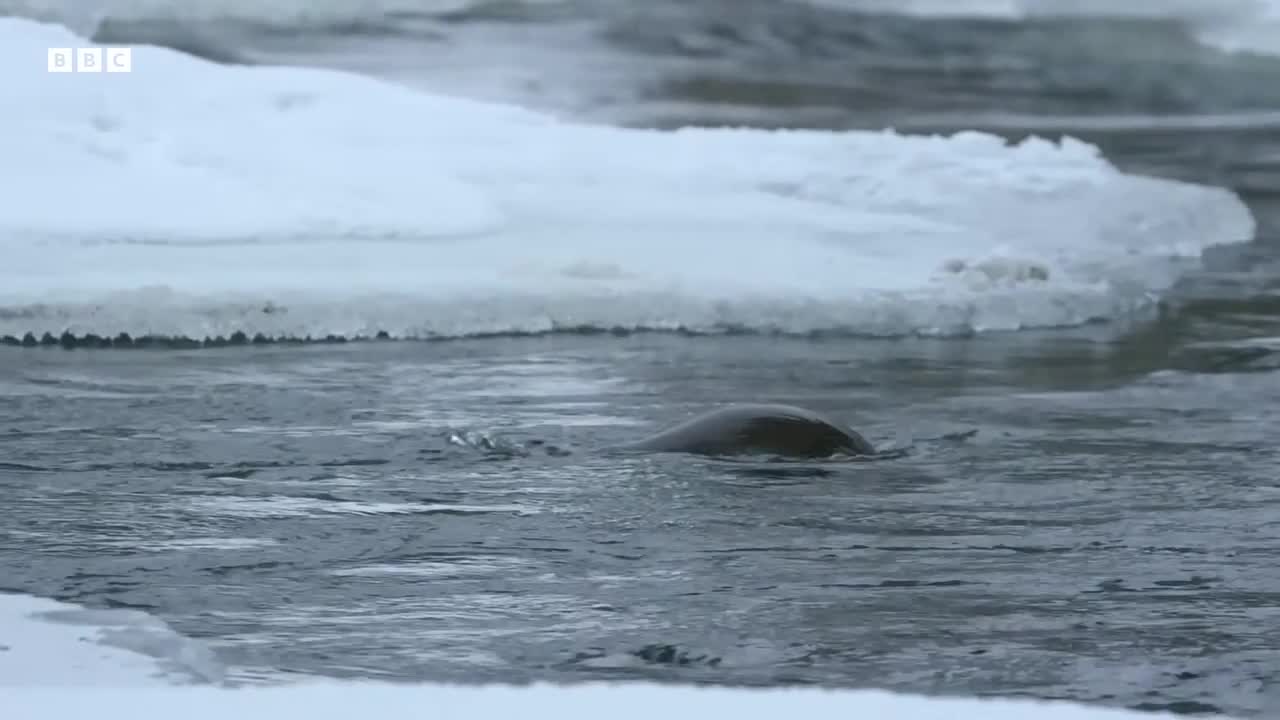
To stay warm and active, they must each catch at least a kilogram of fish every day.
As they enter the water, their dense, oily fur traps air close to their bodies.
Like an underwater blanket, it insulates them from the icy water.
Ice now covers all but a few small sections of the river.
So many of the fish here are now out of sight.
Luckily, otters can hold their breath for eight minutes at a time, enabling them to hunt far beneath the frozen surface.
Throughout winter, as the wind blows and temperatures change, the ice holes on the river shift.
So every day the otters must check each opening one by one.
Their efforts eventually pay off.
They may be small, but these fish are packed with valuable protein and fat.
A nutritious meal that other predators cannot reach while the rivers are frozen.
But the otter's success hasn't gone by unnoticed.
Bald eagles look on jealously.
They too need fish to survive.
But they have no way to reach them under the ice.
Time for a new strategy.
Theft.
Bald eagles are armed with razor-sharp beaks and strong talons that could easily injure an otter.
By travelling together, These two can work as a team.
As long as this river stays frozen, the otters will have to endure this aerial harassment.
In the swamplands of Brazil, the giant otter pups have really gained confidence.
Now a couple of months old, all three are tentatively exploring beyond the den.
But they've still got a lot to learn.
Giant otters are highly social, spending their whole lives in a tight-knit family.
They work together, protecting the territory, watching out for predators and helping out with the babysitting.
The pups need to learn how to contribute to family life.
Today's crucial lesson will be a big step on the road to adulthood.
Toilet training, otter style.
An adult leads the way with the pups eagerly looking on.
Giant otters use communal latrines, meaning the whole family do their business in the same spot.
It's a vital way to mark their territory.
And there's a crucial technique involved.
Key to getting it right is all about rubbing the scent in.
It creates an almighty stink that will see off any other otter family.
Now, it's the three pups' turn.
One plucks up the courage to give it a go.
He thinks about going all the way to the top, but chickens out.
Not exactly the right spot.
And no hint of rubbing.
But it's a step in the right direction.
An adult takes over.
If you want a job done properly, do it yourself.
The pups need to get the hang of the toilet etiquette if they're going to start contributing to family life.
These three are learning fast, but they've still got an important skill to master.
Soon, they'll need to hunt for their own food.
Mastering tricky fishing techniques is a key rite of passage for many water babies.
A visiting male otter woos a female on the lake's shore.
But she seems a little distracted.
Her two pups are nearby.
They are about 10 weeks old and the time is right to lead them from the holt.
Males are not above stealing food from cubs.
So she makes it very clear that he is not going to be joining them.
This female grew up on the lake, so she knows where to take the cubs for a very special trip.
Yellowstone cutthroat trout amassing in the mouth of a stream that feeds the lake.
They're preparing for their annual spawning.
But the trout must wait.
The stream is still running fast, too turbulent to lay their eggs.
It's a nervous time for them and for good reason.
This osprey has a brood to feed and will be back.
Now the otters are here too.
She chooses her moment to lead the pups upstream.
Then leaves them to watch and gives them a lesson in hunting.
A large trout like this, full of eggs, is a trophy catch.
She chews its tail first to make sure the fish can't get away.
While the pups are still demanding milk, the mother otter will often keep the whole fish for herself.
Her pups are happy enough with caviar.
As the flow becomes slow enough for the trout to lay eggs, there is a brief window of opportunity to spawn before the river gets too shallow to swim upstream.
The female digs a trough with sinuous flicks of her body and the attending male fertilizes the eggs as they are laid.
Millions of new lives.
Just as they've done before, Diablo and the family have to deal with this threat.
All the adults start to harass the caiman.
As the cubs keep their distance, Sophia takes her position at the front, sizing up the caiman.
Others move in to try to distract it.
Diablo once again moves in from behind and goes for the tail.
But the caiman refuses to back down. and then begins to fight back.
The cubs panic and follow the adults right into the middle of the fight.
They're in extreme danger now, so the adult otters step up the assault.
The caiman tries to head for the safety of the bushes, but it's too late.
He's outnumbered.
The otters seize the moment.
Incredibly, they overpower the caiman, some holding it down, others biting it in the head.
After nearly an hour of brutal fighting, it's all over.
The caiman may be dead, but Charlie needs to know if all the otters are OK.
It doesn't take long to realize two of the cubs haven't survived the fight.
Stuck in the middle of the action like this.
The young, inexperienced cubs were no match for such a powerful and aggressive predator.
The truce between Otters and Cayman has, for a brief moment, been broken.
What impresses Charlie the most though, is the incredible show of family bonds and physical strength the otters brought together to kill the caiman and eliminate the threat of it from their laity.
Have cups.
Seeing otter cubs in the wild like this is extremely rare.
Charlie counts six tiny cubs, a record number, making a grand total of 15 family members.
Diablo and his mate Sophia are certainly playing their part in helping to maintain the survival of giant otters in this part of the Amazon.
But so many cubs will be quite a handful.
The family will certainly have their work cut out, keeping them out of danger.
The first thing the cubs need to learn is how to swim.
So this family outing is actually a swimming lesson.
Strangely otter cubs don't actually like water, so lessons like this one are essential.
There's one cub in particular who catches the eye.
Not because he's muddier than the others, but because he really doesn't like the water.
Despite mum's best efforts, all he wants to do is get back to the warmth and security of the den.
The other cubs all seem to be enduring their swimming lesson.
Some even look like they're starting to get the hang of it.
But this little cub's just not having it.
So in the end, there's nothing for it but to just pick him up and dunk him in the water.
As cubs, all of the otters here are given names to help any scientist studying them.
It seems fitting to give this cub a name appropriate to Lake Salvador.
So Charlie calls him Dali.
Even with the protection of a big family, the early months of a cub's life can be the most perilous.
Learning to swim is just the first danger to overcome.
Only around a third of all these giant otter cubs will make it to adulthood.
At this age the cubs tire easily, so it's not long before their swimming lesson is over and they're taken back to the warmth and safety of the den.
All this activity attracts Montana's trout fishing experts.
The Otter family.
Mother is taking her young pups out for a masterclass.
Otters can find fish in darkness using sensitive whiskers.
The pups cling tight, picking up the technique.
Like mother bear, she's a skilled teacher and will look after her pups until next year, and they can make it on their own.
It's that slash of red beneath the gills that gives cutthroat trout their name.
As she dines, her pups tuck into the nutritious orange eggs, gobbling them up like sweets.
The smell of fresh fish is in the air.
The bears quickly pick up the scent of the otter's meal.
In shallow water like this, it should be easy, but trout are slippery customers.
Success.
Following mother's lead, Archie jumps right in.
But just like climbing trees, it takes practice.
Mother knows this annual feast won't hang around.
At last, Archie's got the hang of it.
So has Luke.
The cubs first trout dinner is a rare high protein meal.
They've also learned to gobble food down quickly.
Their feast hangs thick in the air.
The scent might attract grizzlies.
Their mother doesn't take chances and leads them back to the canyon.
Most of the trout escape. leaving the stream seeded with eggs.
These smooth-coated otter pups have spent their first six weeks in the safety of the halt, but now it's time to take to the water and their playground.
Singapore, one of the most densely populated countries on the planet.
And thanks to conservation efforts such as cleaning up their waterways, Singapore now has one of the densest population of otters on earth too.
The otters have made the city their own.
And with plenty of fish to hunt, they've even become a tourist attraction.
The young cubs, still relying on their mother's milk, are just learning how to swim.
And after a successful hunting trip, it's time to try some fish.
Now their teeth may be small, but they're still razor sharp.
In their natural habitat, otters will haul out onto a riverbank to feed.
But in Singapore, this marina works just fine.
But house crows have also moved into Singapore.
Native to India and a few other South Asian countries.
House crows have hitched a ride on ships all around the world, appearing as far away as Ireland, South Africa and even the USA.
With big brains and an open mind to all things gastronomic, these avian marauders are well equipped for urban life.
They're a loose social cooperative working together to communicate dangers and to find and share food.
And why catch food when you can steal it from some youngsters?
Crows seem to know instinctively that pulling tails is a good distraction tactic.
It almost seems like a game to them.
They'll even do it when there isn't food involved.
Show a crow a tail and it seems they'll just pull it.
And it helps when you have eight other beaks joining in.
That is, until Mum's had enough.
Eventually the cubs do get tired of the hassle, leaving what's left of the fish to the crows.
Persistence, it seems, is another key crow quality.
But the cubs don't seem to mind.
Plenty more where that came from.
In just another six weeks, they'll be catching fish for themselves.
But they probably have a lifetime ahead.
That otter's nosing that fish and sniffing the fish, right?
And if you look, when it first comes up to it, it puts bubbles out.
And it's got whole loads of bubbles around its mouth.
Right.
Because I'm convinced otters can smell underwater.
So do you think the bubbles are going back into the nose or into the mouth?
I think they're going to both.
Interesting.
It's not improbable because a lot of animals can smell underwater, right?
And it's just a chemical cue and as long as it's concentrated, so it's like really right close to them, it makes sense that they would still be able to smell it underwater.
So other animals that can smell underwater do they just sniff in water or do they use bubbles in this way?
You know, to be honest, I don't think anyone knows.
It's thrilling to think that otters' ability to smell underwater could in fact be an undiscovered survival skill.
I've long thought otters must have this secret ability, and seeing this has inspired me to put my theory to the test.
I'm hoping Rudy might be able to help me once again.
So really, the only definitive way of proving that otters can smell underwater is to do an experiment.
So what we're going to do is we're going to get some fake fish and some real fish.
And we're going to try and film Rudy telling the difference between the fake fish and the real fish.
So what we've got here is a fake piece of plastic trout.
Going to put that on here and we present rudy with two identical looking pieces of fish and to see if you can tell the difference.
So we're going to put this experimental block here under water.
This relies on Rudy investigating each piece underwater, deciding which one is food and then eating it, and Rod and I capturing the whole thing on camera in slow motion.
No interest in the fake one.
Absolutely none.
Wow.
It's so fast and it's so subtle that it's very difficult to work out exactly what's going on.
My camera simply isn't capable of slowing it down enough to see the finer details.
But Rod's camera captures the action 40 times slower than real life.
All right, Rod.
Did you get it?
Possibly.
Yeah?
Really?
It's so quick, and obviously we're slowing it down 40 times.
I think until we actually see it.
My God, that is a close shot.
There's his head.
That's a bubble coming out of his mouth, isn't it?
Oh, he's sucked it back in.
It's done it.
It's done it.
That was it.
Fantastic.
That's amazing.
A bubble came out of his mouth and just as he was lifting his head, he sucked it right back in again.
It wasn't his nose, but it was his mouth.
He draws it back in, hopefully tasting the fish.
It's amazing because you can actually see it happening perfectly.
Rudy actively pushes a bubble onto the surface of the fish, picking up scent molecules, before he sucks it back in, obtaining enough information to determine whether it's something he wants to eat.
This footage helps me understand how otters might find food in dark, murky waters where they can't rely on their underwater eyesight.
They sniff it out.
After being abandoned by their mothers, the orphans were brought to Wild Instinct's wildlife rehab center.
On arrival, they were weak, defenseless, and would not have survived the night.
Attempting to mirror their wild diet, Center manager Mark is giving them chopped fish and milk formula.
But he has concerns about the weakest orphan.
He came to us with kind of a bad leg.
He injured the joint on his right rear leg.
So we're not quite sure whether it's going to heal enough for him to be released or not.
And he also did a slight injury to the joint right in here on this leg also.
And even the good leg is not necessarily a good leg.
So what we're going to do is try to find a zoo for him if he's not able to be released back into the wild.
And if we're unable to find a zoo, then he may have to be euthanized if we can't find a place for him to go.
To keep any attachment to a minimum, It's Mark's policy not to name any of the animals in his care.
Now eight weeks old, the cubs need to tackle an essential survival skill, learning to swim.
Curiously, baby otters don't really like water.
So Mark needs to teach them their most important life lesson.
That water isn't something to be afraid of.
Just like their mother would in the wild, Mark makes soothing calls to reassure them.
Each time they try to get out, Mark plops them back in.
But their swimming lessons don't last too long.
That's because of another surprising quirk of otter biology.
Their coat doesn't become waterproof until they're 12 weeks old.
Until then, being wet could lead to hypothermia.
So surrogate mum Mark does what he can to help out.
Normally in the wild, what they would be doing is rolling around in the grass and the dirt to kind of get some of the water off themselves.
And so we can use the towels to kind of help us out a little bit.
Wild otter cubs face exactly the same issue, so the adults only take them for short dips to stop them getting cold and waterlogged.
The aquarium's head vet, Dr Mike Murray, has anaesthetised a female otter for a check-up, giving me a chance to take a close look.
Look at the size of that.
That's enormous.
She actually feels really warm.
That really, really thick fur they have is designed to conserve heat.
And she really doesn't, without the cold water, have an opportunity to dump heat.
Her coat is so effective that Dr Mike has to put bags of ice on her flippers to stop her overheating.
This is the most beautiful silky soft fur you can imagine.
On the outside it's much thicker, but when you get down deep inside it's just silk smooth.
You can just make out the sort of pale white skin underneath.
It's amazing how wet it is on the outside, and then you peel it back and it's completely dry on the inside.
That's beautiful.
It's so soft you can barely feel it.
It's weird.
And if you look at the undercoat they've got these long guard hairs, but down deep you look at those microscopically and they've got all these little scales that stick off the shaft of the fur.
And what the otter does when it grooms is it just conditions the fur and get those things to lock together. so that it becomes impenetrable to water, essentially, and they can get air in those spaces very similar to a down jacket or a down vest that we might be wearing.
Looking at the undercoat in microscopic detail shows these scales lining the shaft of each hair.
Grooming increases the volume of air trapped in this layer. maximizing its insulation potential.
And in the freezing waters of Alaska, survival relies on good insulation.
This mother is fluffing up her baby's coat.
By blowing into its fur, she's filling it with air to keep him warm.
The more trapped air, the warmer it is.
But for it to be effective, it needs to be kept in top condition.
Which means otters spend hours each day grooming.
Using their flexible spine to reach those hard-to-get spots.