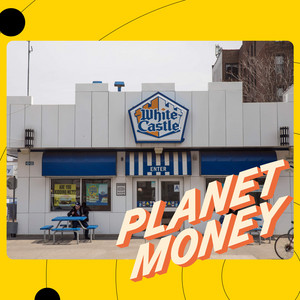
this is Planet Money from NPR.
Hello and welcome to Planet Money, I'm Sally Helm.
There is something uniquely American about the string of low -cost, burger -centric, fast food chains.
Burger King, Wendy's, Five Guys, and of course McDonald's.
But there is one that, even if you haven't visited, you have tasted its influence.
And that is the humble White Castle.
Because, as we will learn in this delightful episode from our friends over at 99 % Invisible, White Castle is really the proto -burger chain.
And this episode gets at something that we refer to sometimes when we talk about the rise of globalism.
This idea that no matter where you go in the world, you can get the same product of the same quality and more or less have the same experience.
As you'll hear, it is both a feature of our modern economy and slightly eerie.
We love the 99 % Invisible podcast and we are thrilled to be bringing you this episode.
Roman Mars is going to take it from here.
But before we begin, a couple of quick notes.
First, this episode mentions Ray Kroc.
The estate of Ray Kroc's widow Joan is a funder of NPR.
And second, we recommend not listening on an empty stomach.
Here's the episode.
This is 99 % Invisible.
I'm Roman Mars. As anyone who has ever been to a White Castle restaurant knows, the food is...
how do I put this? It's never going to be considered classic five -star food, but you know what you're getting when you go there.
Jeremy Brooks has been a diehard White Castle fan ever since going regularly as a kid with his dad.
It's either something you're going to love or you cannot stand.
For starters, the patties are square.
That's kind of their thing.
With five holes in each patty.
And they're small too.
Two and a half inch sliders just big enough to fit in the palm of your hand.
And since they're steamed on a bed of onions, everything is infused with this very specific onion -esque flavor.
Plus you get the steamed buns too, so they're nice and soft.
You can basically just like squish in your hand and just shove in your mouth if you want.
Like the man said, you either love it or you hate it.
I happen to love it and I still do 40 plus years later.
If you've never been to a White Castle though, that's not entirely surprising.
They're not exactly easy to come by.
That's reporter producer Mackenzie Martin who first dug into this story for the KCUR Studios podcast, A People's History of Kansas City.
But that obscurity is also kind of White Castle's thing.
They're only in the US and your state probably doesn't have any.
If it does, even just making it there can sometimes be challenging.
Like in the 2004 buddy comedy, Harold and Kumar go to White Castle.
A film in which the entire plot revolves around trying to find a White Castle.
What happened to the White Castle?
What? There used to be a White Castle right here in this location.
Where is it? I hate to be the bearer of bad news, guys, but Bergeschak, they bought this location about four years ago.
Please tell me there's another White Castle in town.
No. White Castles are so scattered that even I, the reporter of this story, have never actually been to one.
Where I live in Kansas City, we haven't had a White Castle in decades, which is absolutely crushing to superfan Jeremy Brooks.
I drive by the places where I know those locations used to be and I'll look at the building and just let a little quiet sigh out as I drive on And for most people today, that's really all White Castle is.
A semi -obscure, guilty pleasure, cultural punchline.
Which, okay fine, it kind of is.
But White Castle is also so much more than that.
Because over a century ago, White Castle invented something that became so important and all encompassing that today it touches pretty much every person in America.
Sometimes several times a day.
Something that, in other countries, has almost come to define American culture.
White Castle has the strongest claim to have been the first restaurant that is a fast food restaurant.
That's Adam Chandler, a journalist and the author of Drive Through Dreams, a book about Americans' love affair with fast food.
And Chandler says that before McDonald's, before Burger King, before combination Pizza Hut and Taco Bell, there was White Castle.
You cannot throw a stone in the air without hitting a fast food restaurant.
But what White Castle really did in paving the way for all of its brethren is hard to match.
It's hard to understand.
It's hard to grasp because it came from virtually nothing.
The first chain restaurant in the United States popped up in the late 19th century, catering to disembarking passengers along the Atchison Topeka and Santa Fe Railway.
But it catered to a fancier clientele.
And it didn't serve food all that fast.
For that, you were stuck with your typical food carts or automats.
And crucially, none of these places served anything that we moderns would recognize as a hamburger.
Back then, we had kind of a loose confederation of places that served hamburger -like objects.
These proto burgers usually involved loosely ground beef or a meatball served between two slices of bread.
But that's about it.
It wasn't a bun. It didn't have the name hamburger in a lot of instances.
It was just kind of a sandwich.
No one can say for sure exactly when the first properly compacted, bun -in -cased hamburger appeared.
But one of the first steps toward the modern hamburger also happened to be the first step toward fast food.
When, as the legend goes… One day, sometime between 1912 and 1916, a self -described ne 'er -do -well and fry cook named J.
Walter Anderson was preparing some meatballs at a diner in Wichita, Kansas, when, according to David Hogan… He was frying these meatballs and he got frustrated and took the spatula and just slammed it down and made it into a patty.
David is a history professor at Heidelberg University, an author of a book about White Castle.
He put it between two halves of a bun, and now we have the food that we're most familiar with.
And people liked it.
Now, whether Walt Anderson was truly the first to create a contemporary hamburger is not really what matters.
What matters, and the part of the story for which we do not need to issue a disclaimer, is what happened next.
Building on his success, Walt opened his first burger place in 1916, outfitting an old chew -repair stand with three stools selling burgers for five cents a piece.
The stand's official slogan was, buy him by the sack.
David Hogan's book, by the way, is called selling him by the sack.
Eventually, Walt's burgers would be nicknamed sliders.
And contrary to popular belief, sliders are not just tiny burgers.
They're specifically burgers cooked with raw onions, because that's how Walt made his.
As it turns out, Wichita was the perfect place to set America on its burger journey.
In the early 1900s, immigration from Europe and Latin America, urban migration from farms, and the Kansas oil boom brought in thousands of laborers, all looking for a fast, cheap meal.
And these were people who were on their brakes or on their way to the factory or taking lunch or leaving, and they wanted something that was quick and savory and hearty and cheap.
And that is exactly what these sliders provided.
By 1920, Walt Anderson had multiple stands in Wichita, but it wasn't yet a fast food restaurant chain in the way we would understand it.
Because there was still a big obstacle preventing burgers from really taking off.
Most Americans didn't trust ground beef, thanks in part to a book that is so famous, so important and so influential that I'm actually a little shocked to realize that it has never once been mentioned in the course of 569 episodes of 99 % Invisible.
Journalist Upton Sinclair's bestselling novel The Jungle was meant to raise the alarm of the unsanitary and appalling working conditions at meat processing plants.
But it had an unintended side effect.
And everybody who read it or heard about it read instead that, oh my god, eating meat is bad.
Here's just one passage.
There would be meat stored in great piles in rooms, and the water from leaky roofs would drip over it, and thousands of rats would race about on it.
It was too dark in these storage places to see well, but a man could run his hand over these piles of meat and sweep off handfuls of the dried dung of rats.
Oh my god. Suffice to say, the book was impactful enough that over a decade later, many meat products couldn't shake the stink, especially ground meat.
But what ground meat really was and everybody knew is meat that had essentially gone bad was ground up and infused with chemicals, literally preservatives, and it would be marketable for another week or so.
Ground meat was for the poor.
For the better off, eating at one of Walt Anderson's burger stands would have been embarrassing.
Walt told the local newspaper that children would routinely order a half a dozen burgers to carry out, then he'd watch as they would run around the corner to a fancy car where their mothers were waiting.
Too ashamed, he presumed, to come into Walt's dinky little place themselves.
If he wanted the business to grow, Walt needed a partner, specifically a salesman.
Billy Ingram is the ultimate 1920s booster, you know, just hustling nonstop to sell you something.
Edgar Waldo Ingram, who went by Billy, was a Wichita insurance and real estate broker.
And in 1921, he partnered up with Walt to help sell the public on hamburgers, even though, at the time, everyone warned Billy to stay away.
But I told him he should keep his name alive in insurance business because he soon would find out that he was making a big mistake fooling around with hamburgers.
This is one of Billy's old business associates.
But it didn't work out that way.
Did it? Definitely not.
Because when Billy Ingram took a look at the market for burgers, he saw something that bestirred his businessman's beating heart.
No, there was no competition in the beginning.
This is from an interview with Billy years later.
This may seem strange to you, but when I went to Omaha, there were no hamburger stands.
And when I went to Kansas City, there were no hamburger stands.
When I went to St. Louis, there were no hamburger stands in St.
Louis. And when I came to Columbus, there were no hamburger stands in Columbus.
In this glorious vacuum, Billy set about convincing Americans to buy burgers by turning Walt's stands into a special kind of restaurant, the likes of which didn't yet exist.
Walt was well aware of the stigma attached to ground beef.
So he already had fresh beef delivered twice a day and even ground the meat in front of customers.
But with the addition of Billy on the team, these initiatives were taken to new, slightly neurotic heights.
He said we have to have the best product, the healthiest product, in the most cleanly surroundings that we could possibly have.
In 1921, Billy and Walt debuted a new concept with a very scientific sounding name, the White Castle system of eating houses, white to signify purity and castle to signify strength and permanence.
And system to signify a system of eating houses.
What White Castle did was absolutely unique.
I'm sure that there are other versions of automats and small scale diners that that really served food quickly indoors.
But White Castle had a whole system that made it stand out in its efficiency and really replicated the experience of dining in a way that a lot of other restaurants that had multiple locations didn't really do.
That consistency started with the castles themselves.
Every restaurant would soon be made out of white porcelain enameled steel, making the exterior extra shiny and easy to clean.
There was a lot of character in these White Castle buildings.
They actually look like castles.
They had this kind of aura and stained glass, turreted aesthetic that I thought, looking at it, why wouldn't you want to eat there?
It looks like a lot of fun.
Inside, the restaurants all had the same layout.
A grill, a counter, and five stools.
And everything was scrubbed daily, so it sparkled.
The checkered tile, the woodwork, the utensils.
Every restaurant was open concept, so you could watch the cook prepare your burger on a visibly clean grill in front of you.
And from the very beginning, Billy Ingram said, we want our employees to be extremely positive.
We want them to be customer friendly.
Billy insisted that employees all wear clean white shirts, pants, and aprons.
Hair was to be covered by a white paper cap.
Fingernails were to be kept neat and clean.
And elaborate jewelry and wristwatches were strictly prohibited.
The menu featured just a handful of items, coffee, Coca -Cola, pie, and hamburgers, made exclusively of beef shoulder meat.
The smaller the menu, the faster and more reliably the items on it could be made.
Likewise, everything about the patties, the square shape, and the five holes, which were added later, were designed to promote faster cooking and seemingly instantaneous service every time.
The funny thing is today, if we had the exact same experience everywhere we go, we think of it as kind of weird and dystopian, right?
But there is a beauty in going to a place where you know what the experience is going to be like.
You know how much of the food is going to cost.
You know exactly what it's going to taste like.
You know what the store generally is going to look like.
This was also the time when Americans were becoming more invested in national products than locally produced ones.
White Castle appealed to the same customers buying off -the -rack clothing from Sears Roebuck and shopping for Kellogg's Cornflakes and Campbell's Soup.
Uniformity and affordability was the point.
I think there was something about what Billy and Groom was selling with the hamburger that made it seem modern.
That made it seem like he has this proto -assembly line of people creating all these burgers, while a few hundred miles north, the assembly lines of Detroit are churning out Model T's.
White Castle also made its restaurants accessible, strategically building near factories and later college campuses.
And during a time when African Americans couldn't travel safely around the country or freely enter most restaurants, David Hogan says Billy Ingram didn't discriminate.
He was going to take anybody's dollar.
You know, or in the case of this, anybody's nickel.
Meanwhile, in its zeal to introduce hamburgers to the middle class, the company developed some slightly bizarre but effective marketing strategies.
The company commissioned a study at the University of Minnesota, where a medical student ate nothing but White Castle hamburgers and water for 13 weeks.
At the end of the experiment, a food scientist came to the conclusion that a normal, healthy child could subsist off a totally White Castle diet and be perfectly fine.
Kind of like the documentary Super Size Me, except, you know, the opposite.
The combination of predictability, cleanliness, and good old -fashioned false advertising was a winning formula by the early 1930s.
White Castle and along with it, hamburgers were considered so mainstream and trendy that they had even become the favorite meal of beloved cartoon characters.
There's nothing in the world that can compare with a hamburger.
Juicy and fair. It was a craze.
It literally was a craze.
It was like everybody just thought that this new product was so incredible.
Throughout the 1920s and 30s, the White Castle Burger Empire expanded out from Wichita rapidly.
In that interview with Billy from later on, he lists off the locations.
First Laredo, then Omaha, Kansas City, St.
Louis. Minneapolis, Chicago, Detroit, Indianapolis, Columbus, Cincinnati, New York, and New Jersey.
We now have 84 in operation.
But White Castle would eventually encounter the problem suffered by every truly great, innovative, groundbreaking company.
People in cities across America said, okay, there's something about this White Castle.
We're not sure what it is.
Let's just copy the whole damn thing.
Let's copy the name almost.
Let's copy the architecture.
Let's copy the burger.
Let's copy the delivery system.
Let's copy everything.
Give me hamburger. Pickle on top.
Let your horn call 50 slash kippy.
Kids just naturally love crystal hamburgers because the flavor is steamed right into the buns.
Before long, you could find White Hut, White Palace, White Tower, Red Tower, Blue Tower, Little Tavern, Little Crowns, Little Castle.
That's Castle with a K.
Have you ever had one of those wonderful days when everything seems to turn into a tasty donut or a meal of tasty castle burgers?
The quality of these copycat operations was often questionable.
But since many of the White Castle imitators were housed in white buildings or featured castle architecture like turrets, they appeared extremely similar.
Some places didn't even try and come up with a new name.
They just straight up called themselves White Castle.
It's trademark infringement, obviously.
A company is only as good as its name.
You know, when that name gets diluted, it's a threat to their existence.
White Castle ended up suing one of the biggest imitators and winning a large payout.
But ultimately, it was a game of legal whack -a -mole.
It was impossible to go after everyone.
But even if they could, the company would still face a dilemma.
Because the thing that White Castle pioneered, the unique dining experience Walt and Billy started selling back in 1921, it was becoming commonplace.
In a sense, there was nothing unique for White Castle to sell that wasn't also offered by its competitors.
And there was one imitator who would do more than just compete with White Castle.
Instead, it would essentially replace it by becoming nearly synonymous with fast food itself.
Ready for a trip through McDonald's land.
McDonald's was founded in San Bernardino, California by brothers Richard and Maurice McDonald in 1940.
That's 20 years after White Castle.
And at first, just like the other copycats, it took so much from White Castle.
Diligent levels of cleanliness, a limited menu.
And if you find an old picture of the very first McDonald's, it has a slogan that says, buy him by the bag on the marquee.
And that's a direct rip off of White Castle.
But McDonald's had a crucial advantage that all the other White Castle imitators didn't have.
It had Ray Kroc. Kroc was the businessman who took the company national in 1955.
Ray Kroc, bless his heart, just learned somehow to do it bigger.
And ultimately, I guess you could argue better.
Take location for starters.
White Castle places restaurants near factories, downtowns and colleges.
But McDonald's came of age during the building of the interstate and the rise of the suburb.
So Kroc placed his restaurants on increasingly busy highways.
And that was something that Ray Kroc and a lot of his operators and a lot of his executives helped pioneer was a system to basically flood the zone of American roadsides with McDonald's.
McDonald's wasn't just a place for someone on foot to grab food on their lunch break.
It was for anyone in a car on their way to anywhere.
But it was also able to expand much faster than White Castle because it was willing to do something that White Castle refused to do.
It franchised. Billy Ingram, bless his heart, was way too much of a control freak to do that.
The man who wanted every customer to have the exact same perfect experience wasn't about to relinquish any control.
But even if it resulted in the occasional limp fry, franchising allowed McDonald's to grow to 1 ,000 locations in just over 12 years.
Faced with the restaurant's sheer ubiquity, it was easy for the public to just assume that McDonald's did it all first.
And Kroc didn't disabuse them.
To believe the stories of Ray Kroc, he invented fast food.
And of course, that is essentially the message that people get today, is that McDonald's was the revolutionary factor in the fast food industry.
Today, there are more than 40 ,000 McDonald's worldwide.
Meanwhile, there are fewer than 400 White Castles, mostly in the New York area and the Midwest.
Just a blip by fast food standards.
To understand just how small White Castle's geographical and cultural footprint is nowadays, look no further than Wichita, the city where the company was founded.
White Castle left Wichita in 1938.
Now the nearest one is over 300 miles away.
I recently went to Wichita to see the first ever White Castle location, literally on Main Street.
The original building is long gone.
In its place is this large bank.
For many years, I was told, people would stop in and ask the tellers about the history.
But when I arrived, the bank was boarded up.
Eventually, Denise Sherman let me into the bank.
She's the executive director for the Kansas African -American Museum, who now owns the building.
This is the actual White Castle plaque.
Okay, it says, site of the original White Castle opened March 10, 1921.
It's got a photo here.
She showed me how hidden inside the empty building, next to discarded desks and other furniture, was an ode to White Castle bolted to the wall.
But once we were there, Denise didn't have a lot to say about it.
So when did you find out that this was a former White Castle?
I knew a long time ago.
Did you grow up here?
Do you have any thoughts on the White Castle history here?
I think the only thought is that it's a shame we don't have one here, but we will honor that and still keep that plaque there.
I also don't have to keep asking you questions about White Castle if you don't have anything.
I don't know if I can add anything else to it.
It's just one of those things.
Now you might think that Denise is an outlier.
That Wichita is surely lousy with Wichetons, who love to boast about how they invented fast food.
But no. While in Wichita, I tried to gauge the public's civic appreciation of White Castle and its contribution to fast food history.
And although I did find a small handful of fans, mostly the situation was pretty bleak.
What do you think of as the first burger chain that you can think of in America?
If you had to guess, what's the first burger chain, what comes to mind?
McDonald's. McDonald's.
Do you think there's a fan base for White Castle here?
No. Probably not. Probably not.
It's not here anymore.
Yeah. I don't like oniony burgers anyways, so I'm not a huge White Castle fan, so that's fine with me.
Now, if you've spent any time in the Midwest, this all might seem a little strange.
Because there is nothing the residents of a Midwestern town love more than finding something, anything to brag about.
And Wichita is no exception.
They just don't brag about White Castle.
And there is at least one big reason for this.
This is the Pizza Hut Museum.
This is the actual original building.
Sam Morris is director of staff development and special initiatives at Wichita State University, where yes, there is a museum dedicated to Pizza Hut.
Pizza Hut was started in Wichita in 1958.
And while it's not technically the first American pizza chain, it predates all the most famous ones today.
Little Caesars, Domino's, Papa John's.
Today, it has more than 19 ,000 restaurants worldwide.
That's 50 times as large as White Castle.
There's various different memorabilia in here.
The original cash registers around the corner here.
They've got this pair of sweet sneakers.
I think they only got 50 made, but what they were supposed to do is you'd click the tongue and it would order you a pizza.
Wait, what? Yeah. So pretty ridiculous.
But there's all kinds of those types of things.
So there's a Pizza Hut Barbie?
Let's go see that. There is a Pizza Hut Ken as well, but he's right now in storage.
During the tour, I was honestly kind of pissed.
Why wasn't the original White Castle this well preserved?
Where was its fancy museum?
Where was its Ken doll?
But I couldn't be too angry because even if it is a semi obscure cultural punchline, the truth is that today, White Castle is not struggling.
Its definition of success is just a bit different than most of its competitors.
White Castle is still family owned, but it's no longer trying to pitch itself as the definitive fast food chain.
Instead, it's found something else to sell.
You know, our vision as a family owned business is to feed the souls of Craver Generations everywhere.
Jamie Richardson is an executive at White Castle headquarters in Columbus, Ohio.
He is married to a fourth generation Ingram, and he leaves no room for confusion about the company's current strategy.
I'm vice president of marketing for restaurants and retail, but really my unofficial title is Keeper of the Crave.
Over the years, the company has patiently developed a cult following.
People who will go to any length to get their hands on a White Castle slider.
The fact that you can't always find one nearby now actually works to their advantage.
It's kind of like the fast food equivalent of an outlet mall.
Once you're finally there, the whole point is to go nuts and consume as many of those tiny square sliders as possible.
Something, as Jamie explained, they make sure is always easy to do.
So you can buy a sack of 10 or get a Crave clutch with 20, Crave case with 30, Crave crate with 100.
I'm still working on the Crave palette maybe someday.
That's 6 ,982 if you're interested.
Please call ahead. But yeah, it keeps it fun.
We don't take ourselves too seriously.
This approach has earned White Castle an extremely loyal fan base.
When White Castle opened up a new location in Orlando, Florida in 2020, customers camped out overnight and waited in line for six hours.
And for those who just can't wait that long, there's also a version of their favorite slider in the frozen food aisle.
White Castle even has an exclusive Craver's Hall of Fame for its most devoted fans.
In a small room behind an undisclosed door, a group of White Castle staff sift through thousands of applications to determine who has what it takes to be inducted.
Into the Craver's Hall of Fame.
Wow, I can't believe how many Craver's Hall of Fame applications.
Applications are evaluated by a panel of judges according to four criteria, loyalty to the White Castle brand, creative presentation of the story, uniqueness and originality of the content, and extent and magnitude of the author's crave.
Inductees are flown to Columbus, Ohio for a formal ceremony at White Castle headquarters, a building which one Hall of Famer described as Willy Wonka -esque.
In addition to a giant wooden throne in the lobby, there's also a two -story spiral slide.
So there's an emotional connection to these fans that's real.
And at the end of the day, we don't try to be like everybody else.
All of which helps keep White Castle customers coming back again and again and again.
And you can buy them in the grocery store freezer frozen.
It will get you by in a pinch, but it's not the same.
That's Jeremy Brooks, the White Castle superfan who lives in Kansas City, where there are, remember, no White Castles.
Which is why even though he may not be in the Craver's Hall of Fame, he and his friends still make the pilgrimage to the nearest White Castle location.
In Columbia, Missouri, a four -hour round trip.
So is this something that is very premeditated or is it spontaneous?
I would say more spontaneous than premeditated, you know, get to like a Friday night, everybody's off of work.
It's like, all right, you know, whoever's car has the, you know, the most available room or, you know, in best condition as the case might be with some of us, you know, and just hit the road.
Is this in any way inspired by a certain movie?
My, if you want to call it an addiction, call it what it is.
My fascination and my love for White Castle existed long before a said movie existed, although that definitely did not hurt things at all.
At the end of Harold and Kumar go to White Castle, there's this moment.
Harold and Kumar have spent all night trying to make it to a White Castle location when they finally see one in the distance.
And Kumar starts this motivational speech about why his parents immigrated to this country in the first place.
And they wanted to live in a land that treated them as equals.
A land filled with hamburger stands, and not just one type of hamburger, okay, hundreds of types of different sizes, toppings, and condiments.
It's incredibly cheesy, but it does take on new meaning when you realize that what he's referring to, it's White Castle's legacy.
This is about the pursuit of happiness.
This night is about the American dream.
Because, even if it doesn't always get the credit it deserves, we live in the world White Castle built.
One in which, whether you're on the road or in a new city, you're able to get exactly the thing you're hungering for, and to have it taste just the way you remember, every time.
That was Roman Mars and the podcast 99 % Invisible.
They have done incredible work for years explaining cities, architecture, and the world of design.
Recently, they just did a six -episode mini -series called Not Built for This about the climate crisis and its effect on our society.
They've also done all kinds of well -told origin stories like why the LA River is dry, how movies and TV shows decide on who gets top billing, and why leaf blowers are the worst.
And I think we can agree that they are.
Check out their feed or some of their special projects, like a spin -off all about fashion called Articles of Interest, and a series where they read the power broker chapter by chapter with special guests.
If you try it and like it, let them know you heard about them on Planet Money.
I'm Sallie Helm. This is NPR.
Thanks for listening.