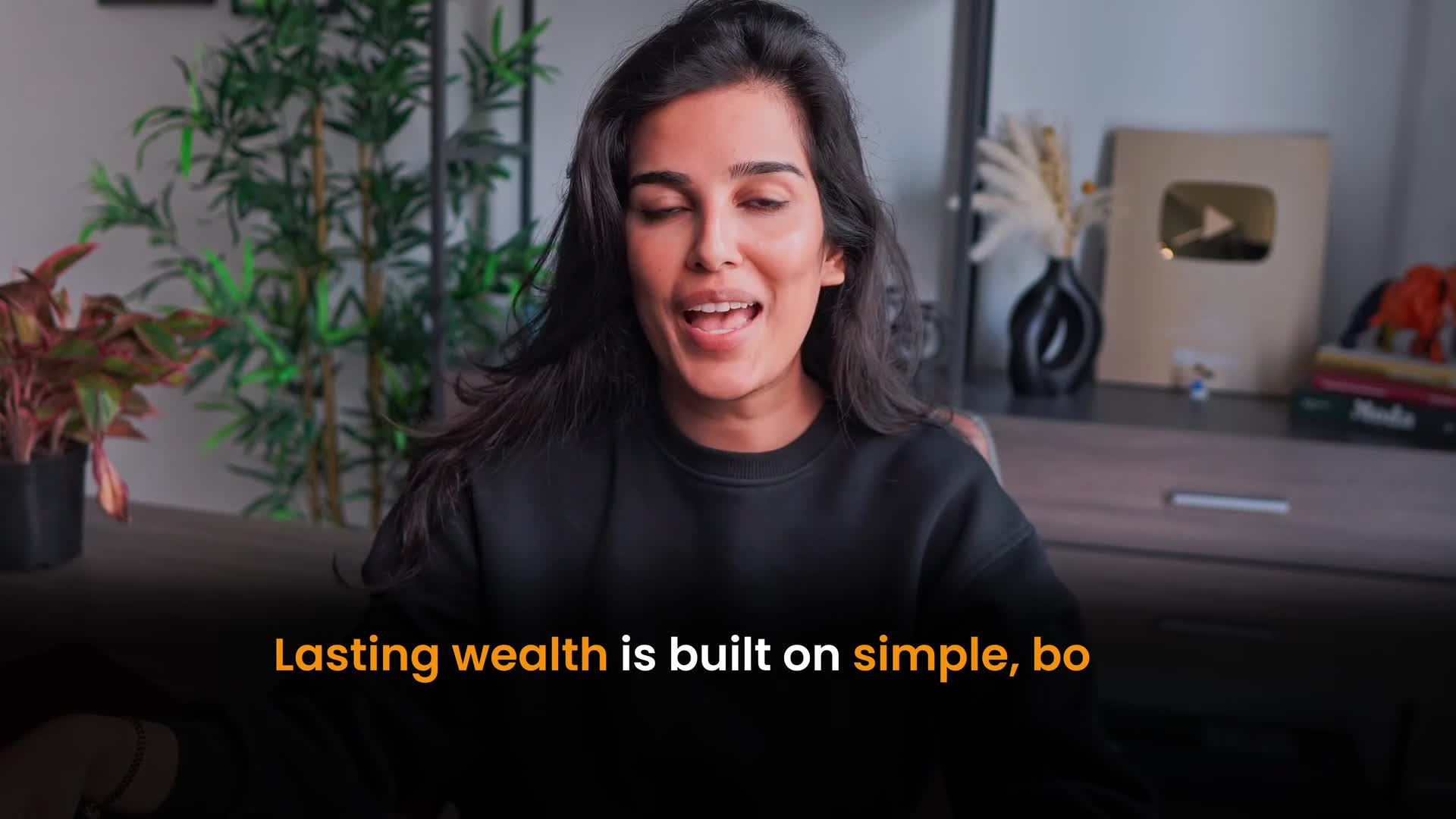
Nobody wants to hear this, but the habits that have had the biggest impact on my finances are deeply, profoundly unsexy.
If you're new here, hi, I'm Nisha.
And until a few years ago, I was a banker, surrounded by people who earned a lot of money and, in many cases, had very little to show for it.
Big salaries, impressive job titles, and almost no financial security underneath.
And what I noticed over time is that the people who actually built lasting wealth weren't doing anything flashy, anything difficult.
The habits were almost embarrassingly simple, boring even.
And it took me longer than I'd like to admit to start copying them.
So in this video, I want to share nine of those habits with you.
They aren't glamorous.
They won't make anyone go viral on TikTok, but they save me more money than more than anything else.
So let's start.
Number one, waiting 48 hours before buying anything non-essential.
The average person spends roughly 3400 a year on impulse purchases, and around one in six Americans say they spent more on impulse purchases than they put in their retirement accounts.
One reason for this could be a psychological phenomenon scientists call hyperbolic discounting.
Basically, our brains are wired to prioritize smaller immediate rewards over larger future rewards.
So the buzz you get from buying something today can feel far far, far more real and tangible than the idea of possibly having more money six months, one year, five years from now.
And the entire online shopping experience personalized ads, low stock warnings, one-click checkouts.
It is built to make that feeling as strong as possible.
The addictive nature of our phones and of social media can make it really hard to resist the urge to spend.
So when I tell you what works for me, it is surprisingly simple.
When I see something that I want to buy and it's above a certain threshold, I tell myself yes, I can afford this.
I can have it.
I just got to wait 48 hours before making that purchase.
Sometimes I add it to my basket and I promise myself I'll come back to it.
But I've noticed that I usually just forget about it.
Or I remember at the back of my head and that urge has disappeared by then.
Most of the time when I visit that same website again, I'm actually surprised to see the item in my basket, because the excitement I initially had for that potential purchase has gone.
If I still want it after two days, at least I know it's a real decision rather than a reflex.
This isn't a glamorous habit, but it saved me more money than I would like to admit.
Number two, avoid single purpose items.
Have you ever bought a gadget that promised to make your life easier?
You used it a handful of times and then you watched it gather dust.
You're not alone.
In a survey of over 1,400 people, 65% said they'd experienced gadget regret.
The biggest culprits were pasta machines, ice cream makers, and I had to Google the next one because I didn't know what it was spiralizers.
They're all things that do one job.
These single purpose items, they aren't cheap.
A Ninja Creamy will set you back around $300.
A pasta maker, another $100.
Only for these tools to sit in a cupboard, taking up space and making you feel guilty every time.
You probably remember their existence.
I've been there too.
I used to own things exactly like this.
Now, before I buy anything, I ask myself, how many different ways will I actually use it?
If the answer is basically one, I think twice.
And when something outlives its original purpose, I also look for new ways rather than just replacing it.
And I apply the same thinking to my wardrobe.
Most of what I own, as you know, if you've watched lots of my YouTube videos black creams, browns everything works together.
I re-wear things constantly, not embarrassed about it at all.
One versatile piece beats three single-use ones every single time.
Number three, reducing friction with how I manage and move my money.
This is one of the most unsexy ways I save money.
Just being organized and automating how I manage and move my money.
And I use Revolut both personally and since day one of setting up my business.
Revolut is the all-in-one finance app used by over 70 million people globally.
And what I really like about it is how it just simplifies everything.
Spending, saving, international payments, it's all in one place.
In fact, the feature I use most is the multi-currency account I hold.
I send and I exchange over 30 currencies euros pounds, US dollars all from the same account.
So if I'm traveling or paying in another currency, I can see the live exchange rate in the app and it automatically converts at the point of payment.
And that's the personal Revolut side.
On the business side, it works in a very similar way.
Working with international clients or platforms that pay in different currencies.
It used to create so much unnecessary back and forth with traditional banks when I was using traditional banks to do this.
Now it all just sits in one place and I can see exactly what's coming in and going out, and the whole thing feels so much more under control.
It just removes a lot of noise from both sides of my finances, which for me is really valuable.
If you're interested in trying it, Revolut are offering a promotional offer right now to all of my viewers.
You can get 20 pounds when you sign up for a personal account and all you have to do is just spend one pence or 200 pounds when you open a Revolut business account.
Just add one pence to the account before June, the 30th 2026, using my link on the screen or in the description, or using the QR code which is on the screen right now.
Fees, promotional terms and T's and C's apply.
Thank you so much Revolut for sponsoring today's video.
The next one on this list is don't immediately go for storage solutions.
If your home is always messy, you can never find what you're looking for, and you hate putting laundry away because there's no room in your closet.
You might be tempted to go straight to the shops and buy more storage.
Another box, a new shelving unit, a set of matching baskets, a new bed that has storage underneath it.
There's a whole industry, in fact, built around selling you the idea that the only solution to too much stuff is just more stuff to put it in.
But buying more boxes or spending thousands on fitted wardrobes won't actually fix anything.
You might not see the clutter anymore, but it's still there and you're paying for it to live with you, even if you never use these items again.
So not only did these things cost you money in the first place, you're now spending even more just to store them, And if you keep accumulating, the problem will only get worse and you'll need to buy even more boxes and organizers and eventually, maybe even a bigger home.
Because the real problem was never actually a lack of storage.
It was most likely the amount of things that you own.
And this is where my second unsexy habit comes in.
Before buying anything to organize or store my belongings, I now ask myself what am I actually putting in here?
And is that purely to organize my belongings or to declutter some of my excess items?
And when I go through these items, I ask myself, have I used any of these in the last 12 months?
If the answer is no, I would just get rid of it.
I usually find that I can save money and make my home tidier by selling or donating things rather than just finding a new home for it.
And it turns out a lot of the organization problem is actually a consumption problem and that is much easier to fix.
The next one on this list is letting things break before replacing them.
According to a study of over 600 consumers, 60 of people with a defective product didn't even consider repairing it first.
They went straight into buying something new.
Of course, if you don't have the skills or tools to fix something yourself and you don't have a friend who can help, skipping the repair stage and immediately buying a replacement can often sometimes be the quickest, most easiest solution.
But the same study found that more than half of people who replaced their TV did so while it was working perfectly fine.
Buying shiny new things and upgrading older tech can be exciting, but that constant cycle of replacing things that still work is often one of the biggest hidden drivers of lifestyle inflation.
It might not seem like an expensive move in the moment, especially if you sell the old item and use that to justify the new purchase.
But every time you shorten that replacement cycle on an item, the numbers add up.
So these days I try to use things for their full lifespan.
I repair where I can and I only replace something when it genuinely can't do its job anymore.
In fact, the one exception I'll say is anything work or productivity related.
If your laptop is so slow that it's eating into your working day, or your equipment is genuinely holding back the quality of your work, replacing it sooner probably makes sense, because in that case, not upgrading is actually costing you money too.
Number six, buying in bulk.
What I'm about to say might seem like a massive contradiction, because just a moment ago, I was encouraging you to wait until you've finished using one item before replacing it with another.
But sometimes it can make sense to do the opposite and stock up while you can.
So, for example, there are certain things I know I'm going to use, no matter what toothpaste shampoo, washing powder, tinned food, anything that doesn't expire quickly.
By buying them in bulk when they're on offer.
The amount I spend on these things over the course of a year is actually lower.
Even if my expenses might fluctuate from one month to the next.
It's not an exciting habit.
There's nothing fun about a cupboard full of conditioner, but again, the savings add up.
And one thing I'd say is and this links back to what we talked about earlier don't let this take over your home.
If you're stocking up on so much stuff that you need extra storage to house it all, it just defeats the purpose.
The goal is to have a sensible supply of things you genuinely go through regularly, not to turn your home into a supermarket or a storage container.
Number seven, not outsourcing everything.
So as you move through your career, particularly if you're self-employed, you might be told to outsource as much as possible so you can focus on what makes you money.
Honestly, it's not bad advice.
I've encouraged people to do exactly this, but there is a point where it goes too far.
When you outsource everything but your job, all that's left for you to do is work.
You start seeing every hour as a billable hour.
Leisure starts to feel wasteful.
Spending a Sunday afternoon cooking or fixing something around the house starts to feel like a poor use of your time.
And before you know it, you're paying people to do things that not only are you capable of doing yourself, But you might actually enjoy doing as well.
And over time, you might also end up losing skills that could be invaluable in the future.
It's a classic case of be careful what you wish for.
If you crave more time and freedom, you might outsource every task you're not paid to do, only to realize that you actually have less freedom than you did before.
So the goal isn't to fill every waking hour with productive work.
It's to build a life that you actually enjoy.
And over the last few years, I've tried to hold on to certain tasks.
Painting my apartment was one of them.
Learning basic sewing so I can repair my own clothes instead of taking them to a tailor.
Cooking from scratch instead of ordering in.
My time is valuable, but there's more to using it wisely than just working all the time.
And number eight, keeping my skincare routine boring.
Have a look in your bathroom cabinet or your makeup bag.
How many products do you own that you've used fewer than five times?
I'll be willing to bet that there's at least one thing in there that got bought, used once or twice, forgotten about and never touched again.
I could probably bet you that.
The beauty and skincare industries love it when we do this.
There's always a new product, a new ingredient, a new routine that someone on the internet swears has changed their life.
But how many of us actually see it through long enough to get the desired results?
Most of us end with a growing collection of half-used products, a confusing routine and ongoing spend on things that may or may not be doing anything at all.
So a few years ago, I dialed my routine right back.
Instead of trying everything and anything all at once, I chose a couple of new products at a time, and I don't let myself buy anything new until those products are finished.
Or if I buy a product that doesn't work for me, I either offer it to a friend, to one of my sisters, or I throw it away.
This might sound wasteful, but this approach actually results in far less waste than having multiple products on rotation at any one time, as the more you have, the harder it is to complete them all before they expire and you don't actually know which one is working.
So now I always use products until they've run out.
And whenever I introduce something new, I only do it after using other products for long enough to see which ones are working, which ones are actually making a difference.
And number nine, creating more, consuming less.
Be honest.
How often do you pick up your phone when you're bored?
You start scrolling and, before you know it, you bought something you didn't even know existed five minutes ago.
We all do it, but why?
There's obvious stuff, of course, such as constant ads, sponsored posts, but there's more to it than that.
Because if you spend enough time online, you might fall into a trap that psychologists call social comparison theory.
Basically, we can't help but measure ourselves against others.
It's a theory first developed in the 1950s, where a psychologist who argued that people seek agreement from others to reduce uncertainty and reinforce their own views.
And we still do this today, looking for confirmation on how successful we are, how attractive we are, how well we're doing financially.
Social media hands us an endless stream of people to compare ourselves to.
But what we're seeing isn't always real life.
Instead, it's a very, very carefully curated highlight role.
Not only can this make us feel behind, it can trick us into thinking that the solution is just one or two purchases away.
And marketers know this.
Aspirational branding influencer culture, lifestyle advertising it's all built around making you feel like you're not quite there yet.
And as an article from the Decision Lab puts up, the goalposts of enough are constantly shifting and impossible for most people to ever reach.
Completely avoiding social media.
Yeah, sure, it isn't realistic for most people.
But if you think your screen time is affecting your finances, this is what works for me.
Whether I'm watching reels on TikTok, watching YouTube videos at the end of that scroll, I pay close attention to how I feel.
How did that content make me feel?
Was it helpful?
Did it teach me something new?
Do I feel uplifted?
If the answer is no, or as soon as I find myself doom scrolling, I take that as a sign to focus on my own YouTube channel.
Write a couple of pages in my journal or go to the gym or plan a creative activity with a friend.
I just get myself out of that rabbit hole that I found myself in.
And it sounds simple, but once you get into the habit of creating, not consuming, two things happen.
First, you spend less money because you're not constantly being encouraged to buy.
Second, you feel better in yourself because you're actually doing something enjoyable and fulfilling with your time, rather than watching how other people spend theirs.
None of these habits actually came to me naturally and I still slip up occasionally.
I spend more time on social media than I should, and I'm sure there's at least one expensive gadget in my kitchen that I've forgotten about, and it's just sitting there.
But over time, by adopting these unsexy habits above, I've definitely managed to save a lot of my money and invest more of my income.
If any of these habits resonated with you, let me know which ones in the comments.
And if there are unsexy habits you swear by that I haven't mentioned, drop those too.
And if there's someone else's comments that resonates with you, give it a like.
You might be surprised at just how often your comments inspire not only my future videos, but other people as well.
Thank you so much for being here.
And don't forget to subscribe if you haven't already.
And don't forget to share this video if you feel like it's going to help someone else as well.
Thanks so much for watching and I'll see you next week.