Support for This American Life comes from Focus Features.
Don't miss Focus Features' Anemone, starring three-time Academy Award winner Daniel Day-Lewis in his long-awaited return to the big screen.
Anemone tells the story of two brothers wrestling with their past and the one secret that has kept them apart for decades, featuring Daniel Day-Lewis, Sean Bean and Samantha Morton.
Anemone, directed by Ronan Day-Lewis.
Rated R, under 17, not admitted without parent.
Only in theaters October 3rd.
A quick warning, there are curse words that are unbeaped in today's episode of the show.
If you prefer a beeped version, you can find that at our website, thisamericanlife.org.
From WBEZ Chicago, it's This American Life.
I'm Ira Glass.
This summer, three people from our show, Zoe and Nadia and Angela, spent weeks at immigration court in New York City, witnessing this extraordinary thing that you might have read about or heard about happening in the hallways there.
And there was one group at the center of that thing that nobody ever got to hear from.
They would not talk to reporters until now when they've been talking to us.
We had them on today's show.
We're going to get to them in a few minutes.
But first, Zoe Chase now joins me in the studio.
Zoe, let's first describe what you witnessed at the courthouse.
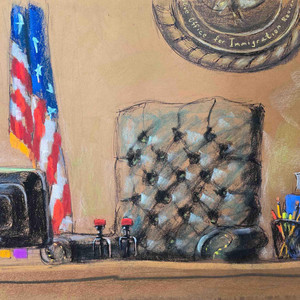
OK, so we visited the courtrooms at 26 Federal Plaza downtown.
And it's basically just a bunch of very old looking courtrooms.
Normally, immigrants are coming in and out, going for their hearings in this place.
It looks like it hasn't been redone since the 90s.
And now...
You take the elevator, you get to the 12th floor.
The door's open and it's just crowded.
Like three or four different kinds of law enforcement, ICE, DHS, the FBI.
I saw the Diplomatic Security Service.
Whatever that is.
Don't know.
Plus reporters, a lot of photographers, activists, lawyers.
Everyone's kind of huddled around one courtroom door like a celebrity is going to come out of it.
And the feeling of it, it's tense and then it's boring.
And then when somebody steps out of the courtroom, ICE surrounds them and handcuffs them and starts hustling them down the hall.
And it gets very rushed, like in ER, everyone's chasing them.
The number, 347, please.
Volunteer lawyers are racing down the hallway after this guy asking for a phone number for a family member.
They can call for him.
347, 347, say more.
I can contact your family.
The guy says, I don't remember, and he's pushed into the elevator.
What just happened?
ICE picked him up.
They've been waiting there all day.
They know who they're coming to get.
There was an ICE officer in the courtroom the entire time texting and coordinating.
And just to be clear, these are people showing up at court.
The government told them to.
They're following the rules as part of this legal process.
And then they are suddenly getting arrested in the hallway and thrown into detention.
Yeah.
And we're doing so many of them here.
It can feel almost routine, like between the detentions.
The agents and the press and the lawyers are just standing around chit-chatting about the podcast they listen to, or Lord of the Rings.
And then something happens that almost reminds everyone of what we're doing here, no matter how many times we see it.
It's one person's life turning completely upside down.
Like this one guy.
His name was Luis from Venezuela.
He was around 50 years old.
He'd actually entered the country legally at a port of entry.
He broke no law.
He was detained in the hallway, pulled into the elevator.
His sister was with him.
Trying to follow him in, the doors closed in her face.
She started jumping up and down.
Everyone just stood there.
The agents hunched over.
They seemed miserable.
Some looked down at their shoes.
The sister, Anyla, eventually tracked him down in New Jersey.
He's still in detention there now.
And were the judges in on this?
Like they're having these cases and then people are leaving their courtrooms and being taken away in the hallway.
We didn't know.
But by the end of the summer it didn't seem to matter what happened in the courtroom, what ruling the judges made.
The agents were picking up whoever they wanted.
And so we were like, what's going on with these judges?
We really wanted to talk to them, but none of them would talk to us.
Well, at first.
At first.
But that changed because what was happening in the hallways was just part of this dismantling of the immigration court.
There was all sorts of stuff happening on the inside, really in the guts of the place, that we could not see, that we didn't even know was there.
And then suddenly the judges started talking, talking and saying some stuff that is totally eye-opening.
And that is going to be our show today.
Today, we're going to hear from people who we normally never hear from, immigration judges, the people who are supposed to make the decisions about who stays and who goes in our country.
And they are saying now that that is becoming very hard to do in a fair way because of the way their jobs have changed in the last few months.
Some of them are being told straight up what their decisions should be.
Today, they take us behind the curtain at the court.
The robes come off.
The judges get real.
They talk about stuff that I have never heard was happening at all.
To hear for yourself, stay with us.
Support for This American Life and the following message come from AT&T.
There's nothing like knowing someone's in your corner. especially when it really counts.
Like when your neighbor shovels your driveway after a snowstorm or your friend saves you the last slice of pizza.
Staying connected matters.
That's why AT&T has connectivity you can depend on, or they'll proactively make it right.
That's the AT&T guarantee.
Terms and conditions apply.
Visit att.com slash guarantee for details.
Sources and methods, the crown jewels of the intelligence community.
Shorthand for how do we know what's real?
Who told us?
If you have those answers, you're on the inside.
And NPR wants to bring you there.
From the Pentagon to the State Department, to spy agencies.
Listen to understand what's really happening and what it means for you.
Sources and methods, the new national security podcast from NPR.
This is American Life.
So like I was saying before the break, for months, no judge would talk to us.
Then this summer they started talking because of what they're seeing behind the scenes at immigration court.
Nadia Raymond talked to them.
Here she is.
It takes a very specific person to be an immigration judge, the kind that likes minutiae, likes listening to hours of translations from like K'iche' to Spanish, to English, just to get someone to confirm their mailing address.
And obviously, you have to believe in rules.
One main rule they have, don't talk to the press.
I ended up talking to 15 judges from all over the country.
Desperate times, I guess.
George Pappas was one of them.
He works at a court in Chelmsford, Massachusetts, close to Boston.
A pretty new judge.
He's been on the bench about two years.
An average day for him until recently was usually one of two kinds of hearings.
Either a lot of quick repetitive, boring hearings just to schedule the next hearing, or a full asylum case.
There were some cases that I could not grant, so I'll go through those, okay?
Sure.
Let me go through those first.
In those asylum hearings...
A person would have to make the case that they cannot live anywhere in their home country because they're being persecuted due to their race religion nationality, political opinion or the ever so squishy membership in a particular social group.
I've seen a lot of cases out of Brazil where the immigrant is saying I'm being persecuted and I fear for my life because the loan shark that I borrowed money from is after me.
I haven't paid back the loan and he's looking to kill me.
I cannot tell you how many times I've seen that claim walk into my courtroom and I'm just shaking my head.
Why is this here?
Rough going, but being chased by a loan shark doesn't make you a member of a particular social group.
So you can't get asylum.
Pretty clear cut.
George denied those cases.
Kira Lillian, a judge from another court on the other side of the country Concord, in the Bay Area.
She also approaches her cases with a healthy level of skepticism, a discerning ear.
Because, you know, that's what she's supposed to do.
And some people lie.
That is something that always happens is that you do hear certain stories repeatedly and certain key details that are repeated and like hundreds of times over.
And so you're just immediately thinking, how can that possibly be the case?
They make you go like side-eyed a little.
Like you're like, is that true?
Yeah.
Yeah.
I never felt angry about it.
In my mind, there are two big reasons why you could hear the same claim from someone over and over again.
One is because it's been manufactured and been farmed out to a whole bunch of people and they're all given the same fake story.
The other is because there's a pattern and practice of human rights violations in that country.
And that's why everybody is giving the same story, because everybody's undergoing the same harm and persecution.
So, you know, that's the challenge.
So that's the job.
Hearings.
And the people appearing in these hearings in Kira's court day after day broke down like this.
People who wanted to stay in the US, their lawyers if they had one, interpreters and Department of Homeland Security lawyers.
And no matter what horror story, from what corner of the world she hears from the bench, she keeps things calm and orderly.
Which is why it was so shocking when I showed up at her courthouse this summer and she could hear the chaos right outside her courtroom.
I knew people were passing out.
I knew we had to call an ambulance for someone whose husband was detained.
ICE officers were hiding in the stairwell.
I could see protesters outside of my window standing in front of the ICE transport vans and trying to block them.
I could see the scuffle.
I could hear the drums and the honking.
And I would go into court thinking everything could explode and I have to hold it.
All the judges they talked to said they were on edge about ICE now being inside the building, just outside their doors in the hall.
This was a huge change.
And at the same time, things inside their courtrooms began to change too.
Jennifer Durkin is a judge at a courthouse on Varick Street in Manhattan.
Right around the time I showed up in New York, a DHS lawyer, a lawyer from the Department of Homeland Security, showed up for court.
They're the side that represents the government, usually arguing to deport someone.
Two things were unusual that day.
First, DHS lawyers usually appear via video for this kind of routine hearing.
This guy came in person.
And second, he filed a motion to dismiss the case.
In fact, he said to her, I'm going to be making a number of motions to dismiss.
What's happening?
So that immediately sounded weird to you?
Yeah.
Yeah.
Why?
Because typically I mean motions to dismiss would mean that they're no longer pursuing a prosecution of the person.
Okay.
Which almost never happens.
And ICE was outside.
There's a series of strange motions being made.
They're coming in person.
It was clear that something was up.
What was up was, instead of arguing why a person should be deported, the government was like we don't want to do that anymore.
Instead, we want to dismiss the case.
Which, if you're the immigrant sitting there, can sound good.
Like, great, I'm free.
But the problem is you didn't win your asylum case.
Your case was dismissed.
And the fact that you had a pending asylum case was the only reason you could stay in the country.
Suddenly, with no pending case, you have no grounds to be here and you're standing just a few feet away from ICE, who are ready to detain you.
And the judges understood that better than the people in front of them.
They were like, how can we just close this case?
For what legal reason?
It looked like a way to just trap people and detain them. the judges didn't know how to respond.
So some of them called their supervisors, who were also judges, known as ACIJs, Assistant Chief Immigration Judges.
Jennifer Payton she goes by Jenna is an ACIJ in Chicago supervising 22 judges.
Has been a judge for nearly a decade.
She was about to board a flight when her phone rang.
One of my judges called my cell phone.
And he's like, ah, they're moving to dismiss in court.
I said, like, adjudicate the case in front of you.
Adjudicate the motion as you would any other motion.
That's it.
Like, any other motion, judge.
Adjudicate this like any other motion you've received.
In other words, keep being a judge.
Follow the rules and make your judgment.
It seems simple to her.
Even if the government is asking for something weird, do your job like normal.
In this situation, the practice is, when one side moves to dismiss, you don't have to say yes right away.
You can give the other side 10 days to think about it.
But then, about a week after that, immigration judges got an email from the Executive Office of Immigration Review, EOIR their bosses who work for the Trump administration.
It was about the motions to dismiss.
And it said, you don't need to give immigrants 10 days to respond.
You may grant the motions that DHS is asking for on the spot.
Most of the judges I talked to read this as instructing them to grant all the motions to dismiss to side with Homeland Security.
Even though the email used the word may, judges heard it as shall.
And that was what was concerning, that we were being told how to adjudicate motions to dismiss.
But just to say, I mean, those are your bosses.
Like, doesn't it make sense that your bosses would be like, this is what we need you to do?
So...
As a supervisor, I never told my judges how to decide a case.
And that is the hallmark of being an independent judge.
You are resolving issues and controversy using your training and your expertise and your knowledge of the immigration laws, and I'm not going to tell you how to decide a case.
And this was tell me how to decide a case.
And that was what was very troubling.
George went to his supervisor, another judge, immediately when this all went down.
And...
I said Judge, you know we're hearing that attorneys for the department are now coming into court and they're asking to dismiss cases.
Respondents are being arrested and put into expedited removal.
Is there anything you want to tell us in terms of how you want to approach this new environment?
And his response was, grant them.
Grant them.
I looked at him.
This was a Teams video.
And I looked at him and I said, you said grant them?
He goes, yeah.
You mean rubber stamp grant them?
When I said rubber stamped, he hedged a little bit.
He goes, well, if they're defective.
So unless they're defective, you want us to grant them?
Yes.
The message was clear.
Don't cause any trouble.
Grant them.
Some judges did just grant the motions.
But George wanted to consider each request and rule according to each specific case.
He didn't want to rubber stamp anything.
So he looked up case law about how to deny these dismissals legally.
And then he decided to share this info and kind of stick it to his boss.
And I made sure that that law was posted on teams where he could see that.
But it was my way of saying, no, this is the way we're going to do it.
Because I would put it out there and say folks, just so you know, here's the law on motions of dismiss.
If you need to deny, here are the case laws you need to be aware of.
These are the standards of review you need to keep in mind.
In order to protect due process, you've got to do X, Y, and Z. Is that what you said in the message?
Pretty much, yeah, pretty much.
Why did you do that?
Because I resisted.
It was my legal way internally to challenge a directive which was wrong.
How did you feel?
Were you scared to do that?
Did it feel like a little strange?
You don't know me.
No, I'm not scared.
I'm not scared.
I'm not scared.
I was angry.
I was angry that we were being manipulated.
Jennifer Durkin from New York didn't see it the way George did.
So I hadn't read it that way, but I do think others did.
I was literally like, which memo?
Oh, really?
You know, I chose to assume that, of course, I would be left with my judicial independence.
That was legal decision-making.
And so to me, I guess I had hoped and assumed that that would be left untouched.
And for a minute there, that was exactly what happened.
She would rule on something based on what she thought was right, which was mostly denying motions to dismiss from the government.
And ICE respected that.
They didn't pick up people from those cases, let them walk out.
But then, all of a sudden, ICE changed their approach.
A couple of weeks later, it didn't matter if you denied them, the people were still being detained.
When did you notice?
How did you notice that it was happening?
They were like, didn't you deny that motion?
And I said, yes.
And they said they took him.
And so I might have, at that point, I might have looked at Opal and I said, okay.
Is everyone just being detained?
OPLA, by the way, is what judges call the government attorney office of the principal legal advisor.
And they said yes to their knowledge, so.
What'd you say to that?
There wasn't much I could say.
To be clear, ICE had the legal authority to detain any immigrant whose case was pending.
They just rarely used it.
But now that it was happening so regularly, that brought up an existential question.
What is the point of the judge?
Whether they granted the motions to dismiss, whether they denied them, it didn't seem to affect what happened to the people in their courtrooms either way.
I knew that my ruling mattered and the way I handled the case legally matters.
But in terms of the practical outcome, ICE was going to do what they were going to do, regardless of my ruling.
Right.
So that's got to be a strange feeling, because it's like you're saying, it matters, but it matters almost like in a very intellectual way but not in a practical way.
Yes.
It matters for purposes of appeal.
It matters in terms of how that person might be able to seek redress in the future.
Um, but it doesn't matter in terms of me being able to influence one way or the other with whether someone's taken into custody.
I know I was always very clear that I didn't have any influence over that.
Isn't that maddening though?
Because it's not that you know.
It's not like you can influence whether or not somebody gets taken into custody, but you're literally saying this person is still in proceedings or under the protection of the court and they're getting picked up anyway.
It really just sort of felt like everything, like the walls were disintegrating around us.
It felt like everything was falling apart.
We have a big, complicated immigration system designed to answer a pretty simple question.
Who can stay and who can't?
And up until now, most immigration judges felt and acted like they were part of the judicial branch of government, an independent branch that just interprets and applies the laws.
But they're not, not technically.
They're actually part of the executive branch within the Department of Justice.
They work for the president.
But till now no administration has ever given them very direct orders about how to decide their cases.
They weren't used to it, and they didn't like it.
But the orders kept coming in the form of policy memos from their bosses at the Department of Justice.
A lot of policy memos, actually, that would start to transform immigration court from the inside.
Some targeted a problem that the Trump administration was blaming on Biden the giant backlog of immigration cases on the books.
Under President Biden, so many people entered the United States that the number of asylum cases exploded, which added to an existing backlog.
The total is now more than 35 million pending immigration cases, with a comparatively tiny pool of judges to adjudicate them under 700.
Immigration judges who worked under the first Trump administration figured they would be given quotas to deal with this.
That's what happened last time.
Close this many cases in this amount of time.
Move through that backlog as fast as humanly possible.
But that didn't happen.
Not at first, anyway.
Instead, they got all the memos.
Like this one that began this way.
EOIR adjudicators have a duty to efficiently manage their dockets.
It is clear from the almost 4 million pending cases on EOIR's docket that has not been happening.
Sick burn.
This memo was like we're going to suggest that you change the way you do asylum cases in the first place.
It told the judges to look at the initial asylum application and Usually the first step in this long process, often filled out by hand by people without a lawyer.
And if that had anything incomplete or incorrect throughout the whole case, don't even hear it.
It was called pretermission of legally insufficient applications for asylum.
Here's Kira.
Especially with someone who's not represented by counsel.
I want to hear from them.
I want to meet them.
I want to hear what they have to say before I adjudicate their case.
I want to hear their testimony.
I want to see what evidence they file.
This felt to Kira like a major violation.
It was telling her, don't think, don't assess, just push this button.
It felt anti-judge.
Worse, it seemed to be cutting off the chance for people seeking asylum to have their cases heard, denying them the chance to present their evidence in a full hearing, denying them the due process that, as a judge, Kira felt she should be protecting.
The due process, by the way, that is enshrined in the Fifth Amendment to the Constitution.
There was something else about the new policy memos that really annoyed the judges.
The memos were very accusatory at the judges and the courts themselves.
The overall tone was basically, you've been doing everything all wrong.
Things are out of control.
Now we're going to put you on a tight leash.
They felt personal.
They seemed like rants, ranting against the way immigration judges were handling cases.
And strongly pushing us into a certain direction.
I heard someone refer to these PMs as the Festivus memos, as they were the airing of grievances like from Seinfeld.
Yeah.
I think the tone was really significant because it didn't sound like any of them were written by someone who knew what the job was that we were doing or understood the concerns that we would be weighing in the courtroom.
It really just seems like a chip on the shoulder.
It's detached from reality and completely unprofessional.
The memos are explicitly furious with everything related to the Biden administration, saying basically that the Biden administration stacked both judge hiring and immigration court policy in favor of immigrants.
And so many memos rescind Biden era policies to fix that.
They accuse the judges, especially the newer ones, of being too into the immigrants, of being foot draggers and taking too long with this imperfect process that we have for ensuring immigrants get a chance to plead their case.
There's one memo that was such an obvious dig at the judges, it was hard to miss.
Oh, this is a good one.
Oh, God, I saw this and I'm like, oh, you have got to be kidding me.
Yeah.
All right.
Title, Neutrality and Impartiality in Immigration Court Proceedings.
Can I ask you to read like, not the middle graph but the one that starts although many immigration judges— Oh yeah.
Oh, my God.
Although many immigration judges scrupulously maintain impartiality towards both parties' immigration proceedings, there are some immigration judges who appear to believe, based on their own personal policy preferences, that exhibiting bias is justifiable in certain situations—.
As long as that bias is in favor of an alien and against the Department of Homeland Security.
In other words, you judges think bias towards immigrants is OK and you keep ruling in their favor, instead of fully considering the arguments from the Department of Homeland Security.
It also said quote judges who would prefer to be policy advocates favoring either aliens or DHS should consider transitioning to alternate career paths.
It's a lot in there.
A lot.
What parts jumped out at you when you read that?
Oh, the alternate career paths.
That was a big one.
Like, if you don't want to be here, just get out.
Well, I just think it's really strange for the headquarters office to say that immigration judges across the country, hundreds of us, are all ruling in favor of one side and not the other.
Like that is pressure to rule more in favor of the side that they claim is being disadvantaged.
It's essentially, I mean, in like the best light, a reminder to be a truly fair adjudicator.
In the best light.
You could take it as a reminder to be a fair adjudicator and respect due process for both parties.
But really, what it was was a suggestion that we should be ruling in favor of DHS and that if we're not, we're being unfair to DHS.
I kept wondering if this impartiality memo actually did change something in the way judges acted.
Did it seep into the courtroom in some way?
I came at this job with constant focus and intentionality to ensure that I was considering DHS's perspective and that I was listening and that I was addressing their points.
That's my only doubt, is if I might have given DHS too much leeway.
So it did kind of get in your head in a way then.
It got in my head.
I don't think it ever affected the ultimate adjudication.
But I do think that there are points where I let a really aggressive DHS attorney continue too long with a hurtful line of questioning because I didn't want to cut them off.
Really?
Because of yeah, because of trying to compensate for I asked EOIR about the memos if they were trying to get judges to decide cases in DHS's favor.
They said that the quote numerous policy memoranda were supposed to make the judges impartial again and undo quote over 20 policies that were unfounded in law or discouraged the timely completion of cases.
That's it.
We also asked for interviews with the director of EOIR and officials at the DOJ about all the changes the judges told us about to get the administration side of it.
They turned us down.
Everywhere these judges turned, they seemed to be getting the message that the job as they knew it, that didn't exist anymore.
ICE was grabbing people no matter what they said.
They were getting these memos where they were both pressured and disrespected.
And, to be honest, they'd been living in an environment where a lot of them felt under threat since the beginning of the Trump administration.
Within hours of Trump taking the oath of office, the acting attorney general abruptly fired a bunch of the immigration bosses at the DOJ, four of the top people.
This had never happened before.
There was no reason given other than pursuant to Article 2.
Basically, the president can decide everything that happens at DOJ.
It was a loud blaring signal to the immigration section that everything would be different this time.
Jenna is senior staff.
She knew the four bosses who got fired, and it really freaked her out.
Also, she'd been put on this DHS watch list, this website funded by the Heritage Foundation.
It calls out, quote, America's most subversive immigration bureaucrats.
Jenna's picture was there, under targets.
So she felt like she was being watched.
She wouldn't wear headphones when she walked the dog.
After that, ask the police to come and check in on her home.
She started looking at all kinds of normal things with extra trepidation.
Like her team's group chat, which was your typical office group chat, where a bunch of work friends talk about the job, complain about the boss, get a little snarky.
I was like, I need to get out of this chat, man.
I just feel like my spidey sense was tingling.
Why?
What was going on in the chat?
I don't know.
It just felt like the swiftness with the firings of Sheila and the other three.
I was like, I just need to really keep my head down.
So she sees herself out of the group chat and finds that really soon she gets FOMO.
So she comes up with a workaround.
I start using Signal because I'm super cool.
And I open my Signal and I start to populate it with some of my ACIJs.
My buddies, right?
The Assistant Chief Immigration Judge chat, I named something like Ass Crack Instant Jokes.
I don't know.
It was a moment.
Just for like each initial?
Right, ACIJ, man.
Everything is an initial, so this is what it was.
Assistant Chief Immigration Judge Ass Crack Instant Jokes.
This becomes a good Band-Aid.
The immigration judges and ass-crack instant jokes do the same thing they do in teams.
Send each other memes, gossip about work.
Until February 14th.
The signal chat starts to pop.
And one of my ACIJ buddies goes, I just got fired.
And someone else says, I just got fired too.
And someone else, me too.
And all of a sudden it was like...
Six?
Actually, it was 20.
13 judges in training and seven ACIJs, people at Jenna's level.
Everyone left standing started doing the math, looking at people's records in the courtroom, being like were they more likely to grant asylum than not?
Is that why they got fired?
Jennifer Durkin in New York heard about the firings, and she was like, aw, crap.
The people getting fired are former immigration lawyers.
Sounds a lot like me.
It was overwhelming for the people who were left.
Here's George.
It was an assault.
It was like an old medieval castle that was under siege.
They were slowly cutting off our food supply.
Now they're cutting off our air supply.
Other judges began to say, I'm resigning.
And before you think that all these judges who were feeling this way must be big asylum granters not really.
George, for example, denied like three-fourths of his cases.
But still, he didn't feel safe.
George packed up his office after the February firings took everything off his walls so he'd be ready, just in case.
Three of the judges I talked to did this.
The pressure caught up to each of them somehow.
I haven't been sleeping that well, and I guess I've had a lot of headaches recently, and...
Some pain in my jaw.
They did x-rays and they said well, you have literally ground down your teeth so that mine are flat.
Oh, my God.
This is all because of the stress of this happening?
I think it's certainly been exacerbated by it.
Yeah.
I don't know how to emphasize how hard these demands were on these judges.
They felt completely squeezed between a duty to give the immigrants in their court a fair hearing and all that the DOJ was asking them to do.
One judge told me they were taking leave because they were feeling suicidal.
Everyone talked about crying, crying at work, crying outside of work.
I've never heard of so many judges crying.
Nadia Raymond.
Coming up, an immigration judge walks into a drag club.
Actually, the judge doesn't walk into a drag club.
He does not talk to the owner.
That is the problem.
That's in a minute from Chicago Public Radio when our program continues.
Support for This American Life and the following message come from AT&T.
Whether you're calling your parents to say happy anniversary or checking in with your kids before bedtime, staying connected matters.
That's why AT&T has connectivity you can depend on, although proactively make it right.
That's the AT&T guarantee.
Terms and conditions apply.
Visit att.com slash guarantee for details.
Just American Life, Myra Glass.
Today's program, The Hand That Rocks the Gavel.
Nadia Raymond's story about immigration judges and the things that they are witnessing inside immigration court these days continues.
It's Fourth of July weekend.
Jenna, the boss judge, decides to go out with her family to a summer home they have on a river.
It's nice and it's rural.
She leaves her government phone charging and isn't looking at it, really wants to unplug.
But at the end of the day, she gets tempted.
Let me just like do a quick little scroll and like just make sure there's nothing I need to really worry about, right?
Mm-hmm.
Mm-hmm.
So I turn my phone and I do a scroll and I see an email.
The subject is notice of termination dash Peyton.
It's from Director Owen.
And the email says, please see the attached email.
Wait, what was it?
What was the attachment?
Hang on.
I can read it to you.
It's all of three sentences.
I probably have it memorized because it was so short.
Wow.
Hang on.
Let me go back and find it.
Okay.
Dear Judge Payton, this notice serves to inform you that, pursuant to Article 2 of the Constitution, the Attorney General has decided to remove you from your position as an accepted service Assistant Chief Immigration Judge with the United States Department of Justice Executive Office for Immigration Review.
Your removal is effective today.
You are required to return all government property by the end of the day.
Sincerely, Cersei Owen, Acting Director, EOIR.
Jenna had been on the bench for almost nine years.
EOIR didn't say why they fired her.
A week after Jenna got fired, George in Massachusetts was approaching the end of his two-year probationary period.
That's the time before judges are made permanent, which is usually not even a question.
Basically, everyone gets made permanent.
The first batch of judges who got fired back in February, though it happened right at the end of their two-year probationary period.
So George knew what was coming.
Yeah, it was Friday, July 11th at about 3.30.
Really?
You predicted like down to around 3.30?
Yeah.
Yeah, yeah.
To the T. Okay.
I wish it was a lottery because I could retire now.
Jennifer Durkin, from New York, got fired that exact same way.
Short letter, end of the day.
Also was at the end of her two-year probationary period.
And Kira was also at the end of her two years.
And out of all the firing stories I heard, hers was the nuttiest.
I was on the record in the middle of a hearing and I got the email saying And when I saw the email that I've been dreading for five or six months, when I saw it come in through my Outlook account, I just said I'm very sorry we're going to have to go off the record for a moment.
And we went off the record.
I looked at it.
I made sure I was reading it correctly.
It was only three lines long.
And it said I needed to turn in my laptop and badge immediately and leave.
And I told the parties that I had just been fired.
Oh, my God. be able to conclude the hearing.
And they both, the attorneys both for DHS and Respondents Council said, what, are you joking?
And I said, I'm not joking.
That's wild.
So like there's like an immigrant and their lawyer sitting there looking at you.
Yeah.
And yeah.
And, for better or for worse.
That lawyer then blasted out something on a listserv that I started.
In the following days, people started sending me screenshots of this email he'd sent out.
And it was, you know, y'all, this is wild.
IJ Lillian was fired on the bench and this is what happened.
And so that was also a little, it just was so public in that way.
You know I was physically trembling and always in court and disturbing and upsetting things happen, disturbing and upsetting facts come to light.
And it is the job of the judge to maintain the dignity and decorum of the court and And to show respect for the parties.
And that's just where I went.
And I told them what had happened.
And I said, I'm going to get back on the record.
And we did.
And I said, my apologies to the parties.
I'm not going to be able to hear this case today.
The court will reach out to you with a new hearing date.
And to respond as counsel.
Can you please explain to the respondent that we're not able to have our hearing today?
And I do apologize for that.
And then we disconnected.
My visceral feeling when I got that message was relief, because I had been living on a knife's edge for months.
Almost all of the 15 judges I talked to no longer work at the DOJ.
A few retired when they were given the option, but most were just fired.
None of them have real answers about why beyond those short letters.
Some have sued.
We asked EOIR about all these firings.
They declined to comment.
Under Biden, a small number of judges were also let go.
And that was seen as political and scandalous then to many Republicans.
It's fair to say though, that the kind of mass reshaping that's happening now is on a different level.
Since the Trump administration began, more than 60 judges have been let go and around 40 resigned, which means that out of the roughly 700 judges we had pre-Trump, about 100 are gone.
Recently, the administration has been talking about bringing in 600 military lawyers to serve as temporary judges to speed through the backlog.
Sitting judges we've talked to say they're worried that these new judges won't get enough training.
So they'll just rubber stamp anything the administration wants.
If all this sounds like the Trump administration is trying to reduce the power of the immigration court and bring it to heel well, some people think that's way overdue.
We talked to Scott Makowski, former deputy head of ICE New York.
He was the removal officer for 27 years.
His job was to find immigrants who were here illegally and deport them.
And the way he sees it, the main thing that got in his way, immigration courts.
My colleague Zoe Chase talked to Scott.
Okay, first off man, it could have been three four, five years before somebody has a fucking hearing.
And then they go to court and the judge will be like, well, you have an attorney?
No.
Okay, we're going to adjourn for nine months until you find an attorney, right?
They get an attorney, then they go, you know what?
I want to withdraw this counsel.
Okay, I'll give you another nine months.
Like, there's cases that have been fucking recalendared for years.
For years, right?
And the American people don't understand that.
Yeah, they're like, come back February 3rd, 2029 or something like that.
Yes, Zoe, that's exactly the issue.
Now, when you're being detained, there is none of that shit.
No one's going to leave you in custody for a year and a half two years before your next hearing date.
You know what I mean?
Now, you can fiddle fuck around and keep going...
You know, I appeal.
I do this.
I want to do that and stay in custody, which they do.
Can I just say what I feel like?
Like what you're saying is making me think is it's easier just to do the whole process, as much of the process, as you can, in a detention setting?
Yep.
Because then you have control over the whole thing and the person will actually be removed at the end.
Zoe?
Bingo.
Bingo.
So that's why we're seeing what we're seeing.
That's exactly why.
Look, the only mechanism, and I'll tell you again, right, to ensure removal is detention.
I know it sucks to hear that, right?
Yeah, it does.
Say you're in court and you lose your case, Scott says.
You're deportable.
But they don't just throw you on a plane.
You walk out of the courtroom.
Government sends you a letter.
Dear so-and-so, you've been ordered deported on this date.
Please show up at my office in 30 days with one bag weighing no more than 44 pounds for your removal.
As you can imagine, most people don't show up.
But if they were in detention, Scott says, easy.
ICE can just deport them.
So he says anyone with an immigration case, let's just get them into detention and do the whole thing from there.
The way former New York City immigration judge, Jennifer Durkin, sees this.
This is exactly what the memos and policy changes are adding up to.
Detention is the point.
I mean...
They'll say it's too efficiently and orderly, I guess, decide the cases.
But I think detention and the constraints that that places on people is the point.
Because then people will, like, be like, get me out.
Yeah.
They'll self-deport because being in detention is terrible, even in the best of circumstances.
Or if they don't, the government will do the job for them.
I spent a lot of time while I was reporting this story trying to put together the puzzle pieces and see what this all adds up to.
What does the Trump administration want the immigration courts to be?
In the end, I don't think it's that complicated.
Trump made a promise of mass deportations, so he's finding a way for the courts to not get in the way.
His people are good at this sort of thing, pulling any lever available to them, showing every institution exactly where their power ends.
And if judges are the obstacle, like wrenches in the gears of the mass deportation machine, that's no problem.
There are a few ways to put pressure on a judge to co-sign on deportations.
You can change procedure, the rules of the court.
That's what the memos did.
You can intimidate, the firings, the threat of more firings coming up every few weeks.
And there's one more, cleaner, more direct and effective way if you run the DOJ.
Change the case law.
Set new legal precedents.
Precedents that judges now have to follow, which is exactly what Trump's DOJ has been doing.
Since March, decisions have been coming fast and furious out of the Board of Immigration Appeals, setting new legal precedents for how things will work now.
For example, the Trump administration has narrowed the kinds of cases that are eligible for asylum and made it much harder to prove them.
Also maybe the biggest change any undocumented person, even if they have a legal case in process, even if they've been in the US for a decade, they can now be detained indefinitely.
Before you could post bond and get out while you fought your case.
Now, no more bond, just detention, nothing but detention, potentially for millions of people.
And in a big picture way, there's no one left at the top to disagree with all these big changes.
Because a month into the new administration the DOJ removed nearly half the judges on the Board of Immigration Appeals.
Everyone had been appointed under Biden, pretty much.
So all this new case law now matches the Trump policy objectives almost completely.
And the judges, of course, have to adhere to it.
So say this all works out the way the Trump administration seems to be hoping and we start detaining more people and having them do their entire legal process from detention.
What does that actually look like?
What's the result when you put all these cases inside that used to be outside?
I want to tell you about one person who had to do this, had to navigate this new world of detained.
Now figure it out from there.
It's a case from where we started, New York.
And the reason I want to take you through his story is because it illustrates the positive side of what the Trump administration is doing.
His case speeds to a quick resolution, and it also illustrates the downside, which I'll get to.
I'm going to call this person David.
He's an asylum seeker.
David's from Ecuador.
I talked with him on the phone.
When I asked him about his life in New York, which was only five months, listen to the feeling.
You can hear him smiling.
David loved New York, like many gay men before him.
He was happy here.
Back in Ecuador, he actually ran this drag club.
It's time to get it on.
That's the name of the place.
Because he says when you do drag, you get on your heels, you get on your wig and whatever else you want to get on.
David told me that in Ecuador it's not an automatic death sentence to be gay, like it is in some places.
There's gay marriage, for example.
But for him, it got really bad there because he had dated a politician who was closeted.
After they broke up, he came after David.
David thinks he sent cops to harass him, smashed up his car.
So David moved to the capital, Quito, to get away from this guy.
And he says the politician and his people followed him.
Beat him up so badly, he woke up at the police station hours later, not knowing how he got there.
This was the moment that David thought, I'm not safe anywhere in Ecuador.
He decided to leave.
And he did everything our government told him to do in order to come here the right way.
He entered the United States without breaking any laws.
He crossed at a border checkpoint, which is legal.
He used the official government app to schedule his crossing, which is how we told immigrants to do it at that time.
It meant he waited for months till it was his turn.
And once he was here, he had permission to work.
And now he was going through the required process to stay.
It was all above board.
David has a sister who lives in New York.
He's 33, number six out of nine siblings.
He decided to go, stay with her, live his New York dream.
And he got a job he liked, doing marketing for a supermarket chain.
And he met someone.
David says, the first thing he remembers is he asked me if I could speak English, and I was like nope.
The man that would become his boyfriend didn't let that stop him.
He sat on the sidewalk with David and Google Translate and they talked for hours.
David was like, he's cute.
They started dating.
And then David gets his first immigration court date.
It's a routine scheduling hearing at the courthouse downtown on June 4th.
He wants to be prepared.
So ahead of time he goes to a law clinic, gets help with his asylum application, makes two copies, one for himself, one for the judge.
But he was watching the news and started to see that ICE was picking up people in the courthouse.
I was afraid to go, David says.
But my boyfriend insisted.
He was like, you want to do things the right way.
My boyfriend told me, go, go.
He and I remember it so clearly.
So, David wakes up the morning of his hearing, puts on his suit to go to work.
He was hoping if it all went well, it would just be a quick thing and he'd go to work right after.
And he heads downtown.
He says there were bad signs along the way.
Like at breakfast, they wouldn't serve him and his friends.
It took forever.
And then he dropped all these napkins.
They blew everywhere in the wind.
It was like a dark omen.
When he finally got to court, he sat in the waiting room, went in front of the judge when it was his turn, offered the two copies of his asylum application, and the judge didn't take them.
He heard the DHS attorney ask for his case to be dismissed.
He heard the judge agree to the dismissal.
Because he'd been watching the news, he knew what that meant.
As soon as he walked out of the courtroom, ICE officers cuffed him and walked him to the elevator.
I went into shock, he says.
All I did was walk.
I didn't know what was going to happen, what was happening.
I didn't feel hot or cold or sadness or happiness, just nothing.
They cuffed my waist, my feet, my hands, and they took me down to the parking lot.
I tried every time I could to tell my boyfriend what was going on, David says.
And the last message that I sent him that he still can't forget is when I texted him.
They're taking me.
David got held on the 10th floor at 26 Federal Plaza in New York for three days.
There's a holding cell there that's supposed to be temporary.
But the summer has become the de facto detention center.
And all reports out of there say that it is rank.
David says it was so packed in there, you could only sleep standing up.
David then got sent to a detention center in Newark, New Jersey.
He would be there for about 10 days.
While he was there, he kept asking ICE to let him do a credible fear interview, which is one of the first steps in the asylum process.
He was like, I had my application.
I'm afraid to return to Ecuador.
He says the ICE officers would just stare at him and not say anything back.
Or they would tell him to do it in writing, which he did.
There was no response.
He never got an interview.
Just to say, he's supposed to get one as soon as he asks.
ICE is supposed to facilitate it.
But that doesn't mean they always do.
And this judges and immigration lawyers told me is one of the biggest problems with having people pursue their cases from inside detention.
ICE sometimes ignores the legal process.
And the detainees don't have much access to a lawyer to force them to follow it.
We asked ICE about all of David's claims, including how they ignored his request to get a credible fear interview.
They didn't respond.
One day in June, ICE put David on a flight.
He didn't know where he was going, and no one told him.
He was brought to a detention center in Louisiana.
Lots of people with cases from New York get sent down south to Louisiana and Texas, where judges are extremely strict, the case law is harsher against detainees and there are more detention centers.
Y ahí había muchísimas personas muchísimas muchísimas, muchísimas literas, muchísimas personas, muchísimos colchones.
There are so many people there, David says.
So many.
Tons of bunk beds in one giant room, and it was super dirty.
It was unbearably hot, he says.
Everyone hung out in their underwear because it was so hot.
I was ready to put up with New Jersey, put up with that as long as I needed to, David says.
But Louisiana?
I didn't want to be in Louisiana one more second.
He says he was ready to self-deport, but he didn't even think he'd have the right to do that.
Two days later, ICE put him on another flight.
Again, he didn't know where he was going.
He found out when he landed.
He was back in Ecuador.
As soon as he got to Ecuador, David went into hiding.
He barely leaves his house, does all of his work from his phone or computer.
He's scared his ex-boyfriend, the politician, will know where he is.
Which is why we can't tell you where in Ecuador he is or his real name.
Because David is scared for his life now that our government returned him to the one country where he felt he was in the most danger.
David's lawyer told me David's asylum case, pretty solid.
He was fleeing a government that was actively trying to harm him, and he has documentation showing what happened.
He's exactly the type of case she thinks the law is designed to protect.
And, at the very least, it's a case that deserves a hearing in front of a judge to figure out what's right.
He never got to do that though, because our government decided to sweep up all kinds of people, some with weak cases, some with strong cases, put them all in detention and leave them to figure out the legal process from there.
So David's case went down the way the administration seems to want.
It was decided quickly and he was deported right away.
The whole thing took about three weeks.
But it only went so fast because we skipped the part where he got due process.
This is what our new immigration system is starting to look like right now.
This is what it's becoming.
Nadia Raymond is one of the producers of our show.
David, by the way, is now part of a lawsuit against the federal government about these courthouse detentions in due process.
Just today, as we're finishing the show that you're listening to right now, we heard that five more judges got fired.
Y yo voy a tu encuentro.
Si hoy no salió de nuevo intento, yo te prefiero.
Well, the program was reported and produced today by Nadia Raymond and Zoe Chase, with help from Angela Gervasi.
It was edited by Laura Starczewski.
The people who put together today's show include Michael Comete, Suzanne Gabber, Cassie Howley, Seth Glynn, Tobin Lowe, Catherine Raimondo Stone, Nelson Ryan Rumery, Alyssa Shipp, Christopher Sotala and Diane Wu.
Our managing editor is Sara Abdurrahman.
Our senior editor is David Kestenbaum.
Our executive editor is Emmanuel Berry.
Special thanks today to Kevin Gregg from Kurtz Band, Kurtz Band, Tetzelli, and Pratt.
Lindsay Gaza, Cheryl David, Alison Cutler, Benjamin Remy, Jeremy Devine, Donna Lee Marks, Elizabeth Young, Matt O'Brien, Brian Lonergan, R.J.
Howman, Brittany Dickerson, Jacob Martinez, Kristen Keplinger, Lauren Kostas and Heather Betts from the New York Legal Assistance Group, Erin Reikland Melnick, Joseph Gunther, Caitlin Patler, Mary Georgiewicz and the National Immigrant Justice Center.
Also, thanks to all the other former immigration judges who talked to us about the court.
A reminder that if you sign up to be a life partner with our program, you get ad-free listening, you get bonus episodes and you get an archive of over 250 Greatest Hits episodes right in your podcast feed.
So anytime you need something to listen to, there's something good right there.
And, of course, by becoming a life partner.
You're helping us keep making this show, doing projects like this one, where we're calling judges for months and months.
To sign up, go to thisamericanlife.org slash lifepartners.
This American Life is delivered to public radio stations by PRX, the public radio exchange.
Thanks, as always, to our program's co-founder, Mr. Torrey Malatia.
There was a farmer, had a dog, and Torrey knows his name-o.
Bingo.
Bingo.
I'm Eric Glass.
Back next week with more stories of This American Life.
This American Life.
Oh, oh.
This message comes from Squarespace, offering a library of professionally designed website templates.
Grow your business with a customizable website.
Visit squarespace.com for 10% off your first purchase of a website or domain.