A quick warning, there are curse words that are unbeeped in today's episode of the show.
If you prefer a beeped version, you can find that at our website, thisamericanlife .org.
Maybe you saw this video this past week.
A veteran meteorologist in Florida, John Morales, on live TV talking about the power of Hurricane Milton as it was still approaching the state.
He was reading the barometric pressure numbers.
It just got to him.
He choked up. It has dropped 50 millibars in 10 hours.
I apologize. This is just horrific.
He was the only meteorologist who seemed pushed to the limits, trying to communicate the scale and intensity of Hurricane Milton.
Noah Berggren, who's on TV in Orlando, declared in a tweet, this is nothing short of astronaut economical.
I'm at a loss for words to meteorologically describe to you the storm's small eye and intensity.
This is now the fourth strongest hurricane ever recorded by pressure on this side of the world.
He would have corrected that to the fifth strongest.
This hurricane is nearing the mathematical limit of what Earth's atmosphere over this ocean water can produce.
Reading that, you get the feeling of somebody trying their hardest to summon words that will do the job to fully warn people.
Evacuate, get to safety.
Fate and circumstance put these meteorologists into a situation where they could use the little bit of power they have to try to alert people and hopefully save lives.
That kind of thing, where somebody has a small amount of power and then something happens, a moment arrives, where they really can make a difference.
And sometimes it happens in politics.
And when it does, somebody who is not usually in the limelight, somebody who's not a household name can end up with immense power.
Events shake out so that random political figures suddenly have the entire weight of a country's future in their hands.
Classic example, I think of Brad Raffensperger, secretary of state in Georgia, who famously got a phone call from then President Trump asking him, after the last presidential election, to find some votes or throw out some votes just to somehow overturn the results in Georgia.
So, look, all I want to do is this.
I just want to find 11 ,780 votes, which is one more that we have.
And flipping the state is a great testament to our country.
Raffensperger, of course, refused.
There was another example like that a couple of weeks ago.
Nebraska lawmakers were debating whether to switch the way Nebraska gives out its electoral college votes in presidential elections.
Nebraska doesn't use the winner -take -all system that most of the states use, which means that it's possible that Kamala Harris could win one electoral college vote from Nebraska, which conceivably could decide the coming election.
In fact, that is such a real possibility in this very close election that Donald Trump personally got on the phone to convince lawmakers to make the change.
And in the end, it all came down to one state senator, Mike McDonald, a Republican, actually, who dug in his heels and said no.
It ended up, it felt like, in every newspaper and news broadcast in the country.
This idea of changing it with 42 days, it's like we're in a football game, you call it Time Out and say, I want to switch the value of a field goal from three points to four points.
That's just not the way we do things.
That's not the Nebraska way.
Today in our show, we have the story of a bunch of people.
And fascinatingly, unlike these other examples, most of them are not professional politicians.
These are just regular voters who suddenly find themselves in this kind of special political circumstance where they have a little bit of power to nudge and maybe to decide the election in one of the key battleground states this year.
And lots of eyes are on them, and it's been a ton of suspense these past two months for how it would all play out.
From WBC Chicago, it's This American Life.
I'm Aaron Glass. Stay with us.
This American Life.
These last weeks before the election, so much of the fight for the presidency is coming down to battles for individual slices of voters who can help throw swing states to one of the candidates or the other.
So campaigns are targeting college -educated suburbanites here, or young male voters there.
And there's a particularly dramatic example of this playing out with a huge chunk of voters in Michigan.
Michigan's a key state for Kamala Harris to win.
She doesn't have many paths to the presidency without it.
And Michigan right now is a complete toss -up.
So back in February, a reliable bunch of Democratic voters started to shake loose from the Democratic coalition.
These were Arab -American voters and other voters who were upset about President Biden's support for Israel right now in the war in Gaza.
There's a huge Arab -American population in the cities and suburbs around Detroit.
Dearborn's the largest city in the country with an Arab -American majority.
And in February, these Democrats, who, by the way, do not want Trump, they see him as even more pro -Israel than Biden.
These Democrats wanted to signal their displeasure with the bombings and the deaths of so many Palestinian civilians with U .S.
bombs and U .S. support.
So back during the Democratic primary, they quickly organized in just a few weeks a campaign to encourage Democrats to not vote for Biden as the nominee, as a kind of protest vote.
They would instead vote uncommitted.
They said they hoped to get 10 ,000 votes like that.
They chose 10 ,000 because that's the number of votes that Donald Trump won Michigan with in 2016.
10 ,000. They did so much better than that.
To their own astonishment, 100 ,000 people voted uncommitted.
It's these voters who shook up the Democratic primary.
If he doesn't get it together and change what he's doing, we will not vote for him in November.
Overnight, an extremely unusual watch party for voters who cast their ballots not for a candidate, but for uncommitted in protest of President Biden's handling of the Israel -Hamas war.
100 ,000 Democratic votes in the primary were so many people that under Democratic party rules, the party had to give these uncommitted voters delegates to the Democratic National Convention in Chicago.
There were two from Michigan and about 30 from other states.
Once inside the hall, these delegates could try to make deals, try to influence Mideast policy.
After all, Kamala Harris needs these voters, particularly in Michigan.
Michigan had enough uncommitted voters arguably to swing it for her or against her.
So the question was, what could they get in exchange for their votes?
Ben Terrace, a reporter with The Washington Post, and our producer, Zoe Chase, have been following one of the leaders of the uncommitted movement in Michigan for months, Abbas Al -Alujah.
Abbas is a Democrat who's had many jobs working for the party.
He very much wants Harris to win.
Ben and Zoe watched him try to broker some deal at the convention and afterwards that would satisfy the uncommitted voters and deliver them to Harris.
It's been hard. It really could affect the election results.
Here's Ben. We meet up with Abbas Al -Alujah the day before the convention starts.
Abbas is someone I've known for years as a reporter.
He was chief of staff for Cory Bush, one of the members of the squad.
I've met a lot of chiefs over the years covering Capitol Hill, and Abbas wasn't like any of them.
He was young, barely 30 years old, and he didn't stick to operating in the shadows, commenting off the record and staying out of the spotlight.
He'd be at protests carrying a bullhorn, and he was unmissable.
Six foot six, built like an NFL lineman, and he was fine standing out.
He also knew how to maneuver behind the scenes, and that really did catch my eye.
He was a kind of insider -outsider type, part policy guy, part activist, and I hadn't seen a lot of guys like that before, so I stayed in touch.
— Recently, he left Washington and moved back to Michigan, where he grew up, and there he got swept up into the uncommitted movement, which is how he ended up here in Chicago for the convention.
He's an uncommitted delegate.
Being a delegate, that gets him back inside, back among the Democratic power brokers.
— The black Toyota Highlander, I think this is us.
— Right now, Abbas is standing on a street corner, waiting for an Uber to take him to the convention center for a cable TV interview.
A bunch of roads are closed for security reasons.
No one knows which ones.
City's gridlocked. Abbas is unruffled.
When the Uber arrives, he folds himself into the car and starts chatting with the driver.
We're heading to the drop -off spot for the convention this week.
— Well, we're gonna find out together, aren't we?
— Where you from? — I'm from Togo.
— Togo? — Yeah. — My dad lived in Togo.
— Really? — Yeah. — Abbas has a way of connecting with anyone he's talking to.
It's partly why he became the de facto spokesperson for the uncommitted delegates.
People just like him.
He seems sincere. — What's the capital city?
— Lome. — Lome. Yeah, he was in Lome.
— Let me see. Is your father a car dealer?
— He's not a car dealer.
He has a brother who is, though.
You can probably guess my father's Lebanese.
— I have a lot of Lebanese friends.
So when I saw them in my bus, I say, I'm good for Lebanese.
— There's a lot of Lebanese.
I mean, in West Africa in general.
— All of them sell cars.
— Abbas is Lebanese.
He lived there till he was six.
And he's still got a lot of family that lives in southern Lebanon on Israel's border.
When he was 15, he was visiting his grandmother when war broke out with Israel in 2006.
He was forced to spend days sheltering in a basement while Israeli bombs were falling all around him, some of them made in the U .S.
He was scared for his life, and he talks about it a lot.
He says this is what activated him politically.
It made him want to get inside the U .S.
government to make some kind of change that way.
— Hey, Abbas is Lebanese.
His wish is my wish.
— I appreciate that, my brother.
— That's nice. We jump out of the car, an escort from MSNBC meets us at the back of an hours -long line of journalists and other attendees.
We get to skip to the front, and we're hustled into the convention center so Abbas can make his TV appearance.
The arena is bumping.
There's music blasting and delegates practicing their roll call vote.
— A big part of why he's here is to talk to the press.
It's a way to put pressure on the Harris campaign.
There are TV studios set up all over the place.
We watch him talk to PBS and MSNBC.
Abbas tells us this is their ultimate goal, a policy change.
But there are other ways the Harris team could respond to them.
— We're actually not asking her to adopt the full policy that, like, every single one of my cousins would want her to adopt, which is a full arms embargo.
But we need her to move in our direction, you know?
And so, like, if she wants to part her full arms embargo, okay, great.
What is your idea? Like, we need to hear it.
— One thing he absolutely needs at this convention, to show that his voters are being listened to and taken seriously by the campaign, is a speaker.
The convention is mostly about speakers, symbols of who the party is speaking to, who the party cares about, the Palestinian speaker on the main stage would be their chance for someone who can represent their perspective.
There are a lot of delegates here who do not want this to happen.
Some of them probably agree with Abbas about the war in Israel.
But the feeling is, right now, you're bringing this up.
This convention is an advertisement.
Don't have a speaker saying Biden and Harris are doing something wrong.
This is an event all about, look at how joyful and united we are.
— Even as Abbas is sitting down for his MSNBC interview, someone who really doesn't see things his way is just leaving the set.
Former Republican congressman Joe Walsh, he's wearing an Israel pin.
We grab him. — Yes, second, actually, we've been following around this guy, a bass over here, who's an uncommitted delegate.
— This guy? — Yep, he's, you know, uncommitted.
They're focusing on Gaza and Gaza and trying to get a ceasefire and enormous embargo.
I see you have the Israel pin.
How do you feel about kind of delegates that are on the fence about Harris right now over this issue?
— My response always is, I'm a Tea Party former Republican who's all on board with Kamala Harris.
If I can do that, anybody focused on an issue they care about can get on board with the — because Trump needs to be defeated, that's it.
— Yeah. Do you feel like it could be a problem for Democrats?
— Yes, absolutely. That issue, the Israel issue divides the Democratic coalition.
I say that as a former Republican.
We're solidly behind Israel for a lot of different reasons.
But this splits the coalition, and I think it's going to be a real big problem for them.
— Could you then try to make the case to them, look, I'm the Tea Party Republican, and I'm going to be voting for Kamala Harris anyway.
Maybe we can just follow this one.
— Because if Kamala Harris came out tomorrow and said, we need to end what — Israel, stop.
If I'm president, I'm not going to give you any more bombs.
We've got to stop it.
I'd be as pissed as you can imagine, but I'm still voting for Kamala Harris no matter what.
Come on! If I can do that — — By the second day of the convention, Tuesday, it's become clear that uncommitted isn't going to get much on policy from the Democrats.
But what they still might get is a speaker.
And so they push on it hard.
— Abbas is asked about it all the time.
He's constantly on his phone, calling people, trying to make it happen, talking to Congress members, people on the Harris campaign, high -ranking DNC officials.
— Hello, my friend, how are you?
Just checking in on the Palestinian American speaker request, because we've got a press availability at 6 o 'clock, and I know there's going to be a ton of reporters who ask me about it.
And I want to be able to say yes, but we don't have a yes yet, so I thought I'd check in.
— Okay. — Well, I mean, I'll say that — I mean, that's what I've been saying, honestly.
I'm saying we don't have a yes, but we don't have a no, and we remain hopeful, so I'll keep saying that.
— Okay. Great. Well, is there any indication of, like, who specifically — you know, like, there's an openness to?
That's the problem he said?
— Okay. — I mean, is there a way we can, like, meet while at the convention center and, like, go through some options?
Because we can help with that.
— The call wraps up without more to it.
— I think they haven't settled on a name.
— Yeah. — Which is not about them.
We can help them. Like, we know plenty of Palestinian.
— You sounded a little discouraged in your voice.
— Yeah, we have such stellar leaders, like, within the Arab American community and within the Palestinian American community, that, you know, like, I don't want to feel like they have a problem with all of us, you know what I mean?
And then, that's certainly not what they're saying.
Like, you know, if they say no, it could be evidence that that might be the case.
But I really don't think that, like, the folks we're talking to, that that's how they feel.
— Abbas is always balancing two very different worlds through his phone.
The first is insider world.
He has lots of contacts inside the DNC.
He's heard that they're close to getting what he wants, but they can't get to yes.
— The other kind of call he's getting is from friends and family, people in Michigan wanting to know, how are you?
How is it? Are you going to get us something?
Family back in Lebanon called a lot too.
This was back in August when Lebanese militants from Hezbollah and Israel had been trading rocket fire across the border for months.
At one point, Abbas hears from his aunt, who sleeps with slippers under her pillow every night, just in case.
She had just fled home in southern Lebanon and gone north.
— And so, yeah, I guess, you know, last night, I got news from my aunt that she couldn't stand the bombing around her anymore, that there was a particular bombing that happened, an airstrike that happened that felt too close.
She'll say, like, you know, I'm such a scaredy cat.
I couldn't take it anymore.
I just, you know, you know, just like but then, you know, she turned serious when she was telling me about how my dad was telling her that I'm going on TV and trying to get them to stop the bombings.
And she expressed concern for my safety.
She said, is it safe for you to talk about these things?
I said, oh, don't worry.
I'm an American. I'm allowed to say whatever I want here.
— So, his family, they're watching him on the news.
They're talking about him in the group chat.
They're telling him what they think of his tactics and his demands.
And they're also telling him how scared they are.
He's holding all these things in his head, which he says can be dizzying.
He knows just getting a speaker at the DNC doesn't change anything for his family, of course.
But he believes it would be a powerful symbol that there is a political party in America that sees them, that's listening to them.
— By midweek, Uncommitted is trying to make the request for a speaker as acceptable as possible.
They'd initially asked for two speakers on the stage, one Uncommitted supporter and a doctor who treated patients in Gaza.
But now they simplified that to one speaker.
How about just any Palestinian?
They suggest a few Palestinian -American elected Democrats, and they prepare their speeches to be vetted.
Still, nothing. Finally, it's Wednesday night, Uncommitted.
One more day left of the convention.
They still haven't heard yes and they still haven't heard no.
So yet another press conference outside the arena.
— Is there room for Palestinian Americans in this party?
Is there room for Palestinian human rights in this party?
I sure hope. I sure hope that the answer is yes.
— And with that, all the Uncommitted delegates head inside because there's a speech they want to see.
The parents of an Israeli hostage kidnapped by Hamas take the stage.
The Uncommitted delegates tell me it's important to them to be here for this.
They think the war is a tragedy.
They want to honor the Israeli victims during their moment.
And yeah, they also want to signal solidarity.
— The parents walk out holding hands.
The father stoops like he's got a weight on him.
The feeling in the room is like heart and mouth.
This is really different from most of the speakers so far, or basically hype men.
The audience breaks into this chant.
— At this moment, 109 treasured human beings are being held hostage by Hamas in Gaza.
Cameras swivel, not to the crowd, but directly up at a boss.
They're snapping pictures of him, watching.
I'm standing next to him, in the corner of the arena, with the rest of the Michigan delegates.
Remember, he's 6 '6".
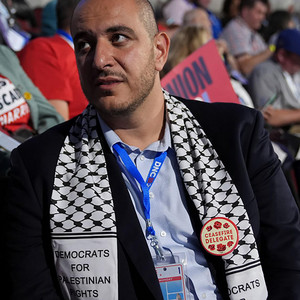
He's so tall with his kafia.
Everyone is standing.
He, of course, is standing.
For some reason, they really want to capture his reaction, if he has any, to the parents.
Watching him, watching them.
His face is expressionless, but wet.
Tears all over the room, as far as I can tell.
At the time the parents were speaking, there was good reason to assume their son Hirsch was still alive.
His death was announced almost a week after the convention.
One part of this speech, in particular, will hit a boss hard and know it.
There is a surplus of agony on all sides of the tragic conflict in the Middle East.
In a competition of pain, there are no winners.
In a Jewish tradition, we say, Kol adam olam kul o.
Every person is an entire universe.
We must save all these universes.
In an inflamed Middle East, we know the one thing that can most immediately release pressure and bring calm to the entire region.
A deal that brings this diverse group of 109 hostages home and ends the suffering of the innocent civilians in Gaza.
The parents leave the stage, followed by an inexplicable choice of music.
And just then, a boss kind of tears out of the convention hall, as best you can through incredibly crowded, narrow stairs, just makes a break for it.
I see him stop just outside the arena.
He's in this one weird quiet space just before the hallway outside.
He's alone, which he never is.
He covers his face and sobs hard into the wall.
Then he's basically running out through the doors of the venue, through throngs of people outside trying to talk to him, and he's rushing past them.
I see we're headed to the security gate.
We go through the security gate and we're on the street.
He doesn't look ready to talk, but I have to say something.
I just gotta ask you, why was that so hard?
Maybe I can collect myself and we could talk about it later.
What I was thinking about during the speech was, in our tradition, it's essentially if you harm or kill any one person, it's like you've harmed or killed all of humanity.
And that's what they spoke about from the stage, about every person being the universe.
In the Jewish tradition, I believe that.
I believe that with all my heart.
Yeah, exactly. Thank you.
I'm sorry. I'm feeling really hopeless.
I'm feeling hopeless.
I'm feeling like...
Of course we need to hear from these parents.
What about the palace?
What about the over 40 ,000 who've been killed, who've been obliterated.
The 40 ,000 universes.
It was an act of suppression of a giant part of this story.
I feel, I felt... I can only imagine what they must have been doing.
It must have been very lonely up there.
And I felt very lonely in that arena.
I gotta go somewhere.
I think at that moment, Abbas knew that was all that was gonna be said on the stage about the war in Gaza, from the people directly affected by the war.
I head back to the convention hall.
I see a bunch of other uncommitted delegates outside.
They're from all over, Hawaii, Washington state, Rhode Island.
Some are Arab American, but not all.
They got a text to come out and meet.
There's a weird empty feeling.
Nobody's talking much.
It seems like they're all just waiting for Abbas to come back.
There's a physical energy shift out here, a loss of power, a loss of relevance kind of in the air.
Like the opposite of an adrenaline surge.
A lonely exhale when the doors close behind you.
But just then, speaking of adrenaline, Abbas rushes back into the scene looking very intense.
He grabs me by the arm and pulls me into a bus shelter that's right in front of the arena so that I'll be able to hear him.
And he's speaking in this uncharacteristically quiet, angry way.
I'm an insider, okay?
People I'm making this ask of are people I know personally.
I've looked them in the face, and I've made a very reasonable ask for us not to be suppressed.
If you're not going to agree with us on policy, at least, at least, don't suppress our voices.
Okay? I think I've made a very reasonable ask.
And they called and said, the answer is no.
Point blank. The answer is no.
I said why, all that stuff.
They said, I was just told to tell you, the answer is no.
And so, I have no options left through the the way that I am told this is the way to make your voice heard.
You engage the system.
So that's what I got to do.
I got to step into my power as a regular everyday person.
I have no idea what that means.
And then Abbas turns and strides away.
Like, if he were wearing a cape, it would have swirled behind his body.
My co -reporter Ben is out here, of course, and he comes over to me.
I just talked to Waleed, he says.
One of the leaders and the unofficial press guy, for the uncommitted.
Waleed just told me that people have been calling Abbas to tell him to not say what he's about to say right now, but he won't be talked downward.
So whatever he's about to say, he's been told not to say.
Then Abbas calls people over for a press conference.
Alright, let's get started.
There's a huge mass of press, like five different mics it seems from Democracy Now Alone.
He asks for a moment of silence for all the lives that have been lost in the Gaza war.
A moment of silence.
He recaps the ask for the Palestinian speaker, recaps the no, and then he sits down on the sidewalk and whips out his phone in front of all the reporters.
And he calls a DNC official he's been talking to.
I got him. Hey, Roger, how are you?
We're at a press conference right outside.
Okay, we tried everything we can.
Okay, we're just asking to be heard.
We're asking for our voices not to be suppressed.
Roger, you know I'm someone who works within the system.
Okay. And the Vice President's decision to suppress us is unacceptable.
And so I've run out of options from my position as a delegate.
And so I'm leaning into my power as a regular everyday person and I'm sitting here.
And I'm not going anywhere, Roger.
I'm not going anywhere.
You all need to change your mind.
I hope you change your mind.
Call me if you change your mind.
Yeah, call me if you change your mind, Roger.
Thank you. Thank you.
Please pass it along.
Tell the Vice President that I'm sitting outside.
I'm not going anywhere.
I hope she changes her mind.
Thank you. Okay, I'm going to be sitting down right here.
I'm not going anywhere.
If any of my... If any of my uncommitted delegate siblings choose to sit down with me, please say your name, say who you are, and feel free to take a seat.
And also... Abbas pulled his whole community into this effort.
He drew tremendous attention to the Democratic Party's lack of interest in what mattered most to them.
Now he's drawing attention to a tremendous failure.
Is it his own? The Democratic Party's?
Either way, it's got to be crushing.
What follows is a long night.
Inside the convention center, Oprah speaks.
Tim Walz speaks. The whole thing is being broadcast on a big screen that hangs on the United Center wall, just behind the sit -in.
The screen keeps showing images of the crowd dancing and laughing and giving standing ovations.
But the press has noticed the sit -in.
And so are the Harris campaign.
At one point, Walid, the uncommitted press guy, comes over to us and says, can I tell you something?
Tell you all something?
Yeah. Every one of the DNC senior staff is standing right there and are trying to make a deal.
And the deal is not...
None of the proposals have anything to do with the speaker or policy change.
Walid motions at one of those outdoor bus shelters.
And sure enough, there's a clutch of people.
Two women, three men on their phones looking in our direction.
One of them was hitting a vape like a steam engine locomotive.
It was pretty funny, actually, watching them on their phone with people who were like 100 feet away.
What kind of deals are they?
They're like, I'm meeting with a campaign manager, I'm meeting with this person, I'm meeting with that person.
What about a meeting with Harris?
Would that be enough?
Not happening, they said.
So we said it's going to be a speaker.
They said no. Have you said why at all?
No. They said, how can we get this to end?
And I said, well, he wants a speaker.
And then they said, what else?
And I was like, an arms and bar.
And they're like, oh, that's not going to end.
So I was like, all right.
And then I'm like, exactly.
That's why we're asking for a speaker.
We've tried to make it easy.
And so they asked what's your plan after Thursday, after the convention's over.
And I was like, well, I think he's betting that you guys will be so embarrassed that you'll give a speaker.
And they're like, well, I mean, the other thing was like, they were like, well, she can't give in on the last day ever.
She can't let the last day of the convention be that she's been bullied by young activists and Arab Americans.
I was like, that was your decision to wait until the very last minute.
So they... I'd like to talk this through.
I mean, we are... I don't know.
They found themselves in this position.
Yeah. Can you picture how it ends at this point?
Or are you just as curious as us?
I think... I think we're going to get a speaker.
I think you can find us Palestinian -American who is palatable for the Democratic Party.
I mean, this was also like...
I told you this, but like several people called me and him to tell us not...
allies who've been standing with us, told us not to do this.
And they say why? Yeah.
That they thought it made us look fringe and small and...
Fringe and small. Not like organizers who could turn out 100 ,000 votes in a swing state.
We've reached out to the Harris campaign about why they didn't agree to a speaker.
They declined to do an interview.
Usually, when they talk about this issue, all they'll say is that they're working around the clock on a ceasefire.
But they were clearly doing some political calculations on this question around a speaker.
My best guess? They worry that agreeing to a speaker would risk controversy and turn off as many voters as it might appease, including Republicans they hope to win over.
Also, they might not feel like they need an endorsement from Uncommitted.
They feel like they'll be able to pick up a bunch of their voters anyway.
And they might be right about all that.
The sit -in goes all night without too much drama.
They keep sitting the next day.
In the August heat, it's tiring.
They look a little defeated at times.
They're getting a lot of press attention though, which is a small win for them.
Well, no, I move from...
In the evening, they give one last press conference.
They end the sit -in, and they head back inside the convention.
Help me singing out nice and loud, y 'all ready to keep down the party, let me one time, DMC say!
Why are you crying?
It's not a Minutia party.
The party is winding down.
Kamala Harris speaks, and then the convention is over.
We head outside while people are streaming out of the United Center.
They're carrying giant signs that say Kamala, and are popping balloons on the street.
The boss has barely slept in days, but he's still standing.
He's in a bind at this point.
He came here with leverage sent by a voting bloc in a swing state.
He said they could be convinced to turn out for Harris if the Harris campaign gave them something in return.
But what did they give them?
No policy change, no speaker.
There's a big risk that these voters could be left even angrier or more hurt or more unheard than they were before.
Amidst the celebrating from the DNC faithful, a number of people come up to a boss, many of them wearing catheas, which have emerged as a sort of visual symbol in support of a ceasefire, to thank him, to embrace, to tell him to keep up the fight.
And then a woman dressed in all white comes up.
A boss tells us she's a friend.
She's Arab American, a friend from Capitol Hill, and she didn't want us to use her name.
She's an aide to a Democratic member of Congress.
And if we don't succeed, Trump, he's going to destroy the entire military class.
They have so offended our people.
They have so offended our people.
Our people being people for whom Gaza is a top policy issue.
They have so offended them that in my opinion, the people who we're inspiring, we're animating, we're motivating, are so pissed off, are so pissed off by 16 ,000 children dead and not have that mentioned from the stage, that this is like they're like, I don't want anything to do with any of us.
I don't even want to vote.
Boss, we don't want that.
Boss, we don't want that.
We can't have people think that.
People have to come up.
You've got to give them something to vote for.
I'm sorry. We know what to not vote for.
Staying inside is like...
And I know with Trump, he's going to fuck us over.
There's no Palestinian anymore.
The entire Middle East is done.
We're done. Yes. Create this movement.
Create this platform for us.
Give us this national recognition of the platform, which this has done.
But we can't have people not go out and vote.
There needs to be a ...
What I'm telling you is unless we intervene, those people aren't going to go out and vote right now.
If the election was tomorrow, they're not convinced that Trump is going to be different on this issue.
No, but he will be.
I know. Boss, he will be.
But this movement has a responsibility to make sure our people know.
We can't have Trump.
Okay. I'm a million percent with you.
But if our people can't get what we want and we're used to that, we still have to go out and vote.
And we try again next election cycle.
We keep trying. But we can't have Trump win.
And you've got to make sure you love this.
You've loved this amazing, beautiful movement.
You created this. I'm doing everything that I can.
I know. I know how to do that.
And that includes, necessarily, like having the tough conversations about Trump.
I mean, you, come spend some time with me in Michigan and hear about how people are talking about Trump.
Now Abbas has to go home to Michigan, Dearborn, and have the hard conversations.
He wants Harris to win.
He convinced a lot of people to vote uncommitted so they could nudge her position on Gaza and Israel.
They didn't succeed at that.
How can he possibly get them to vote for Harris when he's coming back empty -handed?
Zoe Chase and Ben Terrace.
We go to Michigan in a minute.
Chicago Public Radio.
When our program continues.
This is American Life from Ira Glass.
Today's show, A Little Bit of Power.
Ben Terrace and Zoe Chase now continue the story about Abbas Alawiyyah and his block of uncommitted voters.
They pick up the story three weeks after the Democratic National Convention.
It's now mid -September.
Abbas and other uncommitted leaders organize a community meeting in Michigan.
Remember, Abbas helped convince 100 ,000 Michigan voters to check the box for uncommitted in the primary.
Now, if they don't flip back and vote Democratic, it could really determine the results in Michigan.
And without Michigan, Harris could really lose.
That little bit of power it felt like they had back in February has not gotten them an arms embargo, a ceasefire, any suggestion of a policy change from Kamala Harris, or even a speaker on the stage of the Democratic National Convention.
Still, Abbas and the uncommitted leadership need to deliver some kind of guidance about what to do to these same voters.
So we're in Dearborn, where this movement began in the first place.
Many people here have family in the Middle East and lots, like Abbas, in Lebanon, which has been bombed and invaded by Israeli ground forces.
The day we arrive is just before that.
It's the day a bunch of pagers exploded all over Lebanon in an Israeli attack that killed dozens of people and injured thousands.
Abbas's phone is flooded with messages from his family in Lebanon who are really frightened.
Even people in Dearborn seem freaked out by their phones.
Abbas has this dread hanging over him of what's to come.
Before the meeting, we meet Abbas at the coffee shop in town.
He calls the office.
He's scrolling through his laptop through the statement he's gonna read.
Are you nervous at all going into tonight?
I didn't think I was, and then I felt like I was gonna throw up earlier, and I don't know if it was related to this, but it might have been.
I think it might have been.
This is a tough crowd he's about to face.
It's a bunch of people who are gonna render a verdict on what he's been doing, and he's balancing a lot at once.
He does still want people to vote for Harris, but uncommitted promised they wouldn't mobilize to get out the vote operations for Harris without getting something from the campaign.
Later that evening, Abbas joins uncommitted voters and organizers at this huge Islamic community center in town.
It's got tiled floors.
It's very echoey. Chairs are set up in rows facing a panel of speakers.
It definitely does not have a cozy vibe.
It does not feel like it's set up for a discussion.
Maybe 50 people show up.
They're primarily older Arab men from the area, and it feels a bit like a meeting of the dads.
The organizers sit at a long table with microphones and talk for a while about what they have accomplished and how they got here.
And finally, they talk about what's next.
Abbas delivers uncommitted's official word.
At this time, our movement, number one, cannot endorse Vice President Harris.
We've been very clear that the word endorse is a very specific thing.
It means our organization that did 1 .5 million voter contacts that proactively reached out to people and told them to vote uncommitted, we had said very clearly publicly, publicly to our community and to the vice president's team, if you change your policy, we will endorse.
And endorsing means we'll get out the vote for Vice President Harris.
Her campaign made it impossible for us to endorse.
Now, that might mean that some of us still vote for Kamala Harris.
Some of us vote against her.
Some of us might not vote at the top of the ticket.
And that's the conversation we want to invite.
But an endorsement would mean us mobilizing.
Number two, we oppose a Donald Trump presidency, whose agenda includes plans to accelerate the killing in Gaza while intensifying the suppression of anti -war organizing.
And number three, we are not recommending a third party vote in the presidential election, especially as a third party vote in key swing states like Michigan could help inadvertently deliver a Trump presidency, given our country's broken electoral college system.
Okay, so that's what the statement says.
And I wanted to make sure that you all hear it.
Huh? The feeling in the room is, people are confused.
This muddled statement, which does not endorse Harris but seems to be telling them to vote for her anyway, and definitely do not vote for Trump or third party.
When it's finally time for questions, many hands go up.
An early question is about strategy.
Are we throwing away the power of our voting bloc by not recommending one person for us all to vote for?
The second thing is, why don't we, I know the third party is not viable, but is it better than we put our vote there so we can count them, the percentage at least, we can say that one percent, two percent, three percent, especially in our community in Michigan.
Abbas is pretty mad about the way the Green Party has been talking to voters in this part of the state, and he jumps in.
I wanted to take a moment specifically to address the third party question because I know it's a question that folks might have.
My concern is with any candidate that comes to our community and says things like, I have a shot at winning, and if you vote for Trump or for Harris, you endorse the genocide, and the only way not to endorse the genocide is to vote for me.
I am very concerned about that.
They get asked about a third party over and over again.
Jill Stein, the Green Party.
She says no more war, we're gonna stop Israel.
And she's been making a real play in this area, Southern Michigan, committing to no more war specifically.
And another thing people are asking, Democrats need to learn to listen to us.
How else will they listen if we don't withhold our vote from them?
Some people at the meeting are sick of listening to Abbas altogether.
And I'm voting my conscience as a position which needs no genocide.
I'm voting my conscience as a physician, which means no genocide, he says.
Thank you, thank you so much.
We're gonna do one more comment over here.
The meeting ends pretty abruptly, but no one leaves.
People stay, trying to talk to Abbas and the other organizers.
They have a lot of feedback.
Remember, most of these guys voted uncommitted in the primary.
Some of them volunteered, organized, phone -banked.
Like this guy, Amin Hashmi, who's one of many swarming Abbas after the meeting is over.
He's considering voting for Trump.
True, true. Let's see what, if he comes up openly and says something instead of private, let's see if he does that.
If he does that, I would vote for Trump, man.
I wouldn't recommend it.
I think he's a bad guy.
But what else do you have?
I mean, they have not changed their position.
Neither has not moved.
It's going to be one or the other.
And under Trump, it would be a lot worse in my opinion.
How would you change the common law?
I mean, it's not done 10 months, didn't do anything.
What study do you have left?
I think our... We have only four weeks left.
And here's what I...
No, no. I'm not hoping I'm organizing.
Okay, because here's what we've been doing in the meantime.
What happened with DNC?
It's a shame for us, man.
I'm telling you. I felt bad for you, sitting outside, like in camping outside.
I mean, this is nonsense.
Doesn't look good. And it's already showing their neck -to -neck right now, right?
All the polls are showing it's back and forth swinging, right?
Three or four states.
So it's already there.
Why she's not feeling the pain?
Why she doesn't want White House?
What is her strategy?
Who's telling her behind that, no, it's okay.
You can live without Muslims or Arab votes.
Let's keep the conversation going.
Great to see you. Abbas knows pretty much everyone in this room.
And some, for sure, are offering their support.
Like, nice job. I get the feeling that most of these guys, though, are thinking like this voter Rafat Deke.
He's Lebanese, lived in Dearborn for 40 years now, and he's not convinced.
I am both in third party.
I'm not part of third party.
I'm not the green, but I'm a Democrat.
But if I want to vote my conscience this time without political calculations...
I mean, I don't mean to say the most obvious thing.
I just want to know what you think.
Like, Michigan went to Trump 2016 by 10 ,000 votes.
If you vote third party, you're not voting for Harris.
So, you're taking a vote away from Harris.
That's their problem, not mine.
As a boss heads for the door, people are still coming up to him, making the case for voting third party.
One uncommitted leader I talked to worried that maybe this whole thing had backfired.
That by making it so visible that the Democrats weren't listening by asking so publicly for a speaker and then not getting it, they lost more votes for Harris.
Like, who's going to support a party that humiliated us like that?
I asked a boss about this.
And so it's arguable that maybe people got more turned off by the Democratic Party because of that whole thing.
And do you think about that?
And how do you think about it?
Yeah, I do think about it.
And I think that's why the Democratic Party shouldn't continue engaging in this kind of discrimination.
But you don't think that it turned it possibly turned off more voters?
I mean, I think it's possible that it turned off more voters.
That's why the Democratic Party shouldn't have made that decision.
But it never makes you question your tactics.
I didn't make that decision.
So I don't think they should have done it.
For me, as someone who experienced the discrimination, I don't think it's appropriate for me to be asked and for our group to be asked.
But don't you think that you shouldn't have put the person who discriminated, the group that discriminated against you in a position to discriminate against you?
I don't think that's a fair thing to ask of us.
Abbas had hoped that the uncommitted movement would be out now, making calls, knocking on doors, mobilizing people like they did in the primary.
But for Harris this time, that's not happening.
He figures the best thing he can do with the time left is talk to people, person by person, in his life, to convince people not to vote for Trump or for a third party.
One of those people is his own dad.
He was at that community meeting and still isn't sure how he's going to vote.
We meet up with his dad at his warehouse in town.
He is in sales, not car sales though.
Abbas was trying to convince him.
It's two options. One of them is going to be president, so we have to vote against Trump and for Harris.
Like that's how I feel about it.
But do you think that resonates?
Do you think people are going to understand that?
Abbas, even me, huh?
You know how much I love you, huh?
You know, and even if you want blood, huh?
I will give you my blood.
But for this one, I'm not convinced to give her my voice.
I'm not convinced. Do you think if she moves before November 5th, you might?
If she gives? We will give.
But if she wants only to take, we are not going to give.
That's it. You stand with my people, I will give you my vote.
You stand against my people, you are not going to see my vote.
That's it. Easy. Well, we'll keep talking, Bob.
You know, Abbas is one of our leaders that we are so proud of him, huh?
And not as a dad, but as a community.
And because we are proud of him, we don't want him to fall in a hole, huh?
In losing his principles.
Do you think me voting for Harris means I'm losing my principles?
For right now, I'm not happy with that, that's what I want to say.
Conversations like that have only gotten harder to have.
The war in Lebanon has escalated.
It all feels very close to home in Dearborn.
Abbas was recently at the funeral of a friend's father who was killed in Lebanon.
Honestly, every day feels like a funeral, some people told us.
People are so upset and so consumed by what's happening overseas.
It really doesn't feel like a time to have these difficult conversations about the presidential election.
Still, the polls in Michigan continue to be incredibly close.
The Harris campaign has made some attempts to reach out to Arab and Muslim voters recently.
VP Dominique Tim Walz met with a Muslim political organization, which endorsed Harris.
A group of 25 imams threw their support behind Harris, saying in an open letter that she represents, the best option for ending the bloodshed in Gaza and now Lebanon.
One uncommitted organizer told us, listen, it's just too late to change minds.
People she's talking to are sure.
They will not be supporting Kamala Harris, no matter what she does.
Abbas was not impressed by those gestures from the Harris campaign.
He said, that is an insular, limited, and woefully inadequate approach.
That does not do much of anything to persuade people.
Ben Terras with Zoe Chase.
Zoe is a producer on our show.
Ben is a political reporter for The Washington Post and the author of the book The Big Break, The Gamblers, Party Animals, and True Believers, trying to win Washington while America loses its mind.
The world is on the rise.
Let's move to higher ground.
There's nothing left to spend.
Why don't we buckle down?
Cause nothing's ever fair.
A dream that never was.
A open letter of prayer.
People should just regard it as our future is in stone.
Like in another chance.
I'll bow my head down, walking on a plane.
I'll keep on trying to give a living.
To step out in the cold.
A dozen kills you, makes you strong.
You got to take a risk.
My moves are getting bold.
Keep pushing just to lay it all open.
Our program is produced today by Lilly Sullivan.
The people put together today's show include Jidahi Bons, Sean Cole, Michael Comite, Valerie Kipnis, Henry Varson, Turbin Lowe, Catherine Maymondo, Stone Nelson, Nadi Ariman, Ryan Romery, Aixrice Kanderajo, Gars Darcheski, Francis Swanson, Christopher Sertala, Matt Tierney, Nancy Updike, Julie Whitaker,
and Diane Wu. Our managing editor, Sara Abdur -Raman, our senior editors, David Kestembaum, our executive editors, Emmanuel Berry.
Special thanks today to Asma Mohammed, Leila Elabad, Lexie Zidane, Abbas Alhaj Ahmed, Saul Levin, Jeremiah Ellison, Bernie Porne, Reemah Mohammed, Bilal Baidoon, Jordan Acker, the Washington Post Style Section, and the Post Reports Podcast.
Our website, thisamericanlife .org, where you can stream our archive of over 800 episodes for absolutely free.
This American Life is a little bit of public radio stations by PRX, the Public Radio Exchange.
Thanks as always to our program's co -founder, Mr.
Tori Malatia. Got a Rolex the other day.
All he does now is party with his new Rolex friends.
Overnight, an extremely unusual watch party.
Amira Glass. Back next week with more stories of this American life.
Next week on the podcast of This American Life.
This is a case of Henry D.
Number C. Parole board hearings are this weird backwater of the judicial system.
It doesn't get a lot of scrutiny.
Next week we listen in, as board members discuss one case, we see people get persuaded as they try to adjudicate these very squishy, nearly impossible questions, like when is a person rehabilitated?
What is justice? That's next week on the podcast from your local public radio station.