Raise your hand if you want your nails to look perfect all the time.
Me too.
I'm Sarah Gibson Tuttle, the founder of Olive and June, and this is exactly why we created the Gel Manny system.
We wanted to make it possible for everyone everywhere, to give themselves a beautiful manicure at home with our tools and our gel polish that lasts up to 21 days.
Each manicure with our system comes out to just $2.
That's right, $2.
No more 60 70, 80 salon trips that take.
Now you can paint your nails on your time and love them more than ever.
And, by the way, when people ask you where you got your nails done, you're going to proudly brag that you did them yourself.
And here's a little something extra.
Head over to OliveandJune.com and get 20% off your first gel mani system with code DIYGEL20.
That's code DIYGEL20 for 20% off your first mani system at OliveandJune.com slash DIYGEL20.
Hey, I'm Paige DeSorbo, and I'm always thinking about underwear.
I'm Hannah Berner, and I'm also thinking about underwear, but I prefer full coverage.
I like to call them my granny panties.
Actually, I never think about underwear.
That's the magic of Tommy John.
Same.
They're so light and so comfy, and if it's not comfortable, I'm not wearing it.
And the bras, soft, supportive, and actually breathable.
Yes, Lord knows the girls need to breathe.
Also, I need my PJs to breathe and be buttery, soft and stretchy enough for my dramatic tossing and turning at night.
That's why I live in my Tommy John pajamas.
Plus, they're so cute because they fit perfectly.
Put yourself on to Tommy John.
Upgrade your drawer with Tommy John.
Save 25% for a limited time at TommyJohn.com slash comfort.
See site for details.
You're listening to Luke's English Podcast.
For more information, visit TeacherLuke.co.uk.
Hello, listeners.
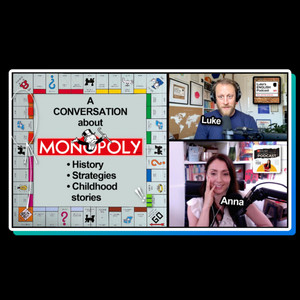
Today on the podcast, I'm joined again by Anna Tyree from English Like a Native.
And we're going to have a conversation all about Monopoly.
Yes, Monopoly, the board game that you probably played as a child with your family.
The game that always takes ages and usually ends in a big family argument.
I actually think this game is fascinating.
We're going to talk all about it, including childhood memories, the rules of the game strategies, the economics of it, the surprising history of Monopoly and some fun facts that you might not know about this game.
So, listeners, you know Monopoly, right?
Do you know it?
I don't know.
Maybe you don't.
Maybe some of you are out there going, what's that?
It's Monopoly, most of you should know.
It's that game where you go around a board buying and trading properties, constructing houses and hotels, in order to make as much money as possible from your competitors, who are probably other members of your family who have to pay rent every time they land on one of your properties.
The aim of the game is to completely dominate the market, so that all the other players go bankrupt and you take all the money, ultimately achieving the status of a monopoly, the one who has total market domination.
And when that happens, you win and everyone else hates you.
Monopoly is sold in more than 114 countries and has been printed in more than 47 languages, so there's a good chance that you know it.
But still, I expect that some of you out there in podcast land have never really played it.
And I suppose that some of you have never even heard of it.
Well, you're going to find out all about it today.
And even if you are an experienced and hardened Monopoly player, hopefully you will still learn a thing or two from this episode.
So, yeah, Monopoly is a board game in the English speaking world.
It's one of the most well-known and successful board games, along with other classics such as Trivial Pursuit Cluedo Scrabble Taboo, Pictionary and, of course Chess, Backgammon and Drafts, to name but a few.
And listeners.
Anna and I are actually going to record an episode all about board games in general for Anna's podcast.
We're going to do that after this recording.
And we're going to talk about classic board games, our memories of playing board games, possibly using board games to learn English.
So that will be available on Anna's podcast at some time, an episode all about board games in general.
But here for my show, we're focusing exclusively on Monopoly.
Monopoly.
There are loads of different versions of this game for different cities in different countries.
In fact, there are over 300 different versions of Monopoly based on different themes like, for example, Game of Thrones Monopoly, Star Wars Monopoly and Pokemon Monopoly, and lots more.
There is actually a lot to talk about here.
Sure, it can be a frustrating game, but it is certainly one of the most enduring board games in the world.
And also, it is fascinating.
So let's have a good long conversation about Monopoly.
All right, Anna.
Hello.
All right.
Hello.
Nice to see you again.
Still awake after that introduction.
Yeah, you did monopolize the introduction, I noticed.
Very good.
Yeah, I did.
I did monopolize the introduction.
Yeah, monopoly.
Maybe we should explore, first of all, what the word monopoly means.
You can have a monopoly and you can monopolize something as well, can't you?
Well, mono means one, right?
So I think that kind of root helps to explain the word.
So if you are monopolizing something, you are the one that's just taking over and dominating.
So you monopolize a conversation or you monopolize the company, monopolize the guests.
It's a tongue twister.
Monopolize the conversation.
That is a good one.
There's always one person in a party or something who dominates the conversation.
No one else gets the chance to say anything.
Yeah, I monopolized the podcast right at the beginning there with an introduction.
But also in sort of in terms of economics.
And finance and society.
You can have a monopoly, which would be a company or a person who dominates the market, not allowing any competitors to come in and compete with similar services.
Generally, monopolies are not allowed.
They're prevented by different types of laws and things in theory.
But anyway, but how are you anyway, Anna?
Yeah, I'm good.
I'm good.
I was telling you just before this podcast that my boys are now sleeping through the night.
So, you know, that makes life completely different.
You can see life in a completely different way when you've actually had some sleep and you're not a zombie.
And it's also summertime and that always makes everything fantastic, apart from the torrential rain.
I was working out in the garden uh, about yesterday, the day before, because we have a like a i think we call it like a gazebo.
It's a built wooden, it's just a roof, there's no walls and it's surrounded by a pond.
Uh, it's really lovely.
This is not your house, this is.
This is in our garden, our garden, we in your garden, right?
Yeah, during lockdown, we decided to rip out the entire garden, design exactly what we'd like.
And so we had this space that's like a dining room.
So we divided the garden into spaces or rooms and decided the function for each space in the garden.
So we used it.
And we have this gazebo, a wooden, beautiful wooden gazebo, which has this deep pond that runs all the way around it and a little fountain at the side.
So it's got the sound of running water.
And we are supposed to use it as a dining room, but I can use it as an office with my laptop on warm days.
And I'm sat there working away in the lovely sunshine and then suddenly thunder, lightning and just absolute torrential rain.
It's like this is both wonderful and bizarre.
Yeah, welcome to england in the summer, where you can have sunshine, but it's not going to last that long.
Yeah, normally gets interrupted by a shower at some point, which is quite, which is nice though, anna.
That is because because, if you know, just in some places, just it's just perpetual.
It's the sun just blasting down constantly, and after a couple of days, that's.
You know, you get the two days of that.
It's like oh, this is nice, sunny all the time, and then, and then after three days, you're like dying.
It's a survival situation, oppressive heat.
So anyway, monopoly.
Now i should give you credit for this topic, because you came up with this idea And it's a great idea.
You did contact me and say, why don't we do an episode about Monopoly?
And I was like, all right, wow, random, but great.
Yeah, I love Monopoly.
Tell me about Monopoly and you.
Do you actually like Monopoly?
I do and I don't.
I used to love Monopoly when I was younger, when my family was smaller, when it was my mum and three kids, and it was simple.
And when I played Monopoly, it was with more adults than children.
And then the family grew when we became seven children.
I was one of seven children.
And Monopoly then was more about me playing with my younger siblings.
Then it wasn't fun.
Why not?
Not at all.
Well, you know, they can't all play very well.
Some of them just cheat the whole time.
You know, so you're basically babysitting as the eldest of seven.
You're just babysitting them.
Yeah.
It's a complex game for the young kids.
Yeah.
And yeah, they're just going to want to pick up the houses and hotels and eat them and...
Yeah.
And then you have to wait for it to come through.
Right.
Exactly.
Yeah.
And they're going to rip up the money and eat that.
And, you know, yeah.
Yeah.
It's too complicated.
Do you still play Monopoly today at all?
So I haven't played for quite a few years being a mum of younger ones.
But I'm sure in about two years time my youngest will be an age where we can play to reasonably sit down and start playing the more serious board games like Monopoly, and that will be the time to introduce it.
So I have played a few times as an adult with friends and family.
It's one of those games that you bring out over dinner well, not over dinner, but after you've eaten dinner um, as a kind of social uh experience.
You know time to switch off the the phones and the screens and interact with one another while also um bankrupting one another.
Uh yeah, how about you?
I absolutely love Monopoly.
I played it as a kid as well like you and never really had a satisfying game of Monopoly as a child.
It would always basically fall apart after probably about 30 minutes um, and i was never able to sustain a game of monopoly with my friends or my brother and our cousins and stuff.
It would always just, you know, the bits would always the things would always get very messy and we'd lose concentration.
But now these days um, we play monopoly quite a lot with my parents, so when my wife and i go back home for christmas or for holidays or whatever, we monopoly is definitely one of the games we play in the evenings and actually it's like a tradition.
Yeah, it's going to become a tradition.
Yeah.
And we've had a Monopoly set at my parents' house for years.
It's been there for as long as I remember.
It's one of the old.
It's like a vintage Monopoly set that it's still, you know, cardboard box, but it's, the box has survived.
You know, it's been looked after fairly well.
Tape on the corners?
No tape.
No sellotape on the corners.
Amazingly enough.
So it's in one piece and all of the cards and the pieces and everything is still there, still intact.
So we're still using that old board even today.
And I love Monopoly these days.
I absolutely love it.
I've got beyond the point where I find it frustrating.
And I've got beyond the point because you know, now I'm so old and mature and so wise Anna, that I now have just decided to enjoy it, whatever happens.
And so there was a time when I'd get really kind of put out and really annoyed if I wasn't winning or if I lost all my money and went bankrupt.
I'd be really upset about it.
You're a sore loser, are you?
Yeah, a little bit.
Yeah.
I mean, I try not to be, but there's no, there was no escaping the fact that it just doesn't.
It's just something really unpleasant about that.
But these days, I've decided to be more Zen-like about it.
And just to, you know, if my mother... wins, then I'll be happy for my mum.
If my dad wins, sure, he'll be smug about it, but I'll just let him enjoy his smugness.
And equally.
If I win, then I try not to gloat about it too much and instead just try and enjoy the game for what it is.
But I find it fascinating for lots of different reasons, which we will probably be discussing in a Like.
For example, I think it's a pretty good game on balance, in terms of the way it's designed.
It's a decent game.
The rules are pretty well balanced.
I mean, it's not just luck.
Some games are just the roll of the dice.
Some card games are basically just luck.
It's a mix of some luck and some strategy, which you can apply in lots of different ways.
And it is quite well balanced in the sense that It's possible to win in various different ways.
You might be losing at one point, but then you can find a way of turning it around.
It's not too complex.
Some board games are ridiculously overcomplicated and I just can't deal with them.
Something like Risk or even Chess.
I'm not quite intelligent enough to really be able to do Chess.
We'll talk about that in your episode, I think.
It's very satisfying when you win money.
There's no denying it.
It's very satisfying when you get properties and you win money.
There's a certain sense of realism to it.
There's a level of realism in the economics of how the game works.
I do think that it could be modernised.
I was thinking about this earlier today.
You know, when you get a property I don't know if you're going to go into this more later, but when you buy a property, then you get to a point where you can build houses on it.
And then when you have so many houses, you can build a hotel.
But at no point do you say OK.
Well, now I'm going to do an extension on my house or build a studio in the garden, which everyone is doing these days.
And I think there is room to modernise the, the original game, bring it more into real life.
People don't move house anymore, they just extend on the house that they've got.
You know yeah, they'd be interesting to tweak the game in various ways.
Um, you know, instead of yeah, like you could choose the ways in which you maybe develop the properties that you've bought, or something like that.
It'd be interesting to see how that changed the whole dynamic of the game.
Like tweaking it in certain ways, turn it into an airbnb Yeah, what would happen there?
It's such a diverse economy that we live in these days compared to, well, I don't know.
I don't really know about economics, but yeah, that would be interesting.
And I just, I mean, I suppose you play the London version of the game, do you?
Yeah yeah, with Pall Mall and Trafalgar Square and Oh, what's the brown one, the first one that you land on.
That's like 60 Old Kent Road.
Old Kent Road, yeah.
We should probably go... We're going to go round the board in a moment.
But yeah, so the London version there'll be like versions of.
You know, the original version is set in a city called Atlantic City in the United States.
I think it's in Georgia, I think.
But, yeah, I love playing the London version because...
You know it's sort of I quite like the atmosphere of London and looking at all the different place names and just the sort of the whole London vibe of it.
Gives you nostalgia, does it?
Yeah, a bit of nostalgia from the days when I was living in London and sort of quite evocative of London stuff.
Is there a French version, a Paris version?
Absolutely.
Yeah, we've got the Parisian version at home.
A kind of a wooden set.
It's in a wooden box with wooden houses and wooden hotels.
And yeah, of course, all the street names are all Parisian addresses.
Can you name a few?
There's Rue Lafayette.
There's Avenue Champs-Élysées.
What else?
There's loads.
Pigalle, which is near to where we live.
Fantastic.
Can you build an Eiffel Tower?
Unfortunately not.
No, there's no like house, hotel, Eiffel Tower.
No, it's just house and hotel.
Actually, interesting point that in the London version, there's no Buckingham Palace.
There's no Big Ben.
And in the Eiffel Tower version, in the Paris version, there's no Eiffel Tower in there.
As far as I remember.
Yeah.
So should we talk about the basics of the game?
What's in the box?
Imagine if you open the box, Anna, what's inside?
Well, you've got your little metal pieces, at least in the one that I had your characters, which I think have changed over the years.
A dice, dice die.
Ah, dice or die.
Hmm.
It's actually two.
You actually have two in the box.
We play with two, which is a crucial part of the game.
So it's two dice, but it's actually one die.
So in terms of vocabulary, yeah, we do say one die, but two dice, little cubes with numbers on.
Yeah.
I did just look this up because I remember we popped it in the notes, die dice, because it is always something that always makes me hesitate.
Like, oh, is it die?
Is it dice?
Which one's which?
And actually now apparently don't quote me on this but in the dictionary in British English dice is acceptable for singular and plural.
Yeah.
Because this is one of those things that people will quite happily correct you on.
It's like a common mistake that, let's say, native English speakers make.
That they'll say, can you pass me the dice?
And you're just talking about one.
And someone at the table will go, actually, it's die.
Die is the singular and the plural is dice.
So, yeah, I can pass you the die, if you like.
And you're like, you smartass.
Yeah.
But yeah, I guess people have used dice, technically the plural word, for the singular version so often now that it's become acceptable because this is how it works if you're a native English speaker.
Make the mistake enough times, it just becomes correct.
Slowly making our lives easier.
So yes, you've got a pair of dice or two dice, if you like, or yeah, so two dice and the tokens.
Oh yes, tokens.
That's the word I was looking for.
The little characters are the tokens.
Yeah.
And then... Which token did you always used to pick?
So I never wanted to be the boot.
I never wanted to be the boot because, like it was, it looked like an old boot with the kind of sides flap toed.
It had.
Like you know, it was just like an old leather boot and you don't want to be the old boots, like an old leather, smelly.
I assume it was smelly.
Um, I just didn't want to be the boot, but I was always.
You know, it was always kind of forced on me because you know my mom and my grandma, whoever else was playing would always get the first pick.
Um, and so if I could, I would take the racing car or the dog.
Um, what about you?
They have.
Some have been taken away and some introduced.
Yeah.
So in the average Monopoly set, there might be a top hat, a thimble.
Do you have any thimbles in your house?
Not at the moment.
No, maybe we do, actually.
We do have a set of needles and thread.
And so there might be a thimble in there.
I don't know.
I haven't checked recently.
What is a thimble?
That's what some people are wondering right now.
Do you want to try and explain that one?
So a thimble is like a little metal cup or a tiny little hat for your finger that protects your finger from being stabbed with a needle or a pin if you're doing any kind of needlework.
I did used to have a thimble in my sewing kit, but I don't think I have one anymore.
And I imagine that these items maybe they represented something in the original game, but I think it's more like they were just household items, things that you'd find around the house to play as your piece.
I suppose so, yes.
I don't really know the origin of those pieces yet.
It's a bit random, isn't it, to have a top hat and a dog and a thimble.
I mean, your theory works with the thimble, but I don't know if that many people have a tiny metal dog lying around their house.
Well, no, but you, like, use the dog.
The actual dog.
Like, sit.
Sit, Fido.
Say, that's my space.
Yeah, I suppose so.
There used to be an iron as well.
The old iron used to be one of the pieces.
An iron?
Well, again, what's that?
What's an iron?
What's an iron?
Or iron?
That's how it's spelled.
Yes.
But it's actually pronounced iron.
Yeah, commonly mispronounced iron for ironing clothes.
I don't use mine anymore, really.
No?
I guess you do because you're a fella and I guess you have to wear a shirt for work.
Yes.
So when I when I go to work twice a week, I do have to iron a shirt.
Yeah, you have to look respectable.
Yeah, I mean, I could look I could look unrespectable, disrespectful, no, unrespectable.
I could I could turn up in a creased shirt.
I don't think I'd lose my job.
I don't think they can fire me for that.
Sorry, Luke.
It's the third time in two months now that you've come without ironing your shirt.
We're going to have to let you go because you can't fire someone like that in France.
It's too difficult now.
There's too many laws that protect employees and they wouldn't stand a chance in court for that one.
Not that people in France don't iron their shirts.
Quite the opposite.
People are very well turned out.
Yes.
Generally in this city, certainly.
But an iron, yes.
So if you want to look presentable, if you want your shirt to have no creases in it, then you'll need to iron the shirt before you, preferably before you put it on.
Don't iron it when it's on you, because you will burn yourself.
Um, so it's a nice little phrase as well, isn't it?
To iron out the creases.
You say oh let's, we need to iron out the details.
Yeah, which is to um, just remove any doubts and honing on the tiny little details of a deal.
Perhaps you iron out the details If you're trying to write a contract or something.
You would iron out certain details, meaning sort of agree to them, make the whole thing smooth.
Exactly.
So it's an idiom that you can apply to other things as well, as just, you know, making your shirts look flat.
Yeah.
It's to perfect, isn't it?
To perfect and flatten.
Yeah.
I guess.
Yeah, yeah, exactly.
So the top hat, the thimble, the iron, the shoe, as you said, or the boot, the battleship, which in our version was like a little ferry, not a battleship.
It's like a little ferry that might take you across a lake or something, or a pleasure boat, something like that.
And a cannon as well.
Yeah.
Like a sort of, I guess, 17th or 18th century old fashioned cannon.
Yeah.
And a sports car and a dog as well.
So I would go for the sports car, of course, you know, because I'm a boy and I want the car.
And so it was always a battle, a race to get to the sports car between my brother and me.
And if I didn't get the sports car, I'd probably go for the boat.
And if I couldn't get the boat, then I'd have the dog, you know.
These days, I really don't care what I have at all, obviously, because I'm 46 years old.
And, you know, you get a certain amount of perspective at this age.
Absolutely.
And choosing the right piece is suddenly not so important anymore.
Happy to be anything.
Yeah.
Yeah, that's right.
What else?
What else is in the box?
You have cards.
I think you have two sets of cards.
Chance cards and community chest community chest yes yeah okay, you know what.
We're going to come back to them, because first we need to talk about the board.
Yes, all right now, this episode is going to be long.
You can just smell it, can't you?
But we also haven't mentioned that.
The money, and that's the important thing, you've got all the money yeah, in the book, in the box, loads of it, Loads.
Beautiful colours.
Like, why do we not have money that colour in... Well, I mean, maybe you do in other countries.
You do in other countries.
In the UK, they're quite bland when it comes to colour.
Yes, the colour of the money in Monopoly is nice.
So it's kind of like the 500... Let's refer to them as pounds, just easier.
£500 is a nice pink, salmon pink colour.
The £100 note is a sort of a rusty orange colour.
The 50 is an off-white.
And the board itself is obviously square.
Do we need to describe what the board looks like?
Do you think we need to do that?
I don't know.
It folds in half.
It's got a big fold down the middle.
Or is it in quarters?
No, you'll know because you've got your pristine set that you use at Christmas.
It depends.
So the original one that we have at my parents' house folds down the middle.
But the French version that we've got neatly folds into four and is easier to store in a cupboard.
It takes up less space as a result.
Yeah.
But yeah, I mean, the board is quite pleasing.
I like the fact that it's square.
And one of the interesting things about it the way it works is that you just keep going round and round and round.
Unlike some board games where it's just kind of like a start and then a finish.
With Monopoly, you're just constantly going round and round and round, which is quite a good thing feature, I think.
So, you know, starting with Go, then you've got like the two brown, the cheap brown properties.
Every side of the board has a community chest and a chance spot.
We'll talk about them in a minute.
There's a station in the middle of every side, a train station in the British version.
Do you remember which stations they are, Anna?
King's Cross.
King's Cross.
Do you know?
I don't.
I don't remember any of them.
King's Cross is the first one.
Then the next one is Marleybone Station.
Marleybone Station.
Piccadilly?
No.
Well, the Fenchurch Street Station, which is a slightly obscure one.
It's not one of the sort of major train stations in London.
And that's on the first road, isn't it?
After the brown, cheaper properties.
No, the first one is King's Cross.
Right. followed by Marleybone on the sort of pink and orange side.
Then between the reds and the yellows, you've got Fenchurch Street.
Right.
And then between the greens and the dark blues, you've got Liverpool Street Station.
Yes, of course.
Which is in the east of London.
OK.
And you also have the utilities as well, the electric company and the waterworks.
Yes.
OK.
Okay.
So you kind of, you know, you roll the dice, you move your piece along.
If you land on a property, you have the option to buy it.
If you land on a station, you can buy it.
If you land on a utility, you can buy it.
There are other things.
If you land on a community chest or chance, you have to pick up a card and basically you're going to win some money or lose some money or do something like move your piece somewhere.
You also have the jail, which you will be just visiting if you roll and land on it.
But if one of the cards tells you to go to jail, you have to stay there.
There's a square in the corner that says go to jail.
There's quite a lot of going to jail in this game.
Yeah, which is great.
Later on, when there's lots of hotels around um ahead of you and you want to avoid them, you're like please send me to jail.
Um, but in the early days when all the property is being bought up, you're like, no, I'm stuck.
Yeah.
Because you really need to buy as much stuff as you can early in the game.
Otherwise you're just going to be, you're just going to go bankrupt really quickly.
Yeah.
Um, so yeah.
And also other things that are in the box.
There are the title deeds um for the properties, which are cards that you can take when you buy a property, and then you can keep it next to you and feel all glad that you own something.
Lay them out in front of you to show everyone how successful you are.
Exactly.
So, OK, we could talk more about the rules.
I'm going to ask you about your strategy for playing the game.
Do you tend to have a particular strategy?
So my strategy is literally just buy whatever you land on.
Um, there is a rule.
I don't know if you're going to talk about this.
I don't want to let the cat out of the bag, but there is a way that people play where they miss one of the most important rules.
Do you know what i'm going to talk about?
Yeah, maybe we should talk about the rules now then because um, it's probably worth trying to explain it.
So just bear with me.
Let me just take a deep breath okay, and try and explain the rules.
Okay, so you land on a property.
If no one owns it, you can buy it.
There's another rule that you're mentioning here, which most people don't play.
But let's just say if you land on a property, you can buy it.
If you get a set of properties, then that's great.
Because if someone lands on your property, they have to pay rent to you, which is a cash amount.
It could be about £20 or something like that, depending on the property.
As you go around the board, the first properties are cheaper. and yield lower rents.
And the last properties at the other end of the board are more expensive.
So the properties get progressively more expensive.
And as a result, the rents of landing on those properties when they're owned get higher as well.
Starting with the crap brown properties going all the way around to the extremely expensive dark blue properties which, in the London edition, are Mayfair and Park Lane.
Okay, so if you land on someone else's property, you have to pay them rent.
Now, if you land on someone else's property and they own all three or all two of those colours, for example if Anna, for example, you have landed on all of the pink properties at some point and you own them all, I have to pay double rent to you in that occasion.
Right.
Also, if you own, for example, all the pink properties, you have the right to start building houses and later hotels on them.
If I land on one of your properties with a house on it, I have to pay you even more rent.
If there are two houses, the rent probably gets doubled.
If there are three houses, four houses, we're talking about astronomical levels of rent in some cases.
And if there's a hotel on there, then I could be paying you 1000 2000, uh pounds or something to stay there.
I mean, it's a nice hotel anna, but two thousand pounds a night is a little bit a little bit much.
Considering there was no breakfast included, i was gonna say um so uh, the chance and the community chest cards are obviously really important because they will essentially gain or lose you money.
They'll put you in different parts of the board.
But that's more or less it.
You can trade with each other.
So if you've got two pink ones and I've got the other pink one, you'll maybe do a deal with me and there's some negotiation that happens.
Yeah.
And it's the negotiations that I think cause the most friction.
When families or groups of friends are playing because someone will always have a favourite and always have like a nemesis that they pick at some point through the game and say I'm going to do everything I can to make sure that you do not progress.
And so they start doing trades with their friends or their chosen one.
And it's like, this is just not fair.
And they gang up on you.
Yes.
They bully you levels of almost corruption or cronyism or nepotism.
Get involved in the game where people start ganging up and, exactly like the kids, start teaming up on you, or something like that.
Now, the game often takes ages.
This is one of the regular complaints about the game that it just goes on forever and it causes big arguments.
Yeah.
Now, what were you going to say about this rule?
That maybe is one of the reasons why the game takes so long.
Yeah, so the rule is and I've never played this rule myself but the rule is that when you land on a property that's not owned by anyone and you decide not to buy it, you have to then auction the property off.
So what we would normally do is you'd land on a property, say, I don't wanna buy this property.
I'm just next, I'll pass the dice along and let the next person have their turn.
And then it's still open and someone has to land on it again to buy it.
But what you should do is say, okay, I'm not gonna buy it.
Who wants it?
And it should be auctioned off.
Yeah, but the thing is, most people don't read all the rules.
Because you say hey, guys got a glass of wine, just had some dinner, let's play a game.
I know, let's play monopoly.
Okay, how does it work?
Well, we'll figure it out as we go and we'll read the rules when we're not sure about something, but no one really opens up the rules and sits there for 10-15 minutes perusing all the ins and outs.
Just play.
And it's a game that we all played.
It's been around for such a long time now that we all played this game as kids and we were all told the rules by our parents or older siblings.
And no one's ever really bothered to read the rules.
And so some of the more complex rules, things or seemingly complex things get ignored, and and the auction thing is definitely one of those.
I can imagine i can understand why people often don't do the auctions, because they can be a bit frustrating.
So just for listeners who don't know, an auction is when um, it's a bit like ebay, when something is sold and people bid on that item and the bids get progressively higher.
I can't remember.
Hold on.
I'll check.
I'll check the value of Trafalgar Square, which is, by the way, one of the best properties you can get in the game because statistically, it's the one that people land on the most.
Really?
Did you know that?
I didn't know.
As a property, actually the most landed on square is, do you know?
Go to jail?
It's just jail.
Oh, jail.
That's the most commonly landed on square, because there are quite a few.
There's a few cards in the chance and community chest piles that send you to jail.
Also, there's another square on the board that says go to jail.
And also, if you roll a double three times in a row, you'll be sent to jail as well.
And that does happen a surprising number of times in an average game.
I never knew that rule.
You don't know that rule.
If you roll three doubles in a row, jail.
So jail is the most landed on square.
But after that, or at least in terms of the actual properties, the coloured properties, Trafalgar Square is the most commonly landed on because seven is the most common number to roll when you're rolling two dice.
I see.
So it's interesting that there is some maths involved in all of this, too.
That's one of the other interesting things about it.
So, yeah, when you roll two dice, statistically, seven is the most common number.
And Trafalgar Square is at the end of a number of sevens.
Yeah.
And there's a there's a card.
I think there's a card that sends you to Trafalgar Square, too.
So anyway, let's say you you've landed on Trafalgar Square.
It's worth 240 pounds, but you don't want to buy it.
Then the other members of the other players, let's say me and this bottle of water that's on my desk that we're playing with.
Yeah, Dave.
Dave Volvik.
So Dave and I get to have an auction.
So it's worth £210.
And let's say you're the banker.
You say, OK, we're going to have an auction.
The starting price is £240.
And I say, yeah, I'd like it for £240.
And Dave goes, £250.
£250.
And then I say, all right, £260.
And Dave says, £270.
And I'm just thinking, oh, God, I really want that.
But I don't want to pay more than £300 for it.
£280 then.
Actually, £300.
I'll buy it for £300.
And Dave's there going, all right, £310.
And it ends up going to Dave for £310.
That's an auction.
And auctioneers, traditional auctioneers, are amazing.
They can speak so fast.
Almost like horse racing commentators.
I'm going once, going twice, sold to the man in the back.
And they've got a, is it a gabble?
What's that thing called?
Yeah, like a kind of a wooden hammer, yeah.
Going once, going twice, sold.
Bang, sold to the bottle of Volvic.
On the table.
Congratulations.
It's not normal in England, listeners, for people to play with inanimate objects.
That's just something that's happening right now as an example.
I saw an amazing auction once in Japan in a market called Tsukiji Market, which is this incredible fish market in Tokyo.
And you can just go in.
It's a great tourist destination.
You can go into the market and see all the fish being loaded in and being processed.
It's just absolutely incredible, the amount of fish and all the different types.
And they have this one room.
It's like this big walk-in freezer.
And laid out on the ground are just these rows and rows of these huge frozen tuna fish.
And there's a guy in the middle on a stepladder auctioning them all off and I've never heard Japanese spoken so quickly in my life.
It's just insane and even like Japanese friends of mine are like we have no idea what he's saying.
So yeah auctioneers, I guess internationally speak incredibly quickly.
I mean, it could be dangerous because you could be interpreting what they're saying incorrectly and be like yeah, yeah.
Or auctions are always those scenarios where you go to scratch your nose and you've just let them think that you're bidding.
And you're like, what?
No, no, I didn't mean to.
Yeah.
Yeah, that's right.
You just scratch your nose and you just bought a tuna fish for £10,000 or something.
So yeah, the auction thing in Monopoly.
Yeah, no one plays that rule, but it does actually speed the game up because it means that the properties get distributed more quickly.
Another rule that people introduce by themselves is the free parking rule.
Do you know about that?
So I know how I play free parking.
We pay any fines that come up through the chance or community chest.
We put that money in the middle.
And then if you land on free parking, you just get all that money.
Yeah.
But I don't know if that's right.
It's absolutely not right.
There's no rule in the rule book that says anything about free parking being some kind of national lottery situation.
Although, yeah, my wife likes to play that version of the game as well.
And, yeah, that seems to be a very common thing that lots of people do.
But it's not written in the rules.
So it's interesting, though, isn't it, how that rule has been co-opted by so many people?
Yeah.
So, what is the rule?
The rule is free parking is just a free space.
It does nothing.
It's just a safe space, which is, I suppose, a bit boring.
But also, I suppose, it's quite interesting.
You could just decide to have any rule on that square.
Yeah, putting all the money from chance and all the rest of it, all those fees, into the middle.
That does perpetuate the game as well, because you're essentially adding a lot of cash into people's pockets when really you want the game to be wrapped up by one person having all the cash.
And if suddenly someone who's losing suddenly gets injected with you know, a thousand pounds, then it's like, oh God, that's added half an hour to the game, at least.
Yeah.
I remember playing a game once.
I don't know why, but there was a lot of money in the middle.
Like no one was picking it up.
And I don't know why there was so much money in there.
Maybe there was a rule that we were playing additional where we, maybe we were paid income tax.
Yeah.
Because there's an income tax space.
Maybe we're paying that into the middle as well.
And the bank ended up kind of running out of money.
And so people were passing go and like, sorry, we're going to have to, you know, write an IOU because, you know, free parking's got all the money.
Yeah.
Yeah, yeah.
Then the other rule that people don't realise is that you can trade at any time.
And my parents are real sticklers for this.
They've decided that you can only trade, I think, before you roll the dice, when it's your turn.
Hmm.
So there's a very limited window of opportunity for trading.
You're only allowed to do it when the dice are in your hand and it's your turn.
And the number of times when you try to do a deal with someone at the table.
It's like Dad Dad Dad, I'll give you Trafalgar Square for those two stations.
And then my mum will be like, no trading, it's not your go.
Now, that's just not true because you can trade any time you like.
Right, right.
Oh, okay.
Yeah.
I mean, that changes everything.
Wow.
It's never going to be the same again.
Yeah.
So you can trade anytime you like.
You should auction off properties if no one buys them.
And the other thing was no free parking national lottery.
That's guaranteed to make the game last forever.
And if you stick with those things and you don't be stingy, you've got to be willing to do some deals and don't protect your favourite loved ones by giving them soft deals and letting them off.
Slipping them a 500.
Yeah.
Or sort of saying oh, don't worry darling, you don't have to pay me the rent on Mayfair with two houses.
Don't worry about it.
Don't do that either.
You've got to be a ruthless, cold-blooded capitalist for this game to actually work.
I saw my mum in a different light playing Monopoly.
I always thought, you know, my mum loves me dearly and she'll do anything for me.
She's my protector.
And then we started playing Monopoly.
And I was like, she is ruthless.
She is cold.
She would always, she would just, yeah, winning was her thing.
She had to win no matter what.
Yeah.
Yeah.
Interesting the way it brings these things out in people.
What makes a great pair of glasses?
At Warby Parker, it's all the invisible extras without the extra cost.
Their designer quality frames start at 95, including prescription lenses, plus scratch-resistant, smudge-resistant and anti-reflective coatings and UV protection and free adjustments for life.
To find your next pair of glasses, sunglasses or contact lenses, or to find the Warby Parker store nearest you, head over to warbyparkercom.
That's warbyparker.com.
Hi, it's Sarah Gibson Tuttle, the founder of Olive & June.
Can I tell you the one thing that always makes my day better?
A fresh manicure.
But here's the thing, who has the time or budget to go to the nail salon every week?
That's why we created the Olive & June Gel Manny System.
It gives you that same glossy, long-lasting manny you get at a salon for so much less.
It comes with everything you need a pro-level LED lamp, salon-grade tools, our damage-free gel polish that lasts up to 21 days.
Just prep, paint, cure, and you're good to go.
And the best part, it's so easy and super affordable.
So skip that $80 salon appointment.
Get that salon quality look at home on your schedule.
Head to OliveAndJunecom.
Slash DIYGel20 and use code DIYGel20 for 20 off your first gel mani system.
That's OliveAndJune.com slash DIYGel20.
Code DIYGel20 for 20% off your first gel mani system.
So, all right.
So what about strategies then?
Do you have any particular approaches to playing the game?
I don't have any specific approaches.
I tend to have an idea of which colours I want to go for, although what I would do is normally see where I land.
So a bit of luck if I land on the blues, I'll start buying up the blues if I can.
I don't shy away from the browns, the cheap browns.
I think they're overlooked and actually can be quite useful when you've got a hotel on there.
Um, i'm not afraid of being in jail.
Once i've got some properties in hand.
I think being in jail is quite a safe place to be because there are.
Do you play rules for how to get out of jail?
Yeah, so there's two ways to get out of jail.
You have a get out of jail free card which you might pick up in the chance is it in the chance or i'm not sure?
Actually three ways to get out.
Yeah, so get out of jail free card, which actually is a something that we use in general language, or this is my get out of jail free card.
If this is like your hall pass or your, how would you explain it?
Um, i don't know just like a thing that you can use to get out of a certain situation like, for example, i don't want to go to that party.
You know, i'll just, you know, use your kids as your.
Oh, you know, the babysitter cancelled.
So you can use your card to get out or if you roll...
If you roll a double, you can still take your turn even though you can't move.
But if you roll a double on your turn, then you're out.
Otherwise, you have to stay in for three turns and then you're naturally out.
OK, four ways to get out.
Oh, OK.
Yeah.
So, yeah, if you stay in for three turns, then you're just released because you've done your time.
Yeah, you've got the get out of jail free card or you roll a double or you pay £50 off.
And that goes into the middle for free parking.
If you like, if you really want to do that.
Yeah, yeah, yeah, yeah.
So you like the browns, you're willing to go for the browns.
The thing about the browns, these are the cheapest ones.
It's a pair.
Yeah, it's quite easy to get to hotels on them.
You know, there's only two cards to get.
And then it costs you relatively, it costs you £500 to go from nothing to hotels on both.
So that's quite, you know, in terms of it's kind of like the pop-up restaurant business of the Monopoly world, isn't it?
Yeah, yeah.
I like to hide some money.
Under the board.
So this is money.
This is my money.
I haven't cheated and taken it.
But it's just like it's almost like, you know, a poker strategy.
Like, oh, poor Anna.
She's hardly got any money left.
So when she lands on me, I'm going to charge her full amount.
And then I go, ha ha ha.
I got some secret money stashed away.
Yeah.
Yeah.
All right.
Do you know which are the best properties? and the worst properties to play.
So this is what I find fascinating about it, right?
Which sets of properties will probably win you the game?
Or which ones tend to be better than others?
Well, I think everyone would assume that Mayfair and Park Lane the two most expensive, I mean they can be.
They can be breakers of people because they are so expensive once you've built up your hotels on those properties.
But I have a feeling that maybe the green set... is quite a good one to have i always tend to land on them and they they are like the next in line in terms of expense they're i think just under the purple ones um and so it can be still eye-watering to pay those bills and as you've already mentioned trafalgar square being the most landed on i'm going to assume that red is is a good one to have Yeah, yeah.
Well, so sort of my understanding before I looked into it in preparation for this episode.
My understanding was always that the second set on every side is the better set on that side, right.
So using that as a starting point.
Now, there's two reasons.
There's two reasons why a set would be good.
One reason is because of the frequency with which people land on those properties.
And we've talked about the statistics of it, first of all, but simply the average roll, like the most frequently rolled numbers, but also in terms of the way the board is designed.
So a lot of people get sent to jail, as we know.
Yeah.
So what happens to you when you leave jail?
You are going to land on the pink and orange side.
And actually you can only land on two of the pink ones if you're starting from jail, because you can't roll a one.
No.
But you've got a fairly high probability of landing on one of the orange.
It's something like 30% or maybe 30% to 40%.
I don't know exactly.
If you start in gel and you roll, you're going to land on one of the orange ones.
And that alone makes orange the most powerful set on the board.
So the oranges are definitely the best.
Orange properties are...
All the orange properties are in the top five most landed on properties on the board.
The other two being red.
OK, just because they're right there when you come out of jail and lots of people go to jail.
There are also some go to land on free parking cards, aren't there, in the community chest?
There's some that say go to free parking.
OK.
I don't know.
I'm sure there are.
But you're right.
There are cards that send you to different parts of the board.
So there's a card that sends you to King's Cross Station.
There's a card that sends you to Pall Mall, one of the pink properties.
There's a card that sends you to Mayfair, crucially.
There's a card that sends you to Trafalgar Square, one of the red properties.
And there's a card that sends you... There used to be a card that sends you back to Old Kent Road.
I don't know if you remember that.
Go back to Old Kent Road, which is one of the cheap brown properties.
So, yeah, those things are important, too.
So...
So my reason against... So going back to the thing about the second set on each side.
So there's two factors that will affect whether a set of properties is good or not.
So one factor is the frequency, as I said, like the frequency with which you land on those properties because of the dice rolls, or because of the jail, or because a card is sending you to that place.
And then the other reason a property set can be valuable is because of the return on investment.
So if you compare the dark greens and the dark blues, or in fact any set.
So on the first side, each house costs £50.
On the second side, they cost £100.
On the third side, they cost £150 to make.
And on the last side, they cost £200 a house.
So if we compare I don't know what should we compare the pinks and the oranges £100 per house, but the orange ones.
So if you've got one house on those orange properties, you'll get more money from that house than if it was on a pink.
Do you see what I mean?
So the amount of money you can leverage from an orange property is much higher than the amount of money you can leverage from a pink property, because you're getting more rent, but the cost of building the house in the first place is the same.
So for this reason, actually, the green properties are pretty bad.
Because if you think about it, it costs £200 to build a house on those properties.
Bond Street.
It's going to cost you £200 to build, to get to hotels.
You're going to have to pump a lot of money in.
£1,000, I think, for a hotel.
Because you have to buy the four houses first, then exchange the four houses and pay an extra £200 for the hotel build.
So it's like 200 times five.
Yeah, it's 1,000.
So that's 3,000 to get all hotels on them.
So that's a lot of money that you're going to have to pump into those three properties.
But it's the status, though, Luke.
You know, it's like Trump Tower.
Yeah.
Yeah, I guess so.
Yeah, yeah, true.
You do feel pretty good when you've got hotels on those green.
But, you know, you feel even better when you actually win the game.
Yeah.
Do you know I never ever, thought about the statistics on.
You know the dice roll what you talked about.
You know the fact that if you're coming out of jail, which you often do, you're never going to land on Pall Mall.
So next time I play...
I'm going to be in the know.
Don't share this information with your family, so that, when you go and play at Christmas, you'll definitely win.
Yeah, there you go, listeners.
Well, if you land on the orange and you can get the properties then.
But I mean, you know, having the oranges is no guarantee.
You can win the game in many different ways.
You can win the game if you've got the greens.
You just got to be careful.
The thing about the greens going back to them again, is that actually the sort of optimal way to use the greens apparently, is to just build up to three houses on them.
And that's where you get the best return on investment.
And beyond that, your return is actually diminishing somehow.
But yeah, my thinking was again before I looked into this was just that the second set on each side was better, because it's like the same price of the houses are the same price as the other set on that side, but you're getting more money from the rent.
So I'd always choose the light blues over the browns, the oranges over the pinks, the yellows over the reds and the dark blues over the dark greens.
Yeah.
But even though Trafalgar Square, which is a red, that's in the first half.
So you still choose yellow over reds, even though Trafalgar Square is statistically the most landed on square.
That's a very good point.
That's what I mean when I say the game is really well balanced because yeah, the yellows are actually better because the return on investment is better, but reds, in a way, are better than the yellows because the frequency of landing on them is better.
Mm-hmm.
So this makes it really interesting.
The dark blues, it's very pricey to build.
And there's only two.
So the chance of someone landing on them is low.
But there's a card that sends someone to Mayfair.
And you can get to hotels relatively quickly compared to the dark greens.
So I reckon if you've got the oranges and the dark blues, you're going to win, because you're balancing out the return on investment versus the frequency.
But you could win with many different combinations.
And you haven't mentioned but the start square, which is go.
Every time you do a lap of the board and you pass go, you are given from the government of Monopoly £200, aren't you?
So you just top up your coffers with your £200.
Yeah, that's right.
Yeah unless, unless you get one of those awful community chest or chance cards that says now pay some money to someone for some dodgy electrics or something, or you need to do some waterworks or something.
You've been assessed for street repairs yeah, so pay some money to someone, then go directly to jail, do not pass go and you're like oh, it's so close to getting my 200.
Exactly.
Go directly to jail.
Do not pass go.
Do not collect 200 pounds.
Yeah, that's one of the most painful cards you can get.
The other painful cards.
Yeah, as we just said was, you've been assessed for street repairs and you have to pay lots of money.
If you've got lots of houses and hotels, then that's devastating.
Yeah.
Especially if you've only just built.
So you've just paid out all that, you've invested all your money, you've got no cash left, and then you have to sell your houses or you can remortgage your properties, can't you?
Yes.
Turn the card over and remortgage it.
And I don't think you can collect rent when it's been remortgaged.
That's right.
So this is another important rule is that yeah, so if you've got properties, you can mortgage them, which essentially means taking them out of the game.
You still own them, but you can't collect rent or build houses on them.
And you get half the value of the property from the bank when you do that.
So it's essentially like borrowing money against the property.
A mortgage, you know.
Yeah, so you can mortgage a property and to get the property back you have to pay again half the property value to unmortgage that property.
Now, here's a question for you.
When you've got, let's say, houses or hotels and you need to remove those, let's say, sell those houses or remove them and get the money back, how much money do you get back?
Let's say it's a house on Pentonville Road, which is a light blue.
It's £50 to buy the house.
How much money do you get when you liquidate that house?
I don't know.
If you sell it back, you mean?
Yeah.
If you need to get cash to pay someone.
Just get back the same amount now.
Same amount.
Yeah.
That's what we do.
Okay.
Is that wrong?
I think it's wrong, though.
Oh.
I think we're supposed to get half the amount.
Oh, okay.
Which is a game changer as well.
Yeah.
Because again, my strategy is if you've got a set, put all your money.
All your cash must be turned into properties.
And you can actually move essentially move your houses around the board based on where the other players are.
So if there's just two of you left and your whatever, your mum or something is approaching the let's say, you've got the light blues and you've got the yellows, and your mum is approaching the yellows and it's your turn you liquidate all the houses on the light blues and turn them all into properties on the yellows.
Poor mum.
And if she doesn't get the yellows, then you quickly sell all the yellows and turn them into hotels on the blues, so you get her on the other side.
Mean.
No wonder it turns into an argument.
But, yeah, these are the strategies, apparently, that you're supposed to use.
I mean, all these rules, they just yeah, all these rules are just designed to drain your money and end the game quite quickly.
Yeah, exactly.
So I mean we probably should be doing this, but yeah, we all like to perpetuate the game for whatever reason.
But it's funny because one of the reasons, if someone said to me, hey, Anna, let's play a game.
Oh, what do you fancy?
I don't know, should we dust off the Monopoly?
I'd go and I'd roll my eyes would probably be my first reaction because it takes too long.
So actually, you know, I think there needs to be a bit of social awareness around, a re-education of the Monopoly board to kind of get a classic being played a bit more often by those who have kind of shunned it, thinking it always takes far too long.
But having said that, I think we all avoid those rules for a reason.
It's because they are a little bit of a pain, aren't they?
Like having to auction properties and not getting the same amount back from your houses and stuff.
Well, that's just because it doesn't suit your snide, your strategies to bankrupt your mother.
But I would quite happily play those rules.
I just never knew them.
No, although the free parking i, i would be upset if i didn't win my money for landing on free parking.
And and there are occasions when you land on free park and you're like yes, and then you look and there's no cash and you're like oh yeah yeah the, the adrenaline rush of landing on free parking.
Yeah yeah, don't take that away from us.
It's like your numbers come in for the lottery but then it's shared between 20 people.
What?
Yeah.
Or just that week, no one bought lottery tickets.
So it's like you've won the lottery.
It's a chance in 16 million and the prize, 10 pounds.
So what about the history of the game?
Did you I mean, you you uncovered some interesting details about this.
OK, so it was.
It was originally created by a left wing feminist called Lizzie McGee.
Maggie Maggie Maggie Maggie, Lizzie McGee.
But this was not she wasn't credited for it.
She was was a working class woman.
And she created this game to kind of reflect like capitalism and how unfair life is.
And it didn't really get taken up by any of the games companies.
No one was that interested in it.
So it was just doing the rounds in people's houses.
People were just passing this around and playing.
And there was a chap, I think called Charles Darrow, who was introduced to the game by some friends over dinner one evening.
They had a go at this game and he was like, this is a really interesting game.
Obviously, he must have already been familiar with the gaming industry.
Because he then phoned his friend the next day and said do you mind if I try and do something real with this game?
And his friend was like, yeah, sure, go for it.
So he made a few changes, then took it to Parker Brothers, which are a gaming company that produces games and markets them.
And the rest is history.
It became a phenomenal success.
And he took all the credit and made millions off the back of it.
Poor old Lizzie was fighting her corner for a very long time but no one believed.
Her said that she couldn't prove it.
But it was later uncovered.
I think someone was doing some research after she died.
Someone was doing some research into the history of the game and discovered all the evidence.
I think they took.
I think it was taken.
It was in a part of a court case or something, something to do with the rights of another game but involving the Parker brothers.
And this journalist uncovered some of the darker secrets of Monopoly and said well, you can't do me for this, because you've taken credit for this game that was actually created by somebody else.
So yeah, it's quite an unfair start.
Yeah.
That is so fascinating and so ironic as well.
We're talking about the turn of the previous century.
So her version of the game was first created in 1903 in the United States.
And it was a statement about the unfairness of the property market.
And so she created the game.
And from what I've read, her version had two Two modes, two game modes.
So you could choose which version of the game you played.
You could play the anti-monopoly version.
Is that right?
Hold on a second.
Yeah, so two game modes, the anti-monopolist and then the monopolist version.
The anti-monopolist version basically rewards everyone when someone acquires a property.
Right.
Because there's taxation involved.
Okay.
So, for example, when you buy Trafalgar Square for 240, the rest of the board also gets some money, because that purchase of land has tax applied to it and that tax is taken from you and sort of distributed.
In order to prevent what happens in monopoly the end game of monopoly, which is where one person has everything and everyone else has got nothing and the game ends which is quite an interesting i always thought that was sort of an interesting critique of capitalism that if monopoly is like a little micro microcosm of capitalism, what can happen is that the whole thing just ends, the whole system just dies when one person has got everything and everyone else has got nothing, which feels like kind of what's going on.
You know to, to an extent in the world where you know um, there's a tiny tiny tiny, tiny portion who are absorbing and getting all, all the the wealth and all the assets.
Meanwhile, everyone else is just desperately struggling and and in order to prevent the uh, you know, one person or a handful of people from monopolizing the entire system yeah, There are laws and taxes and other sorts of checks and balances to try and redistribute the wealth, to keep things even and keep things fair and to stop the whole thing breaking down and the board being thrown in the air and the pieces falling on the floor and people storming off into different rooms crying, you know.
So her...
Her anti-monopolist version was a sort of equilibrium, a method of creating equilibrium.
And the game concludes when equilibrium of wealth is achieved, when everyone owns a fair amount of cash.
Now, this version of the game was not so successful.
Well... Unsurprisingly, maybe.
But for some reason, that didn't seem to appeal to people's sort of gaming instincts.
Yeah.
Well, we want to compete.
We want to win.
We want to crush our opponents.
And, yeah.
Mm-hmm.
Bless her.
So the one that did get turned into what we know as Monopoly today really focused on the other version of the game, the other mode that she created, which was the monopolist mode, which is probably more or less as we see it today.
And this was her statement.
It's like, look, interesting.
Compare the two.
What happens when you have these two different systems?
What's the end result of these two different systems?
So she was definitely making a political statement about the nature of sort of hyper capitalism or unfettered capitalism.
And the ironic thing is that a big corporation took that idea and made millions and millions of dollars from it.
Meanwhile, she got $500 from it.
Wow.
They bought the rights from her eventually and she was paid a sum of 500 and then they made all the money.
Yeah.
It's funny.
I had never thought about it as an educational game for my children to teach them about how a monopoly would work in a society.
But I think it might just teach my eldest son, Jacob.
I think he would just love having all the money and beating everyone.
He's got that kind of mentality.
So I think it would actually just teach him that capitalism is good.
Yeah.
Yeah, but except that, I guess, you know, my daughter's the same.
I mean, she's not really old enough to play the full version yet.
We play a kid's version.
There's like Monopoly Junior where every property is one pound.
The rent for every property is one pound.
You know, everything's one pound.
And, you know, it still works.
But, yeah, they're a bit too young to understand it.
But I guess the lesson should be is like, OK, when you win, that's great and everything.
But look what's happened to your family.
Everyone else is crying.
Mum and dad are getting a divorce.
Yeah, everything's broken down.
Everyone's miserable and unhappy.
There you go.
You see, that's the ultimate effect of it.
Yeah.
I don't know if there's much more to add.
Well, it actually does have a real world impact on relationships.
I don't know if you saw there was something that I uncovered about the fact that it does end in separation for some people.
Really?
It has caused some really serious marital conflict. because people fight so much about it.
I remember my grandma, my late grandma, a very unique character.
She's the kind of person you don't forget if you meet her or you wouldn't have in the past.
She always liked to win.
She was a very strong character.
And when she would play in Monopoly.
If she won the game, she would make everyone call her God for the rest of the day.
Oh, wow.
And do everything for, I am God.
No, you don't call me Jillian.
You don't call me mum or grandma.
I'm God.
And I do not do anything for you.
You do everything for me.
Wow.
So not only was she content to take all your money and grind you into the dirt, but also you had to worship her as a deity for the rest of the day.
Wow.
That's something.
Incredible.
A couple of fun facts to end.
I think we'll end with this.
The most expensive Monopoly set...
Do you know about this?
Yeah, it was like a jewellers.
It must have been like a gold or jewel-encrusted version of the game.
Yeah.
Is that right?
Yeah, the most expensive Monopoly set is worth two million dollars and it's made of it's gold plated.
A lot of the things are made of the dice alone are worth ten thousand dollars.
There are rubies, emeralds and diamonds.
So all the houses are little gold blocks with uh, emeralds embedded in them.
The hotels are the same thing, but with rubies embedded in them.
The dice, the number the, the dots on the each side of the dice are diamonds.
So All the pieces are made of gold.
All of the title deeds are gold plated and the board itself is gold plated.
Wow.
I mean, that must be quite heavy.
I expect so, yes.
Can you imagine you've got the dice and you roll the dice and maybe you're a little bit too vigorous as you roll it, and one rolls off and then falls down the crack in the floorboards or whatever, and then you're just like ah, that's 5000.
We've just lost somewhere and now we're going to rip up the flooring trying to find it.
Yeah, exactly.
I mean, you know, when you are the owner of a monopoly like when you've got a company that is just earning so much money that you don't really know what to do with it then buy yourself a 2 million monopoly set.
Yeah, I guess you don't care.
If you have that much money, you could spend that on a.
You don't care if you lose 5000.
A die down the hole in the floor.
I don't know.
I don't know really, but it would certainly be an extravagant thing to have in the home.
The fastest, the shortest possible game, right?
The shortest possible game, it can be all over within a couple of minutes.
Yeah.
Do you want to know how this works?
Go on.
Okay, so it would be a two-player game.
Now the exact odds of this sequence happening in a two-player game just by chance are one in every two Flippin' heck.
This is a long number.
That's so long.
I think it's...
Okay, it's, oh my God, it's 253,899,000.
No, 253,899,891 million.
Wow.
Actually, that is not the correct way to say this number.
It's actually even longer and more complicated than that.
So this is 253-899-891-671040.
And it should be pronounced 253,899,891,671,040.
Okay, which is actually the longest number I've ever said in my entire life.
So if you're worried about how to read a number like that out loud, don't worry about it too much.
It's highly unlikely you're ever going to have to say that number.
But you can always practice now if you really want to, so that next time you do have to explain the odds of the fastest ever game of Monopoly happening.
You'll be prepared in advance, won't you?
And you'll be able to say, oh yeah, it's 253,899,891,671,040.
And the person you're speaking to will say, stop talking to me.
I don't want to be your friend anymore.
Does that make sense?
I don't know how to say that number.
Do you know how many digits we're looking at?
So 1, 2, 3, 1, 2, 6, 7, 8, 9, 10, 11, 12, 13, 14, 15 digits.
What's a 15-digit number?
Large, very large.
Anyways, it's extremely high, um and uh.
So the way it works is this player one rolls a double six, landing on the electric company, and they let the other player win it right right, they let the other player have it.
Then player one still still the player ones go because they landed through a double.
So the player one rolls again, they do another double six and they land on trafalgar square right of course yeah, and they don't buy it yeah.
Then, because they rolled a double six again, they have another go, they roll a nine and they land on community chest on that last side of the board, pick up the card and by chance they get, or by community chest, in this case, they get uh, the card that says bank error in your favor, collect 200 pounds, oh Okay.
Now, player two, it's their go, their first go.
They roll a double two, meaning that they land on income tax.
They have to pay £200.
Right.
Now, because they rolled a double, they get to roll again and they roll an 11 and they land on Marleybone Station.
Player one, at this point, cannot buy it in an auction.
So player two has to buy Marleybone Station.
Right.
Either they choose to buy it or there's an auction and player one lets them buy it for an exceedingly low price.
OK, then player one rolls.
Player one, it's player one's turn again.
They roll a double two.
Remember, they were on what was a community chest.
Double two takes them to Park Lane, the first of the dark blue properties.
They buy it.
Then they've got another go because they rolled a double two.
They roll a double one and they land on Mayfair.
They buy that.
Then they roll again with any roll that doesn't land on income tax or chance.
They collect £200 from the bank.
Now, before the end of their turn, they buy two houses on Park Lane and three houses on Mayfair.
Now it's player two's turn.
They roll a seven.
They land on chance.
They draw a card which says...
Go to Mayfair.
Advance to Mayfair.
They land on Mayfair.
Three houses.
They can't afford the rent and they go bankrupt.
Player one wins.
Wow.
Wow.
Yeah, there you go.
To guarantee... Here's another statistic that I can actually say.
To guarantee this game occurring, you would potentially have to play Monopoly for 70 billion hours.
Or you'd have to play it for 8051112 years until this version of the game actually happened by chance.
Right.
Or have loaded dice.
Or just cheat, yeah, somehow.
Wow.
And what's the longest game ever played?
I don't know.
I think it's one that I played with my family when I was about 11 during a summer holiday in southern France in 1989, I think.
I think that was it.
Was it more than a day?
Oh, I don't know.
I don't know, actually, what genuinely longest ever... I've got it.
I've got it.
Yeah, you got it.
Okay.
Yeah, I got it.
So, the longest game lasted for 70 days, although...
The Guinness Book of Records, which is obviously the only official document of records, puts the longest game at a mere 61 hours.
OK.
61 hours, though.
That's blimey.
How is that possible that you can keep going for 61 hours?
Well, because they're not playing the proper rules.
That's what it is.
Yeah.
That's what's going on.
Obviously, free parking is the thing that's keeping that one going.
All right.
Well, there you go.
I mean...
Listeners, you're all now armed with all sorts of strategies and inside information about how to win at Monopoly.
But remember what I said at the beginning.
It doesn't really matter if you win or lose.
Ultimately, it's the taking part that counts.
It's just fun to enjoy the world of Monopoly and to see the game unfold, literally in terms of the way you open the board, but also to see the way that it unfolds in terms of you know how the roll of the dice can just make everything happen this way or that way.
Yeah.
All right.
Thanks, Anna.
Thanks for... Thank you.
Thank you.
I am looking forward now to my next game of Monopoly with all that insight, because I'm certain I'm going to win.
Yeah.
Buy properties.
Buy, buy, buy at the beginning.
All the cash that you have, put it into houses.
You can always just sell those houses and get the cash back.
So put all your money on the board and hope for the best and be ruthless.
But be nice if that's possible.
Yes.
Yes.
Will do.
Thank you so much for having me.
Thank you so much too for being on the show.
And so now we're going to record an episode of your show about board games in general.
Yes.
Because there are so many others.
It's not just Monopoly, of course.
Yeah.
Yeah.
All right.
Brilliant.
Lovely.
Looking forward to it.
Let's do it.
Me too.
Okay.
So who wants to have a game of Monopoly now?
Are you just well up for playing Monopoly at this point, after listening to Anna and me talk all about it for 80 minutes?
Maybe that's the case.
Maybe.
Maybe you're thinking, I'm going to play Monopoly.
And they don't even sponsor this podcast, like the makers of Monopoly have nothing to do with this podcast, but we've just given them 80 minutes of wonderful publicity there for nothing.
I mean, so if the people who made...
If the people who make Monopoly listen to this, then, you know, I'll tell you what you could do.
You could send me that lovely $2 million gold Monopoly set.
Millions of people now are going to go out and buy brand new Monopoly sets after listening to this, because everyone listens to this podcast.
All of the top, most important people in the world.
I have their attention and I'm extremely influential.
So just bear that in mind, okay?
I'm talking to the makers of Monopoly here.
You know, the guy, that Monopoly guy, the little guy with the moustache.
And the... Has he got a hat?
What's... Mr. Monopoly.
Mr. Monopoly, that's it.
He's a guy in a black suit.
He's got a black top hat.
He has a sort of a stick in his hand, a walking stick or a cane or something.
And he's got, yeah, a white moustache, black suit, black top hat, black cane.
He's very happy.
Presumably this is the banker.
Is this the banker?
The banker or the wanker?
I don't know.
But the guy who's in charge of Monopoly.
Mr. Monopoly.
Dave Monopoly.
He doesn't have a monocle.
When you pictured the Monopoly guy, the guy from the Monopoly box, the Monopoly game, when you picture the guy a little guy, round head, white moustache, black suit, top hat, did you also think yeah, he's got a monocle, hasn't he?
A monocle is, like you know, glasses glasses on both eyes, a pair of glasses.
A monocle is just for one eye and it's normally attached by a piece of string to not a piece of string like a chain or something to your clothing and you can put the monocle in one eye.
All right, that's a monocle, did you think?
Oh yeah, i know, mr monopoly.
Yeah, dave monopoly, he's got a.
He's got a monocle.
No, he hasn't.
This is an interesting thing.
This is an example of what is it the Mandela effect, where millions of people all have the wrong memory.
They've all got a false memory.
We all seem to think that Mr. Monopoly has a monocle, but he's never had a monocle.
So that's interesting, isn't it?
Yeah, the Mandela effect.
Have you ever heard of the Mandela effect?
Okay, tangent.
This is a big tangent.
The Mandela effect is the name for well, the thing I just described, when people en masse, like thousands or maybe millions of people uh, remember something falsely, and i think it gets its name from the fact that apparently there were millions of people who who thought that nelson mandela had died, um and um, they obviously were wrong because he well, he has died now.
Oh God, this is confusing.
Obviously, he's now dead, isn't he?
He died in 2013.
But before he died, when he was still very much alive, it seemed that thousands of people thought that he was dead when he wasn't.
This is fascinating stuff, Luke.
Never mind the insights that you gave us about Monopoly.
The stuff about Mandela and the Mandela effect is just wonderful, Luke.
I'm not sure.
I think maybe I'm making a meal of this here at the end of the episode, which I didn't really intend to do.
Let me come back to the Mandela effect, maybe in a moment, just to tie up this tangent that I've found myself on.
Instead, let me just say this.
Let's bring this back to the Monopoly episode that you've just heard.
Thanks very much to Anna for her contribution.
I should say that I do feel like I monopolised the episode.
I don't know if any of you noticed that or were bothered by that, but I brought Anna on and then I did like more talking than her.
So I just wanted to say that Anna actually was the one who instigated the whole thing in the first place.
She suggested the topic.
And like I said at the beginning of the episode, she said, oh, how about an episode on Monopoly?
And I said, yes, definitely.
Fantastic idea.
In fact, the thought had crossed my mind before while playing Monopoly with the family.
You know, we're just talking about the game and talking about strategies.
And I had said, oh, it would be good to do an episode about Monopoly, wouldn't it?
Although, to be fair, I do say that about pretty much everything.
Whatever I'm doing, if it's good, then I'm like, oh, I should do an episode about this.
I don't know if I've got a problem there with that.
But anyway, thanks to Anna for sort of giving me a shove, poking me and saying let's do an episode on Monopoly, and then being sort of gracious enough to let me do the majority of the talking.
Uh, maybe you didn't notice that uh, and you would have just innocently ended the episode and you would have thought, all right, great.
But now i've said that you, you're now thinking actually, now that you have said that luke yes, you did monopolize the conversation i think it's fine, it's no big deal, everything's all right.
Um, but yeah, i just had lots of things to say.
But anyway, thanks to anna for her contribution to the episode.
It was lovely to have her on the podcast again And yeah, as you heard us mention there at the end of the conversation, you can now go and listen to Anna's episode of her podcast all about board games, because we continued the conversation and talked about lots and lots of other board games.
And she was the host.
And so, yeah, she did a bit more talking.
So if you want to hear more from Anna, you can go listen to her podcast, English Like a Native.
English Like a Native Podcast.
That's what you can search for, English Like a Native Podcast.
And you should find probably near the top of the list or somewhere in the list an episode about board games with Luke from Luke's English Podcast.
Okay, so go and check that one out.
We had a good conversation about that as well and talked about other things like Scrabble and chess and stuff like that.
Okay, so the Mandela Effect.
I should probably...
Just deal with that.
Okay, what is the Mandela Effect?
I'm reading from a website called techtarget.com.
The Mandela Effect is an observed phenomenon in which a large segment of the population misremembers a significant event or shares a memory of an event that did not actually happen.
Fiona Broome, a paranormal researcher, coined the term to describe collective false memory when she discovered that a significant number of people, at a conference she was attending in 2010, shared her memory that Nelson Mandela had died in prison during the 1980s.
In fact, the former president of South Africa was released from prison in 1990 and was very much alive at the time of the conference.
So no doubt Fiona Broome, this researcher, was at a conference and she maybe said you know what I felt like.
I'm sure that Nelson Mandela died in prison in the in the 1980s.
But he's alive, of course.
But I'm sure that I remember him dying in prison and apparently a significant number of other people were like you know what.
Yeah, I thought that too.
I'm sure that he died too.
I distinctly remember news reports about it, but...
No news reports had ever been made about the death of Nelson Mandela at that time.
So this is interesting.
What is the Mandela effect?
Well, this is what we're talking about.
Why does this happen?
And I mention this because the Monopoly guy, Mr Monopoly, Dave Monopoly, or whatever we want to call him, doesn't have a monocle, even though everyone seems to remember him with a monocle.
Continuing the article.
According to quantum theory enthusiasts, the Mandela effect presents evidence that the multiverse does exist.
So maybe this means that there are alternative universes, in which Nelson Mandela died in prison in the 1980s and Mr Monopoly has a monocle.
This belief is based on the idea that, within each universe, parallel realities and alternate versions of events and objects are present and mixing with the timeline.
In psychology, however, the effect is sometimes compared to déjà vu.
Déjà vu, listeners, are you aware of that?
This is the word in English that we use to describe that feeling when suddenly you feel certain that you've experienced this before, you've seen this before.
Wait a minute, this seems very familiar.
You can just be in some situation.
It could be anywhere.
Maybe you're just in a room or a building that you've never been in before.
You're walking down a corridor and then suddenly, whoa, wait a minute.
I'm sure this has all happened before.
You get that overwhelming feeling that you're seeing this for the second time.
And we call that déjà vu.
And that's French, of course, meaning seen it before.
But we say, oh, my God, déjà vu.
Whoa, really strong déjà vu.
In the film The Matrix, this is put down to being a glitch in the matrix, right?
Oh, deja vu.
Now, psychologists say that the Mandela effect, this fact that so many people misremember something, is similar to deja vu and can be explained by the human capacity for confabulation, the unintentional distortion of memory.
Confabulated memories, which are often associated with the brain's frontal lobes, may seem every bit as clear and detailed as events that have actually happened and are not intentionally created to deceive.
So if you, if you thought that mr monopoly had a, a monocle, a little like lens in his eye, if you thought you know, i'm certain that he had a monocle Well, that might just be a sort of psychological phenomenon associated with your brain's frontal lobes which can make this memory seem extremely clear, even though it never actually happened.
Other people believe that the Mandela effect is linked to conspiracies involving the Large Hadron Collider and the rupture of the space-time continuum.
What?
Yeah, but you know what?
I felt deja vu before they created the Hadron Collider in Switzerland.
But maybe that's just what I think now.
Maybe in reality, I never felt deja vu before the Large Hadron Collider was switched on.
And I suppose if, according to this alternative theory, they broke the space-time continuum and...
I mean, is that possible that when they switched on the Large Hadron Collider, which is a sort of a particle accelerator in Switzerland, I believe is it possible that when they turned it on, they broke the space-time continuum, unleashing the chaos of the multiverse onto existence?
If that is true, then it's not that bad, is it?
Because it seems the worst thing that's happened is that people are like oh, Mr Monopoly had a monocle and I'm sure Nelson Mandela died in prison.
If that's the worst it is, if that's as bad as it is, then it's not that bad, is it?
It's not like...
A rift in the space-time continuum opens and Thanos walks in with the Infinity Gauntlet going.
You know I'm going to kill you all.
It's not that bad.
It's just that we think that a little character on the front of a Monopoly box had a monocle when he didn't.
I can live with that, to be honest.
I could live with that.
In fact, maybe I am already living with it.
The Mandela Effect is relevant to project management and human resources.
As well as other areas of business.
Careful documentation is essential to ensure that details of agreements are clearly specified and not open to interpretation.
In cases where specified details are not adhered to, the documentation can serve as proof of the original agreement.
I suppose what this comes down to is the fact that...
People and our subjective memories are very unreliable, that we misremember things even though we are certain that something happened or we're certain that we saw something.
We can be wrong and not know that we're wrong.
So ultimately, we are the most unreliable sources of evidence, which is worth bearing in mind, isn't it?
In cases of judicial procedure, justice and that kind of thing.
God, how did we get onto this?
How did we end up talking about the breakdown in the space-time continuum and the unreliable nature of human subjective experience?
I don't know.
But this was a good episode about Monopoly.
And even though they don't sponsor this podcast, they could if they wanted to.
I am open for offers.
Although, to be honest, the episode is done and it's out now.
So you're a bit late.
If Dave Monopoly is listening to this without a monocle on and he's going.
Hmm, this has been interesting.
I think maybe I should sponsor this episode of Luke's podcast.
Too late.
The podcast has already been published.
They've already listened to it.
But if you want to give me a 2 million gold and diamond-encrusted Monopoly set as compensation, be my guest.
Will it happen?
Will it happen?
Only Dave Monopoly can decide.
Thank you so much for listening, everyone.
I'm going to stop this nonsense now.
OK, but I hope this has been useful, instructive.
Lots of nice expressions and stuff came up in this episode.
You can always go back through it and check it again.
You know, listen again, listen more clearly, listen more carefully.
You can listen the first time to just try and get the general sense and then listen again.
If you enjoy an episode, listen to it twice.
You can do that.
In fact, I suggest that you do that.
Have you ever done that?
Have you ever listened to an episode more than once?
It can actually be a really fruitful exercise in learning English because, believe me, trust me, you will notice language a lot more clearly the second time round.
The words and phrases will really jump out at you the second time round.
Listen a third time round and you will become even more familiar with all the bits and pieces, the little bits of language, the turns of phrase that we used and the way we said things.
It's very much recommended.
Listen to episodes more than once.
I know you've got a lot of episodes to listen to and they're quite long, but...
It's true.
Listening to episodes more than once can be a very good idea.
It can really help you to notice language, remember language.
Also repeat, you know, use your voice, repeat after me, repeat after my guests, repeat things that you hear.
Okay, that's a very good idea uh, but that's the end of this episode.
Thank you so much.
No more rambling at this point.
I will just leave you here uh, to consider um whether or not uh, the multiverse is real uh, and if it really matters anyway um, you could now go and have a little um sandwich.
There's an idea have a jam sandwich, strawberry jam sandwich.
Okay, all right okay um, don't worry about the multiverse, just have a strawberry jam sandwich and have a game of monopoly next time you're with your family or friends.
Okay, thanks so much for listening.
Speak to you again soon, but for now, it's just time to say goodbye bye bye bye, bye.
Thanks for listening to Luke's English Podcast.
What makes a great pair of glasses?
At Warby Parker, it's all the invisible extras without the extra cost.
Their designer quality frames start at 95, including prescription lenses, plus scratch resistant, smudge resistant and anti-reflective coatings and UV protection and free adjustments for life.
To find your next pair of glasses, sunglasses or contact lenses, or to find the Warby Parker store nearest you, head over to warbyparkercom.
That's warbyparker.com.
Hey, I'm Paige DeSorbo, and I'm always thinking about underwear.
I'm Hannah Berner, and I'm also thinking about underwear, but I prefer full coverage.
I like to call them my granny panties.
Actually, I never think about underwear.
That's the magic of Tommy John.
Same.
They're so light and so comfy, and if it's not comfortable, I'm not wearing it.
And the bras, soft, supportive, and actually breathable.
Yes, Lord knows the girls need to breathe.
Also, I need my PJs to breathe and be buttery, soft and stretchy enough for my dramatic tossing and turning at night.
That's why I live in my Tommy John pajamas.
Plus, they're so cute because they fit perfectly.
Put yourself on to Tommy John.
Upgrade your drawer with Tommy John.
Save 25% for a limited time at TommyJohn.com slash comfort.
See site for details.
You will be directly supporting my work and making this whole podcast project possible.
For more information about Luke's English Podcast Premium, go to teacherlukecouk slash premium info.