The Splendid Table is supported by Broad & Taylor, creators of tools for bread bakers designed by bread bakers.
Broad & Taylor is dedicated to innovating products that simplify the process of making wholesome food from scratch. Tools like the folding proofer offer home cooks perfect temperature and humidity control for consistent dough rise.
It folds down to less than three inches to keep your kitchen counters clear for other goodies.
Visit broadandtaylor .com slash splendid for recipes and more.
There's just something about family road trips.
Windows down, music up, snacks everywhere, and stories that turn into inside jokes for years.
And now there's one more thing to love, pulling over for a chicken sandwich that makes the whole car happy.
Culver's new lineup, crispy, spicy, or grilled, is made with 100 % whole white meat chicken breast. Topped with cool, crunchy lettuce, ripe tomato, I'm Francis Lam, and this is The Splendid Table from APM.
Stewed collard greens, hoppin' john, jambalaya, anything with okra.
These classic southern dishes and countless more can trace their histories directly to the cuisines of West Africa.
They've become part of the backbone of American food, prepared by black and white and cooks of all colors, really.
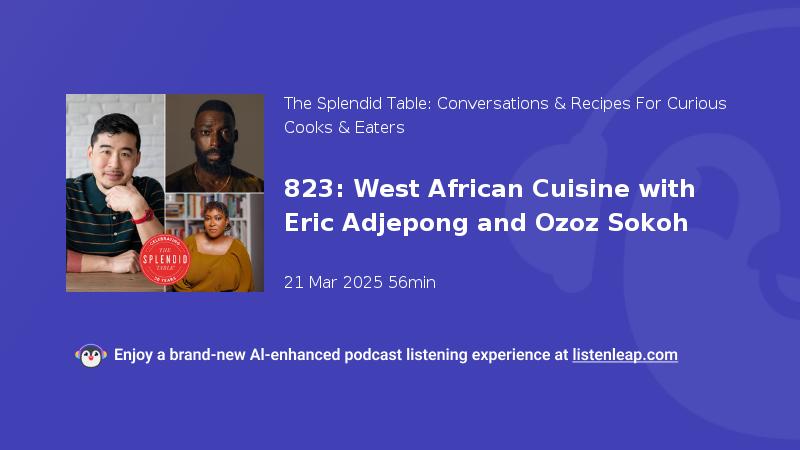
And yet, for most Americans, We're barely scratching the surface of what we know about the food of West Africa With its abundance of rice dishes, incredibly savory stews And deep flavors from dried and fermented seasonings Today we're talking to two extraordinary cooks to learn more about these traditions Later in the show, we'll talk with Uzoos Suko A geologist turned food blogger and passionate student of the kitchen of her native Nigeria Her cookbook is called Chop Chop and we'll start with another author eric ajapak now if you're a fan of top chef you probably remember him getting to the finals
of his season where his food which was inspired often by his family's homeland of ghana kept blowing the judges away or you may have seen him on dozens of shows on the food network well he's been especially busy lately having just opened his restaurant elmina in washington dc and publishing his cookbook ghana to the world recipes and stories that look forward while honoring the past. So, hey, chef, it's great to see you.
Francis, it's good to see you as well, man.
How are you? I'm well, thanks, and I'm glad you could make time for this because you are real busy.
It's all relative, man.
You know, it's been a while, so it's good, man.
It's good to see you.
It's good to hear your voice.
Well, thank you. Well, congratulations to you on everything that's making you busy.
You just opened your new restaurant.
You're publishing your cookbook at the same time.
I don't know why you would ever decide to do that, but there you go.
So let's start with the book.
You know, the title is Ghana to the World.
But I happen to know that its working title was different.
The working title was actually Sankofa.
Correct. So tell us what the word Sankofa means and what does it mean to you?
Yeah, definitely, man.
You're absolutely right.
Sankofa was the initial thought for the title of the book.
And it's based off an indinkra symbol, which are traditional olden symbols that come from West Africa, from the Akan region where my family's from.
And there's so many of them, but Sankofa specifically means to go back, to reach back and to move forward. And that's exactly what the inspiration for the book was, is to sort of like take olden recipes, traditional frameworks of cooking in Ghana specifically.
But then obviously being a background of mine, wanting to push forward and sort of highlight some of the things that have been influential to me as a cook now in present time.
You know, some of the chefs that I've worked with, some of the people that I've been influenced by now, you know, being on Food Network and everything else.
But then when the book started developing and blossoming, we noticed that there was some really traditional recipes that I didn't want to touch, things that I didn't want to like alter, things that I wanted to be as true as I can be.
And then some sort of modern interpretations of what these ingredients can maybe look like, what these dishes possibly could look like as well.
So I would be remiss if I didn't mention and respect and honor the way that my grandparents, my great -grandparents, how they cooked and try to keep as true as I could in that regard, but then also share a little bit of what I'm doing right now and what inspires me and everything.
So it's sort of like an old school, new school sort of vibe into the book.
And Ghana to the World, I think, that newer title sort of embodies that.
Yeah. Yeah. Well, okay.
So it, and that seems like it, it really kind of reflects not just your approach to the book and even your approach to cooking, but it seems to me a little bit, you're, you're the sort of worldview, the way you grew up and the way you sort of find yourself now as an adult.
And, you know, I know you lived in Ghana a little bit when you were young, but you're proud of being a Bronx kid, you know, you know, growing in the shadow of Yankee stadium.
medium so tell me about those two places like how the the culture of the two sort of interacted when you were growing up when you were sort of forming your ideas of the world the best place to grow up honestly um the bronx new york i think uh especially falling into this industry yeah um falling into this industry and food and you know i grew up um near an albanian family i grew up near a jewish family i grew up near a hispanic you know puerto rican family i grew up near or Caribbean family.
And I would go to different homes and have, you know, steamed cabbage with, you know, rice, or I'll have like mofongo, or I'll have oxtails, or I'll have latkes.
But I also came from a very specific part of the world.
And my folks coming here in the late 80s, and the huge, massive Ghanaian community that's here in the Bronx, It was really like the perfect place to be.
There's such a strong tradition.
And a lot of things that you would notice in Ghana now here in the States are really the same.
You know, the celebrations, the births, the funerals, the milestone events, they all sort of celebrated in the same fashion.
And food is always a part of that.
And, you know, again, falling into this industry, I was really, really lucky to not only be influenced by the culture itself, but having those opportunities to go to Ghana and live there for a few years.
But then coming right back here to New York and the Bronx specifically and experiencing those sort of like Americanized, you know, somewhat versions of what Ghanaian life is.
It was a really, really cool upbringing, one that I probably didn't realize how impactful it was in the moment.
Yeah. What are some of your memories?
What are some of the standout memories of moments, meals, bites that you had in Ghana?
In Ghana, eating with my hands was something that I noticed immediately that is something, you know, in Ghana, it's second nature, if not first nature, you know, and the ceremonial sort of aspect of making, you know, grabbing food and mixing food with, you know, the vessels of fufu and benku and kenke or rice, and then grabbing the stew or the pieces of meat.
and sort of creating the perfect bite with your hand, there's that connection that typically gets lost with utensils, right?
With a fork and knife, there's sort of a separation between your hand and the food.
So there's a communication, there's a connection that's somewhat lost or stolen when you can immediately touch something and you know it's hot or cold or you know the consistency of it immediately.
There's sort of like a brain receptor from hand to brain that sort of connects, that is stripped away here in the States.
Another thing, Francis, I would say is the communal aspect.
I don't remember eating anything of an importance or any memorable meal by myself.
It's always with family.
It's always with friends.
And that's the way I love to present food as well.
You know, at the restaurant at Almena, we have an entree course that is shared specifically for those reasons to sort of get that kinetic energy between the table and getting people to pass food around and communicate non -verbally with energy and with food.
And especially at the dinner table, something that I really, really cherish and want to celebrate as much as possible.
So I remember those things specifically.
specifically um but then like you talk about the flavors you talk about the combinations you talk about the heat the sweet the spice um it's all there in in west africa and ghana specifically yeah so you said eating with your hands like that was the first thing you turned to and that's so interesting because it's it's different than you know what we might think of like oh you're eating a sandwich obviously you get with your hands even like a chicken leg or something like that but what you're talking about is like a canadian style of meal you mentioned the tofu you mentioned and rice yeah so typically
a meal might be a starch so fufu is like a pounded yam right like it's like not a puree but it's sticky enough to like pick up chunks exactly right yep and and then dipped into some kind of stew or sauce so it's like you're getting your hands up in that sauce you're holding you're picking up a starch you're dipping it in that sauce so there's an intimacy tell us about some of like what would your favorite stew be or your favorite sauce would It would be if you had a platter of rice in front of you right now.
If I snap my fingers and you're in Ghana, what would you want to be eating?
Or snap my fingers and I'm here in my family home, right?
This is the dishes that I grew up eating here and in Ghana.
Yeah, so, you know, groundnut stew, peanut butter stew is probably the first thing that like, you know, meal that I can remember eating legitimately.
Not like cereal or not like formula.
formula peanut butter stew.
If I think about my first food memories, it's fufu and peanut butter stew.
And that's typically given to like children, young, you know, young children.
Having that fed to me, you know, via my mom's hand, right?
Her vessel. And that sort of choreographed dining experience where you're grabbing a little bit of the fufu, you're grabbing some of that peanut butter stew.
And then, you know, it's being fed.
In Ethiopia, gorsha is one of those really cool terms where you're feeding someone else.
And that's the same sort of style or format, so to speak, that's used in West Africa.
And yeah, that's probably one of the first memories I've had in regards to eating viscerally with my hands.
And eventually when I was old enough, I did it myself.
And now as a father, my daughter's doing it, which is pretty cool as well.
And just seeing that sort of tradition being passed down as it was passed down to my mom from her mom and her mom.
It's cool to see tradition sort of just stay very, very true.
Yeah. Let's turn to some of the specific flavors, like what's in that peanut butter stew?
Describe it for us.
Yeah, the best, man.
It starts off with sort of like the trinity that we typically see in Ghana.
It's onions, it's Roma tomatoes, it's ginger, bell peppers, and that gets sort of steeped in water.
And that water is flavored with bay leaf and thyme and apricot, which is like very indigenous in the family of black pepper pods.
And that water is sort of like grabs the essence of all those really nice, deep herbs.
And then you're steeping the vegetables in it.
And after some time, the vegetables get soft enough to be blended.
So you take the vegetables out, you blend it, and then you put it back in the pot.
And from there, you add the peanut butter, the really creamy, natural, unsweetened peanut butter.
and you're adding tomato paste and then you're building layers with um scotch bonnet um and other herbs and things like that and then probably the most important ingredient is time you know you really want that to sort of slow cook and really develop flavors um in a way that you can't get from a fast 30 minute cook you have to go low and slow and when it's done in that combination and that style and that care man you're left with something that's um earthy number one um um a little bit of spice a bunch of umami a bunch of herbaceous notes again from the time and the bay leaf and it's truly one
of the best things that you can have man and i i can't remember i can't even imagine rather life without it so it's it's in the restaurant it's it's in my heart is it really cooked with a meat or a seafood or yeah at that point it's like the sauce exactly yeah at that point it's dealer's choice so you know i've had it with uh braised chicken i've I've had it with braised beef, braised goat, lamb, or you can just go vegan and have it, you know, as is with a bunch of vegetables and it's equally as good.
Sometimes you add the broth of the chicken or the lamb or the beef or the goat in it to sort of reinforce.
Oh, okay, so those will be separately cooked.
Separately cooked, exactly.
And then you marry the two.
You marry the two right after.
That's chef Eric Aljepan, author of Ghana to the World.
More with him in a minute.
I'm Francis Lam and this is The Splendid Table from APM.
our show is supported by broad and taylor dedicated to innovating unique products that simplify the process of making wholesome food from scratch we all know baking bread isn't simply a recipe it's a process and when it comes to sourdough starter temperature is everything tools like the sourdough home will heat or cool your starter and adjust starter feeding times to meet your schedule the folding proofer provides perfect temperature and humidity control for consistent dough rise and it folds down to less than three inches so you can put it away and keep your kitchen clear and when it's time to
bake broad and taylor's ultralight baking shells trap steam creating that perfectly crisp golden crust everyone can't wait to get their hands on no more lugging around a heavy dutch oven simply pop on a baking shell no preheating required for recipes and more, visit broadandtaylor .com slash splendid.
just dream about that trip.
Book it with Priceline.
I'm Francis Lam and this is the show for curious cooks and eaters.
We're talking with Chef Eric Aragipong about his new cookbook, Ghana to the World.
Let's get back to it with him.
I want to get to another dish, not just popular in Ghana, but I think through many sort of countries of West Africa, but you have a real love for it called uh keliwile?
keliwile yeah yeah good call that's like the ultimate street food as soon as you said it i was immediately transported to like street vendors uh usually like in a newspaper or some sort of wax paper uh they'll throw the spice plantains sweet plantains they always have to be like really dark skin and then uh roasted peanuts and it's a very simple very humble but also so equally as delicious uh sort of snack food and the plantains are not just they're fried uh but they're they're marinated i love a fried sweet plantain oh come on man you can't beat it you can't beat it man it's undefeated it's undefeated
sugar caramelizes so it's actually a little come on man you're talking romantic to me now man yeah yeah yeah exactly okay so you got their fried yeah you got the exactly yeah so you got fried plantains roasted peanuts but the plantains itself are marinated in a ginger garlic blend usually a little bit of heat a little bit of spice in there as well um and you let that sit eight hours is great overnight is even better and you take that and you fry it um and then you get exactly what you described those really crispy ends uh but it's sweet it's spicy has those really beautiful um aromatic back notes
of the ginger and the garlic and then the the crispy or the roasted peanuts as like not only earthiness but a textural element because the fried plantains itself are very soft uh so you need some sort of like breakup up you need a little bit of like um a shake up in the like it can be mundane if it was just plantains right so you have the roasted peanuts in there and then it's just the beautiful combination of soft crunchy soft crunchy as you're going through it and by the time you have it in your hand it's pretty much gone in five minutes yeah that's so good i actually fried sweet plantains the other
night for dinner and my kid squealed when i brought that table i'm like guess what else it's like a plantain it's like it like little candy it's like nature's candy man it's so sweet um and i mean i don't know anyone that doesn't like it and if you do god bless you but man it's delicious yeah it's it's amazing food okay so i want to get to uh dishes that are in your cookbook recipes that are your own so inspired by traditional dishes that aren't themselves traditional you have something i have never seen this before in my entire life i know where you're going i know i know you're going the roasted
banana grits yeah yeah yeah i knew you're going there um i love grits man i love the texture of grits like southern grits like corn southern grits exactly yeah exactly harmony the harmony cornmeal porridge um man i had this wacky idea because there's always a healthy debate between savory and sweet grits right and and what direction you go in and you know it's almost like east coast west coast beef bro it's it's pretty pretty contentious um but i i had the idea to sort of combine it as as uh respecting both sides of the fence so the roasted bananas are just that we take bananas roast them until
the skins get really really dark puree that okay wait do you take like very like what color the skins of the bananas before you roast them like um typically they start to get ripe so not quite ready for like banana bread but maybe like a two three days later if you were to use it for banana bread But one thing that's really, really important to that recipe is the roasted garlic puree that's added into it as well.
So it adds a huge depth of flavor.
You know, you take time and roast and not the herb, but the actual time.
Yeah. And you blend that.
And now you're playing with some really cool combinations of like garlic, banana.
And the idea of it is pretty wacky, especially if you never had.
But we serve it at the restaurant now and it is the number one thing.
that's requested for brunch and it's not too sweet it's not too savory uh but it's just right you know um speaking of porridge that was no pun intended uh but yeah um it's it's it's perfect man and what we do right after the grits are made uh traditionally with um i take some shallots garlic i build those sort of flavors um sweat that out i add the uh the grits to it um typically chicken chicken stock, and then some heavy cream milk mixture.
Get the grits to that, you know, traditional consistency without any flavoring.
And then we go ahead and add in or layer in the roasted garlic puree, a little bit of mascarpone cheese, and then finish it with a little bit of that roasted banana puree.
Sort of thirds and thirds, one, two, and three.
And what you get from the result of that is really just a beautiful, mellow...
The sweetness from the banana sort of intensifies when they get roasted uh obviously the garlic intensifies as it gets roasted and it's just like a really beautiful play um i love love love that dish yeah i really do that's cool i'm sorry i think i cut you off when you were about to describe how you roast the banana so so now the banana is like you know like brown spots maybe now you what do you do to it to to get the so throw it in the oven um 350 400 degrees skin on skin on exactly skin on so you It's an easier sort of like extraction when you're getting all the puree out.
You can just kind of peel the skin, pierce it, let the steam out, and then go ahead and scoop it into your blender, blend it.
And now you have this beautiful roasted banana puree, which you can also serve to your baby, to your kid.
Like it's a delicious sort of like baby food, right?
That's cool. Yeah, yeah.
And it's sweet, but it's not overly sweet.
And then you get the back note of obviously those alliums and shallots and garlic that go in first. bro it's uh you gotta you gotta come over man it's it's one thing to describe it's one thing to experience yeah i gotta get down there i gotta get down there okay so that sounds delicious and uh in the book i was like i'm gonna eat that i went to all these like sort of spectacular kind of dishes like uh like a whole fish and you know these big beautiful chicken stews and roasted chickens um but one that actually really struck my eye that i want to talk about is maybe Maybe this is not necessarily
the obvious star of the book, but you have a roasted cabbage that you serve with coconut beurre blanc.
So beurre blanc, classically French sauce of a little bit of reduced wine, reduced vinegar, some shallots.
And then you basically take that and whisk a ton of butter into it.
A ton of butter, yeah.
Butter sauce. But you do it with coconut.
Tell us how you do that.
that? Man, it's one of my favorite French sauces, probably my favorite French sauce.
And, you know, just to sort of put it on its own head and, again, taking the ingredients that are indigenous to the country and the region in the same sort of formulaic fashion, you're taking, rather than vinegar, coconut vinegar.
So shallots are still in play, tarragon is still in play.
But rather than like your typical white wine or champagne vinegar, we're taking coconut vinegar, a little bit sweeter And reducing that down to that sec to almost like that syrupy consistency.
And then you're adding in white wine.
So it's sort of like a dish that you reduce and then build up with butter, like you mentioned.
So it's reduced down with the shallots, the tarragon, that coconut vinegar, and then I'm adding in coconut cream.
And then I'm adding the butter.
So now you're getting like coconut, tarragon, shallot, and it's absolutely freaking amazing, man.
And, you know, coconut in itself, it's a very, it can be very sweet for it, but it also has a lot of earthy notes too.
So yeah, the combination of that and then like the straight up earthiness and, you know, vegetal note of a cabbage paired with that as it's roasted, it gets a little sweeter, beautiful char.
And then you just go to town with all the sort of like fixings and accoutrements that you want on it.
It's a really, really cool dish.
So let me ask you about one more dish.
This is not a recipe in the book, but this is something I know you're serving at the restaurant right now and you're really proud of.
and uh it's probably a little contentious because it's your take on jollof rice which i know every cook in west africa is like my mother's jollof rice the best in the world don't even try so tell us about your take on jollof no that that take actually started here in this home my mother has the best recipe of jollof rice so don't try it um no man i i was mentioning uh not too long ago if there was like an alien for whatever reason to drop down in central west africa and say take Take me to your number one dish.
I think 8 out of 10 people would say jollof rice.
It's really the hallmark, one of the staples of our cuisine.
It's blended onion, pepper, ginger, garlic, scotch bonnet.
And it gets blended almost into like a vegetable smoothie.
And we cook that down with a good amount of oil until it sort of dries up.
So it's sort of like a version of marinara.
But as the water sort of evaporates, the flavor intensifies.
And then we add spices.
There's curry powder.
There's, you know, different seasonings.
Nutmeg Is a nice addition that my mom likes to do A secret that I'm telling you and everyone else Know And then we add in some jasmine rice And from there, it bakes off So we have that as the base of the jollof And I worked outside of school Right after school, rather, for a chef Adam Shop, one of my really, really Close mentors He ran a restaurant called Nuela In New York, and we served A duck paella and it was a duck leg duck egg duck breast and i really took that inspiration from that dish and and the times that you know i remember cooking it um and that that whole sort of duck egg um duck
breast duck leg lives in that jollof dish so we take a pot add the jollof in there um it gets smoked a little bit so you have a little bit of that smoky back oh cool um and then it gets It's brushed with a sweet, tangy tamarind glaze on the leg, on the on the breast itself.
And then we have our sort of like condiment, the world famous Chita, which is sort of like our exo sauce.
And that gets dolloped all around the the dish.
And then it's also served with a roasted tomato salad.
So you're getting the beautifulness of that.
You're getting a little bit of sweet.
You're getting a little bit of savory, a little tang, a little heat.
And I'm so, so proud.
out. It's cool. One thing that I love, and I know that I'm doing a good job at it, at least in DC, is hearing the Nigerians and the Senegalese people sort of like silently nod their head.
They don't want to fully say it, how good it is.
But to me, that's all the confirmation that I need, man, that we're doing right.
And we did a quick audit.
We've only been open for a couple of weeks now, but it has been literally half of the entree sellers that we've been selling so we're selling a lot of duck now in uh in dc oh my goodness that's incredible you know you're doing it when the nigerian is gonna walk into a canadian's restaurant be like yeah joel off is okay it's all right yeah it's a win for me man yeah it's a win now i want to get to the restaurant elmina obviously we talked about the title of the book book and the word Sankofa, words, titles, names mean a lot to you.
Totally. Tell us why you named the restaurant Elmina.
Yeah, I got chills when you said that, as you said that.
As I was doing the research, this is a project that's been on my heart and my mind for a very, very long time since I was a child, but I didn't know what I wanted to call it.
And when the opportunity really became real to me, you know, this time last year about, you know, getting a space and acquiring it.
And I did a lot of research and it's sort of an emotional connection, but then also like a prideful connection.
Elmina means the gold mine, a treasure.
And when I think about the food that comes from the country, the region, and really the continent at large, the diaspora at large, I think about all the wealth that Ghana has offered to the world, not only obviously in the food being a restaurant, but in the music, in the clothing, in the style and everything.
So it's a very intentional name.
It's also a place that I love to visit.
It's a fisherman town in Ghana and it's a humble town.
It's a hardworking town.
I think folks, they know the castle, you know, and that's one sort of reference point.
Tell us about the castle.
Yeah, the Elmina Castle, a slave castle that was there.
But I think there's an amazing and beautiful opportunity to sort of reclaim and a reclamation project to sort of take back, you know, the meaning there.
When you go to Elmina, no one's thinking about the castle.
They're thinking about the food.
They're thinking about the life, you know, the sort of hardworking, blue collar, really community that lives there.
And I thought about Elmina, man, as the name.
And not only does it just sound so beautiful, but it means so much and it goes deeper.
And when you walk into the space, you're walking into different rooms that represent different commodities, things that bring wealth to the country.
We're in the tobacco room.
We're in the cotton room.
We're in the indigo room that represents the Atlantic Ocean.
We're in the sugarcane room that represents all the beautiful rum and the abundance from there.
And that sort of treasure is what I wanted to really celebrate.
And I'm so proud. I'm so proud of the name.
I'm so proud of the space and establishment.
establishment. Funny enough, you know, as I was sort of like building the team, Elmina came up in different ways as well.
My CDC, his grandparents are from Elmina, you know.
Oh, my God. Yeah. Like just really just visceral connections to the space.
And it just felt right.
The more and more I said it.
And I'm so in love with it.
And I'm really, really happy to represent Ghana in like beautiful way.
I think Elmina is a great opportunity to do so.
Thank you so much, Jeff.
Congratulations to you.
It's great to talk with you.
Cheers, man. Appreciate it, man.
I've got to have you in as soon as possible.
Eric Anjapang is the chef -owner of Elmina in Washington, D .C., and author with Korsha Wilson of Ghana to the World, recipes and stories that look forward while honoring the past. From that book, he left us with his recipe for roasted banana grits with seasoned shrimp.
Find it at splendidtable .org.
So one of the secret weapons I have in my kitchen is a little container of suya seasoning, which is a blend of God knows how many chilies and spices and pulverized peanuts, which give it this incredible richness.
It's a spice blend that's used on grilled meat skewers in Nigeria, and apparently you can get them anywhere, on the street, at bars, anywhere you need a snack.
And you have to figure, if a cuisine's everyday street snack is this good, it only goes up from there.
So to learn more about this fantastic food culture, we turn to Azuz Suko, who kind of never meant to be an expert on the subject.
But she left her native Nigeria to go to university in the UK for geology and later to work in the Netherlands.
And while there, she just missed the flavors of home.
And she started a blog called Kitchen Butterfly and eventually devoted herself to studying Nigeria's vast cuisine, which spans many tribes and regions.
Her debut cookbook, a deep, delicious dive into the subject, is called Chop Chop, Cooking the Food of Nigeria.
So hi, Zos. Thanks for coming by.
Thank you, Francis.
It's funny because I think about the fact that you are known as the Kitchen Butterfly.
But the book you've written does not feel at all like...
you know, lightly flitting around.
There is so much here that I never knew about Nigerian cuisine and culture, especially how a lot of it, you know, you really sort of bring forth the idea that Nigerian culture is, you know, like many places, a mix of different cultures, migrations, history.
I'm really excited to dig into some of it with you.
But I thought we might start with kind of the beginning of the day.
I love how your chapter titles are these sayings and your breakfast chapter is titled Your Morning is When You Wake Up.
When You Wake Up is Your Morning.
Oh, yeah, yeah, yeah.
When You Wake Up is Your Morning.
I love that. So why don't you describe like the scene that you open the breakfast chapter with?
When I think of iconic Nigerian breakfasts, um the opening essay in the breakfast chapter kind of represents that and whether it's the elements that feature at breakfast from like aggege bread to akara and other things but also the beverage which Nigerians collectively call tea and it could be like a black tea and they'll call that after a brand name tea it could be coffee and that would also be called like a brand name coffee.
But when you wake up as your morning is something that a lot of Nigerians understand and relate to.
And it's like you can start your day whenever you choose.
Well, let's start with that tea culture.
You sort of described briefly a sort of tea master making tea.
And also that the tea might be sold with bread, eggs, and also with instant noodles.
And that really struck me as, you know, the child of people from Hong Kong where we would have these formal tea houses.
But also all over the street, we have a culture of just like, essentially it would be diners.
Like an American equivalent would be a diner and you'd have tea and instant noodles and eggs like omelette scrambled eggs, so on and so forth.
Tell me about that culture and some of the dishes that you love.
of. Across the south of Nigeria and the north, you'll find these tea spots.
And they're usually led by men from the north of Nigeria.
And they're called Mishais.
And the Shia connects with Arabic tea culture.
And you can go to the men, and they typically all have tables set up with with, like, benches and people gather around, like, people from all walks of life.
It's kind of like a levelling meeting point where you'll find people of all careers and types and all wanting the same thing.
And that could be a cup of tea or coffee or mellow, like a chocolate drink.
But all of them go by the name of tea in Nigeria.
and and the meshai has his theatrics right he's not really doing it to put on a show but he's kind of cooling and aerating tea by pouring from one cup to the other kind of the way like Moroccan mint tea is poured and served so there's like poured from like from like a high height and you see it sort of splash yes yeah but also it becomes kind of frothy and And it also does the job of cooling the drinks down a bit.
And so he'll have the tea and then he'll have bread.
And you can have the bread on its own with the tea or you can have him toast it, kind of like pan fry it in margarine or butter.
You can also have him make eggs or a version where he scrambles the eggs with like onions and peppers, dips the bread in it, kind of French toast style.
And then he'll flip it.
So you'll have one side that's a little bit eggy and the other side that is toasted.
So you can have that as a sandwich. Oh, cool.
Or you can have a version with instant noodles.
Yes. Oh, I love that idea.
And you have some recipes in this chapter that I really want to ask you about.
One is a corned beef sauce.
sauce? So typically I associate corned beef sauce with Saturdays or Sundays.
So kind of like a weekend sauce that we would make and would make it with canned or tinned corned beef.
And it's fairly common to pair it with boiled yams. And when I say yams, I don't mean sweet potatoes.
I mean, like actual, like true West African yams. Think about it like a mayonnaise, but instead of minced meat, you're using corned beef instead.
Uzon Succo is the author of Chop Chop, Cooking the Food of Nigeria.
More with her in a minute.
I'm Francis Lam, and this is The Splendid Table from APM.
Support for this show comes from Pure Leaf Iced Tea.
You know that point in the afternoon when you just hit a wall?
You don't have time for self -care rituals or getting some fresh air, so maybe you grab a beverage to bring you back.
But somehow it doesn't do the trick, or it leaves you feeling even worse.
What you need is a quality break, a tea break.
And you can do that with Pure Leaf Iced Tea.
Real brewed tea made in a variety of bold and refreshing flavors with just the right amount of naturally occurring caffeine.
With a Pureleaf Iced Tea in hand, you'll be left feeling refreshed and revitalized with a new motivation to take on what's next.
The next time you need to hit the reset button, grab a Pureleaf Iced Tea.
Time for a tea break, time for a Pureleaf.
This is advertiser content from Iams Pet Food.
Hey humans, my name's Hero.
I'm a cat. I'm here to give you a crash course on how we went from fierce hunters to the floofy friends you can't live without.
Although, let's be honest, we could probably live without you.
Around 10 ,000 years ago, humans started farming, which accidentally created a rodent -hunting bonanza.
That meant full -time employment and activity for us.
Humans were like, okay, these guys are chill.
they can stay so unlike dogs ew sorry we basically domesticated ourselves we chose you fast forward to today some of us may not get as much hunting in and okay i admit maybe we can get a little chonky but you can help keep us healthy and active with i'm healthy weight cat food now available in stores and online mind.
I'm Francis Lam and this is the show for curious cooks and eaters.
We're talking with culinary educator Uzuru Suko about the deeply delicious food of Nigeria.
Let's get back to it with her.
I want to ask you about another breakfast recipe you have in the chapter.
uh forgive me if i'm pronouncing incorrectly but there is a recipe for masa yes um masa is a rice cake cooked in a pan with divots but it's wholly it's like you they call them pancakes but they come out as like balls essentially yes so it's similar the batter is kind of pancakey except it's yeasted it's made with rice and you fry it and it ends up looking like this little stairs airs of deliciousness.
And you can pair them with spice rubs.
You can have them with soups.
There are a variety of ways that you can enjoy them.
Yeah. And they're fermented and yeasted, right?
So you take rice, you soak it overnight.
So like, you know, it softens the rice.
Then you puree it with a little bit of yeast. Yes.
You blend it with yeast and a little bit of water.
And then you kind of let that rise and ferment and depending on how sour you want it you could leave it to go for a few hours and then you know so some people fry it once it's reason once right yeah and then it's a little bit sweeter but if you want it to become more sourdough -esque you can let it go longer yeah and then fry it and And you end up with this chewy, gluten -free rice pancake.
Oh, I love that. You also have a version where you cook it on a flat pan.
Yes. And when you describe the cooking, I immediately could imagine this thing where you said you pour the batter in the pan and then as the bottom fries, you don't flip it, right?
You don't. You see all the bubbles start to form with all the gas coming out.
and uh because you're not flipping it you have like almost like this like chewy honeycomb kind of texture on the top and like a little crisp bottom yeah that sounds so good it makes me think of crumpets but also Indian or South Indian appams I think they are and Sri Lankan hoppers yeah yeah yeah well okay that brings me to my next um dish I want to ask you about you know You know, West Africa in general is a rice -loving part of the world, right?
But you have a recipe for Nigerian fried rice.
And you say in the recipe that this is a combination of Chinese fried rice and Indian biryani.
Masala, pilau masala, yes.
Oh, sorry, sorry, sorry, pilau masala.
So talk to us about this recipe and how you see those different cultural strains all coming together in it.
So Nigeria has a long history of relationship with both India and China.
And when I started thinking about the likely origins of fried rice, I looked at what the principal techniques were and the elements.
And it struck me that it is very likely that there were Indian influences because the rice is a yellow, turmeric -colored and curry powder -flavored rice.
And I know that there's a whole discussion around curry powder and its origins and those constructs.
But just thinking about what might have informed the flavor base, it seems very, very likely that it was Indian inspired.
But then you also have a technique and combination of stir frying the vegetables.
So carrots, green beans, green peppers, spring onions.
And that seems very Chinese -esque.
and so just thinking about nigerians are adept at combining elements from different cultures and creating something that's distinctly nigerian yeah and so in your recipe it's flavored with curry powder yes and has all these stir -fried vegetables yes but also um the proteins in it are little shrimps and beef liver.
Yes. Nigerians don't shy away from variety meats.
We are very much head to tail, whole animal, whole fruit and veg people.
Like we will make use of the entirety of the thing, right?
So, you know, with beef and with the cow, we will use all parts of it.
I particularly love liver in my fried rice and this tiny shrimp My children, not so much So when I'm making for them, I kind of skip it But for me, it's like treasure and balance You know, you have all of the flavors You have all of the textures I love it Oh, that sounds delicious I am also a lover of liver That with this sort of like spiced aromatic rice it just sounds so tasty to me okay so this is God I guess my head is really in a ricey place because we've talked about the rice pancakes and fried rice but now I want to go also to Nigerian jollof and jollof is certainly an iconic dish again all
through West Africa I know famously the Senegalese the Ghanaians Nigerians and others all argue who has the the best jollof but I am so excited by your recipe for jollof because there are like three layers or three levels of flavor in it I can tell just by reading the recipe right you um and no bouillon cubes um you have you have a lot of thoughts about bouillon cubes yeah um both my parents were extremely good cooks my dad's passed now but my dad never cooked with beyond cubes he abhorred them and my mom would occasionally use beyond cubes and so for me I learned to cook without beyond cubes
and with beyond cubes and generally just preferred the flavor of my own food without without Beyond Cubes.
And then as I grew older and learned more about how Beyond Cubes really have changed, how Beyond Cubes have changed or have replaced to some extent the typical seasoning that Nigerians might have reached for, but also some of the cultural implication in terms of erasure of some of the cultural practices and traditions.
So I definitely lean towards not using Beyond Cubes.
In some cases, yeah.
But again, I don't hold anyone to the standards I hold myself.
I don't even think...
Sure, sure, sure. Everyone has to do for themselves what they think is best and what works well for them, depending on their family circumstances.
Sure, sure. I mean, i can sense in your voice that you're you're thoughtful about this you're you're careful in what you want to say because um i'm i'm assuming but this is what i'm hearing from you um you don't want to be judgmental about people who are using boiling cubes in their food um the flavor is delicious you know it's sort of engineered to to make us feel like wow that's great i want more of bit but it's also as you said sort of replaced um flavorings seasonings other sources of umami yeah um that nigerian cuisine had before the introduction of of boyan cubes that's sort of what i'm
hearing yes so there's definitely so there's there's competition and as a food historian and someone who's desirous of preserving nigerian culture and cuisine i would like to focus more on and reimagining, reclaiming, restoring some of the more historic seasonings and flavorings.
Yeah. What are some of those seasonings?
So you have a variety of fermented nuts and seeds and they show up as fermented, typically fermented flavorings, whether you're using kind of like indigenous beans called locust beans or some other seeds like melon seeds, which are similar to pumpkin seeds, but have a slightly creamier texture and a sweeter flavor.
You have fermented sesame seeds that also make their way into seasonings.
So think about like a version of soy sauce or fermented black beans.
We have the Nigerian equivalents.
and those pack flavor and pungence yeah and part of it too right are these ingredients and part of it is technique right so to get back to your jollof recipe um we don't need to run through the whole recipe because it is a bit of a project um because of the way that use technique to bring out flavor but there's an element of it where you okay so you when i said there are three levels of flavor.
One is you start the dish by, you know, sauteing onions with curry powder and tomato paste.
So that's, you know, to develop really beautiful flavor.
You have a curry stock.
So you make a meat stock also with more curry powder.
So that's another layer of flavor.
But there's a third element of it where you take a tomato sauce as part of the base for the liquid to cook the rice in, right?
And that sauce is already sort of pre -cooked.
It's a tomato sauce that's already stewed down.
But in the making of this rice, you cook that sauce further with a step, a technique called frying the sauce.
Tell us about that technique.
Okay. So the technique of frying a sauce in Nigerian cuisine is about reducing the sauce down, but also allowing it to to take on flavor and seasoning and changing the texture.
So the texture goes from watery and more water -based to a more desiccated, fried, oil -glazed texture.
And that does something both in terms of the flavor, but also in terms of the mouthfeel and the texture.
it has a it kind of cuts your tongue with a deliciousness is how i like to think of it um but that that frying is essential for jollof that has well -balanced flavors that allows the seasoning come through but also allows you taste the rice as well it and and doesn't leave you with sense of rawness right so rawness from like the the blended or pureed onions and tomatoes you get this more cooked this warmer slow cooked flavor that that works well with what joloff represents which is a celebratory delicious dish yeah that's cool i i love your way of describing that and um and it is and i sort of see
the frying right it's it's a little counterintuitive talking about frying a sauce which would be you know liquid as we would normally think of it but you're talking about cooking it down until the oil starts to bubble out the top and then when you see that bubbling it looks like frying but what you've also done is um reduced it and and really concentrated the the sort of like all the flavor in there and the oil starting to like separate.
That's really cool.
Hey, I want to ask you to, you used the word sweet earlier, and I think you meant sweet as in sugar sweet.
But there's this really cool note in the book.
I love all the little bits about Nigerian language, because it's often so poetic.
But but you say that the word for delicious is sweet.
You'll say a food is sweet, meaning it's delicious, not meaning sugary.
Talk about that a bit.
I love Nigerian speak, especially when it comes to food.
And so if I want to describe a soup that I really enjoyed, that filled not just my belly, but my heart and soul, all.
I could say, man, that egg goussi soup was so sweet.
And a Nigerian would understand that I meant it was nourishing and there was something so amazing about it and fulfilling about the process of eating it.
And so we use sweet to describe deliciousness, not just for sweet things, but for savory things as well.
And I wager that it is because many of the words we use to describe food and eating and culinary -related terms are translated to English from Nigerian languages.
And Nigerian languages have distinct words for things.
So in Yoruba, for instance, a language of the Southwest, you would say odun like it's sweet like it's delicious and that would apply to things whether sweet or savory and then when you translate to english you just leave it sweet yeah i love that and i feel like that's such a great um symbol of how cultures work right it's it's about taking a thing adapting adapting, translating, and then re -translating.
And so something that sounds a little bit counterintuitive to someone who only speaks English.
Well, you're speaking English, but you're speaking English with a different context and a different way of informing that English with other languages and the native languages.
And yeah, I love that.
It's just, I mean, it's literally how poetry works, right?
Poetry works by understanding or learning different ways of looking at an idea or a word that you think you already knew.
I love talking with you about all of this, Azaz.
Thank you so much for your time today.
Well, thank you for having me on.
It was lovely. Ruzu Suko is the author of Chop Chop, cooking the food of Nigeria.
And she left us with a recipe for classic Nigerian jolof rice.
Find it at SplendidTable .org.
And that is our show for this week.
Thank you, as always, for listening.
And a special shout out to Chef Shola Olundoyo, who gifted me his homemade suya spice.
We'll talk to you next week.
APM Studios are run by Chandra Kavadi and Joanne Griffith.
The Splendid Table was created by Sally Swift and Lemonos Ever Casper.
And it's made each week by technical producer, Jennifer Lukey, producer, Erica Romero, digital producer, James Napoli, and managing producer, Sally Swift. Send us your thoughts, your story ideas, and your cooking questions anytime.
Get to us on social or email, contactatsplendidetable .org.
and subscribe to our podcast on Spotify, Apple, or wherever you get your podcasts and leave us a review.
It really helps us out.
I'm Francis Lam and this is APM Studios.
Nobody knows your customers better than your team.
So give them the power to make standout content with Adobe Express.
Brand kits make following design rules a breeze and Adobe quality templates make it easy It's easy to create pro -looking flyers, social posts, presentations, and more.
You don't have to be a designer to edit campaigns, resize ads, and translate content.
Anyone can in a click.
And collaboration tools put feedback right where you need it.
See how you can turn your team into a content machine with Adobe Express, a quick and easy app to create on -brand content.
Learn more at adobe .com slash express slash business.
Thank you to CVS Caremark for supporting this show.
CVS Caremark allows you to get the prescriptions you need, where you need, at the best price for you.
CVS Caremark allows for greater access to medication through broad, flexible network strategies.
They work with more than 64 ,000 pharmacies nationwide, 44 % of which are independent pharmacies.
This coverage means CVS Caremark can give their members the unmatched ability to choose where and how they want to receive their prescriptions.
Go to cmk .co slash stories to learn how we help you provide the affordability, support, and access your members need.