This is Albert Glass.
On This American Life, we're like stories that surprise you.
For instance, imagine finding a new hobby and realizing, to do this hobby right according to the ways of the masters, there's a pretty good chance that you're going to have to bend the law to get the materials that you need.
If not break it. Yeah, to break international laws.
Your life story's really good ones, This American Life.
You're listening to Life Kit from NPR.
Hey everybody, it's Mary Elsigara.
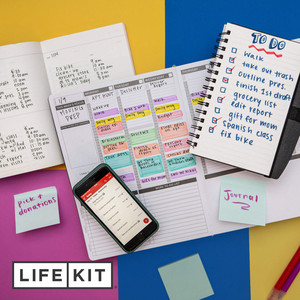
I keep a to -do list on a notepad on my desk.
And when I looked at it not too long ago, I noticed something.
It's kind of all over the place.
On a given day, it might read, Make Allergist appointment by razors.
Retile kitchen floor.
Throw out compost. Microblading?
Microblading, by the way, is something you do to make your eyebrows look fuller.
It's like a tattoo that lasts a couple years.
I mean, the list is filled with tasks, but some are big and some are small.
Some are urgent and some are definitely not.
Some, I'm not even sure should be on there, like the microblading, which I frantically scribbled down after the lady at my eyebrow threading salon asked who messed up my eyebrows so bad.
Hi. Yeah, that was me.
And a tweezer. But yeah, I just never felt like I've had a good system for making a to -do list and deciding what goes on it.
And I don't think I'm alone in that.
So on this episode of LifeKit, we are exploring how to make a better to -do list because there's a lot we want to do and a well -made to -do list can help.
When you make a to -do list that's aligned intentionally with what you want out of your life, it's really powerful.
We'll teach you how to break down your goals into actionable tasks and to figure out a to -do list system that works for you.
This message comes from Wyze, the app for doing things in other currencies.
Send, spend, or receive money internationally and always get the real -time mid -market exchange rate with no hidden fees.
Download the Wyze app today or visit wyze .com.
Tease and seize apply.
I'm Lakshmi Singh. Public radio reminds us of our shared humanity, even at our darkest hours, like with a story of an artist couple who make beautiful spaces for communities to grieve.
We found that people will usually stop by and just feel a little bit more open and willing to talk and share.
Help us make room for light in the dark.
Give before the end of the year at donate .npr .org.
So to -do lists, they're a tool we use to get stuff done, right?
And I mean, how good does it feel when you finally cross off that task that's been hanging over your head?
But warning, to -do lists can also become a trap.
They can feed our impulse to stay productive at all times.
The thing is, we don't want to make a better to -do list just so we can indiscriminately accomplish more.
It's about doing what matters.
That's Angel Trinidad, the CEO and founder of Passion Planner, a company that makes digital and paper planners that show people how to break down their goals into day -to -day actions.
You can access a free version of the planner on their website.
So takeaway number one in making a better to -do list, as Angel was saying, decide what matters to you in this moment.
Because wouldn't it be great to fill our to -do lists with intention so the stuff on them is actually helping us get somewhere?
One way to do this is to come up with a big picture goal, something that's especially important to you right now.
Something that would make a big impact in your life.
Angel calls it a game changer.
What is that one thing that would make everything easier, better, and that answer is different for everyone.
To come up with that goal, ask yourself some questions.
What do I want to be?
What do I want to experience and what do I want to have?
Maybe you want to be more present in your physical body.
If so, your goal could be to run a 5K.
Or maybe you want to give back to your community.
So your goal is to volunteer once a week.
Or you want to become a doctor.
So your goal, take the MCAT.
Now sometimes you don't choose the goal.
Life hands it to you.
Like sometimes your parent is sick.
Or sometimes your dog is sick.
Or maybe you need to find a job or else you're not going to eat.
And that might be your reality for now.
Whatever it is, once you have a goal, you'll break it down into actionable steps and deadlines to put on your to -do list.
And we'll get to that.
First though, I want to acknowledge this goal making approach might feel kind of top down.
Like maybe you don't have a big picture goal in mind yet.
And that's okay. Oliver Berkman is a journalist and author.
He wrote the book 4 ,000 Weeks, Time Management for Mortals.
That's how many weeks are in the average human life, by the way.
And he says another option is to let your current to -do list guide you.
There are various exercises out there like you might know the one that involves asking why five times in succession.
For instance, my to -do list says retile kitchen floor.
Oliver says I could work backwards from there.
So like I want to retile my floor why to make that room look better.
Why? And you know eventually you hopefully get to something that feels like a bedrock value of your life.
And if you don't, maybe that's a sign that it's a kind of a zombie project that could be easily abandoned.
Another tip from Oliver, look at the stuff that's filling your to -do list at the moment and ask.
Do these choices enlarge me or diminish me?
He says this question comes from the psychotherapist James Hollis.
And he finds it really clarifying.
And more useful than asking something like, is this making me happy?
You know, lots of life is not so happy but can be really meaningful and plenty of pleasures are kind of shallow and pointless and you don't want to fill up your life with them.
But does this enlarge me?
Well, let's use work as an example.
Maybe your job right now is hard, but is it the kind of hard that's helping you grow as a person and develop skills or is it the pointless kind of hard?
If it's the latter, maybe it's time to add update resume and pick three jobs to apply to to your to -do list.
Once you have a sense of your priorities and your goals, it's time for takeaway two.
Pick a system, a way of making a to -do list that works for you.
One question to get you started, paper or digital?
Angel says some people like paper to -do lists because they're concrete and tactile.
And what I also love about to -do lists on paper is when you cross it off, there's nothing like it.
Also, paper comes to an end.
When you put it digitally, there's no end.
You can keep going.
And I think that's when to -do lists get really overwhelming.
It's kind of like a cluttered room.
When it's too much, then you just avoid it completely.
Digital has its pluses though.
If you make a to -do list on your phone, it's searchable and quite possibly more organized.
If you do choose digital, there are lots of websites and apps you can try.
Some are built into your phone, some you can download.
Folks on the LifeKit team have used the free versions of Todoist, Notion, Asana and Trello.
Another question to ask yourself, how do you want to structure your to -do list?
Some people prefer a kind of calendar approach with the hours of the day listed.
I like to time block on my agenda.
And it's literally making a square of time for the task.
So, you know, Thursday from 2 p .m.
to 6 p .m., I'll be working on my novel.
Wednesday from 7 to 8 p .m., I'll be at soccer practice.
Friday from 5 to 5 .30, I'll be cleaning my apartment.
This method is called time boxing.
And it can be a good way to understand how much you can realistically tackle in a day since you're visually blocking off time for each of your to -dos.
That kind of awareness gets you thinking, am I spending my time in a way that makes sense for me and what my intention is for my life?
But again, this is about finding a system that works for you.
For Oliver, trying to plan this way feels too rigid.
I've never really found it works to make a very rigorous association between a task and the time of day because my moods, my responsibilities as a parent, random emergencies that arise.
You just can't sort of say, I'm absolutely going to be doing this thing between 3 and 340.
You have to with appointments and things.
But if you try to do it with everything very quickly, it feels imprisoning.
It feels like life isn't any fun anymore, even if you're working on things that matter.
So another option is a straight -up list of tasks.
Call me old -fashioned, but that's what I'm sticking with.
Remember, by the way, whatever you pick is just a starting point.
An important thing here is to feel like your systems for organizing your life can evolve constantly.
Now, once you have a system in mind, take away 3, it's time to fill your list.
Let's start with an acknowledgement.
There are some things you just have to get done.
The tasks of daily living.
Refill that prescription.
Buy groceries. Get more toilet paper.
Those tasks can go on your to -do list, but they don't necessarily have to.
There's this thing within the productivity world called the two -minute rule, and if it takes less than two minutes, just do it right then and there.
It's not worth spending the bandwidth to write it down, hopefully remember it, hopefully do it.
You could also consider automating some of these things.
So they never make the to -do list at all.
Like maybe you have toilet paper delivered to your house once a month.
You're going to need it.
Okay, so we're meeting our daily needs.
Now we want to reflect our bigger goals on our to -do list.
Like maybe one of mine is to redecorate my apartment.
The thing is, and this is what trips a lot of people up, that's not a to -do list item.
So often things hang around on our to -do lists and we don't get them done because we're not even expressing them in a doable form.
Let's break this down.
Which parts of the apartment do I want to redecorate?
Well, definitely the kitchen.
I want to replace the tile floor.
Still not actionable enough.
We're going to have to go even smaller.
Call the hardware store for an estimate.
Now that's doable. Go look at tile.
That's doable. Order the tile.
Also doable. These are the kind of things to put on your list or in your planner.
Oliver says you also might consider limiting your to -do list to four or five doable tasks at a time.
And you're not going to add a new one to that list until you've moved one away, thereby freeing up a slot.
That can help you stay focused because you can't do everything at once.
And that's take away four.
Pick something to let go.
In his book, Oliver talks about the art of creative neglect.
He borrowed that phrasing from graphic novelist and creativity coach Jessica Abel.
You're going to be not excelling on a whole load of dimensions.
If you're going to be like a really good parent and a really good employee, then you're probably not going to be able to be a really good, I don't know, runner of triathlons or something.
There's a million examples.
We really can't do it all.
At least not simultaneously.
So as you're making your to -do list with your big picture goals in mind, pick something to fail at too.
To say, well, okay.
Instead of constantly being dismayed when I realize that I'm not superhuman.
I'm going to make a decision about a few things in advance.
But for this season of my life, I'm just not going to be doing.
So like, you know what?
I'm not going to be keeping a tidy, beautiful house while dealing with a newborn baby and working full time, you know.
And he says when you choose what to fail at ahead of time, you're really changing your mindset.
Because months from now when you see your messy house, maybe you won't actually feel like you're failing.
Instead, you could see it as a reminder of your values in this moment and what you've committed to.
Okay, time for a recap.
Takeaway one, figure out what matters to you.
What are your priorities at this moment?
Do you have a big goal or project in mind?
Takeaway two, pick a to -do list system, paper or digital, hour by hour or a simple list of tasks.
The system can change.
This is just a starting point.
Takeaway three, fill your list with the tasks of daily living but also with steps toward your big picture goals.
And takeaway four, pick something to fail at.
You don't have to do everything all at once and you definitely don't have to do it all well.
Also, remember that to -do lists exist to serve us.
We don't answer to them.
So if your to -do list is making you feel bad about yourself or your life, crumble it up, throw it out and start over again when you're ready.
I think that a lot of us seem to go through life feeling like we're in sort of productivity debt.
You know, we've got to work really hard today to try to pay off the debt by the end of the day.
But remember, Oliver says, there's nothing you need to do to earn your right to exist.
Before we go, an editorial note.
We want to let you know that Angel Trinidad, the founder and CEO of Passion Planner and LifeKit reporter producer Andy Tagle have been friends since college.
But we asked Angel to share their experience with us, not because of this personal relationship, but because four other LifeKit staffers independently discovered Passion Planner and found it to be a really useful tool to help them manage their time.
For more LifeKit, check out our other episodes.
We've got one on how to stop procrastinating and another about how to improve your focus.
You can find those at npr .org slash LifeKit.
And if you love LifeKit and want even more, subscribe to our newsletter at npr .org slash LifeKit newsletter.
Also, have you signed up for LifeKit Plus yet?
Becoming a subscriber to LifeKit Plus means you're supporting the work we do here at NPR.
Subscribers also get to listen to the show without any sponsor breaks.
To find out more, head to plus .npr .org slash LifeKit.
And to everyone who's already subscribed, thank you.
This episode of LifeKit was produced by Audrey Winn.
It was edited by Sylvie Douglas.
Our visuals editor is Bec Harlan and our visual producer is Kaz Fantoni.
Our digital editors are Malika Garib and Danielle Net.
Meghan Kane is the supervising editor and Beth Donovan is our executive producer.
Our production team also includes Andy Tagle, Claire Marie Schneider, Margaret Serino, and Thomas Liu.
Engineering support comes from Kwesi Lee, Andy Huther, and Josephine Nienni.
I'm Mary Elsigara. Thanks for listening.
It's cuffing season.
The cold months where we might look for a warm somebody to cuddle up to.
But dating isn't always warm and fuzzy.
And this year there were so many big debates about how we love.
On It's Been A Minute, our cuffing season series will help you answer some big questions.
Like, what is the ick really about?
Or is it okay to date for money?
To find out, listen now to the It's Been A Minute podcast from NPR.
Have you ever been on a date with someone and suddenly found yourself disgusted by something they did?
Well, you might have gotten the ick.
On It's Been A Minute, we're asking the big questions about dating.
Like, what's actually happening when we get the ick?
And is it about them or about you?
To find out, listen now to the It's Been A Minute podcast from NPR.
Wherever you get podcasts.