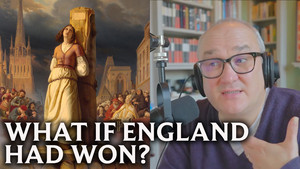
Henry, by the grace of God, King of France and England, to all who will see this present letter greeting
It is sufficiently notorious and well-known how, for some time past, a woman calling herself Joan the Maid abandoned women's clothes and dressed and armed herself like a man, a thing against divine law and abominable to God and condemned and forbidden by every law.
She committed cruel murders and, as reported, seduced and abused simple people by trying to convince them that she was sent by God and knew heavenly secrets.
While fostering these deceptions and engaging in hostilities against us and our people, she was captured fully armed by some of our loyal subjects, then brought to us as a prisoner.
And because many have suspected and accused her of superstition, of spreading false dogmas and of crimes of treason against divine majesty, we have been urgently entreated by the Reverend Father, our beloved and loyal counsellor, the Bishop of Beauvais, to surrender Joan to the Reverend Father for questioning and examination so that, after gathering a proper assembly, he can proceed against her according to the rules and regulations of divine and canon law.
So that was a proclamation issued on the 3rd of January 1431, and it was issued in the name of the nine-year-old king of France, Henri II, who is better known in England as King Henry VI.
Now, Henry had arrived in France in April 1429, and three months later He had made a ceremonial entry into Rouen where unfortunately, Tom Henry had not impressed the locals, had he.
So we are in our final episode about Joan of Arc.
And let's start with Henry VI, the hero of this story in many ways.
So he had arrived.
He's a little boy, he arrives in Rouen and the French sadly, don't really take to him, do they?
Well, so Henry VI is one of the great losers of English history.
And I'm afraid that that kind of trend of being a loser begins early.
Because here he is he's nine years old, he's arrived in Rouen and he does not impress people at all, because the crowds have turned out to cheer him and all he does is complain that they're making too much noise.
He then heads straight into the castle and basically refuses to leave it.
And by early January, when that edict that you read out is issued, he is still there.
He's this kind of nervous, very uncharismatic, effectively invisible little boy.
And this is a huge problem for the English regime in France, because they really need Henry to, you know, work a bit of the old royal magic to work the crowds, all that kind of thing, and henry's simply refusing to play ball.
To be fair, he's nine years old, so i mean, it is what people call a big ask yeah, but?
But i think you either have that uh, that sense for the, for the stardust, or you don't, and henry doesn't, unlike his father, henry v, who absolutely did so.
On the one hand, you have henry, this nine-year-old little boy uh, cowering in the castle.
Now, on the other hand, you have a rival claimant to the uh, throne of france, don't you?
Charles VII from the House of Valois, who for a few generations have been the royal dynasty of France?
And Charles VII, having hitched his wagon to the Star of Joan of Arc, has been crowned king in the great cathedral at Reims, which is where the Valois kings are traditionally crowned.
And by doing that, he has wormed his way into the hearts and minds of his French compatriots.
And actually this is a big kind of psychological blow in the struggle between these two characters for the French throne, isn't it?
It is.
And so the Duke of Bedford, who is Henry VI's regent in France, has decided you know, there's nothing for it.
We're going to have to have a coronation for Henry as well, to try and blot out the memory of Charles VII's coronation.
And this is why he has basically been brought to France.
However, there's a problem with this plan.
Because Reims is still under the control of Charles VII.
So it's inaccessible to Henry VI.
He can't go there and be crowned.
And Paris, which is the only conceivable alternative location for a coronation.
I think Bedford feels it's in a very febrile state.
Again, it's too risky at the moment to take Henry VI there.
So the poor lad, I mean, he's useless, but you've got to feel for him.
He's stuck in Rouen.
It's an absolutely killing winter, completely bleak and freezing.
And he's stuck there waiting for a coronation that it seems might never come.
So, you know, all in all, it's very unfortunate.
But this is not the only possible propaganda coup. that the English have up their sleeves, is it?
Because it's important to them, basically, to undermine the legitimacy of Charles VII.
And if they can't get their own candidate into the cathedral to be crowned, one thing they can do is to cast doubt on Charles VII's coronation by basically saying the person who has arranged all this, the person who lies at the heart of his regime, is not privy to secrets from heaven through voices and angels.
But basically, it's a witch, is a figure of darkness.
And this person is, of course, Joan the Maid who we heard about in the introduction, Joan of Arc, because she's now fallen into English hands.
She has.
She's been sold by a Burgundian nobleman to the English.
And we heard at the end of the previous episode that she'd arrived in Rouen on the 23rd of December 11th.
1430.
And she had been handed over to the guy who is the current captain of the castle in Rouen.
And this is a very formidable man, a guy who makes a very formidable jailer.
He is Richard Beauchamp, the Earl of Warwick.
And he had been a very close friend of Henry V.
Henry V wasn't a guy given to friendship, but he liked Warwick.
And Warwick therefore feels a kind of personal responsibility, I think to Henry VI and had arrived in France essentially at the head of the young king's escort.
And in the words of a contemporary, he was a man of impressive bearing, exceptional judgment and great military experience.
And as such he perfectly understands the urgent need to make an international spectacle of James' trial.
He knows that this has to be done on the stage of not just France, but of the whole of Christendom.
But if that's going to happen, he has to keep a tight leash on her.
Because she's already tried to escape, hasn't she?
Twice.
And the second time, if I remember correctly, she jumped out of a 60-foot tower and basically only damaged her back or something.
Got very badly concussed.
I mean, yeah, I'm not entirely sure.
And this is the Middle Ages, so...
I don't know.
But Warwick is not going to let anything like that happen on his watch.
So the moment Joan has arrived in Rouen, she's taken straight to the city's castle, which is the absolute nerve centre of English rule, not just in Normandy, but probably now by France, because Paris has become so unstable.
And of course, it's the very place where Henry VI is staying.
But Joan's quarters are obviously much less luxurious than the king's.
She is immured in a large, cold, unfurnished cell in one of the towers of the castle.
And it only has two very narrow arrow slits to let in the light.
So it's a very kind of grim place to be kept.
And in this cell, she is shackled by her ankles to a huge wooden beam.
There are four English guards on rotation keeping watch over her day and night.
And Warwick forbids anyone to talk to her without permission.
So she, you know, she is absolutely not, for instance, getting any legal advice.
And this point about legal advice is important, of course, because the English authorities from the outset are determined that she will go on trial.
She will be convicted.
And she will be put to death.
And this, as we discussed last time, is not purely a question of kind of cynical policy.
They genuinely believe that she is a witch and that she represents something diabolical, don't they?
Yeah, I mean, I think Bedford especially does and Warwick does as well.
And This sense that they are dealing perhaps, with satanic powers is one of the factors that has influenced them in agreeing to outsource legal proceedings to the ecclesiastical authorities.
And specifically, as we heard in the edict that you read out from, issued in the name of Henry VI, She is going to be transferred for trial to the Bishop of the Sea in which Joan had first been taken prisoner.
So to quote that edict, our beloved and loyal counsellor, the Bishop of Beauvais.
And this is a guy we've heard of before, Pierre Cochon.
So Pierre Cochon is going to preside over this.
It's important to say, isn't it, it's not a trial process. as we would understand it.
You know, people aren't shouting, objection, your honour, and all of this kind of carry on.
Yeah, it's no jury or anything like that.
No, it is a.
This is an ecclesiastical court and it is literally an inquisition, an investigation into suspected heresy.
And Well, talk us through some of the procedure, because the procedure has been established over the last couple of centuries, hasn't it?
And this isn't necessarily a show trial.
I mean, people take this stuff very seriously.
Yeah, and there's a very precise format by now for inquisitions.
So the initial responsibility of the judges, Cochon is one.
They are also, in due course, going to recruit a local head of the Dominican prior to be the second judge.
Their responsibility is clear.
They have to establish that the person who is going to be sent to trial has a reputation so shocking, so pestiferous, that it positively demands to be investigated.
And in the case of Joan, this is seen as being a very simple matter because she, by this point, has become easily the most famous woman in Christendom, perhaps the most famous person full stop.
So to quote a German theologian contemporary such wonders Joan has performed, that not just France, but every Christian kingdom stands amazed.
So this trial is going to be massive news, whatever happens.
But it also means that on the 9th of January, when Cochon indicts Joan as a woman of what he calls mala fama, so notoriety he can take it as read that everyone knows what she's done.
He doesn't have to kind of adduce it.
He doesn't have to justify it.
And he draws up two particular counts of heretical behaviour.
The first is to quote the charge sheet that Joan had dared to perform, to speak and to publicise many things contrary to the Catholic faith and injurious to its articles.
Secondly that, utterly disregarding the honor due to the female sex, throwing off the bridal of modesty and forgetting all female decency, she wore the disgraceful clothing of men, a shocking and vile monstrosity.
And these two trials signal what, over the course of jones trial, are going to be the main focus of Cochon's investigations.
So specifically, the truth or otherwise of Joan's claims to have received direct communication from the heavens?
So in other words, the validity or otherwise of her voices.
And secondly, what Cochon sees is her absolutely mulish insistence on wearing male dress, which is directly contrary to biblical injunctions.
It's interesting that that issue about male dress looms so large, doesn't it?
It does, for reasons that we'll come to in the course of the trial.
So before that, Cochon has to pile up all of this evidence and all of these documents and stuff.
And this goes to the point about whether or not this is just a show trial by a kangaroo court.
And I believe a lot of scholars now argue that that's to do it an injustice that actually this is a much more serious and painstaking proceeding than is popularly imagined.
Is that right?
Well, and not just popularly imagined, but than is normal in an inquisition.
It is incredibly detailed and forensic.
So, to quote Daniel Hobbins, who published this translation of all the documents relating to Joan's trial into English, and he emphasizes in his introduction to that collection the degree to which Cochon is not, you know, he's not trampling on the recognized procedures in an inquisition.
Absolutely on the contrary, he is going to inordinate pains to ensure that the rules are very, very strictly followed.
And this is why we have all the many documents that we do relating to Jones' trial.
To quote Hobbins, Cochon believed his role in the trial would bear examination from even hostile observers.
And because he knows that, you know there is we've said there's going to be massive, massive international interest in this case.
That's the whole point of doing it.
So he knows that he can't afford to cut corners because otherwise he will get criticism.
Everything has to be done precisely by the book.
And so this is why, even though Cochon had indicted Joan on the 9th of January, he then spends about six weeks making sure that everything is in absolutely perfect order before the trial itself actually begins.
So they send investigators, don't they?
To Joan's home village of Donremy, which is a difficult task because, as we discussed, it's a liminal space.
It was full of bandits and it's now full of French, basically.
So it's a dangerous place for his investigators to go.
And poor Joan has been subject to a lot of physical examinations.
And now she has yet another one by the Duke of Bedford's wife, the Duchess of Bedford.
To check again whether she is a virgin or not.
And she still is.
So she passes that test at any rate.
Yeah.
And meanwhile, Koshan is drawing up all of these lists of questions and stuff, isn't he?
And he's hiring people.
So officials and inquisitors and whatnot.
Yes.
So a huge number of advisors assessors examiners theologians, expert witnesses, all these kind of people are being lined up.
And in fact, over the course of the trial, 131 lawyers theologians priests, abbots end up participating in it.
And the kind of amazing fact for people who think that this is an English kangaroo court all but eight of these 131 figures are French.
That's so surprising.
And of those eight, only three are English.
It's a lawyer and two theologians from Oxford.
Now, that really is a twist, because I'd always assumed this was a completely English-run affair.
But these are French people who are part of Henry VI's party, his faction, as it were.
Are they?
Yeah, all loyal to the Burgundians.
They genuinely think that Henry is appointed by God.
They accept the Treaty of Troyes.
They think that Charles VII is an imposter, a usurper.
So they are all in.
Right.
Well, they sent out tremendous people.
So the 20th of February Cochon is ready and he delivers this formal summons to Joan, telling her you have to appeal before the tribunal the following day.
And so at eight o'clock on the morning of the 21st of February, this very dramatic day begins.
Yes.
So Joan is led down from her cell up in the tower and she's led out into a courtyard and taken to the chapel of the castle in Rouen.
And this is where Cochon and the assessors are gathered.
And of course you know we've said how the apparatus of this trial is very French, but the security is definitely provided by the English.
So there are English guards everywhere.
And the Earl of Warwick is a kind of constant lurking presence in the background.
He is definitely keeping an eye on proceedings.
So Joan is brought in for her trial.
She is still dressed in male clothes.
Her dark hair is still cropped short.
And although obviously she hasn't been getting much sunlight because her cell only has those two arrow slits, she impresses people, I think, with her bearing.
She looks resolute.
She looks unbowed.
But you know, she's a teenage girl and she is being brought into this room full of men, all of whom are much older than her.
And of course, who are infinitely her superiors in learning.
So Joan, you know, we've said she was raised peasant.
She's illiterate.
She has no expertise in theology.
She has no familiarity with the kind of moral and metaphysical terms that her judges and her assessors are going to be bandying around.
And she has no real understanding of the legal procedures that in which she is now ensnared.
She has the vocabulary, she has the modes of expression of a peasant, a very smart intelligent, often sassy peasant.
But she is not a scholar from the University of Paris.
And these are the guys that she is facing.
And I think it is an incredibly Kafkaesque environment because you know, we've said she doesn't have a defence lawyer.
She's going to have to effectively conduct her own defence.
She has all these kind of guys who are large numbers of people who are just firing questions at her.
There's never a single topic.
They're always coming at her at different angles.
There isn't any continuity of the personnel.
You know, one judge will be there one day, gone the next.
I mean, incredibly bewildering for her, I think, and intimidating.
But right from the start she displays confidence, an astonishing degree of self-possession of spirit.
And to read the trial proceedings, I think it is impossible not to be incredibly impressed by her.
So it starts by Cochon tells her, you must swear an oath on the gospels to tell the truth.
And she kind of lays down a marker right from the beginning, doesn't she?
Because she says, I don't know what you wish to ask me.
Perhaps you might ask me things I can't tell you.
Think So what are these things that she can't tell him?
Well, there's a number of things, but absolutely top of the list is her voices.
And she tells Cochon you know I'm very happy to answer questions about my parents or about everything that I've been doing since I left their house.
But to quote her, the revelations to her from God, she defined those voices.
She is saying, you know, that's a different matter.
They are off limits.
And she goes on to explain that she had only ever talked about these voices to Charles VII and she doesn't believe that she is permitted by heaven to discuss them.
And she specifies you know, I am not allowed to talk about them, even were it necessary to cut off my head.
And she then tells Cochon, you know, but I might be able to in eight days time.
What's happening in eight days time?
Well, it's obviously a number that she's kind of snatching.
From the void.
The voices have promised to get back to her by eight days.
Yeah, the voices will get back to her.
Exactly.
Wow.
And Koshal had not been expecting this.
But, you know, he's not having any of it.
And in the days that follow, he and the assessors are just harrowing and chivvying Joan relentlessly to try and force her to talk about the voices.
Right.
So Joan adopts different tactics, doesn't she, to keep the Inquisitors at bay.
So one of them, nice cricketing metaphor for you, Tom, she plays a dead bat.
Next question.
Often she says certainly at the beginning, she says this thing You know, this is just between me and God.
I'm not going to tell you everything for I don't have permission.
But then she changes the strategy at times, doesn't she?
She talks, she says, well, you need to talk to somebody else.
You need to talk to the scholars who investigated me in Poitiers.
Remember we talked about that when it was sort of like a kind of viva she had by Charles VII's churchmen.
And there's such a kind of touching degree of naivety to that, to imagine that the scholars in English Rouen would ever go and consult the scholars in Valois Poitiers.
You know, it's kind of a reminder that she doesn't entirely have a handle on the politics of it all.
I think
And also I mean, having said that she's not absolutely got her finger on the pulse of of the politics, i mean she does have this incredible kind of earthy common sense of a peasant.
If you're a 19th century historian you'd call it yeah, you know.
But she, you know, she's started kind of being badgered by koshore and said you've got to tell us everything.
And she responds as a saying among little children that people are often hanged for telling the truth.
You know, and she's, she's not wrong there.
But basically there are 15 sessions of interrogation And they are exhausting and they are kind of merciless.
And over time, she begins to concede more and more ground.
She does.
So already by the second session.
So remember, in the first session she said I'm not going to talk about voices.
By the second session, she's already doing that.
She's starting to talk about how she first heard them, how she'd known that it was an angel speaking to her.
So all the details that we mentioned in our first episode describing how Joan came to hear the voices back in Domremy this is where those details come from.
And then in the third session, she reveals that the voice is still very much a presence.
It's still very much with her.
So she tells Cochon and the rest of the court that she had heard the voice three times the previous day.
And she specifies once in the morning, once at Vespers and a third time when the bell rang for the Hail Mary at night.
And people may remember that the very first time back in Domremy when she heard the ringing of bells,
She reveals that the voice had woken her up in the morning while she lay sleeping.
And she also says that she had asked it for its advice on how best to deal with her interrogator's.
And she says the voice told me to answer boldly and God would help me.
And then in the fourth session.
So that was in the third session.
In the fourth session we get a real bombshell, don't we?
Because for the first time, she says, I know where the voice comes from.
I know what the voice is.
It is the voice of St.
Catherine and St.
Margaret, and their forms are crowned with beautiful crowns in rich and precious fashion.
So remind listeners, Tom St Catherine of Catherine Wheel firework fame had been martyred for refusing to surrender her virginity.
And St Margaret, exactly the same.
And a further detail St Margaret had been so fired with the love of the gospel that she had dressed up as a man to smuggle herself into a monastery.
Right.
Very, yeah, very suggestive.
So there's an emphasis there on virginity and on cross-dressing, which people may feel is perhaps psychologically significant.
And then, shortly after that bombshell, there's another bombshell, because she describes again in detail the very first time she heard the voice back in Don Remy.
And she reveals who precisely had been behind that voice, to quote her, I saw St.
Michael before my eyes, and he was not alone, but was well attended by angels from heaven.
So St.
Michael, the captain, the archangel, who is the captain of heaven, the great patron of French resistance to the English.
It's St.
Michael also who had spoken to her.
So you've got St.
Catherine, St.
Margaret, St.
Michael.
So you mentioned the great historian Johann Hausinger.
And this argument that basically, this is the first time it's occurred to her who the voices are, that previously she didn't know.
Yeah.
So, to quote Huizinga, it seems plausible to me that it was only fairly late, perhaps even only during her trial, that Joan linked her inspirations to the figures she knew best and cherished most among the saints.
And so these saints, you know, she would have viewed them almost as her intimates.
And I guess what Heusinger is suggesting is that, under the pressure of this interrogation, she reaches for these saints almost as metaphors for the voices.
You know she is being harried and harried, and harried and she's desperate to try and put into words, to explain to her inquisitors what the voices mean to her, why she loves them, why she trusts them, why these voices bring her consolation.
And so she turns to the saints that she loved best.
And I think that what you get in this testimony from Joan is a sense that she is trying to understand what she's been having and definitely her inquisitors are struggling to understand as well because there is a real sense in which what jones testimony reveals is an experience of the supernatural that is fundamentally unlike most other testimonies from visionaries, from people who claim to have heard or witnessed the saints.
So like Catherine of Siena, who we mentioned before.
So it's not like that.
It's different.
It's more earthy, more concrete, more... Less abstract, I think.
Right.
Joan is not a girl for abstractions.
So, on the one hand, Joan is absolutely convinced that her voices do come from heavenly entities, that they are independent of her, that they are exterior of her, that you know they are not rising up from inside her, from her head or whatever.
On the other hand and this, I think, is what distinguishes her from most visionaries she's incredibly matter-of-fact about them.
They are as real to her as her parents had been or, you know, her friends back in Domremy.
So Cochin asks her, did St.
Margaret speak English?
And Joan thinks this is a ridiculous question.
She laughs.
Why should she speak English?
She's not on the side of the English.
And then again, she's asked, well, what about St.
Michael?
Was he clothed or was he naked?
And Joan answers, well, ridiculous question.
Of course God can clothe St.
Michael.
And so I think it's unsurprising that her judges, who perhaps are too attuned to abstractions and to notions of the supernatural and theology and so on,
They really struggled to get a handle on the kind of the vividness of just how real these voices are to Joan.
Interesting.
They don't think that Joan is making this up.
I think there is one inquisitor who does think this, who does think that she is deluded.
I mean, it's not unheard of for teenage girls to make up stuff.
No, it is interesting.
And I think when you read her testimony you can see why they, why they would believe that, because Joan is speaking with an utter conviction.
And although we haven't really heard her in her own voice before this, except when she dictates her letters, I think the way in which she convinces people that what she's saying is true whether it be the king or her fellow captains or the common soldiers or whatever there is an intensity and a conviction that is very convincing.
Now, of course, the issue then, once that is accepted, is if these voices are real, then what are they?
It is impossible for the inquisitors in Rouen to accept what Joan is insisting, that they are of heavenly origin because of course This is a political trial.
And if they accept that these voices are of heavenly origin, then that is immediately to destroy the legitimacy of the Lancastrian regime that they are serving.
Equally, though, to condemn the voices as satanic raises its own issues.
And the inquisitors are learned men and a lot of them are honest men.
And they are troubled by the question of whether it is actually heretical to be deceived by Satan.
Because, you know, humans are fallen.
We are all in a sense deceived by Satan.
Satan is very powerful.
Like, it's not your fault if Satan gets his teeth into you.
And so another example of how this isn't just a kangaroo court opinion among the assessors on this issue is split.
And one of the theologians actually says, well, you know, this is above our pay grade.
I think we should really go and consult the Pope.
And of course, Cauchon and definitely Warwick is having none of that.
You know, we can't afford to involve the Pope in this.
That would be terrible.
So it's a bit of a nightmare for Cauchon.
And what he really needs is for Joan simply to confess her errors and recant, because that would cut the whole Gordian knot.
And so he and his fellow judges focus on two particular aspects of Joan's testimony.
And they've obviously kind of sniffed these two areas as being the ones where Joan is most vulnerable.
And the first of these people may remember, at Torr The Dauphin had asked Joan for a sign to reassure him that she really was who she said she was.
She really had been sent by God.
And you didn't tell us what this sign was.
You kept this a secret, Tom.
Right.
And that is because Joan wanted to keep it a secret herself.
She had been, throughout the course of the trial, exceedingly reluctant to reveal it.
And she kept insisting, you know, I have promised to keep this a secret.
She doesn't actually say who to.
I think the Inquisitors assumed that she had promised her voices.
But it may be that she'd promised Charles VII.
We don't know.
Anyway, finally, she just gets worn down and she reveals the truth.
And she says that an angel had appeared and had brought the Dauphin a crown of purest gold.
The angel appeared to her and to the Dauphin? and to the dofa and to the court everyone in the court in everyone in the court yes okay that this angel had been accompanied by a host of other angels and also by uh saint catherine and by saint margaret what they're all crowded into the council chamber or whatever well jane will later specify that they were very small i mean i think she's implying that they're kind of shaded away into a different dimension throughout her account of this she is obviously really struggling to make sense of something that she feels is real but can't put into words however these are the words that she gives She then says that the angel had given the crown to the Archbishop of Reims and that the Archbishop had then given it to the king.
And I see your expression.
It's one of disbelief and, dare I say, contempt.
Well, you were not alone because...
The theologians listening to this, they just say, this is mad.
This is ridiculous.
And there's one particular one, from Paris, who says this is a presumptuous, misleading and pernicious falsehood, a fabricated matter that diminishes the dignity of angels.
I mean, that's my objection to it, actually, that it diminishes the dignity of angels.
You would have served well on the bench of assessors at Joan's trial.
I think I'd be a brilliant inquisitor, to be honest.
So the other issue, of course, is this perennial question problem of her male clothing, and the reason is because it opens joan up to a very obvious accusation.
Joan says that essentially she is wearing her clothes, her male clothes, because the voices want her to wear them.
However, this is in direct contradiction to the teachings of the church.
So essentially, Joan is placing the testimony of her voices above that of the church, and this is palpably heretical.
She hasn't got a leg to stand on here, basically, not even a leg of male hose.
It also, of course, in the opinion of her assessors, demonstrates that the voices are indeed satanic, because the voices would not be instructing her to do something that is against biblical instructions.
So that also is something where they feel Joan is on a very sticky wicket.
So on the 23rd of May, those two charges the fact that she made up rubbish about the sign that she gave Charles VII and the fact that she insists on wearing male clothing, together with 10 other charges, among which is the proposition that by jumping out of the 60-foot tower she'd been trying to commit suicide rather than escape, and kind of various other items like that.
These are presented to Joan.
She's told that, in the opinion of her judges, these charges satisfy them, that she is indeed a heretic.
And her judges require her to confess and to repent all these faults if she is to be spared.
Right.
And she doesn't, does she?
For my words and deeds mentioned in this trial, I refer to them and I wish to stand by them.
So She's going to stick to her guns.
She's not going to change her gene now.
She's still standing strong.
So the next day, a tumbril is brought to the foot of her tower.
Joan is led down.
She's put into the tumbril.
And the tumbril then rattles through the streets of Rouen to an abbey in the centre of the town where there is a cemetery.
And this is the largest open space in the city. and thousands have gathered there.
And they are gathered around a huge wooden stage on which Cochon is sitting, his fellow judge, the Dominican, all the various other assessors from Joan's trial and a host of ecclesiastical luminaries, of whom the leading figure is a genuine cardinal, the only English cardinal at the time, a guy called Henry Beaufort, who is also he's, the richest man in England and he is the great uncle of Henry VI.
So a very serious player indeed.
Warwick, of course, is also, you know, he's come to watch.
The Duke of Bedford is not there.
He is absent in Paris.
But of course, he is keeping a very close eye on proceedings as well.
So Joan is led to a scaffold and she's stood there to hear her sentence.
Before the sentence is delivered however, a theologian comes forward, joins her on the scaffold and delivers a sermon.
And his text is, a branch cannot bear fruit of itself unless it remain in the vine.
In other words, someone who detaches herself from the vine of the church is asking to be consigned to the fire.
I mean, that's the subtext.
Joan listens to the sermon.
She still refuses to confess.
And so Cochon rises to his feet and he delivers his judgment, which is that the accused is a heretic and therefore, like a withered vine, should be cast out of Holy Church and handed to the secular arm which, in effect, is Warwick and the English.
And The executioner is standing by outside the cemetery, so beyond the consecrated ground of the abbey.
A great bonfire has been prepared.
The stake has been erected.
Everything is ready to go.
The sentence is that Joan is to be burned alive, consumed by the purifying flames of fire.
So the end is approaching, Tom.
But is there a twist?
There is Dominic.
Because as Cochon is saying this, suddenly, unexpectedly, Joan rises to her feet.
And Cochon is so surprised by this that he hesitates.
And as he hesitates, Joan raises her voice again.
And she declares, to the astonishment of everyone gathered there, that she is going to submit to the church and her judges after all.
She is going to abjure her visions and revelations, and she repeats this over and over again.
Joan the maid, at the very last moment, has been brought to submit.
Crikey, what a twist.
Come back after the break to find out what happens next.
Welcome back to The Rest Is History.
What an extraordinary twist.
So, after all that, after all her defiance at the trial, Joan of Arc, to the astonishment of her judges, of the Bishop of Beauvais, Monsieur Cochon, and everybody else who has gathered in the centre of Rouen to see her condemnation to the flames she has just recanted, abjured her sins.
And Cochon, who expected her to go down fighting, is so stunned by this, isn't he, that he doesn't know what to say.
Yeah, and so he turns to Cardinal Beaufort and says, well, what on earth do I do now?
And Beaufort replies that Joan has spoken out as a penitent and so therefore there can be no question of handing her over to the secular arm, in other words Warwick and the English guards, and instead she should be classed back into the bosom of Mother Church.
And this, I think, is a big reassurance to Cauchon, because of course he's not just a cardinal, so he knows what he's talking about on the theological dimension but he is also the great-uncle of Henry VI, so he can be presumed to be speaking for the English establishment at the same time.
And so Cauchon... you know, he's got the backing of the Cardinal.
So he stands up and he orders that Joan's abjuration be drawn up in the form of a document.
And this document obliges Joan specifically to acknowledge that she had been the dupe of evil spirits.
And the emphasis is on that word dupe.
So she is not admitting to witchcraft, but she is publicly stating that she had been tricked by satanic forces and when she led Charles VII to his coronation in Reims.
And this, in the opinion of Cochon, is sufficient.
Job done.
You know, he's got his result.
Right.
So she wasn't colluding with evil.
She was deluded by evil.
That's an important, important difference, isn't it?
Yes.
And so this abjuration is then brought to Joan and she marks it with a cross.
And Cochon now delivers his sentence on the penitent.
First of all, he releases her from the bonds of her excommunication.
But then, in the very next sentence, he delivers a crushing blow which obviously stuns Joan, who I think was expecting that with her abjuration she would be set free.
Cochon declares Because you have rashly sinned against God, we condemn you to a salutary penance of perpetual imprisonment, with the bread of sorrow and the water of affliction that you may weep there for your faults.
And Joan is then bundled away and she is led back to her cell where, a few hours later, she is visited by a delegation of clerics, and they bring her a dress, a woman's dress, which she obediently puts on.
And she is then shaved bald so that all traces of her, you know, her masculine haircut is gone.
So big blow to Joan this because she, I think, probably very naively thought that they would just say oh well, you know, off you go.
Well done.
But she's going to be locked up forever.
Now, what did the English high command think?
Because they wanted to make a real example of her, because they genuinely believed that she was serving the interests of Satan and supporting the French and hearing her voices and stuff.
And now they've been slightly frustrated of their goal, haven't they?
Yeah well, Bedford isn't actually there, but I think there's no question that all along, his goal has been to see Joan condemned as a sorceress, because her powers of witchcraft are essentially what excuse him his failures.
If he can blame the disasters that have overwhelmed the Lancastrian regime in France on sorcery, then in a sense he is absolved of personal failure.
And this, of course, is a kind of tribute to Joan.
It's an acknowledgement that I suppose that, rather than just being a duke, She'd been something much more sinister, much more significant, that she personally had been the agent of English misfortunes, which in turn is to cast her as someone kind of special.
And I think there's an irony here because for Joan, the sense of herself as someone special I think that also was very important to her.
And I think that in the days that follow her confession, she starts to reflect on this.
And she thinks I've given up this sense of myself as God's medium, as God's messenger, in exchange for life imprisonment.
Is that a reasonable exchange?
And so she falls to pondering her future.
Yeah, she's given up her identity, right?
As she sees it.
She's given up what made her special.
And now she's bitterly regretting it because she's just sitting there in prison.
And that will be her reality for the rest of her life.
And she's betrayed her king.
And I think most crucially of all, she has betrayed her voices.
And so, four days after her recantation, ominous news is brought to Cauchon and to Warwick that Joan has put her male clothes back on.
When her assessors come to see her.
She gives various reasons for doing this.
First of all, she claims that she was tricked into swearing never again to wear men's clothes, that she hadn't realized that was what she was doing.
She then, i think, also strongly implies that her guards were sexually abusing her.
So, to quote the record of the clerk who was taking the minutes that, being among men, she thought that wearing men's clothes was more lawful and appropriate than wearing women's, And she also declared that she would rather die than spend her entire life, you know fettered, living on bread and water.
And so her judges, I think, are clearly stunned by this.
And they say to her, well, you know, if this was the case, why ever did you confess?
Why ever did you abjure?
And then comes, I think, the most touching moment in the whole story of Joan.
She answers very simply.
And it brings home to you, this is a teenage girl.
She says, I did it for fear of the fire.
And I kind of find it heart-rending.
And perhaps even at this late moment, she might still have saved herself.
But then comes the straw that breaks the inquisitorial back.
Again, to quote the clerk who's been taking the minutes.
She was asked whether she had heard the voices of St.
Catherine and St.
Margaret since the last Thursday, which is when she had repented.
She said yes.
Oh no, she's back on the voices again.
And the clerk then later scribbled in the margin of the minutes this single comment.
Responsio mortifera.
A fatal reply, the reply that is going to kill her right, because the very next day, the 29th of may, cauchon gathers his experts in theology and canon and civil law.
They meet in the archbishop's residence in rouen, and their verdict is unanimous, isn't it?
Joan is now very.
She has outed herself very clearly, in defiance of the court and of their opinion, as a heretic.
Yes and so.
That being so, the church washes her hands of her and they decree that she is unregenerate and therefore excommunicate and therefore to be handed over to the secular power.
And the next day, early in the morning, very early in the morning, one last deputation of clerics come to visit her.
And you can imagine how thrilling that must be for Joan on her last day.
Yet another load of clerics.
And Joan talks to them in very muted, very despondent tones, as well she might have done.
And you can see what she's been thinking about from the topics that she brings up.
So her thoughts are still very much on Charles VII and that sign that she had given him.
And you can tell that she has been turning it over in her mind, that she's really been struggling to make sense of what precisely had happened.
And she says that yes, there had been an angel who had given the Dauphin a crown, But that angel, she now says, had been herself.
That's a mad thing to say.
She's gone from saying the room was packed with angels who were two feet tall to saying actually I was the angel.
I think to say I was the angel is high risk.
I think that it was a very intense moment for her.
I mean, who knows what was going on?
But definitely she felt that something had happened and that she she is trying to make sense of it still in her very last hours.
And then, of course, she speaks of her voices and she declares whether they are good or evil spirits.
They appear to me.
So that suggests a degree of doubt that she's wobbling again.
I don't think she's wobbling, but that she loves them and she's going to stay loyal to them, even if, you know, at the cost of being burnt to death.
OK.
So then a friar enters the cell and hears Joan's confession.
And then, throughout this, the term of her imprisonment, Joan has been denied communion, been denied the Eucharist.
And she has a great devotion to the Eucharist.
And so this has been a source of great distress to her.
And now I think a gesture of mercy on Cochon's part, he allows her to have communion.
So that's nice of him.
Well, that's kind.
It's now nine o'clock and it is the morning of the 30th of May, 1431.
And Joan is brought from her cell.
She's weeping.
She is surrounded by a large squad of English soldiers and they escort her from the castle to the market square in Rouen. where inevitably a huge crowd they've picked up on the news they've gathered joan is in male clothes so she's not forced into a dress um and on her head she wears a kind of a cap like kind of old-fashioned dunce's cap it's um inscribed with the words heretic relapse upper state idolater so uh that's all bad news and basically the format of On this morning is the same as it had been six days previously.
So a sermon is given and then Cochon reads out the sentence.
But this time, Joan keeps silent.
The sentence is delivered and accepted.
And Joan is then handed over to the English guards, who remove her up to the top of an immense bonfire and Joan is weeping and she requests crucifix, and an English guard, with a kind of display of mercy, of kindness, of sympathy, gives her a makeshift crucifix and Joan hugs it to her chest as she is then chained and bound to the stake.
And the fire is lit and the smoke begins to rise.
And Joan, her lips had been moving in silent prayer throughout, And then people in the crowd hear her cry out through the smoke Jesus Jesus, Jesus.
And in due course, decades later, lots of stories would be told of her death.
So there's a story that a priest had rushed to a nearby church and had brought out a crucifix from there, you know, on a great kind of pole, and held that before her for as long as she could see it, until the smoke blotted it out.
That the executioner, that one of the English soldiers, even Cardinal Beaufort himself, had wept to watch her fate and that her heart, no matter how repeatedly the fire was stoked, refused to burn.
And again, people can make of those stories what they will.
But of one thing there is no doubt once the embers had cooled, her ashes were swept up and they were dumped unceremoniously into the Seine.
So six and a half months after that, in Paris, in Notre Dame no less, Henry VI was crowned as Henry II of France.
Now meanwhile in the court of Charles VII, the rival court, has Joan been turned into a martyr?
Have there been howls of protest?
Has her death become a symbol of suffering, of the sanctity of France violated by the English.
No, they don't make anything of Joan at all.
Isn't that extraordinary that Charles VII, who owes her so much, basically acts as though she never existed.
Well, is it extraordinary?
I'm not sure it is because Joan has become a huge embarrassment.
And, you know, she is now a condemned heretic.
So Charles VII wants to keep very, very quiet about it.
But the thing is, people do not forget about her.
She remains very much an emblem of French resistance, despite her fate.
And her death does not lead to a revival of Lancastrian fortunes.
And the coronation of Henry in Notre Dame does not blot out the memory of how Charles VII, with Joan at his side, had been crowned in Reims.
And the continuing silence of Charles VII.
The ungrateful silence of Charles VII, one might say, his refusal so much as to mention the name of this peasant girl who had done so much to save him from ruin.
This doesn't mean that Charles has forgotten Joan.
And actually in due course, 19 years after she had been burnt to death in Rouen in February 1450.
Finally, Charles does speak her name.
And he says a long time ago, Jeanne Lapucelle was taken and captured by our ancient enemies and adversaries, the English, and brought to the city of Rouen.
And the reason that Charles feels able to speak her name at last is because since Joan's death and 1450, so much has changed.
So to go through some of the bullet points here.
In 1435, the Duke of Burgundy, Philip the Good, who for so long had been resolute in his refusal to reach terms with the guy who he blamed for murdering his father, namely Charles VII.
He does come to terms with Charles VII, and a pact is signed between France and Burgundy, and this effectively leaves the English alone.
The following year, Charles VII enters Paris.
He has reclaimed the capital of France.
1440, a real straw in the wind.
The English are so desperate to try and patch up terms that they allow the Duke of Orléans, who'd been kept as a prisoner in England since the Battle of Agincourt.
They allow him to come home, back to France.
And his captivity had been the longest of any prisoner in the And in November 1449, so that is four months before he finally mentions the name of Joan of Arc.
He had entered Rouen, the capital of English Normandy, and he does so beneath the fluttering of the standard of Saint Michael the archangel.
And by his side, his greatest captain is with him.
And this is the man who is no longer known as the bastard of Orléans but, since 1439, as the Count of Dunois, the guy who had been at Joan's side at her greatest triumph, at the relief of the siege of Orléans.
So it's now, when they reclaim Rouen 19 years later, that they finally address the issue of Joan and her treatment by the English.
And this is the point at which Charles VII basically, I guess he kind of institutionalises the idea that Joan was a martyr destroyed by a kangaroo court.
Yes.
So again, in this proclamation that he issues in February 1450, the English had tried Joan by certain persons who had been chosen and given this task by them.
And during this trial, they made and committed several errors and abuses, such that, by means of this trial and the great hatred that our enemy had against her, they had her put to death very cruelly, iniquitously and against reason.
And you can see why Charles is now saying this because if he can have that original verdict scrubbed, then that is a real help in legitimising his own coronation.
And Charles VII does what leaders do today when they want something done.
They institute a public inquiry.
And for the next six years, a succession of these inquiries, these inquests, these reports are delivered and they culminate in an official retrial.
And they sift through all the details of Joan's life and all the details of her death.
And it has to be said that, while this is going on, the public, you know, the public stage of france, great events continue to happen and these events serve as a reminder to everyone in france.
That joan, you know, she'd said that she would uh, relieve the siege of orleans.
She did.
She said that she would crown charles vii, and she did.
And she had said that the english would be, to quote her, kicked out of france, You know, by 1456, when the retrial is staged.
That has come true.
So in 1450, the French complete their conquest of Normandy.
In 1451, Gascony in the southwest of France.
So Bordeaux and all of that you know had been a possession of the English crown for 300 years by this point.
The French take that back.
1453, the old war dog Sir John Talbot dies.
You know, the guy who'd been fighting at Orléans, who'd been captured at Patay, who had remained the most menacing of all the English captains resisting the French.
He gets killed.
His army gets wiped out in Gascony by French artillery.
It's a very symbolic moment.
You know, the Longbowmen are superseded.
The age of English military supremacy has gone.
And, in effect, the death of Talbot at the Battle of Castillon in 1453 marks the end of the Hundred Years' War.
And of all the many conquests of Edward III, of Henry V, there is only one tiny fragment of France that remains to England, and that, of course, is Calais.
And even that will be lost a century later in the reign of Mary Tudor.
Of course.
But the real moment that sets the seal on France's victory comes in july 1456.
The 7th of july doesn't end.
It comes in the palace of the archbishop of rouen, and this is the day that the judges who have been appointed to review joan of arc, jean lapucelle's trial, that they meet to announce the results of their inquiry.
Yeah, and they have.
You know, they've consulted a great number of people, so people who've known joan, everyone from from Joan's mother to Dunois, the bastard of Orléans and the Duke of Alençon.
You know, people remember.
You know her biggest ducal fan.
They'd all given evidence.
Of course, one person who had not given evidence was another of her comrades-in-arms, Gilles de Rais, the breton guerrilla leader, and that was because he had been executed in 1440 on a charge of heresy and of raping and murdering and i quote the charge sheet 140 or more children.
Yeah, not a good guy.
He's an embarrassment.
The veil is drawn over him.
So what's the verdict of the judges?
They announced that Joan's original conviction had been invalid, that it had been delivered corruptly deceitfully slanderously, fraudulently and maliciously.
And of course this not only redeems Joan's own reputation.
It also confirms that Charles's coronation in Reims had indeed been ordained by God.
And so Joan is no longer condemned as a heretic.
And she can be inscribed in the annals of French history as the country's greatest heroine.
And it is a position that she has held ever since, right the way up to the present day.
And next week, in a special bonus, we will be exploring that legacy and, Of course, if you want to hear that, you know what you've got to do.
You've got to go to therestishistory.com and sign up there.
But Dominic, before we leave, we have one last duty to perform.
And that is to pay tribute to a hero of France whose achievements have been, if anything, even greater than those of Joan of Arc.
And who is this paragon?
So this is somebody else who came from a very obscure background Tom, and rose to tremendous heights, undreamt of by his peers.
He too has spent years hearing voices, not the voices of St.
Catherine and St.
Margaret, but rather more cheerfully, our voices, because this person is Theo Young-Smith, our producer.
So he has produced, at my count, at least 450 episodes of The Rest Is History since he joined the show at the end of 2022.
He has run recordings in Ireland, in France, in the Netherlands, in Bosnia-Herzegovina.
He's run several live tours of the United States and Australia.
He's taken us to New York, to Los Angeles, to Disneyland and to the Sydney Opera House.
He's taken the rest of his history to heights we would never have dreamed of when he joined the show.
He's been a great friend and comrade to us.
He is a credit to Scotland, to France, and of course to Wellington College.
And Tom, he will leave.
He's moving to spend more time with his Nintendo Switch.
And he...
And he will leave very, very, very big shoes to fill.
So we are tremendously grateful to Theo, aren't we, for the last three years?
We are so grateful.
And we know we're not a little gutted that he's moving on because he has been so influential on this podcast has played such a crucial role in its success.
And This is not the last we will be hearing of from Theo, because he will be coming on a bonus in due course where we'll talk to him about everything he's done with the rest of his history.
And perhaps he'll tell us what his plans are.
Because to be honest, they are as yet opaque.
He'll also.
So about six months ago, he began work on the famous Stones bonus the Rolling Stones bonus, in which he claimed he was piling up books in his garret.
And the Stones bonus has never materialized, basically because he's been too busy working on the show.
But finally, admittedly, very belatedly, the Rolling Stones bonus will finally materialize.
So that's something for everybody to look forward to.
So two bonuses to come with Theo.
One where he talks about himself, which he'll enjoy.
And one where he talks to Dominic about the Rolling Stones, which I think he will also enjoy.
So everybody, thank you very much for listening.
Tom, thank you for four splendid episodes.
And above all, Theo, thank you for everything.
Bye-bye.
Bye-bye.
A billionaire financier.
Powerful friends.
Hidden networks.
And questions that refuse to go away.
Was Jeffrey Epstein a spy?
I'm Gordon Carrera.
And I'm David McCloskey.
And we're the hosts of.
The Rest is Classified the intelligence and national security podcast from Goldhanger.
And we've just released a gripping new series investigating whether Epstein was linked to any spy agencies.
And asking what those agencies might have known about him.
Listen or watch now on Spotify, YouTube, or wherever you get your podcasts.