If you want more from the show, join the Rest Is History Club.
And with Christmas coming, you can also gift a whole year of access to the history lover in your life.
Just head to therestishistory.com and click gifts.
This episode is sponsored by Hive.
Britain revolutionised the future with the might of industrial power.
But now you can transform your own energy future and take control with the power of Hive, with solar panels, turning sunlight into greener electricity and enabling you to sell excess back to the grid.
And Hive's thermostats make it possible for you to heat your home without lifting anything more than a thumb and an impressed brow.
Their heat pumps draw warmth from the air and they keep it exactly where you want it.
No smoke, No waste.
Hive's EV charger lets your car charge quietly overnight.
Recharging while you do too.
Hive brings it all together.
Heating, charging and solar.
Managed from one simple app in a quiet revolution.
In the long history of power, Hive helps you finally know yours.
Head to hivehome.com to find out more.
Subject to survey and suitability.
Hive app compatible with selected technology.
Paid for surplus requires SEG tariff.
Hello everyone and I hope you had a wonderful Christmas.
Now we have two festive treats coming up for you today and on Thursday.
And these are two halves of a show that we recorded at the Royal Albert Hall on the 4th of May this year with a full orchestra and professional opera singers.
And it has to be said, me.
So like last year's episodes on Mozart and Beethoven, these episodes will be accompanied with music.
The first episode, today's episode, is on Tchaikovsky, and Thursday's episode will be on Wagner.
Enjoy. so ¶¶
Thank you.
¶¶
So welcome or welcome back to the Rest History Live with Orchestra.
We have the amazing Philharmonia Orchestra here with us.
And today we're playing probably my two favourite composers, Tchaikovsky and Wagner.
So here to tell you more about them are Tom Holland and Dominic Sandbrook.
Hello Kensington gore and welcome to.
The rest is history, Dominic.
It's fantastic to be back at the Royal Albert Hall, isn't it?
And thank you so much, everyone, for coming.
And wow, do we have a show this evening.
We do indeed.
So we will be talking about not just two of Oliver's favourite composers, but two of the greatest composers who have ever lived.
Their lives a brilliant window. into the surging passions of the 19th century.
So we'll be in Russia under the Tsars, we'll be in Germany in the age of Bismarck.
A world of romantic idealism, of sexual secrets, of Tom, some very pungent politics.
Very pungent.
We do like pungent politics on The Rest Is History.
This show really does have it all.
It really does.
And you've already had a flavour of the music we're going to be hearing this evening.
So that, of course, was the opening of Tchaikovsky's Ballet Swan Lake, first performed in 1877 and, as Ollie said, played by the Philharmonia Orchestra and conducted by the equally brilliant Oliver Zethman.
And we should start by paying tribute to Oliver because these shows were his idea.
He literally put the band together.
And as you will find out, and as you've already discovered with that wonderful performance of Swan Lake, he's not half bad at conducting either.
Not bad at all.
But let's get right into our first story.
And this is the life of perhaps the most romantic and certainly the most flamboyantly Russian of all the great composers.
Right, exactly.
So...
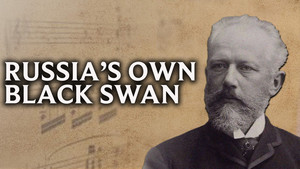
This whole show that we have for you this evening is very much a 19th century affair and we're going to kick off in the year 1840, because that is the year that a young Pyotr Ilyich Tchaikovsky was born in a little iron-making town called Votsinsk, which is about 600 miles east of Moscow, in the foothills of the Urals.
So we are deep in the heart of russia.
We're in a classic russian landscape, the kind of churches with their golden domes, the vast fields, the deep birch and beach forests.
It's the kind of landscape that is familiar if you've read uh, tolstoy or dostoevsky or any of the great russian novelists.
Exactly, exactly.
So to give you a bit of context, Russia at the time is an autocracy ruled by the Romanov Tsars, and it's got this vast population of serfs and peasants.
Now, it's often described as a backward country, but that's not necessarily true in every respect.
Russia has been expanding at a colossal rate by 1840, when tchaikovsky is born, it's a vast continental empire, all the way from finland and poland to the caucasus and the pacific, and tchaikovsky's family is doing well out of the russian empire, isn't it?
Um, so his, his father, manages the local ironworks.
They've got servants And actually shocking detail Dominic Tchaikovsky's mother's family are actually French.
They are Huguenots who fled to Russia as refugees.
So we're not holding that against them.
No, we don't hold that against them.
So he even actually had a French governess.
And we know a few details about Tchaikovsky's early life from the French governess.
She said he was a bright boy, but incredibly sensitive.
She said he was as brittle as porcelain, a child of glass.
And Tom, very much like our goal-hanger stablemates.
We actually have Rory Stewart with us in the audience.
And nobody would ever say Rory was as brittle as porcelain.
Of course not.
Of course not.
So the Tchaikovskys...
They're not a tremendously musical family, actually, as it happens.
I mean they do have a piano, but basically everyone who's middle class in the 19th century has a piano.
And none of them are very good at playing it.
No, they're not terribly good at it.
But then one day, Piotr's father, Ilya, comes home from St.
Petersburg.
He's been on a business trip.
And he has this kind of barrel organ called an orchestrion.
And the point of this machine is that it would basically mimic the sound of an entire orchestra.
So we wouldn't actually need the Philharmonia if we could only invest in one of those.
Oliver's life would be so much easier.
So this is how the young Tchaikovsky falls in love with music.
Basically, you feed a sheet into this thing, and you turn it.
It could be Mozart's greatest hits, and away you go.
And actually, it's Mozart that Tchaikovsky really falls in love with.
Mozart becomes his great hero.
So in the next few years, the family move around quite a bit.
They see the cities, St.
Petersburg and Moscow.
They go to different places in the Urals.
And I often wonder whether this is the fact that they move around, whether this gives Tchaikovsky one of his defining traits, which is an extraordinary affinity with the people and landscape of Russia, this intense sense of patriotism.
Much later on in life he wrote I have never come across anyone more in love with Mother Russia than me.
I love Russian people, the Russian language, the Russian way of thinking.
I love the sacred legends of the dim and distant past.
I love it all.
Almost the paradox of this is that even as it's very Russian, it's also very European, isn't it?
European culture is still very marked by romanticism, by the cult of landscape, the cult of sensibility and, I guess, above all, the cult of nationalism.
So all sorts of writers and composers across Europe, not just in Russia, are fascinated by folk traditions and history and ancient myths and legends.
And we will be coming on to someone else who is interested in myths and legends in the second half.
We will indeed.
But at the time when he was growing up, I think, to his family, the idea that Tchaikovsky would be the great Russian musical vehicle for all this would have seemed relatively unthinkable.
Because although they have a piano...
Most Russians, as you said, have a piano, most Russian middle-class families.
But in Russia, middle-class boys don't go on to become musicians.
So when they go to the opera house or the concert hall, the musicians they hear playing are touring Western European musicians.
It's not seen as a proper thing for someone like Tchaikovsky to do.
So to begin with, Tchaikovsky doesn't pursue a musical career.
He pursues a much more glamorous profession, which is to become a civil servant.
And I'm not joking when I say that, because I mean anyone who's read a Russian novel will know that to be a civil servant is really quite something.
Very prestigious vocation, very difficult to get into.
Right, it is difficult to get into.
So when he's 12 years old, his parents sent him to a boarding school in St.
Petersburg, which is called the School of Jurisprudence.
That's where you learn to become an official.
So he wears a military uniform.
He has to swear an oath at the age of 12 to God, throne, and motherland.
And he has to work every day from 6 o'clock in the morning until 10 o'clock at night.
And that is the routine, Tom, that we have replicated with our own producers, Theo and Tabby.
I think, Dominic, you are flattering Theo there, who is never knowingly up before midday.
No, you're right.
It's sweet of you to say that.
So Tchaikovsky is there in this school until he's 19, and then he becomes an administrative assistant at the Ministry of Justice.
But all this time he's been into his music.
He's been writing waltzes and songs and things.
And unlike most civil servants, he becomes a real dashing, sort of swashbuckling man about town.
I have to say, his dad is very impressive at this point.
So he's about 21 and his dad sits him down and says this civil servant thing, it's obviously not you.
Why don't you go for music?
Why don't you try it?
And so Tchaikovsky says, well, if dad's saying that, I might as well.
And he does.
And the timing is perfect because the following year in 1862, St.
Petersburg's first musical conservatory opens its doors and Tchaikovsky is there.
Right.
He's one of the very first students.
And like a lot of students, he reinvents himself.
He grows his hair long.
He wears much more sort of raffish clothes.
So kind of Carnaby Street in the 60s?
Well, as we will discover, slightly more San Francisco in the 60s.
Yes, of course.
So he's sort of turning himself into an artist with a capital A And eventually he gets a job in Moscow teaching music at the new conservatory there.
So now he really has become a proper kind of working musician, a working composer.
He teaches students.
He writes songs, he writes little operatic pieces, a first symphony, and all the time he is developing this intensely romantic style, sometimes grand and sweeping, but sometimes very kind of delicate and intimate.
Yeah, and we're going to hear an example of that right now, aren't we?
And, Dominic, it's a song he wrote in 1869.
But because I don't speak Russian and because you are the master of tongues, perhaps you'd like to give the Russian title first, before we come on to the English translation.
Yeah.
Close your ears, please, Oliver.
It is... What is it?
You heard... You all heard... which, Tom, as you will know, translates as None But The Lonely Heart.
And a great favourite of Frank Sinatra, who recorded it four times and sadly Frank can't be with us this evening.
But it doesn't matter, because we have an even better singer than Sinatra, and that is Marta Fontenelle-Simmons, who is going to perform None But The Lonely Heart for us now.
Only the one who knew the light of desire will understand how I suffered and how I suffer.
Thank you.
.
.
.
.
.
.
.
.
.
.
.
.
.
.
.
.
.
.
.
.
.
CHOIR SINGS
But who will give me a husband who will understand how love is and how I am?
¶¶
You see, who needs Frank Sinatra?
That was Marta Fontenot-Simmons and the Philharmonia Orchestra, conducted by Oliver Zeffman.
Absolutely wonderful.
Now Tom, I know your Russian is absolutely perfect, so you won't need me to translate any of those lyrics, but just in case For everyone else,
Yeah, for everybody else.
None but the lonely heart can know my sadness, alone and parted, far from joy and gladness.
And they capture something, I think, that is central to Tchaikovsky's reputation the great secret drama of his life, which is, of course, his love life.
So Tchaikovsky probably first fell in love when he was a teenager at the School of Jurisprudence, and his love object was another student, a young man called Sergei Kirieff, who was about four years younger than himself.
Now, it probably wasn't a physical relationship, probably a case of adoration from afar.
But then Tchaikovsky fell for another young man, Alexei Apuktin, who ended up becoming a poet.
And this probably was a physical relationship, and it was the first of many in Tchaikovsky's life.
And I think it would be fair to say that the vibe of Russia in the 19th century isn't massively kind of gay-friendly, is it?
LAUGHTER
So we are doing a series starting tomorrow, actually, on Peter the Great.
And he had decreed the death penalty for any hint of homosexuality in the army back in 1706.
And then, in 1832, Nicholas I, another Tsar, had declared that any civilian convicted of homosexual behaviour would be packed off to Siberia which, to be fair, basically seems to be the response of Russian Tsars to almost anything.
LAUGHTER
But most of these punishments were never carried out.
And I think that's because in 19th century Russia, homosexuality, it didn't kind of define you.
It wasn't an identity.
It was seen as just being a taste.
And so if you had money and if you had connections, the chances of prosecution, let alone conviction, were actually very, very small, weren't they?
Yeah, they were small.
It's really interesting.
So, as you said, homosexuality is condemned as a vice by the Orthodox Church.
But it's fascinating that in all Tchaikovsky's life there is only one tiny hint of scandal or public criticism.
And that's a newspaper article in 1878 that was sort of muttering darkly about the teachers' love affairs at the Moscow Conservatory.
And even though Tchaikovsky visited gay brothels, he went cruising in parks.
He made no secret of his affection for handsome young men.
That was really the only tiny hint of public scandal in all his life.
But that hasn't stopped Tchaikovsky's biographers since from kind of basically tearing each other to shreds over the question of whether he felt haunted by his sexuality or whether he was completely mellow about it.
Yeah, so in the Soviet Union, this was a big problem. for historians and biographers of Tchaikovsky.
And they went out of their way to play down his sexuality.
And in fact Soviet historians effectively went into the archives to erase material that they thought presented him in a bad light.
But in the West, particularly I have to say in Britain, people tended to play it up.
So in the 20th century Tchaikovsky became in western scholarship he was seen as the gay composer, so first of all kind of condemned as a hysterical neurotic and then held up as a kind of as a hero of gay rights.
But I mean not saying that he's a hysterical neurotic, but there are hints that he struggled with his sexuality, aren't there?
I mean that he he finds it hard to sleep at times.
He seems to have become depressed.
He has kind of nervous breakdowns occasionally.
Yes, but that said, most recent writers point out that he led a very active and indeed very colourful love life.
In fact...
I think we can safely say, a little too colourful for 21st century tastes.
Because he almost always fell for men who were a lot younger than himself.
Boys.
Well, he was particularly drawn to boys of about 14 or 15, which a lot of people may find very unsettling.
So, I mean, he's kind of the Russian Oscar Wilde, maybe, in that sense.
So a kind of a great gay icon.
But a lot of his gay relationships are with people who are much younger than him and so inevitably there is a kind of power differential.
There isn't there.
Yeah, I think that's fair to say.
I think it's a pattern you see again and again in Tchaikovsky's life.
So there's a musical prodigy called Vladimir Shilovsky, who's 14.
Then there's a 15-year-old, a music student called Eduard Zak.
And Tchaikovsky had a real passion for him, and Zak actually ended up taking his own life a few years later.
And a lot of this story is very murky because it was effectively erased by Soviet censors.
So it's very hard to say what exactly happened between them, but what we do know is that Tchaikovsky was absolutely devastated afterwards.
And one of his biographers says you sense the presence of a complex and intense psychodrama that is almost entirely hidden from view.
And hidden from view presumably because Tchaikovsky himself is trying to bury it.
So there's doubly a kind of darkness, a darkness that Tchaikovsky wants to bury the memory of this in, but also a kind of personal darkness that Tchaikovsky is feeling kind of element of self-hatred, perhaps almost depression.
Yeah, I think that's fair to say.
I mean after Zach's death, he goes into this deep, deep depression and then, as so often, he emerges with a great burst of energy.
So it's 1875.
He comes out of this depression and he's commissioned to write a ballet, and that became the piece we heard at the beginning, Swan Lake, one of the most beloved pieces in the whole canon.
And then, a year after that, he falls in love again with a violinist called Josef Kotek, who was then 21.
When, for hours on end, I hold his hand in my own, passion rages within me with unimaginable force.
My voice shakes like that of a youth, and I speak a load of nonsense.
And Dominic, that is Tchaikovsky, not you.
That's not me talking about Theo, Tom.
That's Tchaikovsky talking about this bloke, Kotech.
So this is a letter that he writes to his brother Modest, his younger brother Modest, who is also gay.
And they would talk quite openly about all of this, which leads me to think that Tchaikovsky is probably not quite as tortured and as repressed as we often assume.
I suppose another issue is, I mean, honestly, I mean, who ultimately cares?
Does this matter?
Of course, in the immediate aftermath of Tchaikovsky's death, there are lots of people who feel it does matter.
So...
Tchaikovsky dies and Tolstoy, who by this point is about 810.
He writes there is always something not quite clear about him, more as a man than as a musician, which I'm guessing is a reference to his sexuality.
And certainly in the decades that follow Tchaikovsky's death.
There are critics who condemn his music as neurotic and effeminate.
Presumably, they are saying that because they're not really talking about his music at all.
They're talking about his posthumous reputation.
Right, but I think with all of this stuff, it's important not to sort of blow it out of proportion.
There's a great music critic of the 20th century called Richard Taruskin and he wrote a brilliant, brilliant essay on all this, which actually Oliver, our conductor, put me onto.
And Taruskin said look, we should stop seeing Tchaikovsky as this angst-ridden, guilt-ridden kind of neurotic artist.
By and large, this is somebody who is very successful, who has loads of fun, actually loads of money, and is generally pretty happy.
All of that said Tom, you are right that there are issues, shall we say, because in 1876 he does basically the most unexpected and implausible thing you could possibly imagine.
I mean so unexpected, so implausible that I think we should probably have a bit of music beforehand to brace ourselves for it.
And what we're going to hear now is a piece he wrote in 1878, amid the great emotional crisis of Spoiler alert Tchaikovsky's marriage.
And that is what we will be coming to in a moment.
But first, the third movement of his violin concerto, played by our soloist, the brilliant Lea Zhu.
Enjoy.
MUSIC PLAYS
.
.
.
¶¶
¦ ¦
Thank you.
¦ ¦
¶¶
¶¶
¶¶
¶¶
¦ ¦
¶¶
¦ ¦
Thank you.
¶¶
¶¶
Thank you.
Thank you.
¶¶
¶¶
Thank you.
This episode is brought to you by the Philharmonia Orchestra, who are turning 80 this year.
And to celebrate, they're giving away 80 free tickets for first-timers for every concert in their 2025-2026 London season.
Now, if you've never booked with the Philharmonia before, you can choose any concert in their London season.
They're all at the South Bank Centre.
You can get two tickets completely free.
There is no catch.
Just world-class music. live.
So the Philharmonia's first concert was in 1945, and ever since then they have been a part of Britain's cultural fabric, constantly evolving and always ambitious.
They have scored more than 150 film soundtracks and video game soundtracks.
They've collaborated across all kinds of genres, classical icons, jazz.
They've even done heavy metal.
I mean, this is not just orchestral.
It is adventurous.
So this is your chance to experience one of Britain's great orchestras and some of the world's top soloists in one of the world's great venues.
To book, head to philharmonia.co.uk slash free tickets.
That is philharmonia.co.uk.
Come for the music.
Stand for the ovation.
This episode is brought to you by hotelscom.
Make your next trip work for you.
Hotelscom just rolled out a game-changing feature called save your way, and it's as simple as it sounds.
When you book a trip as a hotelscom member, you decide how to use your savings.
Choose to take the instant savings now or to bank the savings as rewards for later.
It's your call.
Envision converting discounts on this week's day into rewards for a luxurious beach getaway next year.
No complicated maths, no blackout dates.
Just you choosing how to make your travels work harder for you. only at Hotels.com.
Save Your Way is available to loyalty members in the US and UK on hotels with member prices.
Other terms apply.
See site for details.
Hello, I'm Professor Hannah Fry.
And I'm Michael Stevens, creator of Vsauce.
We thought we would join you for a moment, completely uninvited.
We are not going to stay too long, unless you want us to, of course.
We're here to tell you about our brand new show, The Rest is Science.
Every episode is going to start with something that feels initially familiar.
And then we're going to unpick it and tear it apart until you no longer recognise it at all.
Yeah, banana flavour doesn't taste like bananas.
Yeah, what is that about?
So it is supposed to taste like an old species of banana that was wiped out in a banana apocalypse.
And now you will only find it in botanical collections in the gardens of billionaires.
Wow, banana candy is actually the ghost of a long extinct banana.
So if you like scratching the surface, thinking a little bit deeper or weirder yes, definitely that too.
You can join michael and i every tuesday and thursday, wherever you get your podcasts.
I can't tell you what a privilege it is to be actually on the stage listening to such virtuosity.
It's such an honour.
So thank you, Leah.
Just amazing.
So, Dominic, Tchaikovsky's marriage.
I think we've established he's very much not the marrying kind of a guy.
So what's going on there?
I mean, does he think it's his duty?
He's got to lie back and think of Russia?
What's going on?
Tchaikovsky felt the pressure of social expectation, basically.
I think he felt that he ought to get married, that it was the thing to do, whether he wanted to or not.
So...
Already, in 1868, he had proposed to a soprano called Desiree Artaud, which I think is a sensational name for a soprano.
Right.
And she says yes.
Yes, she did.
But it very quickly, I think much to his relief, fizzled out and she married somebody else.
But then in 1877, he started getting letters from a young woman called Antonina Milyakova.
And she had very briefly been a student of his, a music student.
Now Tchaikovsky had completely forgotten her, but she had certainly not forgotten him.
She had developed this great crush on Tchaikovsky.
And she basically starts sending him these letters.
She's a super fan, I suppose.
And he agrees to meet her.
And at the second meeting, I think very recklessly, he asks her to marry him.
And immediately she says, oh, yes.
Brilliant.
And Tchaikovsky thinks, I have made a huge mistake.
LAUGHTER, And so the wedding, when it happens, is not 100.
The kind of wedding that a bride dreams of, is it?
Because they get married in Moscow in July 1877.
And when the priest says to Tchaikovsky, you may kiss the bride, Tchaikovsky responds by bursting into tears.
LAUGHTER
Yes, so the wedding night is not a bundle of laughs either.
As soon as they reach the hotel Tchaikovsky, in desperation, takes a massive sedative and goes straight to sleep.
And poor Antonina has no idea what's going on.
But it's fair to say nothing much is going on.
Right.
Because a few days later Tchaikovsky writes to his brother and he says look, I find my wife absolutely repulsive.
And Tchaikovsky capable of great charm, but not on this occasion.
No, not on this occasion.
So he's very miserable.
He's made a terrible mistake.
He thinks about throwing himself into the river Moskva.
But in the end, he basically flees to the countryside and leaves Antonina behind.
And not just the countryside, right?
I mean, he basically goes on a massive European holiday.
So he goes to Paris, to Florence, to Rome, to Vienna, desperately trying to think of ways to avoid her.
Yeah.
And then in the middle of all this, I mean, it should really have been his honeymoon.
His great love interest, Josef Kotek, pitches up in Switzerland to see him, which I imagine doesn't help with his kind of I should really get back with my wife kind of thoughts.
So you may remember from a few moments earlier that we said Kotek was a violinist.
So this is actually the moment that inspires Tchaikovsky to write the piece that we have just heard, the Violin Concerto.
And when you listen to it, you can feel there's this kind of incredible sense of excitement.
Musicologists must hate this kind of talk, but perhaps there's a sense there of the frenzy of passion that he's feeling for Kotek.
But also it's a little bit mad, isn't it?
Yeah.
And maybe that's the effects of his marriage.
Well, here's a really mad thing.
So the mad thing is that that piece that we've just heard played so brilliantly got one of the worst reviews in the history of classical music from the great Viennese critic of the day, Edouard Hanslick.
Hanslick said that listening to that was like being in hell.
He said...
Tchaikovsky has proved for the first time the hideous notion that there can be music that stinks to the ear.
I mean, that is mad.
Well, I mean Tom, as we often tell rival podcasters, rival history podcasters, you should never let the critics get you down.
That's so true.
So, Dominic, just two questions.
And I'm guessing the answer to both these questions is no.
Did they ever consummate their relationship?
They did not.
And did they ever get back together?
Again, they did not.
So he went back to Russia.
He asked Antonina for a divorce.
She said no.
They separated, but they didn't divorce.
He did give her financial help later in life.
And they did sometimes meet, but he was always, I have to say, very cold and almost a little bit cruel when they met.
And actually, by and large, when people talk about the great composers, they always overlook, or indeed are downright rude about, the wives.
So perhaps we should spare a thought for Antonina.
She had a really rough time through no fault of her own.
She actually ended up going mad and ended up in a lunatic asylum.
So it's a very sad story.
And there's kind of a sense that meeting Tchaikovsky isn't always great for your long-term mental stability here, isn't there?
And I wonder, Dominic, whether it was worse for Anthony precisely because she had been such a fan.
And they separate, just as Tchaikovsky is about to embark on the kind of, you know, the absolute pinnacle of his career.
So the 1880s.
He's become a massive national, actually an international fan celebrity, and people are comparing him to Mozart and saying that he can turn his hand to anything.
Well, I mean not anything, obviously not marriage, but symphonies concertos ballets, you name it.
Basically, Tchaikovsky can do it.
Very Mozart, yeah.
And this is not just a question of Tchaikovsky's genius, it's also a question of the context.
So in the 1880s, I mean, Russia obviously has some pretty pretty major political issues which culminate in the Russian Revolution, but culturally it's a very rich and self-confident and sophisticated place.
Now the Tsar at the time, Alexander III, is a massive reactionary and he is very keen on the idea that Russia is distinct from the rest of Europe, that it's sort of set apart by its Slavic history and identity.
And so for Alexander and his court, The idea that Tchaikovsky is a distinctly Russian composer with a distinct Russian style, borrowing from traditional folk melodies and songs and whatnot, that becomes really, really important to them.
Despite the fact that this is exactly the kind of thing that is going on in countries across Europe.
So Sibelius is doing it.
Vaughan Williams in due course will do it.
So what does the Tsar say to that?
The Tsar doesn't give a damn about that.
I think it's fair to say.
So the Tsar, to the Tsar, he doesn't give a damn what Sibelius is doing.
All that matters to him is that Tchaikovsky is a sort of authentic Russian hero.
So in 1884, he invites Tchaikovsky to St.
Petersburg to receive the Order of St.
Vladimir extraordinary honor for a composer.
He gives him a ring as a personal present and he also gives him a lifetime pension, which is a sign of just how much Tchaikovsky is valued, um.
So, putting the marriage to one side yes, his life is pretty good.
So he's got, he's got his pension, he's got his kind of honor.
Yeah, he's very popular, he's kind of famous um, and he has even has a kind of very well actually, the kind of perfect patron, who's a woman called Nadezhda von Meck.
Um and uh, She's the perfect patron because they never meet, but she just chucks loads of money at him.
Right, yes.
And also, he's a massive star in America, isn't he?
Right.
He's actually very like us.
He goes to New York in 1890.
He conducts at Carnegie Hall.
He loves it.
The thing he loved most when he came back and he couldn't stop talking about it was the telephone in his hotel.
He was amazed by this telephone.
And he kept ringing the reception just to kind of try out the phone.
Very like Theo Young-Smith on our American tours ringing for room service.
He was never off the telephone, was he?
And then, when he gets back home from America, he gets to work on one of the most joyous and celebrated things that he ever wrote, and that is his ballet The Nutcracker.
And the good news Dominic ladies gentlemen, is that we are now going to hear two of its most glorious moments right now.
The sad news is that we are not going to dance to it, but you can't have everything.
Right. so so so so Oh.
Thank you.
Thank you.
So that, of course, was the dance of the Sugar Plum Fairy and the Russian dance, both from the Nutcracker and Dominic.
It's starting to feel a lot like Christmas, isn't it?
Because, of course, the Nutcracker, the story of a wooden Nutcracker doll that comes to life at Christmas.
Yes, and that was first performed in St.
Petersburg in December 1892.
So at the time, Tchaikovsky was 52 years old.
He was at the peak of his powers, the peak of his popularity, and he's probably got what 20 years ahead of him, writing unimaginable masterpieces.
But just a year later, his story takes a tragic twist.
So on the 10th of October, 1893, Tchaikovsky arrives in St.
Petersburg by train and he's planning to stay with his younger brother, who we've already mentioned, Modeste.
And Dominic, we're going to be talking about the history of St.
Petersburg in a couple of weeks on the podcast, because of course we're doing Peter the Great and St
Petersburg is founded by Peter the Great on very marshy, very boggy land, a lot of mosquitoes.
And so it is notoriously unhealthy, isn't it?
Right.
It's always been plagued by cholera outbreaks, one of which is raging in the autumn of 1893, and all the restaurants have been told by the authorities that they have to boil their water before giving it to the customers.
But 10 days into his stay, the 20th of October, Tchaikovsky goes out with his mates on the Nevsky Prospekt and they go into a restaurant and he asks for water.
And the waiter says, we've just run out of all the boiled water.
If you hold on a little while, we'll get you some more.
Tchaikovsky says, I don't want to wait.
I'm very thirsty.
I'm sure it's fine.
Just bring me a glass of unboiled water.
You can probably guess what's coming.
The next day, he complains of feeling unwell.
He says, don't call a doctor.
I'm sure it'll be fine.
Three days later, by the time they do call a doctor, it's obvious it's not fine.
And so it is that at 3 in the morning on the 25th of October 1893, Pyotr Ilyich Tchaikovsky died of kidney failure.
Or did he?
Because, Dominic, you know I love a mad conspiracy theory.
You do.
And it's fair to say that even at the time there were people who were skeptical of this whole unboiled water story.
And they said that Tchaikovsky would never make such a stupid mistake.
And therefore, there must be a more sinister explanation.
And actually, you've said how Mozart was Tchaikovsky's great hero.
There are elements here, aren't there, of the rumors that start to spread around Mozart's death, the possibility that perhaps he'd been murdered.
And...
Aren't there historians who kind of dabble in these kind of waters about Tchaikovsky?
There are indeed, yes, who dabble in these murky waters.
So a very good example is an eminent British historian, biographer called David Brown, and he suggested that Tchaikovsky had taken poison, that he'd killed himself under pressure from his old schoolmates.
He said basically his schoolmates had convened this court of honour And they had handed down their verdict that Tchaikovsky must either take the decent way out or they would expose the secrets of his sex life.
And what credibility do you give to this theory?
You know my methods, Tom.
I find this very unconvincing.
First of all, Tchaikovsky doesn't strike me as a man who is haunted by guilt or anxiety or fear in the autumn of 1893.
Actually, he's on cloud nine.
He's just finished his sixth symphony.
He's in very good form.
Actually, I think behind all this, people struggle with, I think, the idea that a superstar, an international celebrity of this kind, an artist, could be cut down by something so random and so meaningless and banal.
And I think people also struggled at the time, especially with the idea that cholera, which was a disease that afflicted the kind of urban poor, the starving masses, could have carried off such a great man.
I think they found that very hard to reconcile.
Now, for me, I think probably he did have cholera.
I think the boiled water story, as bizarre as it is, is probably true.
Anyway, what we do know is that his funeral was a massive deal.
It was the first commonest funeral ever to be held at the Kazan Cathedral in St
Petersburg.
And it's a sign of his celebrity and his importance that 60,000 people applied for tickets.
So that's Tchaikovsky not just dead but now buried.
And Dominic, I wonder, can you give us your verdict on Tchaikovsky?
Where does he stand in the history of music?
So, a lot of people would see him, well, he's undoubtedly Russia's most beloved composer.
I think there's a very good argument that he's Russia's greatest composer.
There have always been critics who have dismissed him as a bit lightweight or a bit easy, as a bit too audience-friendly.
I don't think that's a bad thing, by the way, being audience-friendly.
I know you don't, don't I?
The comparison with Mozart, I think, is a good one.
I think nobody since Mozart could do so many different things so quickly and so skillfully.
More broadly, Tchaikovsky has come to represent the idea, the musical idea of a Russian soul, the idea of Russia itself.
Sort of torn between Europe and Asia, East and West, all of that stuff.
And he would have loved that, wouldn't he?
Because he was a massive patriot.
His country meant so much to him.
What was the thing he was saying about?
He said that I've never come across anyone who loved Mother Russia more than I did.
Right, exactly.
So basically, he is to Russia what you are to Britain.
Oh, Tom.
Love it.
Thank you.
That's very kind.
That's kind.
You're welcome.
You're welcome.
Well, to capture that, there is one work, of course, above all.
And this is the work that really captures, I think, his Russian patriotism.
And it was commissioned in 1880 for the opening of the Cathedral of Christ the Saviour in Moscow.
And this cathedral had been commissioned years before, hadn't it?
And it was designed to serve as a memorial to the sacrifices made by the Russian people in their defeat of the invasion by Napoleon, which had happened in 1812.
Um, napoleon had occupied moscow but had been defeated by the russian strategy and by the winter and had been forced to retreat in terrible circumstances, had ended up kind of getting frostbite and eating frozen horses and all kinds of things.
And you look gutted at this failure of french strategy dominic, absolutely devastating.
Regular listeners to the rest of this issue will know is littered with french catastrophes and this is one of the most purely enjoyable.
Anyway, Tchaikovsky he agreed to write a short piece of music for the opening ceremony and this piece captures the whole story of the 1812 campaign.
So you get the kind of melodies of the Russian Orthodox Church, you get folk tunes, you get Tom, the strutting bombast of the Marseillaise.
Strutting bombast.
You get bells, you get gunfire, you get celebrations and you even get music cannons.
So it's literally a banger, ladies and gentlemen.
Um, by far tchaikovsky's most popular work, and i think there is no better piece with which to close his story and this half right.
Well, before we have the music, let me just remind you that we'll be back after the interval in the second half with the life of richard wagner.
Now can i just ask are there any members here of the rest is history club?
Well, that's very good to know.
And as always, the good news for you club members is that you can hear that second half right away.
You don't have to wait.
Ad free.
But I'm afraid the rest of you will have to wait until after the interval.
It's such a bargain, isn't it, Dominic?
It's such a bargain.
But for now we leave you with Oliver Zeffman, with the Philharmonia Orchestra and with Tchaikovsky's 1812 Overture.
¶¶
.
.
.
¶¶
¶¶
¶¶
¶¶
Thank you.
¶.
¶¶
¶¶
¶¶
¶¶
¶¶
Thank you.
¶¶
¶¶
¶¶
¶¶
Thank you.
¶¶
Thank you.
Thank you.
¶¶
Thank you.
Thank you.
Thanks so much for listening.
We will be back on Thursday in 2026, our first episode of the year.
And that will be with the second half of that show that we recorded at the Royal Albert Hall.
And the focus of the show will be the most controversial of all classical composers, Richard Wagner.
I hope you enjoy it.
Bye bye.
Bye bye.