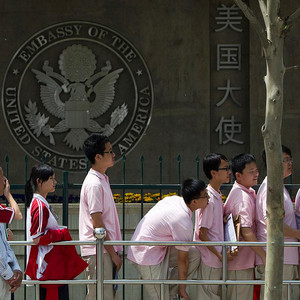
President Trump's idea of 600,000 is not likely to occur anytime soon.
That's conditional on US universities can't get enough applications.
He can't actually have an ambition to increase the number of Chinese students in America whilst keeping the MAGA sentiments pleased.
There is hope going forward of a better relationship.
How much resource would he be willing to put in terms of attracting Chinese students?
The damage has been done.
We are going to see continued doubts in the minds of parents and younger people about the United States as a higher education destination.
The Chat Lounge. on hot issues in a more casual way.
Welcome to the chat lounge.
I'm Tian Yun.
U.S.
President Donald Trump has defended his decision to issue 600000 Chinese student visas, despite opposition from his supporters.
Beijing welcomed the move, but questions remain.
Is this a genuine shift or just a political maneuvering?
Can Chinese students trust these promises when they still face interrogations and deportations at US airports?
Joining me for a chat on this topic Jonathan Aronson, Professor of International Communication and International Relations School of Communication and Journalism University of Southern California, the United States.
Orwick Powell, an adjunct professor at Queensland University of Technology in Australia.
And Li Lun, an assistant professor of economics, Peking University in China.
Great to have you all on this show, gentlemen.
So, Professor Aronson, it's your first time on the show.
Shall we begin with you?
We can.
It's the second time, but that's okay.
On this particular show.
The US government has tightened policies affecting Chinese students since Trump's actually first term.
And just a few months ago, the Trump administration talked about aggressively revoking Chinese student visas and tightening screening for mainland and Hong Kong applicants.
So have you noticed any decrease in the number of Chinese students in your class or university over the years?
And were you surprised by Trump's sudden U-turn statement?
Well, if I may, let me give a little statistics and data for your audience, because it may help.
Right now, there are about 11 million students from international destinations in the United States as of 23-24.
That number dropped by about 11% last year.
We do not have numbers yet for that.
The largest components of that are Indian students followed by Chinese students.
Between India and China.
That accounts for over 50 of all international students in the United States.
So that becomes a baseline.
My own university, University of Southern California, is one of the five largest acceptors of Chinese students and international students in the country.
We get about 28% of our students.
We have roughly 6,000 Chinese students last year.
We'll see how much it is this year.
But it is an important part of our components.
One last thing, and then right now there are about something under 300000 Chinese students total in the United States.
So President Trump's idea of 600,000 is not likely to occur anytime soon.
That number has dropped, not increased in the last couple of years.
Dan, were you surprised by his U-turn in his attitude?
Nothing about Donald Trump surprises me.
All right.
And here in China, Professor Li, you studied at the University of Chicago and now teach at Peking University.
Have you noticed any of your students rethinking or even changing their plans to study in the States because of government policies there?
Well, you forgot to mention one earlier experience, that I also received my undergraduate education from the States.
I went to Rice University in Texas.
So I'm definitely one of the person that you know benefit from these policies early on in the previous administration.
So right now definitely, you know, every year I would supervise or write letters for a number of students who are interested in applying to universities abroad, not only in the States but also in, you know Singapore, in UK and Europe in general.
So, in terms of students rethinking or changing their plan, what I usually tell my students is that you should apply to as many programs as possible as you know humanly available, and then you choose and pick your offers afterwards.
But I do observe this tendency of you know, after students receive their offers, they tend to hesitate a little bit over you know, should I go to the US or should I go to UK?
A real life example is A very close student of mine got offers from Columbia University and also Oxford, both master's program.
He was pretty determined to go to Columbia basically before hearing about all of these policies.
But recently, I think, he changed his mind and he determined to go to Oxford, just because of several concerns.
Of course, expenses is one of them.
But, you know, comparatively, UK and US in terms of this is not that much apart.
So one of his major concern is that how likely it is for him to get a job afterwards because of this overall tendency to be putting higher pressure on Chinese students a little bit.
I could even say discriminatory policies towards Chinese students.
And he was aspiring to work in an international organization afterwards.
So he became a bit worried and basically switched his mind to go to Oxford because he thinks he'll be treated more fairly in the UK.
So that's not like an individual experience.
I think a lot of students.
They either choose to get a PhD not from the US but from a Chinese university or not to go to US at all and switch to Europe or other countries.
So definitely, I mean I'd love to share more of this experience along with our two guests later down the interview.
But from my personal experience, I think this definitely have a pretty long lasting effect on how students are, you know, choosing or thinking of their study destinations.
I would add one thing.
All right.
Which is sometimes it's not the student themselves, but their mother.
Yes.
Yes.
Yes.
That's definitely true.
Yeah.
They're worried for their children.
What we are finding is that if Chinese students are accepted at a program in the United States one in London and perhaps one in Canada or Singapore then they are less likely now to because of President Trump and because of the unpredictability to come to the United States.
However, if they're only accepted at a university in the United States, they're still coming.
I think mothers do matter.
Right.
Because of those policies.
I think some other countries or the governments or educational authorities are smiling, at least.
One of them could be Australia, right, Professor Powell?
Look, I think one of the interesting dynamics of late is that reputations, particularly in the higher education arena and research arena, are developed over a long period of time, and a hard one, but they are very, very quickly destroyed.
And the capricious and whimsical nature of the us administration's approach to higher education, research funding and the question of chinese students and chinese researchers let's not forget the legacy of the china initiative of the department of justice has significantly dented the reputation of American higher education and research in the eyes of many, including people from China.
And the evidence points that out.
The numbers show very clearly that, having peaked in 2019 2020, the number of students from China in American colleges and universities has dropped significantly dropped, almost 100000 actually, from a peak of 372000.
So I think that the decisions of late by the administration are likely to have long lasting effects.
They're likely to scar the perceptions that many people will have about the quality of American higher education, whether or not that's warranted or not.
And of course, we all know that making decisions about higher education is a big decision, because not only is it a substantial financial commitment, but it's also one where continuity and time factors are necessarily part and parcel of the decision.
If administration policies are going to chop and change with no sense of stability from one month to another, It's very, very hard to make the kinds of commitments that people need to make if they are to embark on an overseas study experience.
So I think that there has been substantial damage done.
That said, it has been an opportunity for education and research institutions in other parts of the world, including in China itself, where institutions have been systematically and progressively going up the rankings in terms of their research outputs and their and their global rankings, and i would expect that, in fact, over the course of the next five to ten years, a larger proportion of chinese undergraduate or high school graduating students will actually attend universities in China rather than go overseas.
Indeed.
Yeah look.
The Australian higher education sector over the course of the last four or five years has been under some indirect pressure, coming mainly from concerns about the impact of international students on would you believe it the Australian housing market, and that has led to the imposition of significant quotas on higher education or education visas, which has limited the number of international students that can come to australia at any moment in time.
Now that has radically impacted australian higher education, to varying degrees, of course, from institution to institution.
Some institutions had evolve their business models over the course of the last 30 years to become heavily geared towards servicing the international student full fee paying market.
And those institutions, of course, have had their financial circumstances dramatically impacted as a result of these decisions by the Australian federal government.
Now I think the higher education sector has made it very, very clear that the limits on international students coming to Australia is creating adverse financial impacts, which ultimately affects their ability to deliver higher education to Australian students as well.
And perhaps the federal government is revisiting the issue, especially in light of the fact that The United States has, for a number of the reasons that I mentioned earlier and the others have touched upon, has become far less attractive, relatively speaking, than it was maybe five years ago.
Yeah, maybe the Trump administration can borrow some lessons from Australia.
The Chat Lounge.
The Chat Lounge unpacks views and opinions on hot issues in a more casual way. back to the States.
President Trump said he doesn't want Ivy League schools to struggle because that would damage the whole education system.
So, Professor Aronson, was he exaggerating or deliberately inflating the issue?
I'm originally a trade person.
And one of the things that was recognized and President Trump has now recognized is is that education is trade and the net income coming into the United States from international students has been about 50 billion.
That's something that catches the president's attention.
It also creates huge numbers of jobs.
And the losses that we just had this year could add up to as much as 7 billion in lost tuition and 60000 jobs in the United States.
So somebody persuaded the president that this was not something that they wanted to do.
And, as a result, I think that he has now gone on, not just for Ivy League schools, because it's the Ivy League schools, like Harvard and Columbia, that he has been particularly negative towards, but also to smaller schools that are elsewhere.
Those are the schools that conceivably could be hurt.
The reality is that Columbia, even though it has a huge number of international students, still has a whole lot of people who would like to come there.
So they will be less hurt than some of the smaller schools a school like Northeastern or Carnegie Mellon that are very good schools but are more dependent on international students than in terms that they can't substitute domestic students for them.
Right.
To Professor Power from a third country's perspective, do you see Trump's U-turn as a negotiating tactic while trade talks with China continue, rather than a genuine policy shift?
Well, as Professor Aronson mentioned, higher education is a substantial net revenue generator for the United States.
So if President Trump has concerns about trade deficits, then perhaps what he's doing here in the higher education space is drawing attention to the fact that the United States experiences a substantial trade surplus in a whole range of services areas, including higher education.
I'm not convinced that it's part of a negotiating framework, nonetheless.
I think, as Professor Aronson mentioned, the fundamental realities in terms of employment and revenues are real issues and they are no doubt, I think, are playing into the minds of people in the administration and also all the way to the White House itself.
The concern that I have, and as I mentioned earlier, is that this chopping and changing of policies simply is not conducive to long term education, decision making on the part of parents and younger people.
High education is not something that you make a decision about on the basis that somehow you will go to one place for three months and have the policy changed on you.
You need to make decisions that are premised on the idea that you can have a dependable three to four year outlook in terms of circumstance, whether it's funding, visas.
And, of course, the broader safety environment is also something that increasingly plays on the minds of many parents as they consider international education with their children.
So, as I said, Reputations are a hard one and they take a long time to build in terms of quality of the education, the quality of the research opportunities and the career opportunities thereafter, as well as the broader international studies experience in terms of the living and the cultural exchanges.
But these things can be destroyed very, very quickly.
And rash, impulsive policy pronouncements simply don't help the higher education sector number one, but they certainly don't help the need for the United States and China, two countries that currently are experiencing tensions, to find ways of alleviating these tensions in areas that one would think perhaps the least controversial of areas.
Research collaborations in so many areas really is not a geopolitical issue at all.
And yet it has been caught up in this web.
And unfortunately, I think the damage has been done and we are going to see continued doubts in the minds of parents and younger people about the United States as a higher education destination until things settle down a lot more.
Right.
Professor Lee, do you agree that maybe the biggest motivation behind this or behind Trump's U-turn is financial, like both Professor Aronson and Professor Powell mentioned?
You know, it's about trade, it's about economy.
Or is it more like political signals?
Because he said you know, getting along with other countries is good, especially with nuclear powers.
Does that sound like a convincing rationale?
Yeah, I definitely agree with both professors that in the policy I think 100 reflect both Trump's ignorance of how university finances work.
Of course, he's going to put higher pressure, give more obstacles for Chinese students.
But then, when he learns more about these, students are actually contributing a lot to universities finances and balance sheet.
He changed his policy again and suddenly welcomed 600000 students to United States.
And this showcased some sort of hypocrisy, because even though, from a objective point of view, students are a crucial part for universities' balance sheet, for universities' revenue, but no students want to be admitted just because there are very important sorts of income.
They want to get to the States because they want to receive high quality training.
They want to be respected.
They want to have good job prospects after they graduate.
They don't want to be just seen as, pardon my language, but cash cows and just be exploited.
And after receiving two years or one year of master education kicked out or without any, you know, career training or job experience?
But that's sadly, I think a lot of, you know, the cases or experiences of the students.
So I think eventually students are going to take that into consideration.
Whether do I still want to go there paying full tuition without scholarship, but sometimes treated differently or even treated like enemies or spies?
And without any hope of finding a real job or be respected.
So that's, of course, a little exaggerating for the current situation.
But I think, in terms of the political pressure, in terms of the future, in terms of the uncertainty that Trump created that he's on again, off again policy with his change in people's expectations I think this needs to be considered.
So in terms of admission, so he wanted to create 600,000 new student visas.
But that's conditional.
US universities can't get enough applications.
Whether these universities can get as many applications, because universities can't just let anybody in.
They still need high quality applicants.
So whether they can fulfill their, you know, send enough offers, that's another story.
And before we explore what's going to happen next, a very small question to Professor Aronson.
I got some online comments here.
They're saying that yes, the real reason may be financial, but at the same time, and I quote, fewer Chinese students also makes it more difficult for the CIA to recruit fresh agents.
So how true is that?
It may or may not be true.
That was beyond my pay grade.
But I think it's much more looking at Silicon Valley and seeing the huge number of leaders and entrepreneurs in Silicon Valley who are of Asian background, sometimes born not in the US.
I'd also like to make one distinction which I think is important, which is that there are three groups of students that are coming.
They're the undergraduates, the master's students, and the PhD students.
And the ones that really are critical to the finances of American universities are the master's students, because they're the one, and that is, the most rapidly growing group.
PhD students in the United States in most disciplines are fully funded.
So if a Chinese student comes to my university as a master's student, sadly their parents probably have to pay the whole fare.
But if a PhD student comes, we give them five years of support, including stipend and tuition.
So that's a very different situation.
What we're looking for very often is the best of the best.
Uh, the master students are where it's most difficult to figure out what's going on, because if you don't get that group, the whole university's budget can be into trouble.
Right, thanks for that explanation, and you actually, unlike trump, you did a very good advertisement.
For us schools, This has been the Chop Lounge.
Then can the promises be trusted, when Chinese students still face interrogations and deportations at US airports.
That's coming up next.
Sideline Story brings you all things sports related.
The hottest topics, latest events, juiciest stories, all with a very personal take.
Subscribe to Sideline Story podcast for heated sports discussions covering events that are happening in China and around the world.
Welcome back to the chat lounge.
We continue our chat on the U.S. plan to recruit 600,000 Chinese students.
Let's move on to what comes next.
Actually, Beijing welcomed Trump's U-turn, hoping his words would be implemented in practice.
But Professor Powell, in your view, how realistic is that expectation?
Well, I think that there are two issues.
Firstly, there is the risk that there will be another policy U-turn or a substantial modification in the not too distant future and unfortunately, this pattern of whimsical and capricious policy making has become one of the defining features of the administration.
So, from a risk point of view that looms large, Assuming that that all settles down, there will nonetheless be the practical issues that we need to attend to, namely that students have already been making their decisions and applications to go elsewhere on the basis of the issues that we've all been talking about on the program already.
And even targets or big numbers, and the President is fond of big numbers.
The idea of 600000 is a level that has never been reached before.
400,000 has never been reached before.
372,500 was roughly the peak prior to the pandemic.
We're down to about 270,000 now.
So we're talking about a doubling of numbers to get to the target.
I doubt that that's going to happen.
That's the first thing I'll say.
The second thing I'll say is that, notwithstanding what the United States is or isn't doing, this episode has caused the broader marketplace to respond, meaning that students and their parents have begun looking elsewhere and are realising that there are alternatives to the United States for a high quality, international higher education experience.
And, of course, higher education institutions in other parts of the world, have responded to the situation by reaching out to Chinese universities and Chinese education systems to build new pipelines that will enable students to find their way to other countries other than the United States.
I think it's going to be very, very hard to turn 600,000 as an objective into a practical reality.
Actually, I think Beijing, it's not like it's pushing Chinese students to go to the States.
What they want is, I think, is just a fair treatment from the US authorities.
You know, just days after Trump's comments, US media reported the case of a 22-year-old philosophy student, with full documentation and a scholarship, who is interrogated, denied entry and banned for five years when trying to enter the states via Texas.
One of several such incidents.
Trump's new decision has also met with anger and shock from some of his most fervent supporters, including those in the Make America Great Again movement.
They're saying admitting those Chinese students would replace American students' opportunities, questioning whether the decision fit the government's America First agenda.
So with those above mentioned.
Professor Aronson, this kind of domestic resistance also would make Trump's policy implementation very difficult, right.
Absolutely.
And I agree with the others that getting to 600000 is probably a pipe dream, at least at this stage.
Make it what his domestic politics is very difficult.
We are seeing all sorts of attacks by his own people, by the Democrats.
So nobody at the moment much cares for President Trump, except a group of true believers.
And those true believers are sort of shocked by this kind of talk about bringing more Chinese students here.
So I agree with the others that the consistency of what you're going to get to be able to say I'm coming to a university for three or four years And once I'm here, I'm here.
But at the university, we often have to advise our students, don't go home for Christmas.
Maybe you're better off just sticking around, because we can't guarantee what's going to happen when you return.
I just want to mention that one of my students had a very similar experience as what Professor Aronson said.
So she was in Harvard during the incident where Trump was having an issue with Harvard, and she didn't go back to China for any of her winter breaks or summer breaks.
Just very recently she returned to China and talked to me and we had this conversation and she was very worried that if she returned to China there is a possibility that she would not receive a return like the visa and go back to the US to finish her studies.
So I think that's very true and very realistic concerns.
Yeah, actually, I was about to talk about this.
Like your student, many are worrying that they could be admitted and suddenly expelled or deported halfway through their studies, which is a huge concern for, you know, especially students.
So Professor Lee, in your view, those fears are not exaggerated.
They're justified, right?
Well, I can't say, because I mean, US has always been, you know, in some cases, you know, not a very safe place where it has its problem.
China has its problems.
But I mean when you are making a decision, whether you are going abroad to study, there's always different level of concerns or risks that you need to consider.
So now basically, with all of these new visa policies, whether they're welcoming you, whether they are trying to shut you away, I think this is something that the students they need to, based on the case-by-case standard, to try to make their own decisions.
But I do think that, again these obstacles or, for example, in some fields, especially those with related with quantum computing, with AI or with the more advanced areas, students are more likely to be so-called checked when they're passing the border, the customs, because these students have known several cases where students are taken to a back office and being questioned for hours sometimes, and sometimes They were asked to show their WeChat record, to show their photo album, and so on.
So I do think this is a risk or let's say a concern that's growing.
It also depends on how prestigious the schools are.
I remember when I was admitted to the University of Chicago, my mother, as Professor Aronson said, was worried that the safety in Chicago isn't very good.
But I think, as long as the schools still have the prestigious status and the leading status, a lot of Chinese students are still willing to go despite of these risks.
Then did your student, did she tell you what she's gonna do if worse scenario happens?
Well, she's still in her second year of study, but I think a silver lining or a good ending of the story is that she still is trying to apply for a PhD program in the States and pursuing a PhD in economics.
So I think that's a very good example of saying, despite all of these tensions and obstacles, US education still is very attractive, especially for global talents.
You all mentioned, it's really difficult for President Trump to reach his goal of recruiting, like some 600000 Chinese students within a short period of time or within the foreseeable future.
Then would you give him some suggestion or solution for him to reach the goal then, Professor Powell?
Look, I think I'm the wrong person to ask, to be honest.
I'm not an American.
Or you don't want to provide your...
And I believe that the Australian higher education system offers a high quality alternative to the options available in America.
All jokes aside, of course, look, I think that there are just broader challenges at play here.
And some of those go to the issues that are unfolding culturally and in terms of the culture of politics and the politics of culture in the United States that bubbles over and affects the national policy towards other countries and in particular China number one as well as the attitudes that certain sections of the American community has towards foreigners and again, particularly people from China number two.
The challenges around even flagging this 600000 student target in terms of the reaction that it has provoked amongst the MAGA base, I think speaks volumes about the difficulties that the Trump administration encounters as it tries to square the policy circle.
And this isn't the only issue where it has what is in effect contradictory policy ambitions.
No wonder it is finding it so difficult to shape a coherent and cohesive policy policy agenda for America, because it's trying to keep disparate and at times contradictory stakeholders happy.
And it doesn't have a way of doing that.
You know you can't actually have an ambition to increase the number of Chinese students in America whilst keeping the MAGA sentiments pleased.
They're simply not going to accept that it is legitimate and rational and in America's interest for the United States to play host to a larger number of international students, particularly from China.
The politics on Capitol Hill tells us that the attitudes towards China and all things Chinese is incredibly negative, to a point where we have senators Graham and Blumenthal talking about bone crunching sanctions against China and India because they dare to purchase oil and gas from Russia.
We have, of course, coming from Capitol Hill, years and years of anti-Chinese sentiment.
We've got laws being passed in Texas banning Chinese from renting and buying land and property.
So none of this is actually conducive to the realisation of these objectives.
Now, what's the advice to a president confronted with that, when that, in fact, is his own political base?
Well, at the end of the day, a coherent policy framework driven by a rational assessment of national interest, as opposed to an emotionally charged approach to policymaking, would go a long way towards improving the outcomes for America and for Americans.
That's really all I think I can say on this issue.
Yeah, bring down the anti-China narrative in his administration first, at least.
And Professor Aronson?
I think that's overblown a little, but part of it is that the people who are more worried about Chinese students don't know Chinese students.
That if you look at the universities, they're in big cities.
The big cities tend to be much more democratic and much more welcoming.
If you look at the demographics in the United States over the last 40 years, there is much more acceptance and globalization.
My kids, when they were growing up, Their favorite food was always Chinese and Japanese food.
That was the norm.
And I think that the cultural acceptance is much greater there.
It is the people in Montana or the people in Idaho or the people in smaller rural areas that don't see any of these students who are worried about them.
Once people get to know these students it becomes a much easier problem, so that many of the Chinese students feel very welcome, feel very at home.
And there are enough of them at the big universities that they have a cultural community internally.
They're not the only person at the university or in the department.
So I think it's a little bit overblown about the hatred, because there are some people who hate everybody, but most people don't.
Most people in America are really quite welcoming to those from other countries and other cultures.
And, in some level, the biggest problems that the Americans have right now is that much of the US economy, that both the service economy and the agricultural economy, depends not on Chinese students or Chinese workers, but on South American and Mexican workers.
And that I see as being much more a flashpoint that could really blow up in Trump's face.
The Chat Lounge.
The Chat Lounge unpacks views and opinions on hot issues in a more casual way.
Now, what would be your suggestion to President Trump if he wants to get 600000 Chinese students in the States?
Step one, settle with all of the universities and let them do their research.
Let them have their funding.
You can extract some things from them.
Sometimes they have become more what he would call woke in certain departments.
But in the departments that Chinese students are in, which are predominantly STEM departments, predominantly the sciences and engineering, that's just not the case.
The biggest thing, if we look at an existential threat to the planet, it would be climate change.
And he denies that it is a problem.
So China is now ahead of the United States on climate change, on renewables, on all of these things.
And yet, if we're going to solve 30 years out to make progress on China, the basis is pretty clear already.
US and China have to agree.
They have to work together and they have to be able to use AI to solve what are really wicked problems, or probably at least first ask his supporters to stop calling Chinese students communist spies.
We're agitating that idea, right, Professor Li?
Well, I don't think that's realistic because if you look at the, basically the follow the MAGA movements, most of its leaders, if you talk about Steve Bannon, if we talk about Tucker Carlson, I think they all hold a very strong suspicion towards Chinese students, towards Chinese citizens and Chinese nationals.
So I don't think it is quite realistic even for Trump to say you know, stop hating Chinese, or stop you know, start welcoming more Chinese students.
And then the MAGA base is going to follow his call.
Because, by the end of the day, you know, the MAGA base are still.
They also are, you know, living people.
They also have jobs.
They could have jobs in law enforcement.
They could have jobs in ICE.
They could have jobs in, you know, a lot of corporate America, you know, employers.
I think one of the greatest danger for the States, between the States and Chinese students is that you know, the McCarthyism start to develop and people start to kind of look to each other and think are you a spy from China?
We're not.
So if that emotion start to develop.
Then, even though you know officially, the US government or Trump, can hold a welcoming stance to Chinese students when it comes to the mega base, when it comes to each individual person, when they're considering, you know, should I hire this Chinese student or an Indian student?
Or should I hire this Chinese student or an American student?
I think that, even though they may not say it aloud, there could be some discrimination, you know, behind it.
In terms of ICE enforcement, in terms of, as the example you mentioned, the 22-year-old philosophy students not any STEM students, but philosophy students were banned entry for five years.
When it comes to this, it's important to mention that it's also within the responsibility of and law enforcement or border control agency to give this punishment.
So it's not beyond their responsibility to do so.
They're not crossing the line.
So, when it comes to actual execution, will the market base really follow what Trump is saying and start welcoming students?
When they're seeing more Chinese students, which they do not have any chance to know personally.
They're just seeing more Chinese walking down the street.
Will they find it more welcoming or friendly, or will they feel a little danger or threatened?
So I think, looking ahead, I'm not very optimistic in terms of the two countries can collaborate in terms of people-to-people exchanges, like in the past.
I think one of the greatest dangers that I worry about is that there's going to be more widespread suspicion, or this change in attitude towards Chinese citizens, or even for those US citizens that are Chinese-American, that are born in the States.
Of course I may be a little too pessimistic, but that's the thing, that's the direction that we definitely not want to go to, because it threatens, it dampens anything.
It threatens international collaboration.
It threatens collaboration in research, in scientific cooperation.
It threatens everything.
So right now the world is too interdependent to allow such things to happen.
But unfortunately, the closer I look at the MAGA movements and their sentiments, the more worried or concerned I become.
So you're saying there's nothing can be done for President Trump to win back the hearts of Chinese students?
Well, they could.
I think he definitely could.
First, I'm not sure if he is simply putting the statement or is it one of his top priorities.
Right now, I don't think it's one of his priorities.
He's basically saying, you know, it would be good if we had more Chinese students.
How much resource would he be willing to put in terms of attracting Chinese students?
For example, expanding the areas for you know that's welcoming for Chinese students, or expanding the job prospects for Chinese students, or creating or fostering environments is more friendly for Chinese students all across America, not just in cities or in all the states.
I just don't think he's willing to go that far.
And it's also against his political movement or his main message that he's trying to send to his base.
So I'm not really thinking that he wanted to do it so badly, and he just simply couldn't find enough measures.
I think it's just the opposite.
He's trying to maintain the finances or keep the budget for colleges apart and he's trying to say go ahead and let them in, but I'm not doing anything extra to kind of attract them or make the US more welcoming for them.
Honestly, I just don't think that's one of his policy priorities.
All right.
And Professor Powell, are you as pessimistic in this regard when it comes to US-China people-to-people exchanges in the long run?
Well, in the long run, it's a different question to the next six months or 18 months.
A lot will happen in the long run, and much of it will be factors that President Trump ultimately won't be in a position to impact, and it's because the issues that are reshaping the world and, as a result of that, the relationships and attitudes of countries towards each other, are not issues that are amenable directly and solely to the control of the US administration.
The short term challenges aren't going to go away.
The United States administration has a view that China is an adversary and it has embarked, through multiple administrations now, on policies aimed at containing China's economic development and to continue placing military pressure in China's own immediate area.
The United States continues to provide arms to countries that are within close proximity to China, deploying medium-range missiles onto the Philippines, as well as pushing the separatist forces on Taiwan Island to purchase more American military equipment hardware, and it continues to have a military presence actually on Taiwan Island, contrary to historic agreements that the United States would withdraw a military presence from the island.
So there are many things at the moment that I think contribute to a very strained relationship.
The issues around trade is another one.
And of course we have in the United States a number of policies at state level focus very much on discriminating against Chinese people, not just Chinese companies, but Chinese people insofar as purchasing or renting properties etc are concerned as well.
And none of that adds to a conducive environment.
But none of that's easy to change either.
You know, the political forces that have locked much of this in place remain dominant.
These are powerful voices.
The voices of the neoconservatives on Capitol Hill tend to get their way, and they've been getting their way not only in relation to China over the last decade or so, but in relation to other parts of the world.
So right now I think it is not only difficult but actually politically unlikely for there to be substantial change in tone, let alone substance, from the United States administration vis-a-vis China.
Consequently, is going to feed through into the body politic at large.
The only glimmer of hope at this stage can be gleaned from the experiences of those who jumped onto Little Red Note earlier this year and interacted directly with Chinese people through social media.
And we have seen a small drop in negative attitudes amongst the population at large in the United States towards China, which suggests that with an atmosphere that is less antagonistic, particularly from politicians, the people in the united states are very much able to develop a more rational and cosmopolitan attitude towards others in the world.
And on that basis, in the long run i'm hopeful, if not optimistic, that we will see much better relationships between the peoples of the two countries.
That's what we are hoping for too.
And last but not least to Professor Aronson, your expectation on US-China people-to-people exchanges and probably, under what conditions do you expect President Trump may reverse his position again?
He could.
I agree with my colleagues.
This is not a happy time for the relationships.
But the world is not flat.
It's bumpy.
So relationships in some areas, for instance, California, is much better than it is in other areas.
There is hope going forward of a better relationship in terms of this.
And we have no idea what Trump is going to do.
And that unpredictability makes it very difficult.
I have no idea.
I have no special way of knowing what is going on with that.
But Black Swan events, something that tomorrow is very different from today, he specializes in that.
But he could reverse himself if he is persuaded to.
And frankly, I see the hope of bringing more Chinese students and offering more visas to be a small positive step that could lead to a slightly better relationship.
It is a win-win both for the United States, which makes some money on it for its universities which are dependent on international students, but it is also an opportunity for international students from China India, Korea to come to the United States and to interact on a very positive way.
And on that note, we wrap up our chat.
Many thanks to Jonathan Aronson, Professor of International Communication and International Relations School of Communication and Journalism University of Southern California.
Warwick Powell, Adjunct Professor Queensland University of Technology, and Li Lun, Assistant Professor of Economics, Peking University.
You can find us on all major podcast platforms.
Please email us your comments at radio at cgtn.com.
I'm Ting Yun.
Join us for more insights at the chat lounge next week.
Until then, take care.
The strong wind was howling and whistling.
He was the first Chinese citizen to graduate from Yale University in the mid-19th century.
I was born on the 17th of November.
She had prominent features.
Three of us were old enough to lend a helping hand.
He navigated between two vastly different cultures and moved further to realize his dream and promote understanding between the people of China and the United States.
Ye Mingxin was a native of Hanyang.
I realized no danger.
China is really awakening.
Come and join us in discovering the incredible journey of Yong Wang in his autobiography My Life in China and America.
Check out the audible stories on radio.cgtn.com and all major podcast platforms.
Just search for the podcast Books and Beyond and find My Life in China and America.