Want to speak real English from your first lesson?
Sign up for your free lifetime account at EnglishClass101.com.
Hi, everybody.
My name is Alisha.
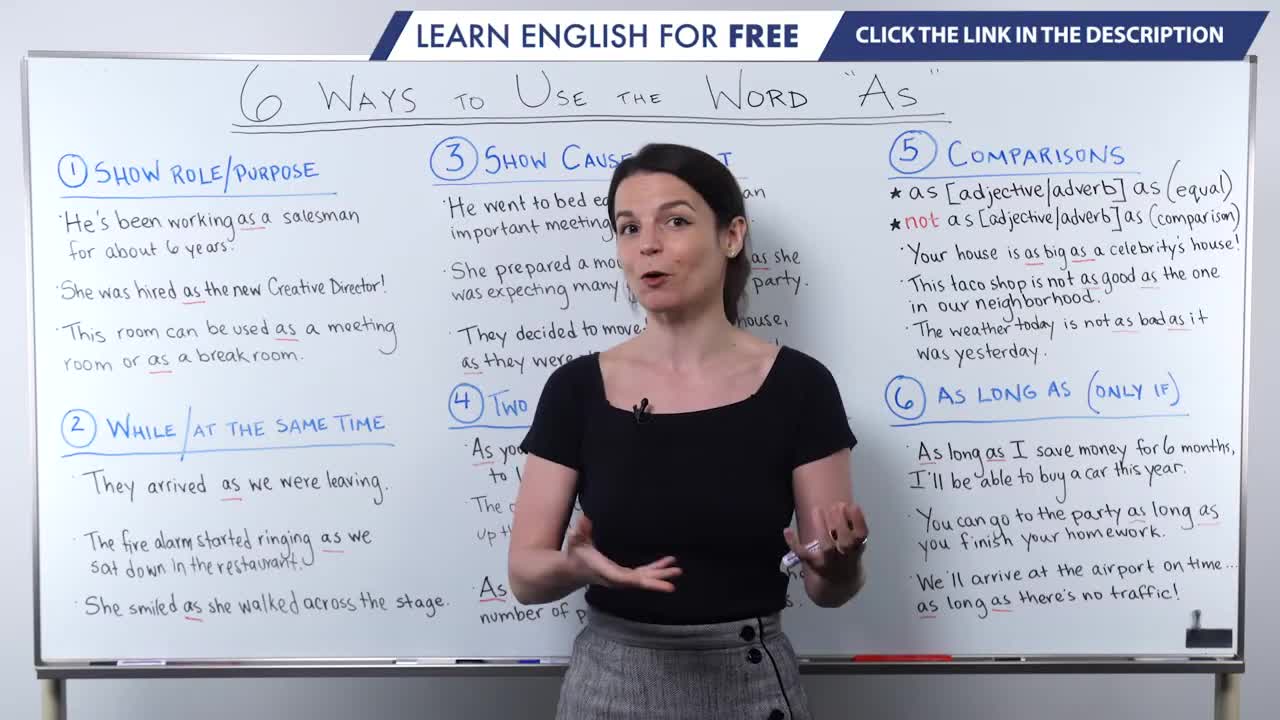
In this video, I'm going to talk about six ways to use the word as.
Let's get started.
Okay, the first use I want to talk about is to show the role or the purpose, purpose of someone or something.
We often use this as before job titles or other roles in our community, in our company or in an organization.
We can also use this as to express the way we use something or the purpose of something.
Let's look at some examples.
First, a job example.
He's been working as a salesman for about six years.
He's been working as a salesman.
So this as comes before the job title.
And in this case we have our article before.
Salesman been working as a salesman for about six years.
So we do this to show the person's role.
We do the same thing in our second example sentence.
She was hired as the new creative director.
She was hired as the new creative director.
So in this case, we have as the new creative director.
So this is the job title creative director and we have new to show.
It's a new position or a new role.
We also have the here.
So the shows that there's just one creative director.
She was hired as the new creative director.
As comes before all of this.
This is one phrase expressing this new role.
Okay, now let's look at this use of as to talk about a purpose.
So, this room can be used as a meeting room or as a break room.
This room can be used as a meeting room or as a break room.
So in this case, we are talking about the purpose of a room.
So a multi-purpose room.
We can use this room for many different things.
In this case, we can use this room as, so for the purpose of a meeting room, or as a break room.
So this shows the different functions or the different purposes.
So we can use, as in this way to express our roles, our jobs and the ways that we use different things.
Okay, so with this in mind, let's continue to use number two, which is quite different.
Use number two is as to mean while or to mean at the same time.
So in this case, we have two things occurring at about the same point in time, and we want to express that.
So first example here, they arrived as we were leaving.
So these two actions are they arrived, past tense, as we were leaving.
So this means maybe we're in the process or we were in the process of leaving.
We were still there, but we were just about to go.
So we connect these with as to show that these two situations or these two actions happened at about the same time.
So we can think of this as kind of like while or at the same time.
Let's look at the second example.
The fire alarm started ringing as we sat down in the restaurant.
So again, we're showing two actions happening at about the same time.
So...
The fire alarm started ringing at the same time as we sat down at the restaurant.
So we use as to do this.
Please note we cannot replace as with while here.
For example, the fire alarm started ringing while we sat down in the restaurant.
We wouldn't use it in this way.
While we tend to use with progressive actions that are happening at the same time.
So we tend to use while when we talk about two continuing actions happening at the same time.
We're seeing in these situations.
In these cases, we have a simple past tense action and a progressive action.
Same thing here, a simple past tense action and a progressive action.
So we don't use as and while in exactly the same way, but they do communicate the same feeling of two things happening at about the same time.
Okay, let's look at the last example.
She smiled as she walked across the stage.
She smiled as she walked across the stage.
So in this case, we have again a simple past tense action.
And in this one, the second part, we also have a simple past tense action.
So in this sentence we might hear some people using while in place of as as in.
She smiled while she walked across the stage.
That's because these parts match in terms of the grammar, in terms of the tense used.
But me personally, I think I would probably still use as in this case instead of while, because while sounds a little more natural if we use it with the continuous or the progressive form.
So, for example, she was smiling while she was walking across the stage might sound a little bit more natural.
But in this case, I would use as to mean these two things happened at the same time.
Okay, great.
So we have our first two uses, showing the role of someone or the purpose of something, and we have two things happening about the same time, or that two things happened at about the same time.
Let's go to use number three now.
So use number three is to express a cause and a result.
So in this use, we are connecting some kind of action and that expresses the cause of something.
And then we also see the outcome or the result of that thing.
I want to note that this use is a little bit formal.
It may even sound a little bit old-fashioned, but we do still use it from time to time, so it's important to understand this use.
So let's look at the examples.
First, he went to bed early as he had an important meeting in the morning.
He went to bed early as he had an important meeting in the morning.
So here we have our two independent ideas.
He went to bed early.
One, this is the action.
As he had an important meeting in the morning.
This... is the cause of this result, okay?
So we have the reason for something.
You can think of this as in the same way as because, right?
He went to bed early because he had an important meeting in the morning.
So typically in today's english we use because a lot in this position, but every once in a while we maybe want to sound a little more formal or a little old-fashioned.
Every once in a while we use as to express the same idea again.
We have this cause and result relationship.
Let's look at the next example.
She prepared a mountain of food as she was expecting many guests at her party.
So again, we have this cause-result relationship.
She prepared a mountain of food.
This is the result, the outcome.
And why?
She was expecting many guests at her party.
This is the cause.
So again, we can think of this as meaning because.
She prepared a lot of food because she was expecting a lot of guests at her party.
So as expresses the same idea.
Okay, let's look at the last example for this group.
They decided to move to a bigger house as they were planning to have a family.
They decided to move to a bigger house as they were planning to have a family.
So again, we have this result and the cause.
So again, we have this because type of meaning here.
They decided to move to a bigger house because they were planning to have a family.
So again, although we use because a lot more in today's English, sometimes people still choose to use this as to connect their ideas that express the cause and the result of something.
So it's good to know this one.
Okay, great.
Let's continue to number four.
Number four is very interesting.
We use this use of as to express two changes happening at the same time.
So this is a bit different from point number two.
I talked about two things that happen at about the same time, two separate actions.
The key here with number four though, is the two things are changing at the same time.
For example, two things are increasing or two things are decreasing, or maybe one thing is increasing and the other thing is decreasing at the same time.
The key with this use is change, and we'll also see.
There are some specific grammar patterns we tend to use with this type of as.
So let's take a look.
First one.
As you get older, it gets harder and harder to lose weight.
As you get older, it gets harder and harder to lose weight.
So, this is expressing as you get older, so as your age increases.
We are talking about one change here.
And then it gets harder and harder.
So it gets more and more difficult.
It becomes more and more difficult to lose weight.
So the difficulty increases.
So we're talking about one point, increasing in age as you get older.
And the other thing, trying to lose weight or getting more and more difficult to lose weight.
So we're expressing two changes happening at the same time.
We also see this as something something comma, it gets Comparative.
Comparative.
This is another common pattern that we see with this type of as use.
We'll see another example in number two here.
So let's read it.
The air got colder and colder as we climbed up the mountain.
The air got colder and colder as we climbed up the mountain.
So...
Again, we have two things changing.
One, the air gets colder and colder.
So that means the air is becoming cold, right?
We do this repetition for emphasis.
The air got colder and colder is thing one, changing.
To, as we climbed up the mountain.
So, we are going up the mountain, climbing up the mountain.
These two things, these two changes are happening at the same time.
We express this, we connect these ideas with and.
So this sentence follows the same kind of pattern as the first one, but we can move this as section to the end of the sentence.
In this case I could say as we climbed up the mountain, the air got colder and colder and it's still 100 correct.
It's up to you to choose which part you want to emphasize.
Generally, the part at the beginning of the sentence is going to sound like it has a little bit more emphasis.
So you can choose which position is best for you.
Okay, let's look at one more example.
As airline ticket costs increase, the number of people traveling decreases.
So again, we have two things changing here.
As airline ticket costs increase, as they go up, the number of people traveling decreases.
So in this case, we have changes in two directions.
Costs increase, travelers decrease.
The number of travelers decrease.
We express that these two changes are happening at the same time, with this as pattern.
So a good way to know that this is the one that's being used is that this, as will come at the beginning of this sentence as an introductory clause, like this as something something comma, that's a good hint, plus this comparative form harder and harder or colder and colder, That's one big hint.
That this is the changes at the same time, kind of as
So keep in mind that this one, again, is used to express changes happening at the same time.
The one we talked about in number two expresses two actions that happened sometimes in the past, or sometimes they happened or they were happening at the same time, but not just changes.
So that's the key difference between to and for, okay?
Great, so let's continue to the last two points.
The last two points are some basic grammar review points.
So five, number five, we use as for comparison.
So this is a very basic English grammar point, but let's review it very quickly because sometimes people, I think, forget parts of these sentences.
So we use as in a couple of different patterns.
We use as to express that two things are equal with this pattern.
So noun A is as adjective or sometimes adverb as noun B, right?
So this thing is as something as noun B.
Or, we can also express a comparison with a negative.
Not as something as something.
Okay?
So, A is not as adjective as B, for example.
So we use this as pattern to describe things that are equal and to make some comparison.
So let's review with a couple of examples.
First, your house is as big as a celebrity's house.
Your house is as big as a celebrity's house.
So that's like saying, your house is the same size as a celebrity's house.
Maybe it's really big, right?
So the problem sometimes we see, I think maybe learners get a little bit confused about as and than right.
So we use than a lot when we make comparisons, like your house is bigger than my house, for example.
But when we want to show that two things are equal, we use this as as around our adjective no than here, okay.
So use this to express that two things are equal.
Noun one, your house.
Noun two, celebrity's house.
Connect them to show they are equal with as big as.
Okay?
Great.
Let's look at a couple more examples.
First, or second rather, this taco shop is not as good as the one in our neighborhood.
So this is a negative, right?
This taco shop is not as good as the one in our neighborhood.
So in this sentence, this taco shop here not as good lower, lower quality than the one, the taco shop in our neighborhood, right.
We show this relationship with not as good as, okay?
Again, we have as on both sides of the adjective here.
We do not use than in this sentence.
Okay, let's look at our last example.
The weather today is not as bad as it was yesterday.
The weather today is not as bad as it was yesterday.
Again, this means today's weather is not as bad as it was yesterday.
So another way to express this, yesterday's weather was really, really terrible.
Today's is, okay.
So again, we're following the adjective with as.
So as on both sides.
So keep in mind that this is a very common pattern for as.
Okay, let's finish off this lesson with point number six.
So point number six I wanted to focus on this expression as long as, because I think it's sometimes very confusing.
What does this mean?
Does this have to do with length?
Sometimes.
Yes, we can use this expression in this pattern.
Actually like, this marker is as long as that marker, which means they are of equal length.
However, we have this as long as expression, which means only if it acts as part of a conditional expression.
So let's look at some examples of this.
First, As long as I save money for six months, I'll be able to buy a car this year.
So, what does this mean?
As long as I save money for six months.
So, we can understand this as only if.
Only if I save money for six months.
I'll be able to buy a car this year.
That means I must do this thing.
I must do this thing in the as long as clause in order to make this thing possible.
Okay?
In order to make this main clause possible.
I'll be able to do this thing.
Okay?
So we use as long as to mean only in this case.
All right?
So you'll notice this comes at the beginning of the sentence, at least if this clause is first.
Okay?
So let's take a look at another position that we see as long as used.
Tune.
You can go to the party as long as you finish your homework.
You can go to the party as long as you finish your homework.
So in this case, we have our main clause here.
You can go to the party as long as, or only if you finish your homework.
So this is something a parent might say to a child, right?
So, again, only if you finish your homework.
That's what as long as expresses here.
All right, let's finish up the last example sentence.
We'll arrive at the airport on time as long as there's no traffic.
Okay, once more.
We'll arrive at the airport on time as long as there's no traffic.
So again, we can replace as long as with only if to understand this.
We'll arrive at the airport on time only if there's no traffic, right?
Only in this situation or only if this is true, right?
So this is the use of as long as.
We understand this as only if and I hope that this helps you to see the different positions in the sentence that as long as takes in comparison to the comparative form of as long as.
So pay attention to the location of as long as to help you understand whether it's a comparison or it's an only if construction.
Okay, great.
So those are six different ways to use the word as they are very different.
There are many very different uses of as, but I hope that this lesson gave you a good introduction to the various ways that we can put as into our sentences.
So, of course, if you have any questions or comments, or if you want to practice making some example sentences with the word as, please feel free to do so in the comment section of this video.
Also, don't forget to like this video and subscribe to this channel.
Also, don't forget to check us out at EnglishClass101com for some other things that can help you with your English studies.
Thanks very much for watching this lesson and I will see you again next time.
Bye!
Want to speed up your language learning?
Take your very first lesson with us.
You'll start speaking in minutes and master real conversations.
Sign up for your free lifetime account.
Just click the link in the description.