Hello hello, hello and welcome to English Learning for Curious Minds by Leonardo English, the show where you can listen to fascinating stories and learn weird and wonderful things about the world at the same time as improving your English.
I'm Alastair Budge, and today it's the start of a new year and also the start of a new three part mini series, all on the theme of words and language.
In part one
Today's episode, we are going to talk about words of the year.
The words chosen each year by dictionaries for their particular cultural importance that year.
In part two, we are going to talk about the concept of euphemisms in English.
When you describe something unpleasant or uncomfortable in a more friendly way.
And in part three, we are going to talk about the word enshotification.
It was coined in 2022, but we'll look at what it means, how it has evolved since then and what it tells us about the world we live in.
Like all of our mini-series, parts 2 and 3 will be member-only episodes, so now's my chance to remind you that if you'd like to listen to those, as well as our hundreds of other member-only episodes, plus learn with interactive transcripts, vocabulary lists, study packs and more, then I'd love for you to check out our membership.
You can do that over at leonardoenglish.com.
Okay then, let's get right into it and talk about words of the year.
One of the great but also frustrating things about language is that it is constantly evolving.
Words change their meaning, spellings change, grammar changes, words stop being used and entirely new words are introduced.
And the more people that speak a language and the greater the variety of people who speak that language, the more this is the case.
English, with its hundreds of millions of native speakers and billions more non-native speakers spread over practically every country in the world, is in a constant state of evolution.
One of the ways in which lexicographers try to document this evolution of language is by choosing a word of the year.
A word or expression in English that has been of particular cultural significance that year.
It doesn't have to be a completely new word although often it is but it has to be a word or expression that entered the language in a way it never had before.
Now I should start by saying that defining a word of the year isn't actually an English language invention.
It was inspired by the German tradition of Wörth des Jahres word of the year in German which started in 1971.
It's now a tradition followed by most major English language dictionaries, including the Cambridge and Oxford dictionaries, Merriam-Webster Dictionarycom, as well as the American Dialect Society and the Australian National Dictionary Centre, which reflect language used in American and Australian English respectively.
So what we are going to do today is talk about this tradition.
We'll start by talking about how it works and the process of how a word ends up being chosen as word of the year.
Then we'll talk about some of the particularly interesting ones from the past 20 years or so.
And we'll end by talking about the words of the year for 2025.
Let's start with the basics.
How do dictionaries actually choose a word of the year?
Well, it all depends slightly on who you ask, but broadly speaking, it's a combination of data and editorial judgment.
Most major dictionaries now analyze enormous databases of written and spoken English.
This used to be primarily from things like newspapers books, the radio and TV, but it's expanded to include everywhere that language is recorded.
Social media, YouTube videos, podcasts, and so on.
By analysing this data, lexicographers can identify which words are being used more than usual, which words have appeared out of nowhere and which words have suddenly taken on new meanings.
So that's the data side.
But it's not just a question of numbers.
It also involves people sitting down and thinking carefully about what a particular word tells us about that year, not just how often it was used, but why.
What does it reveal about how people were feeling, what they were talking about and what mattered most in that particular moment?
That's the editorial side, and some dictionaries even add a third element.
They release a short list but put it to a public vote, letting members of the general population decide what the word of the year should be.
And while each dictionary might have its own criteria, there are usually a few common themes.
Words that reflect politics culture technology, social movements and, more recently, the internet and how we talk online.
So, now that we've covered the basics of how the word of the year is chosen, let's take a look at some actual examples.
We won't go through every year, but I want to share a few highlights from the past couple of decades.
Some are funny, some are serious, some are quite surprising and others you might already use in your everyday English.
Let's start by going back to 2005.
That year, the American Dialect Society chose the word truthiness.
Now, although you might look at that word or hear that word and think haven't seen that before, but okay, it has truth in it.
And innus probably means the quality of whatever the adjective or noun was.
In this case, truth.
So maybe truthiness means something like the quality of being true?
That would be a perfectly good guess, perfectly reasonable, but it isn't right.
Truthiness was a term popularised by the American comedian Stephen Colbert to mean something that feels like it should be true, even if it isn't.
It was a new word for an old idea, the idea that people often believe what they want to be true, not what is actually true.
With Colbert.
He used it to criticise politicians and media figures who weren't so interested in the facts, just in what sounded good and felt like it was true.
In particular, it was aimed at President George W Bush and his famously strong convictions, like the existence of Saddam Hussein's weapons of mass destruction, even if there wasn't any evidence.
A nice word, right?
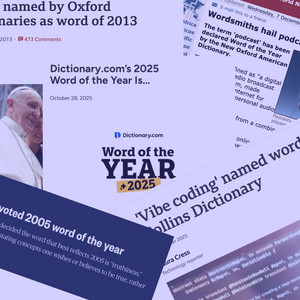
Jumping ahead to 2013, Oxford Dictionaries chose selfie as its word of the year.
As you no doubt know, a selfie is a word for a photo you take of yourself, typically with your phone.
And, although it probably seems completely unbelievable to anyone under the age of 18, Anyone who lived before the iPhone and Instagram will know that this wasn't something that people always did.
So there wasn't really a need for a word to describe it.
It's interesting to mention this because the inclusion of this word as word of the year clearly pinpoints this cultural shift.
And if a historian in 100 years needs to figure out the exact date when humans started taking pictures of themselves en masse well, the choice of selfie as word of the year provides a pretty good clue.
And we can go on.
In 2016, post-truth was the word of the year.
This referred to a time when objective facts seemed to matter less than emotions or personal belief.
It was the year of Brexit, the US presidential election, and intense political polarisation.
It's a pretty depressing word, but one that definitely captured the feeling at the time.
In 2022, Oxford let the public vote on the word of the year, and the winner was goblin mode.
A goblin.
If you don't know, this word is a sort of imaginary naughty, often ugly creature that plays tricks on humans.
And Goblin Mode describes a kind of lazy, messy, and unapologetically unbothered attitude.
Someone in Goblin Mode might be eating junk food in bed and ignoring all responsibilities, simply not caring about what anyone else thinks.
It's not plight word necessarily, but it clearly resonated with a lot of people who were feeling burnt out or just done with pretending to be productive all the time.
And that brings us to the present.
In a moment, we'll look at the words that were chosen in 2025.
But before we do, I want just to have a quick pause to ask what all these words have in common.
They aren't just words, really, they are signs.
They reflect what people are thinking about, what people are worried about, what they're joking about and how language adapts to express new ideas or feelings.
So, with that in mind, let's turn our attention to 2025.
What were the words of the year this time?
And what do they tell us about the moment we are living in?
One of them is a bit surprising.
It's not even a real word in the traditional sense.
It's 6-7.
Yes, the number's 6-7.
That was chosen by dictionary.com as its word of the year for 2025.
If you've heard of this word before, it's probably because you have young kids.
And if you haven't heard of it before and you're wondering what it means, the honest answer is nobody really seems to know.
I have a six-year-old son and one of his friends came over to play the other day.
I asked him, in Swedish, because we live in Sweden, how are you?
And he responded, 6-7, the English expression 6-7.
His mum shrugged and said she didn't really know why he said this and it seems like there is no definite answer to what it means.
According to dictionarycom, 6-7 became popular on TikTok and other social media platforms in 2024 and 2025.
It started off as an in-joke, then a trend, then a meme and somehow ended up becoming a phrase that means everything and nothing at the same time.
Young people have used it in videos comments as a gesture, as a sort of catch-all response to almost anything.
If someone asks a question and you don't really want to answer, you can just say 6-7.
If you're joking around with a friend and want to tease them, just say 6-7.
It means whatever you want it to mean, and that's kind of the point.
The team at dictionarycom described it as a playful gen-alpha expression of absurdist internet humour.
It's chaotic, slightly annoying, kind of meaningless, and oddly fascinating.
And importantly, if you are old enough to vote, you're probably too old to use it.
So, 6-7 was one of the words that was chosen.
The Collins Dictionary, interestingly enough, didn't even include it in its shortlist.
There were 10 words shortlisted for its potential word of the year.
Aura Farming Biohacking Broligarchy Clanker Coolcation Glaze Henry, Micro Retirement, Task Masking and Vibe Coding.
We can actually go through them one by one quickly.
Aura farming is when people post highly edited or curated photos online to boost their image.
Biohacking is the idea of using science or self-experimentation to try to improve your body or mind.
Brolligarchy describes a group of powerful men who are all close friends, a kind of brotherly oligarchy.
Clanker is a derogatory term used for a computer.
Coolcation is a holiday, somewhere cool.
Not cool as in fashionable, but cool as in temperature, often taken to escape extreme heat.
Glaze is to excessively or undeservedly praise someone.
Henry is All in capital letters stands for high earner, not rich yet, which is used to describe someone who earns a lot of money but still feels financially squeezed.
Micro retirement means taking a break from work, not forever but for a while, like a mini retirement earlier in life.
Task masking is pretending to multitask when in reality you're just switching between tasks and not doing any of them well,
And finally, vibe coding, which is using AI tools to build software.
And it was this that was the winner.
Vibe coding if you haven't heard the expression refers to the way that people are now using artificial intelligence to write computer code.
Instead of sitting down and typing out hundreds of lines of code manually, people like me are now prompting AI tools with natural language.
Last year, I built a Chrome extension that helps people learn new English vocabulary, as well as a tool that gives you feedback on your written English.
And both of those were vibe-coded.
I have some knowledge of software development, but most of the code was written by AI, with me checking it, rather than it being written from scratch by me.
If you've done this yourself, you'll know it's pretty magical.
It's a completely new way of building software and it's changing.
Who gets to call themselves a coder?
You no longer need to know every programming language.
If you know how to ask the AI in the right way, in some cases that can be enough.
So that's vibe coding.
And like 6-7, it says something about the time we're living in.
One word reflects how fast the next generation is playing with language and identity online.
The other reflects how fast our relationship with technology is changing, especially when it comes to work, creativity and skills.
But will people still talk about vibe coding in 20 years?
Well, most probably not.
Software development might not exist in exactly the same way.
And the probability of someone typing, create a signup form into a text interface seems slim.
And as for 67 well, like anything that starts as an in joke, as soon as it enters the mainstream it ceases to be funny and stops being used.
So the probability of anyone knowing what 6-7 means in even 10 years' time seems equally slim.
Some words of the year, however, do have staying power.
In 2005, the New Oxford American Dictionary declared its word of the year to be a word meaning a digital recording of a radio broadcast or similar program made available on the internet for downloading to a personal audio player.
A word that derived from a mixture of broadcast and iPod.
The word was broadcast.
As you might have guessed, podcast.
Back then, 20 years ago, it was not just a new word, but a new concept.
The idea of downloading or streaming spoken content on demand was still relatively new.
Today, of course, podcasts are everywhere, including what you are listening to right now.
So on one level, these words of the year lists are a bit of harmless fun, a way for a dictionary to guarantee it's going to make the news and cultural commentators to have something to write about during a traditional slow period of the year, even if that word or expression is forgotten a matter of 12 months later.
But On another level, they're not just words.
They are snapshots, tiny time capsules, a reflection of what people were talking about, what people were paying attention to, what people were concerned about, confused by or inventing.
Some, of course, will fade away into obscurity.
Others might just shape the way we live and speak for many years to come.
Okay then, that is it for today's episode on words of the year.
I hope it's been an interesting one and that you've learned something new.
As a reminder, this was part one of a three part mini series on the theme of words and language.
Next up we'll be talking about euphemisms and we'll go through a bunch of commonly used ones in English.
And in part three we'll talk about the fantastic linguistic and cultural concept of Enshitification.
As always, parts two and three will be member-only episodes, so let me briefly remind you that you can listen to those as well as learn with our study packs, interactive transcripts and more with a membership of Leonardo English.
You can find out more about that over at leonardoenglish.com.
You've been listening to English Learning for Curious Minds by Leonardo English.
I'm Alistair Budge, you stay safe, and I'll catch you in the next episode.