Hello, hello, hello and welcome to English Learning for Curious Minds by Leonardo English. the show where you can listen to fascinating stories and learn weird and wonderful things about the world at the same time as improving your English.
I'm Alastair Budge and today we are going to be talking about the Nobel Prize.
For over 100 years, prizes have been awarded each year to men and women for their contributions to the fields of physics, chemistry, medicine, literature, and perhaps most famously, peace.
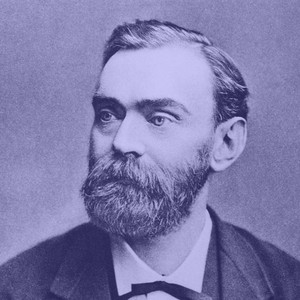
The man behind the prize is Alfred Nobel.
And in today's episode, we are going to hear his fantastic story.
But before we get right into all of that good stuff, I want to remind you that you can become a member of Leonardo English and follow along with the interactive transcript and subtitles over on the website which is leonardoenglish.com Membership of Leonardo English gives you access to more than double the number of episodes plus all of our learning materials including instant translations in 12 languages, study packs, and much, much more.
So, if you are ready to take the next step on your English learning journey, the place to go is LeonardoEnglish.com.
Okay then, let's get right into it and talk about Alfred Nobel and the Nobel Prize.
What would someone write about your life when you die?
If you had some magical power to see into the future, to after you had taken your last breath, and you were the sort of person about whom obituaries might be written, What would it say?
Would it say that you'd lived a good, honest life, been a good parent, brother, sister, son or daughter? that you had made the world a better place, however that might have been.
For one man in 1888, so the perhaps apocryphal legend goes, This was not a fantasy, but a reality.
In 1888, the Swedish businessman and inventor Ludvig Nobel died.
News of his death was sent by telegram, but one French newspaper seemed to have got a bit mixed up.
Instead of writing the obituary for the recently deceased Ludwig Nobel, it published the obituary of his very much still-breathing younger brother, Alfred.
It was not a glowing report on Alfred Nobel's life.
Instead, it described him as the merchant of death, a man who became rich by finding ways to kill more people faster than ever before.
Don't worry, we'll come to why they might have called him this in a minute.
Alfred Nobel read his obituary, presumably pinched himself to confirm that he wasn't in fact dead. and must have decided that he didn't like the idea of being remembered in this way.
He couldn't change his past, but he could change his future.
And, importantly, how he would be remembered after his death.
So, in his last will and testament, he declared that his considerable fortune would go towards the establishment of a prize for outstanding achievements in five fields.
Physics, chemistry, medicine, literature.
And peace. Now, Ludwig Nobel did die in 1888, and his brother Alfred did leave his fortune for the establishment of the Nobel Prize.
But there are some questions about the truthfulness of this obituary mix-up story.
It is often reported, but it doesn't appear on the official Nobel Prize website, and is dismissed as a myth by many historians.
And, like many legends, this one is no doubt retold, because it sounds like it could be true.
An elderly man sees how he will be remembered and wants to do something to change it.
As to whether it is true, I will leave you to come to your own conclusions.
But to understand why this then 54-year-old Swedish businessman might have found himself described as a merchant of death, and why he might have decided he wanted to do something about it.
We need to go right back to these stars.
He was born in 1833 in Stockholm, Sweden.
He came from a middle class family, but one that found itself perpetually short on cash.
His father, Emmanuel Nobel, was an inventor and engineer.
A clever man, clearly, and one full of ideas, but not always the best businessman.
Like many inventors and engineers, he had grand dreams and a habit of pursuing ambitious projects that didn't always work out.
As a result, the family struggled financially in Alfred's early years.
When he was just five years old, his father was forced to declare bankruptcy.
The family had to leave their comfortable home in Stockholm and start anew. his father however didn't give up he moved to russia to seek new opportunities leaving his family behind in sweden It was a bold move, but it paid off.
In St Petersburg, he managed to convince the Russian military to invest in his inventions. particularly underwater mines and underwater explosives.
Before long, he was running a successful armaments factory and had made enough money to bring the whole family over to join him.
So Alfred Nobel, at the age of nine, moved to Russia.
There, he and his brothers were given a private education that was far better than what they would have received in Sweden.
They studied science, literature and languages.
And the young Alfred turned out to be a gifted student.
By the time he was a teenager, he could speak five languages fluently.
Swedish, Russian, French, English and German.
He had a particular interest in literature and poetry, which led to tensions with his father, who wanted his sons to follow in his footsteps. and become engineers, not poets or writers.
Eventually, the young boy was sent abroad to complete his education.
He travelled around Europe and studied chemistry in Paris, where he was taught by some of the leading scientists of the day.
And it was in Paris that he met a man who would change the course of his life.
The Italian chemist Asciano Sobrero. Sobrero had recently discovered a highly explosive substance called nitroglycerin.
It was far more powerful than gunpowder.
But it was also extremely unstable. For gunpowder to explode, you need some kind of spark or flame.
It won't just explode on its own. Nitroglycerin was far less predictable.
Even the smallest movement or change in temperature could cause it to explode.
Sobrero saw its power, but believed it was too dangerous and unstable to have any practical use.
Alfred Nobel disagreed. He became fascinated with the idea of taming nitroglycerin. of finding a way to make it stable enough for practical use.
And this wasn't, by the way, because he was fascinated by weapons or he had some great desire to develop military technology.
His intended use for it, and where he thought the biggest commercial opportunity lay, was in construction or mining.
This was the second half of the 19th century.
Roads and railways were being laid across Europe and North America, and mines were being dug.
Thank you. You could hire hundreds of people to dig a tunnel through a mountain with pickaxes and shovels.
Or you could just blow it up with explosives.
It would be cheaper, quicker, and perhaps unexpectedly, given we're talking about blowing things up, even safer.
And it's this obsession with explosives that would come to define the next chapter of his life.
Nobel returned to Sweden and threw himself into experiments.
He set up a laboratory in the back of his father's factory, and spent countless hours mixing chemicals, testing compounds, and trying to work out how to make nitroglycerin safer to handle.
The potential was enormous. But so was the danger.
As you might imagine, they were frequent accidents, some small, others deadly.
In 1864, a massive explosion at the factory killed five people, including Alfred's younger brother, Emil.
It was a devastating blow, personally of course, but also professionally.
There were calls for his experiments to be shut down.
Local authorities banned the production of nitroglycerin within the city limits.
And clearly, nobody wanted to live next to the Nobel explosives factory.
But Nobel didn't stop. Instead, he moved the work onto a barge, a boat, anchored in the middle of a lake. far from anyone who might be harmed if something went wrong.
And then, after years of experimentation, he made a breakthrough.
He discovered that if you mixed nitroglycerin with a kind of absorbent clay called Kizuga, it became far more stable.
You could shape it into sticks, transport it without fear of accidental explosion, and control when and how it detonated.
He decided to name this new invention after the Greek word dynamis, meaning power.
It was, as you might have guessed, dynamite.
It was a revolution. Dynamite was cheaper, safer, and more effective than anything that had come before.
Within a few years, Nobel had patented it across Europe and North America.
It was used to blast tunnels through mountains, build railways, dig mines and clear canals.
Bridges, dams and entire cities were constructed with the help of dynamite.
But, as became quickly apparent, dynamite is also pretty handy for non-peaceful purposes.
Although Nobel had originally intended it for industrial use, people quickly saw its military potential.
It was more powerful than anything they had worked with before, and much easier to transport than older explosives.
Armies began to use it for demolition, sabotage and battlefield engineering.
It also found its way into the hands of anarchists and revolutionaries who used it in political assassinations and bombings.
And Dynamite wasn't the end of it. In the 1880s, Nobel developed another explosive compound called a ballastite, which was one of the first smokeless gunpowders.
It was adopted by several European militaries and used in modern ammunition.
This invention brought him even closer to the world of warfare and reinforced the image of him, not just as an inventor, but... as an arms manufacturer.
This left him a conflicted man. Yes, his inventions had made him very wealthy.
He established factories and laboratories in over 20 countries.
He held more than 350 patents in his lifetime.
He was a chemist, an engineer, a businessman and a global industrialist.
But his creations could and were being used to kill.
He was also increasingly a man alone. He never married.
He moved frequently. leading the French writer Victor Hugo to describe him as Europe's richest vagabond.
He had no permanent home, and would typically live in hotels or alone in large houses, surrounded by books and papers.
He wasn't, however, completely without friends or companionship.
In the 1870s, he had placed an advert in a Viennese newspaper for a housekeeper.
It read, Wealthy, highly educated, elderly gentleman, seeks lady of mature age, versed in languages, as secretary and supervisor of household.
One of the applicants was a woman called Bertha Kinski.
She was an Austrian aristocrat, down on her luck, well-read and highly intelligent.
Nobel hired her, but after only a couple of years, she left to marry a former lover.
That might have been the end of the story, but the two kept in touch.
They continued to write to each other for decades.
Bertha Kinski, who became Bertha von Suttner, went on to become a leading figure in the peace movement.
Her 1889 novel Lay Down Your Arms became an international bestseller and helped spark a new wave of pacifist activism across Europe.
In their letters, they exchanged a healthy debate over the moral implications of Nobel's inventions.
This was clearly something that he was thinking deeply about.
But his conclusion, at least in one letter, was that dynamite could act as a vehicle for peace, but just in an unexpected way.
To quote one letter directly, perhaps my factories will put an end to war sooner than your congresses. on the day that two army corps can mutually annihilate each other in a second, all civilized nations will surely recoil with horror and disband their troops.
End quote. Now, as to whether Nobel truly believed that, or it was his way of legitimising his inventions and making himself feel better…
I will let you be the judge of that. What is not up for debate is that when Nobel was drafting his will and deciding how best to use his considerable fortune, Alongside the prizes for the sciences and medicine, he included an award for... the person who shall have done the most or the best work for fraternity between nations, for the abolition or reduction of standing armies, and for the holding and promotion of peace congresses.
That became the Nobel Peace Prize. And when Alfred Nobel died, alone and without any direct heirs.
In 1896, in Sanremo, Italy, His fortune went to the establishment of this collection of five prizes.
Physics, chemistry, medicine, literature, and of course, peace.
The sixth prize, by the way, the one in economics, was only added much later, in 1968.
This fortune, by the way, was vast, equivalent to $300 million in today's money.
It has since been well invested, and the Nobel Foundation now has assets of around $700 million, more than enough to continue dishing out prizes until the end of time.
Now, interestingly enough, when his dying wish was first revealed, there were not rounds of applause and claps of joy.
The first reaction was... Confusion. He hadn't told anyone about this wish.
And after having had numerous bad experiences with lawyers in his business career, He had drafted the will without one.
As such, there were a bunch of questions to be resolved, and the organisations that he had named to administer the prize had been given no idea of the plan. his extended family fought the will too.
After all, a huge fortune was at stake. and he had pledged it all to this then theoretical prize.
It took a while, but after five years and endless back-and-forth negotiations, the Nobel Prize Foundation was established.
Since the first prizes were awarded in 1901, they have been awarded more than 600 times to over 1,000 individuals and organisations.
Some are names you'll recognise instantly.
Marie Curie, the first woman to win a Nobel Prize, and indeed the only person to win one in two different sciences. physics and chemistry.
Martin Luther King Jr. for his non-violent fight for civil rights in the United States.
Malala Yousafzai, the youngest ever laureate, who stood up for the rights of girls to receive an education.
Nelson Mandela. Albert Einstein. Ernest Hemingway, Mother Teresa.
It is, in many ways, a roll call of human achievement, a celebration of the best that people can do.
But not all laureates are remembered so fondly.
Some choices, with the benefit of hindsight, are harder to justify.
In 1949, the Portuguese neurologist, António Egos Moniz, was awarded the Nobel Prize in Medicine for developing the prefrontal lobotomy, a procedure now widely condemned as brutal, ineffective and deeply damaging.
Thousands of patients were lobotomized across Europe and North America. often without proper consents, and often with disastrous consequences.
The prize, however, has never been revoked.
And then there's the Peace Prize, which is probably the most politically charged of them all. it has been awarded to plenty of people almost universally recognised and agreed upon for their contributions.
People like Mother Teresa and Nelson Mandela.
But in 1973, it was awarded to Henry Kissinger and Lei Dok Tao. for their efforts to end the war in Vietnam.
Lê Độc Tàu declined the prize, citing the ongoing conflict.
Kissinger, on the other hand, accepted it, despite the fact that the bombing of Cambodia and Laos continued under his watch.
And Kissinger and peace were not two words that many people put in the same sentence.
The choice was so controversial that two members of the Nobel Committee resigned in protest.
So to wrap things up, like anything, the Nobel Prize is not perfect, and not without its contradictions.
It has been awarded to people now criticised as cruel and inhumane.
It has been accused of being used to make political points.
It is a prize made possible by dynamite.
But for all its flaws, the Nobel Prize still holds enormous symbolic power.
It can shine a light on discoveries no one had heard of, lift unknown writers out of obscurity. or bring global attention to a political cause that had gone unnoticed.
It's a prize that rewards ideas. Ideas that push humanity forward. even if progress itself is messy, uneven, and imperfect.
And perhaps that's what Alfred Nobel had hoped for.
Not to erase the past, but to influence the future.
Not to rewrite his life, but to shape how it might be remembered.
And more than a century later, his name is still spoken every year in connection with some of the most important breakthroughs in science literature.
And at least in my book, that isn't such a bad way to be remembered.
Okay then, that is it for today's episode on Alfred Nobel and the Nobel Prize.
I hope it's been an interesting one and that you've learned something new.
As always, I would love to know what you thought of this episode.
Did you know the story about the Nobel Prize?
Is there someone you think is deserving of it who hasn't won?
Or someone undeserving who has? Let me know in the comments below if you're listening to this somewhere where you can leave a comment, and for the members among you, you can head right into our community forum which is at community.leonardoenglish.com and get chatting away to other curious minds.
And as a final reminder, if you enjoyed this episode, and you are wondering how to more than double the number of episodes you can get, plus learn with our interactive transcripts, subtitles and key vocabulary, then the place to go for that is leonardoenglish.com, and if you aren't yet ready to become a member but you'd like to do something to support the show, then I'd love for you to think about leaving a review or a star rating on your favorite podcast app.
It takes less than 30 seconds to do, but they are super helpful. and each one brings a smile to my face.
You've been listening to English Learning for Curious Minds by Leonardo English.
I'm Alasdair Budge, you stay safe, and I'll catch you in the next episode.