Hello, hello, hello and welcome to English Learning for Curious Minds by Leonardo English, the show where you can listen to fascinating stories and learn weird and wonderful things about the world at the same time as improving your English.
I'm Alistair Budge and today it's the start of another three -part mini -series, this time on the theme of citizenship and identity.
In part one, today's episode, we are going to talk about the case of Italy and the country's recent referendum on easing the rules on citizenship.
In part two, we'll talk about the Windrush scandal, a recent British political scandal in which tens of thousands of people, people, mostly from former British colonies in the Caribbean, found themselves treated as outcasts in their own country.
And in part 3, we will talk about the battle between the Mediterranean island of Malta and the European Union, a battle for the right to sell citizenship.
As with all of our miniseries now, parts 2 and 3 will be member only episodes so now Now is the time to briefly remind you that you can listen to those, as well as the rest of our more than 550 -strong back catalogue, as well as learn with the interactive transcripts, study packs and more with our membership.
There is a link to that in the description for this episode, or you can just head to LeonardoEnglish .com Okay, then let's get right into it, and ask ourselves what makes an Italian.
Now, I want to start this episode by telling you something about me.
It's not a secret, and I'm certainly not ashamed of it.
But it's not something that everyone knows, and it's not something that's immediately obvious.
It's not something that you would guess by looking at me.
It's not something that you would guess by hearing my voice.
It's not something that you would guess if I told you about my parents, my brother and sister, my cousins, or anything about my childhood.
It's this. I am Italian.
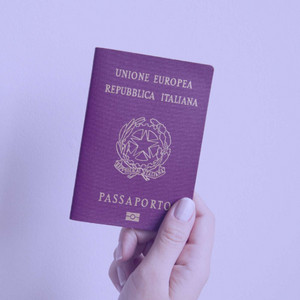
I have an Italian passport.
I am, legally speaking at least, as Italian as Giorgio Armani or Sophia Loren.
In fact, I am more Italian than tens of thousands of people who were born and raised in Italy, who speak no language other than Italian, know no other country but Italy, but are not Italian citizens.
I have Italian citizenship through marriage.
My wife is Italian, which allowed me to become an Italian citizen.
There are a few technicalities to this, different waiting periods, depending on whether you live in Italy or not, and whether you have children, and then you have to pass a language test and not have a criminal record. But, in my case at least, I was eligible to become an Italian citizen after three years of marriage, despite not living or working in Italy, or having any connection to Italy apart from my wife.
Interestingly enough, for my wife, If the reverse is not true, it is significantly more difficult and expensive for her to become a UK citizen than it is for me to become an Italian citizen.
Now, especially for the Italians listening to this, you might think this is perfectly fair, you might think it is grossly unfair, but it is the law.
As you will know, a country has the right to set its laws on who is entitled to citizenship.
At birth, citizenship is typically granted based either on ius soli, where a child becomes a citizen of the country they were born in, or ius sanguinis, where the child becomes a citizen by blood, because their mother or father was a citizen, or some combination of the two.
Most countries in the Americas, like the US, Mexico and Brazil, prioritise use soli, where anyone born in the country is a citizen, regardless of the citizenship of their parents, while most European countries, like Italy and the UK, are much more restrictive and prioritise citizenship through descent.
You become a citizen through ancestry, through blood.
And globally, most countries also offer some form of pathway to citizenship, even if you were not born in that country, or have no ancestry in that country.
Typically, this is through either marriage, as it was in my case, or an extended period of time spent living in that country, but there are other ways, such as the topic we'll cover in part 3 of this mini -series, paying lots of money.
In the case of Italy, the country has relatively loose restrictions when it comes to acquiring citizenship through ancestry or marriage, but much stricter rules regarding citizenship through residency.
Or to translate that into plain English, I was able to become an Italian citizen after just three years of being married.
But someone Someone who was born in Italy and had lived in Italy their entire life but whose parents weren't Italian citizens, well, unless they had applied for citizenship between their 18th and 19th birthdays, they might find it very difficult to become Italian.
And it was this that was one of the key focuses of a referendum put to the Italian public in early June this year.
The referendum actually had five questions, with four of them relating to labour laws, but the most important question was one on citizenship.
The public was asked to vote on whether the time limit for non -EU citizens living in Italy to become Italian citizens should be reduced from 10 years to 5 years, which would bring it in line with other European European countries, such as France, Germany and the UK.
As a quick side note, Italy has quite a strong tradition of holding referendums and an equally strong tradition of those referendums failing to reach the required turnout rate of 50%.
So they are often used more like political tools to express unhappiness at government policy and direction rather than genuine vehicles of political change.
So, who exactly was pushing for this referendum?
And perhaps more importantly, why now?
Well, the short answer is the political left, trade unions and a coalition of pro -immigration and civil rights groups.
Italy, like much of Europe, has seen significant immigration over the past 30 years.
And many of the children of these immigrants, these second -generation Italians, have grown up in Italy, speak only Italian, go to Italian schools, and consider themselves Italian in every way.
But in the eyes of the law, they're not.
They are foreigners.
For years, there have been growing calls to make it easier for these people to obtain Italian Italian citizenship, to officially recognise their Italian identity – not just socially or culturally.
Supporters of the Reform argued that the existing system is unfair and out of touch with modern Italy.
After all, they say, if someone has lived in Italy for most of their life, paid taxes, gone to school, speaks the language fluently and calls Italian home, doesn't this make them Italian?
And this question of citizenship has also become wrapped up in wider debates about Italy's ageing population and its future workforce.
The country, as you may know, has one of the lowest birth rates in Europe, with 1 .24 births per woman, and hundreds of thousands of young people leaving for other countries.
Its population is ageing and shrinking, shrinking, with a quarter of the population aged over 65 and just 12 % under the age of 14.
Its economy increasingly depends on migrant labour to keep key sectors running, everything from agriculture to elderly care to logistics.
From this perspective, making it easier for long -term residents and their children to to become citizens isn't just a question of fairness, so the argument goes, it's also a practical solution to a looming demographic crisis.
In short, Italy needs more people, and many argue that it should start by giving citizenship to people who are already there.
But, as you might expect, not everyone agrees.
Opposition to the reform comes mainly from the Right where political leaders have consistently argued against the loosening of the rules around citizenship.
For these parties, citizenship is not simply an administrative label, a matter of residency, or a tool to secure economic growth.
It's about identity, history, culture and, in their eyes, about protecting what it means to be Italian.
Italian. They argue that Italian identity is something inherited through blood and tradition, not simply acquired by living in the country for a few years and being able to correctly identify the difference between an espresso macchiato and a cappuccino. There's also the question of control.
Like in much of Europe, in Italy immigration has has been one of the most polarising political issues for years, particularly since the European migrant crisis of 2015.
The right argues that relaxing citizenship rules could act as a pull factor, encouraging more immigration, and that the system should remain strict to prevent abuse use and protect the country's social cohesion.
And beyond ideology, there is, of course, political calculation.
The issue of citizenship divides public opinion quite neatly along political lines.
For the right, opposing reforms like this is a way to mobilize their base, to present themselves as defenders of tradition, of the nation, of Italian values, however you might define those.
And while supporters framed this reform as modern, inclusive and pragmatic, opponents presented it as rushed, dangerous and as something that could erode and dilute Italian identity.
So what happened? Well, the referendum, in the great tradition of Italian referendums, was declared void after only around 30 % of the eligible population turned up to vote.
Of those who voted, around 65 % voted to reduce the term limit, with 35 % voting against it.
But this was to be expected.
The Prime Minister, Giorgia Meloni, who was one of the major critics of the proposal, encouraged her supporters to to boycott the referendum.
So it was hardly surprising that more yes supporters turned up to vote than the no side.
And anyway, legally, a minimum turnout of 50 % is required for a referendum to be binding.
So the entire thing was declared null and void.
The result was met with cheers by Milani and her supporters on the right, and with dismay by those who had campaigned for the referendum who were mainly on the political left. Now, without getting too dragged into the topic of Italian politics, I think it is useful to look at this referendum and the case of Italy as an example on the question of citizenship.
What makes one person Italian and another not?
What does this mean?
And what implications does it have for the future of the country?
In the case of Italy, the country has historically had very generous rules on citizenship by ancestry, by descent.
In other words, there was a strong preference for the idea that citizenship is something that is passed down from generation to generation, not easily acquired by cultural assimilation.
In fact, until May of 2025, there were no generational limits for eus sanguinis citizenship.
Let's say someone emigrated from Italy in 1861, the year of unification, to America, and they and all of their descendants lived in the US, never setting foot in Italy again, and never speaking a word of Italian.
Italian. And, to make it even more dramatic, let's say they renounced all Italian culture and traditional Italian food.
And, to make it even worse, their favourite pizza was Hawaiian.
Their descendant, born in 2011, 150 years later, could – if there was an unbroken chain of direct relatives who claimed Italian citizenship – also apply for Italian citizenship.
citizenship. If this sounds theoretical, it really isn't.
An estimated 1 .2 million people in Argentina are Italian citizens, including the President, Javier Millet, who has never lived or worked in Italy.
Now, contrast this with the estimated 2 .5 million foreigners who have been living and working in Italy for more than five years.
The recent referendum referendum, was about the question of whether they should have the right to Italian citizenship, and indirectly whether their children should also become Italian citizens.
To give you an example, let's say a couple from China have been living and working in Rome for the past nine years.
They have no Italian ancestors or heritage, but they speak fluent Italian.
They also have a couple of kids who were born and raised in Italy, and and they can correctly tell you what kind of pasta goes with what kind of sauce, and they would never dream of using cream in a carbonara.
If the referendum had passed, the couple would have been able to apply for Italian citizenship, and their children could become Italian, rather than having to wait until they were 18 to apply.
As you heard, the referendum didn't pass.
It failed badly, and there are even suspicions that there will be another referendum on whether to raise the limit from 10 to 12 years, making it even more difficult to become a citizen by naturalisation.
And of course, Italy isn't the only country grappling with these kinds of questions.
Take Germany, for example.
Up until the year 2000, German citizenship law was based almost almost entirely on jus sanguinis, on ancestry.
But in 2000, things started to change.
Children born in Germany to foreign parents can now receive German citizenship, as long as their parents have been legal residents for a certain period of time.
And the limit for citizenship citizenship by residency was reduced from 15 years to eight, and in 2024 it was reduced again to five years.
In fact, my sister, who lives in Germany, is in the process of becoming a German citizen.
France, for its part, has long operated under a more inclusive model, with automatic or semi -automatic citizenship for children born born in France to foreign parents who have lived in the country.
Even countries like Switzerland, which are traditionally seen as quite restrictive, have gradually eased their naturalisation rules for second -generation immigrants.
Italy, by contrast, has held on tightly to the idea that citizenship is primarily something passed down through blood.
And, And, in many ways, this reflects the country's own history.
For most of its modern existence, Italy was a country of emigration, not immigration.
Millions of Italians left for North and South America, for Australia and for parts of Europe.
The Italian state made a conscious choice to maintain legal ties to these people and their descendants, even generations later.
Hence the extremely generous rules on citizenship by descent.
But now, as Italy has become a country of immigration with millions of people from Africa, Asia, Eastern Europe and the Middle East settling and raising children in the country, This old legal framework is starting to show its cracks.
And, at its core, this is a debate about what citizenship really means.
Is it a legal status passed down from your ancestors, even if you have never set foot in the country?
Is it a reflection of cultural belonging, of language, school, work and daily life?
life? Or is it something else entirely?
A contract, a symbol of participation, of being part of a shared national project?
In the case of Italy, these questions remain unresolved.
And if the result of the referendum is anything to go by, they are likely to remain unresolved for some time to come.
Okay then, that is it for today's episode on the question of Italian citizenship.
To everyone, and especially to the Italians listening, I hope it was an interesting one and that you might have learned something new.
As always, I would love to know what you thought of this episode.
What do you think is the right way to define who becomes a citizen or not?
Do I deserve my Italian citizenship?
Or is the country handing out passports too liberally?
I would love to know, so let's get this discussion started.
Let me know in the comments below if you're listening to this somewhere where you can comment.
And for the members among you, you can head right into our community forum, which is at community .leonardoenglish .com and get chatting away to other curious minds.
And as a final reminder, this is part one of a three -part miniseries.
Next up, we'll be talking about the Windrush scandal.
And in part three, we'll be looking at a country that wants to keep selling its passports to the highest bidder and talk about Malta's battle with the European Union.
Those will both be member -only episodes, so if you'd like to listen to those and our full, unlocked catalogue of more than 550 other episodes, then the place for that is leonardoenglish .com.
You've been listening to English Learning for Curious Minds by Leonardo English.
I'm I'm Alasdair Budge, you stay safe, and I'll catch you in the next episode.