Hi there, Alistair here.
Let me quickly tell you about something super exciting.
Registrations are now open for our five -star rated course, The Mules.
We first offered this course in 2023 and it was a huge success with hundreds of people from all over the world taking part and leaving amazing reviews.
So I'm thrilled to tell you that we are running it again.
yen. Registrations will be open until midnight this Sunday, and the course is going to start on Monday, July the 7th.
Now, what is The Mules, you might be thinking?
Well, it is a new story -based course that combines the magic of a professionally produced audio drama with English language lessons.
It will all take place over the course of 30 days.
So every day, you'll get a new chapter of the story, as well as a video lesson taught by me, complete with a quiz, transcripts, key vocabulary lists, and more.
Hundreds of curious independent learners have taken it already and loved it.
I think you will love it, and I would love to see you in the course.
You can find a link to register in the show notes for this episode, and remember, you will need to register for it by midnight on Sunday, July the 6th, in order to take part.
Right, that is it from me.
Now it's time to enjoy this episode.
Hello, hello, hello and welcome to English Learning for Curious Minds by Leonardo English, the show where you can listen to fascinating stories and learn weird and wonderful things about the world at the same time as improving your English.
I'm Alastair Budge and today is the start of yet another three -part mini -series, this time on the loose theme of power struggles in post -colonial Africa.
In Part 1, today's episode, we are going to learn about Mobutu Sese Seko, the man who ruled the Democratic Republic of Kongo with an iron fist and a leopard -skin hat.
In Part In part 2, we are going to learn about the curious case of the man who went to Eton, the most exclusive private school in Britain, studying alongside princes and plutocrats, but was arrested on the charge of attempting a military coup in Equatorial Guinea.
And in Part 3, we are going to zoom in on Angola to understand how Chinese power and and money have changed the rules of the game in post -colonial Africa.
As a quick reminder, as with all of our mini -series now, parts 2 and 3 will be member only episodes, so now is the time to quickly remind you that if you'd like to unlock those, as well as hundreds of other member -only episodes, interactive transcripts, study packs and more, then now is the time to check out our membership.
The place for that is leonardoenglish .com.
OK then, let's get right into it and talk about Mobutu Sese Seco.
There was a 1990 New York Times bestseller called A Natural History of the Senses, where the author went into detail about the reasons that tastes change over time.
Why do children tend to dislike certain flavours, but start to enjoy them as young adults?
else? Why are our preferences at 45 often different from those at 25?
In the case of today's protagonist, at the age of 25 his favourite drink and his only contribution to his wedding banquet was a single crate of beer, but at 45 his tastes had evolved.
involved. Any guest at one of his parties would be greeted with a flute of pink Laurent Perrier champagne.
Now, this is probably not best explained by any scientific theory, but rather by the fact that at 25 he was a lowly army officer, and at 45 he was the undisputed leader of sub -Saharan Africa's largest country, and by some estimates, one of the wealthiest men in the world.
This is the story of Joseph -Désiré Mobutu, or Mobutu Sese Seko, as he would later be called.
He was born in 1930 in Lizala, a small town in what was then the Belgian Congo.
Congo. His mother was a hotel maid, and his father a cook working for a Belgian judge.
His father died when he was only eight years old, and his uncle and grandfather stepped up as sort of joint father figures.
It wasn't a privileged upbringing by any means, but the young boy was clever, confident confident, and somewhat rebellious.
He was known for all sorts of pranks and tricks on his Catholic school teachers, and with age, these turned from classroom jokes into more serious acts of disobedience.
He even ran away from school on a boat, reportedly to go and meet a girl, and was found down river several weeks later.
her. As punishment for his misbehaviour, he was kicked out of school and forced to join the Force Publique, the colonial army run by the Belgians, where he served for a few years before becoming a journalist. Now, before we move on, it's worth just reminding ourselves a little bit about the history of Congo at the time Mobutu was a young man.
It was a Belgian colony, and of all the colonial regimes in Africa, it's hard to find one more extractive, oppressive and brutal than the Belgians colonisation of the Congo.
You might know this already, perhaps you might remember some of this from episode 289 on King Leopold II, but if you don't, here's a brief reminder.
The country was treated as a vast resource mine.
Rubber, copper, uranium, diamonds, all extracted for Belgian profit, with practically zero consideration for the livelihood or well -being of any of the native people.
The colonial administrators were fiendishly cruel, and the local population was kept in a state of dependency and fear.
It was seriously grim, and an estimated 10 million Congolese people were killed directly and indirectly in the first 23 years of Belgian colonisation alone.
And, as per most countries that were colonised, but even more so in the case of Congo, there had been practically no investment in local infrastructure, training of local people, or creation of laws or institutions.
This meant that when independence came, as it inevitably did in 1960, Congo was desperately unprepared to govern itself.
There was no political infrastructure, no experienced civil service, no established judiciary and no military leadership beyond the Belgian officers who had run the force publique.
Unlike British or French colonies, which had at least had some form of elite education system for local people, Belgium had deliberately avoided training a Congolese professional class.
Indeed, at the time of independence in 1960, there were just 30 Congolese university graduates in in the entire country—a country of around 15 million people at the time.
So back to Mobutu. At the time of Congolese independence, he had been working as a journalist for a few years, and had become friendly with a man named Patrice Lumumba.
Lumumba was a fiery orator and committed nationalist who won the country's first democratic election.
As his secretary, he chose Mobutu.
But if you are thinking of a secretary as an administrative helper who brought coffee and tea and greeted guests at the reception...no, Mobutu was a very different kind of secretary.
He was charismatic, spoke several languages, fiercely intelligent intelligence, and was effectively Lumumba's trusted right -hand man and confidant.
Or, as one US ambassador's private notes put it, this was an extremely intelligent man, very young, perhaps immature, but a man with great potential.
Lumumba had clearly seen this potential too, and promoted Mobutu to Colonel and soon after Chief of Staff of the National Army, a meteoric rise that gave him enormous influence over the country's only cohesive institution at the time.
But for Lumumba, it would backfire terribly.
Shortly after the Declaration of Independence, on the 30th of June 1960, the country had fallen fallen into disarray.
Lumumba was technically the Prime Minister, but his hold on the country was shaky at best. Force publique soldiers mutinied, and when it looked like the United Nations peacekeepers sent in to help wouldn't be able to contain them, the Prime Minister, Lumumba, turned to the Soviet Union for assistance.
The Soviets sent technical advisors and support, support, which helped quell the unrest, but created an altogether different problem.
This was 1960, the peak of the Cold War, and the United States got very nervous at the idea of Soviet influence in the newly independent Congo.
With the backing of Belgium and most likely U .S. Intelligence, Mobutu orchestrated a coup -like intervention that removed Lumumba from power.
Lumumba fled, was arrested by troops loyal to Mabutu, but instead of being tried or protected, he was flown to a breakaway province hostile to his leadership and handed over to his enemies.
There, the country's first democratically elected elected leader, was brutally tortured and executed, with Belgian officers watching on.
His death shocked the world, and remains one of the darkest stains on Congo's post -independence history.
Now, importantly, this first coup, as it has been called, was relatively bloodless.
It wasn't good news if you were Patrice Lumumba, but it seemed like Mobutu was a loyal army army officer who only had the best in mind for his country.
He claimed it was a neutralisation of all political figures, Lumumba included, and declared that Congo would be governed by technocrats for the following 6 months.
What actually happened though was less a smooth smooth technocratic transition, and more a chaotic power vacuum.
The so -called neutral government that Mobutu installed quickly lost legitimacy.
Regional leaders and army officers began acting independently.
The country effectively fractured.
In the mineral -rich south, backed by Belgian mining interests, one province declared independence.
In the east, another city became a stronghold for Lumumba's supporters.
There were foreign troops from the United Nations, Belgian commandos, and even Cuban advisers in the mix.
The entire country was being pulled apart by competing forces, and Mobutu, far from being a neutral arbiter, was quietly consolidating power in the background.
Over the next few years, he positioned himself as the one figure who could hold the country together.
And to a population exhausted by years of instability and civil war, the idea of a strong man didn't sound so bad.
So, in 1965, at the age of 35, Mobutu saw his chance.
He used a request request from the president to temporarily restore order, as a springboard to launch a military coup.
He seized control of the country, and in a landmark speech declared that Congo had been so damaged by politicians and bad actors in the five years since independence that it would take at least another five years to get things back on track.
back. So, he dissolved parliament, banned all political parties, and declared that for the next five years there would only be one voice in the Congo – his.
This was 1965, and for the next 32 years he would rule the country through a mixture of carrot, stick and cult of personality.
And so began the process of rebranding not just Mobutu the man, but the nation itself.
In 1971, he renamed the country Zaire, saying the name Congo was a relic of colonialism.
He also renamed himself, dropping Joseph Desiree and adopting a far more theatrical theatrical title, Moubutu Sese Seku Kuku Ngbendu Waza Banga, which roughly translates as the all -powerful warrior who, because of his endurance and inflexible will to win, goes from conquest to conquest, leaving fire in his wake.
Quite something. And he didn't stop there.
Streets, cities, rivers and even clothing were swept up in this new cultural vision.
Western names were replaced with African ones.
Suits and ties were banned from government offices and replaced with a colourless shirt known as the abacoste which is short for abat le costume or down with the suit.
Foreign music was pushed aside in favor of homegrown styles.
The whole campaign was called the Authenticite Movement, meaning authenticity in English.
Now, this movement was initially very popular in the Congo or Zaire as it was then.
And it was also praised by some foreign commentators.
After all, Mobutu was pushing for a kind of cultural decolonisation, encouraging pride in African identity after decades of European rule.
But others were more sceptical.
They said it was less about pride and more about power.
Authenticity didn't just strip the country of European names.
It gave Mobutu the excuse to eliminate anyone who wasn't authentically Zairean or who disagreed with his vision of what that meant.
He was now not just the president, but something closer to a monarch. He installed giant portraits of himself in public squares.
His face appeared on banknotes, stamps, and school schoolbooks.
He referred to himself as the Father of the Nation, the Guide and the Messiah.
At official events, his name would often be introduced with a list of over a dozen honorific titles.
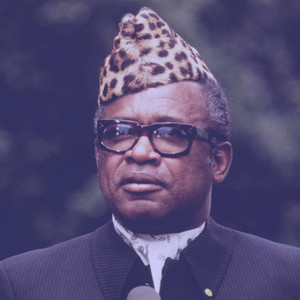
And, of course, there was the leopard -skin hat.
Always present, always perfectly positioned, it became a symbol of his rule.
Part theatre, part menace.
this. Alongside it came his carved, ebony walking stick, his dark glasses, and his meticulously tailored abacus.
This was a man who took image seriously, a man who understood the power of performance.
But behind the smiling portraits and grandiose titles was a deeply repressive regime.
Dissidents were routinely tortured or disappeared, opposition parties were outlawed, and intelligence agencies kept the population under constant surveillance.
Public executions were staged to send a message.
Mobutu's grip on power wasn't just psychological, it was brutally enforced.
And during all of this, the country was in a serious state of decay.
Mobutu ruled through a complex web of patronage, of disbursing power, favours and money to his family, friends, and allies.
If you were loyal, you were rewarded.
If you weren't, you were either exiled, imprisoned, or worse.
Corruption wasn't just tolerated, it was built into the system.
In one speech, speech. He said, If you want to steal, steal a little in a nice way.
Only if you steal so much as to become rich overnight, you will be caught.
Perhaps he should have clarified that there was one man for whom this rule didn't apply – him.
Estimates vary, but Mobutu is believed to have embezzled somewhere between $4 and $15 billion during his time in power.
power. Indeed, in 1970, he is estimated to have stolen 60 % of the entire country's annual budget.
And this wasn't all stashed away in Swiss bank accounts.
There were lavish displays of wealth and opulence.
He built a huge palace in his ancestral home in Northern Congo, which which was dubbed the Versailles of the Jungle.
He had more homes in France, Portugal and Switzerland.
He travelled with a refrigerated case of pink champagne.
And there are reports of suits being sent to Paris for dry cleaning.
In the 1980s, he even reportedly had a Concorde jet pick him up for shopping trips in Europe.
Meanwhile, back in Zaire, as it was then, them.
Schools crumbled, hospitals lacked medicine, teachers and civil servants often went unpaid for months.
The economy became increasingly dependent on foreign aid and loans.
And when there was a crash in the price of copper, which was one of Zaire's main exports, the country literally ran out of money.
Inflation soared, debt piled up, and the state became became little more than an empty shell.
Yet, Mobutu remained in power – partly because he was a master manipulator, but also because of geopolitics.
Throughout the Cold War, the West had seen him as a reliable anti -communist ally.
He hosted CIA operations, supported US -backed rebels in Angola, and regularly reminded Washington Washington that if they didn't support him, the Soviets might take over.
The irony, of course, was that Mobutu wasn't exactly consistent in his ideology.
He had been outspoken in his admiration for Mao Zedong and had flirted with ideas from the Chinese Revolution.
He condemned European decadence, all while sipping French champagne and collecting directing fine European art.
He presented himself as the symbol of African pride, while secretly collaborating with Belgian intelligence to remove Lumumba, one of the continent's great anti -colonial leaders.
It was hard to see what he stood for, apart from his personal enrichment that was.
And by the early 1990s, things were falling falling apart.
The Cold War was over, and as there was no threat of the Soviet Union trying to push communist ideology in Africa, the West no longer needed Mobutu.
The aid dried up. Western diplomats, who had once been his staunch allies, now publicly called for democratic reform.
And inside the country, people were fed up.
up. Civil servants hadn't been paid in months, university students were protesting, the army was unpaid and increasingly mutinous.
Strikes, demonstrations and riots became common. The myth of Mobutu's invincibility began to crumble, and with it, the carefully constructed image of the father of the nation.
Pro -democracy movements were sweeping the continent.
Mobutu, who was now aging and increasingly unwell, was forced to start promising reforms. He said there would be free elections, but they never came.
In 1996, a rebellion sprung up across the country.
Their armies swept through eastern Zaire with lightning speed, facing little resistance.
Mobutu's once -feared army barely fought back.
Many soldiers simply deserted while others joined the rebellion.
In a matter of months the rebels had captured vast swathes of the country.
Their leader, a man named Laurent -Désiré Kabila, promised an end to dictatorship and, as his forces advanced westward, city after city fell without a fight.
Mabuchu's control evaporated almost overnight.
So he fled, first to his palace in the north of the country, the so -called Versailles of the jungle, but even there, he was not safe.
He attempted to negotiate a peace deal, but no one was interested.
The world had moved on.
on. What's more, he was a very sick man, and had been battling prostate cancer.
He tried to negotiate with France for medical treatment, but they refused.
No -one wanted to be seen propping him up any more.
He boarded a plane, and flew to Togo, then to Morocco where he had property.
He arrived in Rabat as a disgraced former leader, his entourage vastly reduced, his fortune frozen or looted.
He died just a few months later, in September 1997, aged 66.
There was no state funeral, no national mourning, just a quiet death in a foreign land, a dramatic fall for a man who who had once styled himself as the embodiment of a nation.
And yet his legacy lives on.
Not in statues or street names – most of those were removed a long time ago – but in the structure of the state he left behind.
A system of patronage, of centralised power, of wealth concentrated in the hands of a few.
The Democratic Republic of Congo is one of the wealthiest countries in the world in terms of its natural resources, with huge deposits of copper, cobalt, gold, diamonds and other precious metals.
It has a population of more than 100 million people, yet 75 % of them live in poverty.
In 1960, when Mobutu first took power, it was one of the most industrialised countries in Africa, second only to South Africa.
It is now one of the poorest. Clearly there are many more reasons for this than Mobutu Sese Seko.
He was a man of his time, a product of colonialism, Cold War politics and personal ambition.
But his story is also a warning of what happens happens when power is unchecked, when image replaces substance, and when a country is ruled not for its people, but for the enrichment of a single man in a leopard -skin hat.
Okay then, that is it for today's episode on Mobutu Seiseiseko, or to give him his full title, the all -powerful warrior who, because of his endurance and inflexible will to win, win, goes from conquest to conquest, leaving fire in his wake.
As a quick reminder, this is part 1 of a 3 part mini -series on the loose theme of power struggles in post -colonial Africa.
Next up in part 2 will be an episode on Simon Mann, the ex -Etonian who tried to hatch a plot to launch a coup in Equatorial Guinea, and in In part 3, we will be talking about the Angolan model and the new economic model China is pioneering on the continent.
As a final reminder, like with all of our mini -series, those will both be member only episodes, so let me quickly remind you that if you'd like to unlock those, as well as all our other bonus episodes, learning resources and more, the place to go for that is leonardoenglish .com.
You've been listening to English Learning for Curious Minds by Leonardo English.
I'm Alistair Batch, you stay safe and I'll catch you in the next episode.