Hello, hello, hello, and welcome to English Learning for Curious Minds by Leonardo English, the show where you can listen to fascinating stories and learn weird and wonderful things about the world at the same time as improving your English.
I'm Alastair Budge, and today is the start of yet another three -part miniseries this one is on the topic of World War One but we aren't really gonna talk all that much about World War One at least not directly instead we are going to explore this period through the lives of unusual characters involved in the war some more directly than others So in today's episode, part 1, we are going to talk about the amazing story of T .E.
Lawrence, the British archeologist and army officer, who fought alongside Arabian tribesmen for a united Arab nation, all while harboring a guilty secret.
Next up in part 2, we'll learn about the story of Mattihari, the Dutch woman who became an exotic dancer and the talk of Paris before being executed by a firing squad on the charge of being a spy.
And in part three, in the interests of balance we will talk about Manfred von Richthofen, a German aircraft pilot so deadly he was known to his enemies as the Red Baron.
As with all of our mini -series, parts two and three will member only episodes, so if you'd like to unlock those, as well as hundreds of other bonus episodes AND all of the study packs, interactive transcripts, and more, then click on the link in the description, or head over to LeonardoEnglish .com.
OK then, let's get right into it, and learn about the unlikely life of T .E.
Lawrence. A title you'll often find in lists of the film's ever made, is the 1962 classic, Lawrence of Arabia.
The trailer for the film opens with wide -angle shots of a man trekking through a vast desert on a camel.
As the camel obediently plods forward, putting one foot in front of the other in the scorching desert sand, you hear the words of the narrator, ostensibly about the man on the camel.
He says, I deem him one of the greatest beings alive in our time.
His name will live in history.
It will live in the annals of war.
It will live in the legends of Arabia.
The quote is attributed to Winston Churchill.
Immediately, the viewer is hooked.
if Churchill, the great wartime leader, is calling this man one of the greatest beings alive in our time, well, that certainly is something.
The trailer continues with the narrator going on to say that, no man of our time has drawn upon himself so much praise and so much criticism.
It is a fair assessment but now we must move from talking about the movie to the real man.
Thomas Edward Lawrence was born in 1888 in North Wales the second of five sons.
He was a shy but passionate boy when he set his mind to something he did it.
And from an early age he was passionate about history.
When he was 15, he spent the summer cycling around a large area of southern England with a friend, visiting every single church he came across.
The boys took notes, made rubbings of brass memorials, and when they had finished, they presented their findings to the Ashmolean Museum in Oxford. As you might imagine, the museum's curators were astounded and impressed by the boy's attention to detail.
And this wasn't a one -off.
The teenage boy had got the bug.
He had had a small taste of adventure.
Later that summer, he cycled around France on his own, visiting medieval castles and taking notes.
Then he did the same thing again the following summer, still aged only 16.
This clear passion for understanding the past earned him a place at Oxford University, where he read history.
And for his thesis, he went one step further.
In his last year at university, and aged only 20, he embarked on a three -month trip to Syria to study castles of the Crusader era, so medieval castles.
Now, even putting aside the more recent political instability in the region, even in the 21st century Syria is not the easiest country to get around.
But Lawrence visited in 1909.
And he was going from abandoned castle to abandoned castle.
There was practically no infrastructure, no way of getting from one castle to the next.
So he mostly walked and rode on donkeys, claiming to have travelled a grand total of 1 ,600 kilometres.
He had already developed a keen interest in the Middle East but this trip really took it to a new level.
And this area, I should add, was still part of the Ottoman Empire.
There was no Syria, no Lebanon, no Jordan.
this was all part of the sprawling Ottoman Empire and this will be of vital importance to the rest of our story.
So, in 1910, at the age of 22, Thomas Lawrence graduated and, like any fresh graduate, he was in the market for a job.
Clearly not any job though.
It would have to involve some form of exploring the past, preferably in the Middle East. And sure enough, he did not become a lawyer or an accountant.
He found a job as an archaeologist. He worked across the Middle East in modern day Lebanon, Syria, Israel and Egypt.
And he seemed different from most of the other Western archaeologists exploring the area.
He studied Arabic and spoken practically fluently.
He was actually interested in the language and culture of the people living there, whereas most of his fellow archaeologists believed they were there to teach. There was nothing they could learn from these backwards, desert people.
Now, fast forward to 1914.
The assassination of Archduke Franz Ferdinand of Austria in the now Bosnian capital of Sarajevo had ripple effects that extended all the way to the Arabian desert.
As you may know or remember from our last mini -series on the theme of The Fall of the Ottoman Empire, the Ottomans sided with Germany.
Suddenly, this vast swathe of territory in the Middle East was the enemy.
Lawrence was sent to Egypt, which was under the rule of the British at the time, where he was tasked with making sense of what was going on in the region.
He was, in many ways, the perfect man for the job.
He spoke Arabic, he understood local customs and traditions, and he felt more at home in the Middle East than he did back in England.
But at this stage, Lawrence was not yet a hero, not yet the legendary Lawrence of Arabia.
He was simply a junior intelligence officer, working behind the scenes in Cairo, reading reports, interrogating prisoners, and trying to make sense of the complex tribal and political landscape of the region.
And it was complex. The Ottoman Empire ruled over the Middle East, but its control was not absolute.
In the deserts of Arabia, tribal leaders held enormous power, often ruling over their lands with little direct interference from Constantinople.
The British, who were desperate to weaken the Ottoman position, saw an opportunity.
If they could convince the Arab tribes to rise up against their Ottoman rulers, it would divide their enemies' forces and stretch their resources thin.
The man at the center of this idea was Sharif Hussein of Mecca, the ruler of the Hijaz, a region that included the two holiest cities in Islam, Mecca and Medina.
Hussein had grown increasingly wary of Ottoman rule and had ambitions of establishing an independent Arab Kingdom.
And the British promised him exactly that, if he could overthrow the Ottomans.
that was. In 1915, there was a series of letters exchanged between Sharif Hussein and the British High Commissioner in Egypt, Henry McMahon. In these letters, McMahon seemed to confirm that if the Arabs helped to overthrow the Ottomans, they would be granted their own independent state.
And so it began. In 1916, Hussein's forces, led in large part by his son Prince Faisal, launched attacks against Ottoman garrisons.
But it was not a smooth campaign.
The Arab forces were desert warriors, skilled at a certain type of warfare where horses and swords were involved, but they were bitterly unprepared for a war fought by machine guns and artillery.
What's more, they lacked unity.
Many tribes were reluctant to join the revolt, suspicious of British intentions, or unwilling to commit without clear guarantees of victory.
This is where Lawrence entered the picture.
By this point he had itchy feet from sitting at his relatively cushy Cairo desk job.
Two of his younger brothers had been killed in the bloody battlefields of northern France, and he felt a deep sense of guilt that he hadn't really done anything.
He was ready, and he jumped at the opportunity to get closer to the action.
He was sent from Cairo to meet Prince Faisal in person to assess the situation and determine how Britain could best support the Arab fighters.
What he found was a movement that was full of ambition but lacking a defined strategy.
The Arab forces had the advantage of mobility, knowledge of the terrain and motivation, but they lacked the heavy weaponry, discipline and resources of the Ottoman army.
Lawrence believed the Arabs needed a new way of fighting.
They could not win a conventional war against the Ottomans, they didn't have the numbers or the weapons.
Instead they needed to wage guerilla warfare, hit and run attacks, sabotage and psychological pressure.
Rather than trying to hold and defend territory, they would move like the desert itself, appearing suddenly, striking hard, and disappearing before the enemy could retaliate.
Faisal listened. He seemed to understand that Lawrence, unlike most of his fellow British officers, was not trying to command the Arabs but rather to advise them in their own fight.
A strange friendship developed between the British officer and the Arab Prince, two men from entirely different worlds but seemingly united by a shared vision of Arab independence.
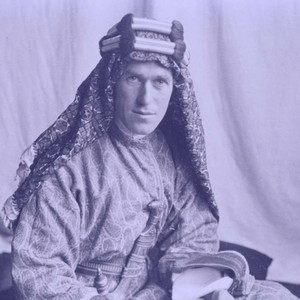
Lawrence abandoned his British uniform and instead dressed in flowing white robes like an Arab sheikh.
It was partly practicality, the robes were more suited to the desert, but it was also a symbol.
He was not just an outsider observing the revolt, He was part of it.
He fought alongside the Arab soldiers.
Not just hanging back, sipping tea and advising the prince, but on the front lines, leading guerilla missions, setting off explosives, and getting involved in a far more active way than he was meant to.
Remember, he had been sent to be an informal advisor to the prince.
He hadn't been sent to fight.
And, although he wasn't a soldier by training, he seemed to have a natural sense of military strategy.
Perhaps the most famous example of this was with Akbar.
The port of Akbar, on the Red Sea, was a vital Ottoman stronghold.
It was heavily defended from the sea, where the Ottomans expected any attack to come.
But, Lawrence had a different plan.
Instead of attacking from the water, he proposed an impossible route, crossing the deadly Nefuad Desert and attacking Akba from behind.
The journey was brutal.
Lawrence, Faisal's fighters and the fearsome Bedouin cavalry, led by a fierce warrior named Oda Abu Ta 'i, crossed nearly a thousand kilometres of some of the harshest terrain on earth, suffering from thirst, exhaustion and the relentless heat.
When they finally reached Akbar in July of 1917, coming from the desert in the north rather than by sea in the south, they took the Ottoman defenders by surprise.
The garrison collapsed.
Some defenders fled into the sea in panic.
It was a stunning victory.
Akbar was a turning point.
It gave the Arab forces a port for supplies, a symbolic victory and credibility, on the world stage.
Lawrence rode for days through the desert to deliver the news to British commanders in Cairo.
He arrived, sunburnt, half starved, and covered in dust, but triumphant.
However, the war was not over.
After Akbar, Lawrence and the Arab forces turned their focus to the Hejaz railway, which was the lifeline of the Ottoman forces in the region.
Instead of trying to capture cities, they attacked the railway itself, derailing trains, blowing up bridges and planting mines.
It was a war of sabotage.
The Ottomans could never be sure where the next attack would come.
And it was during one of these missions that Lawrence experienced the darkest moment of his life.
In late 1917, he traveled in disguise to the town of Dera, deep in Ottoman -controlled territory.
He was dressed as an Arab and attempting to gather intelligence when he was captured by Ottoman forces and brought before the local governor, Hajjian Bey.
In his own account, Lawrence wrote that he was beaten, tortured, and sexually assaulted by his captors.
He was eventually released, most probably because he never revealed his true identity.
Had he done so, and had he been unmasked as the notorious el Ahrens as the Arabs called him, he would almost certainly have been shot.
Now this makes for a great story and it is a particularly good part of the movie.
But its truth is somewhat debated.
The only account of it comes from Lawrence himself and he was prone to exaggeration.
What really happened, if anything, will most likely never be known, but what is clear is that something changed in Lawrence after Dera.
He became more ruthless in battle.
He authorised brutal reprisals against Ottoman troops, including the execution of prisoners.
Some of his Arab allies noticed the shift. He was no longer just a strategist and a diplomat, he was a man who'd been broken and rebuilt by war.
By 1918, Arab forces alongside the British reached Damascus.
The Ottomans were in retreat.
Lawrence rode into the city alongside Faisal's men.
No. It was supposed to be the moment of Arab independence.
It was not. While Lawrence had been fighting in the desert, diplomats in London and Paris had already divided the Middle East without any consultation of any of its leaders.
This was a secret deal signed in 1916.
The Sykes -Picot Agreement, in which the British and the French carved up the region after the inevitable fall of the Ottoman Empire.
The French would take Syria and Lebanon, while Britain would control Iraq, Jordan, and Palestine.
Arab independence was never part of the deal.
Now here's where it gets a little more complicated for T .E.
Lawrence, the supposed flag -carrier and chief proponent of an Arab liberation movement.
Lawrence knew about the Sykes -Picot agreement.
It's not clear exactly how much he knew, perhaps not all the details, but it's highly likely that he knew of its existence.
While apparently promising Prince Faisal one thing, and earning his deep trust and respect, he knew that politicians back in London and Paris had no plans of honoring this agreement.
The promises in the exchange of letters had been kept deliberately vague on the part of the British, giving the Arabs the idea that they were firm promises but leaving room for the British to hold up their hands later on and say, ''Oh no no, that's not at all what we meant'' The Arabs were to be used, plain and simple.
And once they had done their job and caused enough disruption to the Ottomans, they would be discarded.
Now, although Lawrence knew about this, it seems that he'd tried to ignore it.
Perhaps he hoped that by the time the war ended, and it was clear how important this Arab revolt had been.
Britain would have no choice but to honour its promises to the Arabs.
But things did not turn out that way.
When Damascus fell, Faisal was declared king of Syria, but the French soon removed him by force.
The Arab kingdom Lawrence had fought for vanished almost immediately.
He was devastated. He returned to Britain, a broken man.
He refused a knighthood, turned down honours, and withdrew from public life.
He changed his name, enlisted in the Royal Air Force, under a false identity.
And lived the rest of his life in a self -imposed exile, in a 60 metre square cottage in the countryside.
In 1935, at the age of 46, he died in a motorcycle accident.
Some say he was running from the past, from the weight of broken promises.
Others see him as a tragic figure, a man who tried to shape history but was ultimately powerless against the forces of empire and diplomacy.
And the Middle East he left behind, to state the obvious, was not the one he had envisioned.
The borders drawn by Sykes and Picot still shape the region today.
The struggle for Arab independence continued for decades and resentment towards Western involvement never faded.
To this day T .E. Lawrence is remembered in different ways.
In Britain to most he is a romantic figure, a daring adventurer.
In the Arab world he is a more ambiguous symbol.
To some, a hero who fought for Arab independence.
To others, a man who, knowingly or not, played a role in one of the greatest betrayals of the modern Middle East. He is nothing if not impressive.
And to end this episode, I will leave you with a quote from the man, which I think sums up his sense of adventure.
All men dream, but not equally.
Those who dream by night, in the dusty recesses of their minds, wake up in the day to find it was vanity.
But the dreamers of the day are dangerous men, for they may act their dreams with open eyes to make it possible.
Okay then, that is it for today's episode on T .E.
Lawrence, otherwise known as Lawrence months of Arabia.
I hope it has been an interesting one and that you've learned something new.
As always, I would love to know what you thought about this episode, we have lots of listeners from all over the middle east, so tell me, what do you know and think about this man?
Hero, villain or somewhere in the middle?
I would love to know so if you're listening to this somewhere where you can leave a comment like Spotify or YouTube then now is the time to get doing that.
Or for the members among you can head right into our community forum, which is at community .leanartoenglish .com and get chatting away to other curious minds.
And as a quick final reminder, this is part of a three part miniseries on unusual characters from World War 1, and next we'll have the Dutch exotic dancer Matahari and the deadly German fighter pilot Manfred von Richtofen.
Better known as the Red Baron.
Those will be member -only episodes, so if you'd like to unlock those, as well as hundreds of others, then the place to go for that is LeonardoEnglish .com.
You've been listening to English Learning for Curious Minds by Leonardo English.
I'm Alex de Budge, you stay safe, and I'll catch you in the next episode.