Hello, hello, hello and welcome to English Learning for Curious Minds by Leonardo English, the show where you can listen to fascinating stories and learn weird and wonderful things about the world at the same time as improving your English.
I'm Alistair Bunch and today is the start of another three -part mini -series, this time Come, on the very loose theme of the fall of the Ottoman Empire and the birth of modern Turkey.
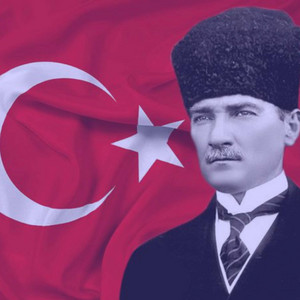
In part 1, today's episode we are going to talk about probably the most requested subject in the history of this show, the life of Mustafa Kemal Ataturk, the father of modern Turkey.
In part 2, we are going to talk about the life of a very different and less well known figure, Ali Pasha, the so -called lion of Wanina.
And in part three, we will turn to Cyprus, the Mediterranean island, split in two, and home to one of Europe's last great unresolved conflicts.
As with all of our mini -series, parts two and three are going to be member -only episodes, so now is the time to quickly remind you that you can unlock all of our member -only content, Plus, learning resources like interactive transcripts with translations in 12 languages, study packs and more over at LeonardoEnglish .com.
Right then, let's get right into it and talk about the Father of Modern Turkey.
On the 15th of October, 1927, the then President of Turkey stood up to give a speech. To say it was not short would be something of an understatement.
It took him thirty -six hours to finish and was broken up over six days.
It was called Nutuk, or The Speech in English, and it has become one of the most important historical documents in Turkish history.
Now, you might think, well, Turkey, or at least the geographical area of Turkey, does have a long and storied history.
The Persians, the founding of Constantinople, the Eastern Roman Empire, then the Byzantine Empire, the Ottoman Empire, and so on.
There is a lot to get through so no wonder it took him so long.
In fact, he didn't talk about any of this, at least, not in any real detail.
The history of Turkey as per this speech started on the 19th of May 1919.
This is the date when the speaker Mustafa Kemal Ataturk landed at the town of Samsun, a port town on the southern side of the Sea.
The speech went on, and in it Ataturk presented the situation Turkey found itself in at that time, or rather, the situation in which the country we now know as Turkey found itself.
The modern Republic of Turkey was, at that time, part of the Ottoman Empire, the vast, multi -ethnic empire that had ruled large parts of the Middle East, North Africa and southeastern Europe for over six centuries.
At its peak in the late 17th century, it ruled over 5 .2 million kilometers squared, covering much of modern Greece and the Balkan area, Syria, Iraq, Israel, Lebanon and North Africa.
It was a gigantic territory greater even than the Roman Empire at its height.
For empires in the world, feared by European kings and emperors alike.
Its armies had marched as far as Vienna, its navy controlled the Mediterranean, and its capital Constantinople was a city of immense wealth and influence.
But it had passed its peak, and by the late 19th century the empire was in deep decline.
European diplomats and commentators had been watching its decline for decades and had taken to calling it the sick man of Europe.
Now, we'll get into how it eventually collapsed in a minute.
But first, it's worth briefly touching on some of the reasons for the decline of the Ottoman Empire because they help explain the rise of Ataturk.
Firstly, as is often the case with great empires, corruption and mismanagement had weakened the empire from within.
Secondly, a series of military defeats had stripped it of territory.
And thirdly, it was just too large and had too many competing different ethnic and religious groups.
The Arabs, the Greeks, the Armenians and the Slavs, to name but a few.
This was an era of nationalist movements and, perfectly reasonably, you might argue, these groups wanted a country to call their own.
They didn't want to just be subsumed, swallowed up, by an empire to which they didn't feel a strong sense of allegiance.
Then came the First World War.
It was bad news for everyone, but particularly bad news for the Ottoman Empire, which by this time was no longer ruled by a strong sultan but by a group of military leaders known as the Three Pashas.
These men led the empire into World War one, making the fateful decision to side with Germany and Austria -Hungary.
It was a disastrous decision, the nail in the coffin for the sick man of Europe.
The Ottomans lost battles on multiple fronts, from the deserts of Arabia to the mountains of the Caucasus.
Hundreds of thousands of soldiers were killed, an estimated one and a half percent of the population.
By the time the war ended in 1918, the Ottoman Empire was effectively finished.
And if that wasn't bad enough, Its enemies, the victorious allied powers of Britain, France and Italy, were now circling like vultures.
They had won the war and they planned to carve up the Ottoman Empire among themselves.
And they did. Or at least, they tried to.
Under the terms of the Treaty of Sèvres, which was signed in 1920, huge parts of the Ottoman Empire were handed over to foreign powers.
Greece occupied the western region of Anatolia, of modern -day Turkey, while Italy took the South.
The British controlled Mesopotamia and Palestine.
The French took Syria and Lebanon.
Even the Ottoman capital, Constantinople, or Istanbul as it's now called, was occupied by Allied troops.
The Ottoman Empire was already seriously down from its peak, having gone from over 5 million kilometers squared to 1 .6 million on the eve of the First World War.
And, after the Treaty of Sèvres, it was left with a chunk of land in the middle of Anatolia, less than 500 ,000km2, around the size of Sweden.
Too many, it seemed as though Turkey would soon be reduced to nothing more than a rump state, a tiny, powerless remnant of the once great empire.
that. So, enter stage right, Mustafa Kemal Ataturk.
Before we get into exactly what he did, let me tell you a little about his early life, as this also helps you get a taste for quite how multi -ethnic the region was, how, over the years, its various towns and cities have switched allegiances and even names.
Ataturk was born in 1881 in the city of Saronika which, at the time, was part of the Ottoman empire but today is in Greece and it has a different name, Thessaloniki.
Mustafa Kemal Ataturk was not his real name, at least at birth.
Both Kemal and Ataturk came after for reasons we'll get to in a minute.
The only name he came into the world with was Mustafa.
If this sounds unusual, it wasn't.
It was fairly customary in the Ottoman empire for children not to be given a surname, as they would typically acquire other names, other ways of identifying themselves later on in life.
In terms of his parents, he came from a modest background.
His father was a customs officer and his mother was a devout Muslim.
His mother reportedly pushed for the young boy to have a religious education to be schooled in a madras, but he went down a different path.
After his father died, when the boy was only seven years old, he convinced his mother to let him enroll in a military school.
And it was there he got the name Kemal which means perfection or maturity in Turkish.
His maths teacher, so the legend goes, was so impressed by his intelligence and discipline that he gave him this nickname.
And it was there, in military school, that he became fascinated with the idea of change.
This was at a time when it was patently clear to anyone, from the sultan to the teenage boy at military school, that the Ottoman Empire was already in deep decline.
The empire was losing territory.
European powers were dominating world politics.
Many young officers, including Mustafa Kemal, started to realize that the Ottoman system was outdated, corrupt and incapable of modernizing.
And it wasn't just a realisation that these young men had but a desire to do something about it.
Mustafa Kemal became part of a new generation of military leaders who wanted to reform, reshape and modernize the country.
After graduating and with plenty of opportunities to hone his military chops, he quickly rose through the ranks.
He fought in Libya against the Italians in the Italo -Turkish war of 1911 and 1912.
Then, when war broke out in the Balkans, he went there.
Everywhere he went, he distinguished himself.
He was young, but he was clearly a capable military leader.
And then, in 1915, came the moment that would make him famous — Gallipoli.
A year into World War I, in a bid to defeat the Ottoman Empire, seize control of the straits and open up a vital supply route to Russia, British and French forces launched an ambitious naval and land invasion.
Their target was Gallipoli in the eastern Mediterranean, which was guarded by the poorly equipped and underprepared Ottoman Army.
Strategically, this mission made a lot of sense, and the British and French forces, two of the strongest military forces in the world, anticipated moving through the peninsula with minimal resistance.
They grossly misjudged their opponents.
After 8 months of bloody fighting, with an estimated quarter of a million casualties on each side, the French and the British troops retreated.
Against all odds the Ottomans won.
And Mustafa then only 34 years old, was one of the key commanders of this historic victory.
It was during this battle that he gave one of his most famous orders to his men, an order that would go down in history as defining his character.
I do not order you to attack, he said.
I order you to die.
But while Gallipoli made him a hero and provided plenty of sound bites to use later, it did not change the fate of the Ottoman Empire.
The empire was still on the losing side of the wall and by 1918 it was collapsing.
The Sultan was powerless, allied forces occupied Istanbul and the country that had once been feared and respected was on the chopping board ready to be devoured by foreign enemies and powerless to do anything about it.
Now it makes for a much better story to say that there was only one man who stood against all of this and were it not for Mustafa Kemal Turkey would not exist. The reality seems to be that there were many other decorated generals and military leaders who were keen to stand up to the foreign powers.
And had it not been Mustafa Kemal, it would most likely have been someone else.
But history is full of what -ifs.
And in the case of Turkey, it was not another general, but Mustafa Kemal, that would change the course of history.
So, we are now at the starting point of Natuk, the date at which Mustafa Kemal Ataturk begins the story of the Republic of Turkey.
In May 1919, he boarded a ship and set sail for the northern coast of Anatolia, to the Black Sea port of Samsun. When Mustafa Kemal arrived in Samsun on the 19th of May 1919, he was still, officially at least, an officer in Ottoman army.
But in reality he had already begun to set himself on a very different path.
He had been sent to Sampson by the Sultan's government under the pretext of restoring order in Anatolia, but he had no intention of following orders from central command back in Istanbul.
Instead, he was about to launch what would become the Turkish war of independence.
Now, this war went on for four years, and it warrants much more than just a passing mention in an episode.
But in short, the Greeks, the French, the British and the Armenians were all pushing into Anatolia from different directions.
The Ottoman government and the Ottoman ruler, the Sultan, were doing little to intervene.
To many, it seemed as though the country was finished.
The Ottoman Empire had just lost a world war, the allies were in control, and there in the middle was a fledgling Turkish nationalist movement led by a quite popular but not universally known general.
How could a group of rebels with limited weapons and no international support, stand a fighting chance?
To cut a long story short, Over the next three years, Mustafa Kemal turned a fragmented resistance into a disciplined army.
He lured the Greeks inland, far away from their supply lines, and won a series of decisive battles.
Now, you've heard that he went to military school and had spent practically his entire life in the army, but it's hard to overstate quite how capable a military leader he was.
He was fearless on the battleground, had been injured multiple times and had the scars to prove it.
He was demanding to his soldiers, famously telling them that he expected them to die for their country at Gallipoli and proclaiming that he would see the creation of a Turkish state or he would die trying.
All accounts point to a charismatic and brave leader.
This was not a man who sat back at headquarters and moved around pretend soldiers on a map.
This was a decorated, respected and highly effective military leader.
Now, fast forward to 1922 and, against all the odds, the Turkish nationalists had pushed the foreign forces practically all the way out of Anatolia and the Greek army was forced into a chaotic retreat towards the Aegean coast. The Turkish forces entered the coastal city of Izmir and the war was effectively over.
One by one the occupying powers withdrew.
The British, who were unwilling to risk another conflict, decided to negotiate.
The result was the Treaty of Lausanne which was signed in 1923.
It replaced the humiliating treaty of Sevres and declared that it would recognise the independence of a new republic of Turkey.
Mustafa Kemal had done what seemed impossible.
He had not only defeated the foreign occupiers but he had also dismantled the Ottoman system itself.
A few months later on the 29th of October, 1923, he declared the establishment of the Republic of Turkey, the Republic of Turgia to give it its correct modern name.
Naturally, he would be its first president.
The Sultan, whose family had ruled the Ottoman empire for 623 years, was deposed and sent into exile.
The Ottoman Empire, once one of the most powerful empires in the world, was no more.
But Mustafa Kemal was not finished.
The war was over, but now came the real challenge, building a modern nation from the ashes of an empire.
He had fought for Turkey's independence, but now he would fight for its transformation.
In his mind, independence was not enough.
To truly survive in the modern world, Turkey had to change.
And it had to change fast. He wasted no time.
Almost immediately sweeping reforms began.
And this wasn't just about political structures.
It was about language, education, religion, culture and the very way people saw themselves as citizens of a new republic.
One of the first and most radical changes was the abolition of the caliphate in 1924.
For centuries, the Sultan of the Ottoman Empire had not just been a political ruler, but also the spiritual leader of the Muslim world.
People expected that even if the empire collapsed, Turkey would retain this religious authority.
But Mustafa Kemal had other ideas.
He wanted Turkey to be a secular state, one where religious institutions had no influence over politics.
This was shocking. The idea of separating Islam from government was unheard of in a Muslim -majority country.
And, indeed, even today, most Muslim -majority countries have Islam as the official, state religion.
They are not secular.
As you might imagine, many opposed Ataturk's decision.
But he pushed ahead.
Religious schools were shut down.
Islamic courts were abolished.
Turkey was to be a modern, secular state.
This even came down to legislation around clothing.
And this brings us on to perhaps the best known of the reforms, the decision to ban the fez.
In case you didn't know, a fez is that hat with no brim, no cap in the front.
It was particularly popular during the Ottoman Empire and it was also practical for the majority Muslim population.
Because it had no cap, no bit in the front, you could wear it during prayers, and touch your forehead to the ground.
Kemal, so the story goes, was no great fan of this Islamic practice of prostrating yourself and touching your head on the floor.
So he banned the hats that made this practice possible.
Instead, Turkish men were ordered to adopt European style hats, which would help create a modern Western -style identity for Turkey, and provide a clear break with the past. Then came language reform.
For centuries, the Turkish language had been written in Arabic script, and it also had a bunch of loanwords from Persian and Arabic.
As a result, it was a script that many found difficult to read and write.
Mustafa Kemal wanted literacy rates to rise.
And he believed that by simplifying the language, more people would be able to read and write.
A modern nation, after all, needed a modern, accessible language.
And so in 1928 he ordered the complete switch to the Latin alphabet.
It was an extraordinary move.
Overnight books, newspapers and street signs had to be rewritten.
Mustafa Kemal himself went from town to town, teaching people how to use the new script.
There are photos of him, the president, standing in front of a blackboard, chalk in hand, demonstrating the new style of writing.
Education was another priority.
The Ottoman Empire had an education system where religious and secular schools operated separately.
Mustafa Kemal scrapped this system entirely.
A new, unified education system was put in place, free from religious influence.
Schools were to focus on science, mathematics and modern subjects, subjects that would allow Turkey to compete in the modern world.
Women too saw dramatic changes under his leadership.
Under Ottoman rule, women had been largely excluded from public life.
But now, under the new republic, they were encouraged to work, study and participate in politics.
Women were granted the right to vote in Turkey in 1934, a fact that many Turkish people like to point out, is earlier than in many European countries.
But these changes did not come without resistance.
Many in Turkey, particularly in the countryside, saw these reforms as an attack on their traditions.
There were rebellions, opposition movements, and even assassination attempts.
But Mustafa Kemal was ruthless in his determination.
He cracked down on dissent – exiling or imprisoning those who opposed his vision.
He believed there was no room for delay, no time for debate.
Turkey had to modernize and it had to do it quickly.
Now there are those who criticized and still criticize his methods but it is hard to argue about his effectiveness as the primary architect of the Turkey that exists today.
By the time he died in 1938 the country he left behind was unrecognizable from the Ottoman state he had been born into.
Turkey was a republic, not a sultanate.
It had a secular government, a modern legal system, a new language and an education system modelled on Western ideals.
He was given the surname Ataturk in 1934, meaning father of the Turks.
This was, in fact, the same year he introduced a law requiring all Turkish citizens to adopt a surname.
Until then, as you heard about at the start of the episode, most people used only a first name and a title, or patronymic, a name that signaled who their father was.
But now, for the first time, every Turk was required to choose a family name.
His given surname was of course Ataturk, meaning father of the Turks.
Every year at exactly 9 .05 a .m. on the 10th of November, the exact time Ataturk died, the entire country of Turkey stops what it is doing to observe a minute's silence.
Busses stop in the middle of the road, workers put down their tools and TV chat show hosts bow their heads in respect.
– he might have been draconian at times, he has been called a dictator, but it is hard to argue that anybody is more deserving of the title, the Father of Modern Turkey.
Okay then, that is it for today's episode on Mustafa Kemal Ataturk, I hope it's been an interesting one, and that you've learned something new.
For the Turkish listeners out there, and the dozens of people who've asked me over the years to make an episode about atatürk, I hope you in particular enjoyed it and thought they did some justice to this clearly incredibly impressive leader.
And as always, I would love to know what you thought of this episode.
What other interesting nuggets do you think people should know about Atatürk?
Do you think Erdoğan sees himself as a 21st century Atatürk?
And if so, how is this manifesting itself?
I would love to know!
If you're listening to this somewhere that allows you to comment, like Spotify or Youtube, just add a comment below.
And for the members among you, you can head right into our community forum, which is at community .LionelEnglish .com and get chatting away to other curious minds.
And as a quick reminder, next up on this loosely Ottoman -themed miniseries will be episodes on Alipasha, the so -called Lion of Wanina, and the divided island of Cyprus.
Those will both be member -only episodes, so for one last time, if you'd like to unlock those, as well as hundreds of others, and learning resources for every single episode, I'd encourage you to check out our membership.
You can do that over at LeonardoEnglish .com.
You've been listening to English Learning for Curious Minds by Leonardo English.
I'm Alastair Budge, you stay safe, and I'll catch you in the next episode.