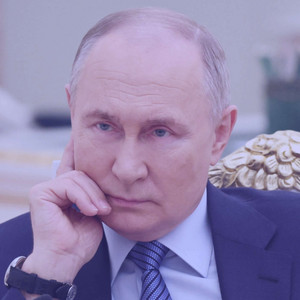
Hello, hello, hello, and welcome to English Learning for Curious Minds by Leonardo English, the show where you can listen to fascinating stories and learn weird and wonderful things about the world at the same time as improving your English.
I'm Alastair Budge, and today is the start of another three -part miniseries, which I'm giving the name of Putin and Poison.
In part one, this episode, we are going to look at the life of Vladimir Putin, learn about his early life and rise to power, and find out how he went from a small, rat -infested apartment in St Petersburg to the heart of the Kremlin.
In part two, we are going to look at a very specific event in the life of Vladimir Putin.
The murder by poison of his former colleague and then critic, Alexander Litvinenko.
And in part three, we are going to look at the tragicomic time that two Russian agents traveled to the sleepy town of Salisbury in England, in a failed attempt to poison a double agent called Sergei Skripal.
As with all of our mini -series, parts two and three will be member -only episodes, so if you'd like to really get into the weeds of the story of Vladimir Putin and unlock our more than 250 other member -only episodes, plus interactive transcripts with translations in 12 languages, study packs and more.
Then I'd highly recommend checking out our membership.
We now have members from over 100 different countries and I'd love for you to join them.
You can find out more about that at leonardoenglish .com.
OK then, let's get started and learn about the life of Vladimir Putin.
The siege of Leningrad was one of the most brutal events of World War II.
From 8 September 1941 to 27 January 1944, the Russian city, now known as St.
Petersburg, was surrounded by German forces, with Finnish troops occupying positions to the north.
This siege involved 872 days of non -stop artillery and bombing raids in an attempt to annihilate, to completely destroy, the city and its 3 million residents.
Alongside this, the winter of 1941 was brutally cold.
Temperatures dropped to minus 40 degrees Celsius.
Residents were forced to burn books to keep warm.
Dogs, cats and rats were killed to supplement the miserable 125 grams of bread a day that each resident was allocated.
An estimated 1 .5 million people died, but most not from German bombs or bullets, but from starvation.
Early 1942 was particularly brutal, with an estimated 100 ,000 people dying from starvation every month.
To put it another way, that's one person dying from starvation every 25 seconds.
Two people who were lucky enough not to perish were Vladimir Spiridonovich Putin and Maria Ivanova Putina.
Eight years after the end of the war, in 1952, they had a son.
It was somewhat unexpected.
Maria was 41, as was Vladimir, and they had already had two sons, both of whom had died.
The first as an infant, and the second in the Siege of Leningrad.
This son's name, the boy born on October 7th 1952, was of course Vladimir Putin.
There are very few records of the early life of Vladimir Putin, few pictures or official documents and what we know comes mainly from the man himself.
This has led to some conspiracies including that he was actually born in the Ural Mountains to a different mother.
But these don't have enough evidence for us to warrant giving them any more time than this.
Putin grew up in what we would now describe as extreme poverty, living in a communal apartment without heating or its own toilet.
By his own admission, he was a street kid, living on the streets, learning how to fight and stand up for himself.
Indeed, one of his favourite anecdotes from this time is a story about chasing the rats that infested his apartment building.
To quote Putin directly, there, on that stair landing, I got a quick and lasting lesson in the meaning of the word cornered.
There were hordes of rats in the front entryway.
My friends and I used to chase them around with sticks.
Once, I spotted a huge rat and pursued it down the hall until I drove it into a corner.
It had nowhere to run.
Suddenly, it lashed out and threw itself at me.
I was surprised and frightened.
Now the rat was chasing me.
It jumped across the landing and down the stairs.
Luckily, I was a little faster, and I managed to slam the door on its nose.
He tells this story a lot, so he obviously likes it.
Firstly, it reminds the listener of his upbringing as a regular, working -class Russian.
He is like you. He understands the plight of the average Russian, because he is one, or perhaps more accurately, he was one.
Secondly, it brings to mind the idea of him being a lifelong rat crusher.
He might have started chasing rats in a squalid Leningrad apartment block, but the rats have just changed into his political opponents.
And finally, to his opponents, foreign and domestic, it warns them not to back him into a corner.
Like the rat, if he has no option to escape, he will attack.
Or at least, according to many Western commentators, that's what he wants them to think.
He was, according to his official Kremlin biography, a troublemaker, uninterested in his studies and more interested in fighting and judo than homework.
What he was interested in was the KGB, the Russian Secret Service.
While he was still at high school, he knocked on the door of the KGB offices and inquired about how to join, and was basically told to go away and come back once he had graduated from university.
He studied law, which he was told gave him the best chance of being accepted to the KGB.
And sure enough, after his graduation in 1975, he joined the KGB.
Now, the nature of his work at the KGB is a closely guarded secret, but most biographies of Putin suggest that it was a lot less exciting than it might sound.
He was based in Russia for the first ten years, and then was in Dresden in then East Germany from 1985 to 1990.
And he wasn't operating in the shadows, hiding in ditches, or secretly breaking into apartments to gain intelligence.
According to a 2012 biography by the Russian -American journalist Masha Gessen, and I'm quoting directly, Putin and his colleagues were reduced mainly to collecting press clippings, thus contributing to the mountains of useless information produced by the KGB.
In other words, he was pushing paper around.
It was a rather meaningless office job, but the mystique around it later allowed Putin to let people imagine that it might have been something much more important.
Soon after the fall of the Berlin Wall in 1989, he returned to Russia, before resigning from the KGB in 1991 and finding work in the St Petersburg local government.
His first significant political role was as an aid to a charismatic man called Anatoly Sobchak, the mayor of St Petersburg and a former law professor.
Putin worked as Sobchak's right -hand man, officially in charge of foreign relations.
This job involved attracting international business to the city, something that was desperately needed as Russia transitioned from communism to a capitalist economy.
He got a name for himself as being an effective bag carrier.
Someone who was reliable, would always do the work, was a safe, unthreatening pair of hands.
But in reality, this job gave Putin access to two things that would become central to his later career.
connections and control connections with powerful business people government officials and some would argue criminal organizations and control over who got what and under what terms It was also during this time that allegations of corruption began to follow him A 1992 investigation accused Putin of allowing
raw materials like metals, to be sold abroad in exchange for food imports that never arrived.
The amount of involved was significant, and it painted an early picture of a man willing to bend the rules for those in his circle.
However, none of this damaged his career.
Sobchak was loyal to Putin, and in Russian politics, like in many countries unfortunately, loyalty is often more important than integrity.
This loyalty went both ways.
When Sobchak lost his position as mayor in 1996, Putin stuck with him.
He even helped him flee to Paris when Sobchak faced corruption charges.
Putin, it seemed, was a man who understood the importance of doing favours and collecting them when the time was right.
In 1996, Vladimir Putin moved to Moscow, leaving behind his relatively modest role in St Petersburg.
And, once in the capital, his career took off at lightning speed.
He quickly gained a reputation for being loyal, reliable, and, importantly, unambitious in the eyes of those in power.
This made him the perfect candidate for those looking to elevate someone they could control.
In 1998, he was appointed head of the Federal Security Service, or FSB, the successor to the KGB.
Just a year later, in 1999, Boris Yeltsin, Russia's first president, made him Prime Minister.
Putin's appointment came at a chaotic time for Russia.
The country was struggling economically, politically, and socially after the collapse of the Soviet Union.
Boris Yeltsin himself was deeply unpopular, and his government was plagued by corruption scandals.
He was also an awful drunk and was seen as a liability.
The sober Putin, on the other hand, presented himself as a calm, no -nonsense figure, a man who could bring order to the chaos.
His first major test came in 1999, during the Second Chechen War.
A series of apartment bombings in Russia killed over 300 people, and the government blamed Chechen rebels.
Putin's response was swift and brutal.
He promised to hunt down the perpetrators, famously declaring, we will pursue terrorists everywhere.
If we catch them in the toilet, we'll drown them there.
This tough rhetoric and his decisive actions won him widespread support.
To many Russians, especially compared to the permanently drunk and unreliable Yeltsin, He seemed like the strong leader the country desperately needed.
Then, on New Year's Eve 1999, Boris Yeltsin resigned as president.
In a surprising and dramatic announcement, in which he talked about the need for Russia to move into the new millennium with new leaders, he handed power to Putin, who became acting president.
At that moment, Vladimir Putin, a man who had risen from obscurity and was partly given positions of power because he was thought not to want it, was now the leader of Russia.
Just a few months later, in March of 2000, and in no small part thanks to his perception as being someone who could effectively deal with Chechnya, he won the presidential election, becoming the duly elected leader of the country.
When Putin officially became president in 2000, Russia was in disarray.
The economy had collapsed following the financial crisis of 1998, oligarchs were running the country, and there was widespread disillusionment with the government.
Putin quickly moved to restore order.
One of his first targets was the oligarchs, Russia's super rich businesspeople who had amassed enormous wealth during the 1990s.
Some oligarchs, like Roman Abramovich, struck deals with Putin, pledging their loyalty in exchange for keeping their fortunes.
Others, like Mikhail Korokovsky, were less fortunate.
Korokovsky, once the richest man in Russia, was arrested and subjected to a show trial, where this billionaire was placed in a cage in court.
Unsurprisingly, he was found guilty, imprisoned, and his company taken over by the state.
This sent a clear message.
In Putin's Russia, no one was above the law.
Unless, of course, you were loyal to Putin.
At the same time, Putin worked to consolidate political power.
Independent media outlets were shut down or taken over by state -run companies.
Political opponents were sidelined or had unfortunate tumbles out of fourth -floor windows.
And protests were suppressed.
But while critics, both at home and abroad, accused him of authoritarianism, many Russians supported him.
Putin's first term as president coincided with a boom in oil prices, which was very good news for a country where oil and gas make up a fifth of the economy.
Under Putin, the economy stabilised and living standards improved, at least in the early years.
He positioned himself as the man who had restored Russia's pride and power.
He also cultivated a very specific image of himself, the fearless leader.
He was photographed riding horses shirtless, diving into icy waters, and piloting fighter jets.
This was especially the case during his brief hiatus from the presidency, when, after serving for two terms, he stepped down as president, as required by the Russian constitution, and his ally, Dmitry Medvedev, became president.
As you may remember, this was in 2008, and at the time, there was reportedly a popular joke being told by Russians that gives you some indication of who people thought was really in charge.
And the joke goes something like this.
Prime Minister Vladimir Putin gave Medvedev a car without a steering wheel.
Medvedev gets into the car, then says, but where's the steering wheel?
Don't worry, answers Putin.
I'll be doing the driving.
After this brief four -year period, ostensibly not running the country, Putin was re -elected as president in 2012, and he has been running the country ever since.
In 2020, he even pushed through a constitutional amendment, meaning that, theoretically at least, he could remain president until the year 2036.
Now, in the incredibly unlikely case that you'd never heard of Vladimir Putin before this, you might have thought that he sounds like an effective, strong leader.
And there's not much more to it than that.
But, of course, the path to get here, and what he has done to maintain his power, has come at a brutal cost.
One of the most controversial moments early in his rise to power came in 1999, during the wave of apartment bombings that killed over 300 people in cities across Russia.
These bombings, which the government blamed on Chechen rebels, provided the justification for Putin's launch of the Second Chechen War, a brutal military campaign to bring the region back under Russian control.
But suspicions have lingered that the bombings were not the work of Chechen terrorists, but a false flag operation orchestrated by Russia's own security services to justify the war and bolster Putin's image as a strong leader.
In other words, these bombings were not the work of Chechen terrorists, but of the FSB, on Putin's orders, and hundreds of innocent Russian citizens were murdered to provide justification for a war in Chechnya.
On one occasion, for example, bombs were found under an apartment block, and FSB agents were seen placing them, but when pressed, the government said that it was simply a training exercise.
Not everyone is convinced, and the Kremlin denies it vehemently, but the bombings remain a dark shadow over Putin's rise to power, and the truth remains a subject of debate.
The second Chechen war that followed was marked by extreme brutality.
The Russian military indiscriminately bombed Chechen cities, including Grozny, the capital, which was described by the United Nations as the most destroyed city on earth at the time.
Tens of thousands of civilians were killed, and reports of war crimes, including torture and summary executions, were widespread.
This approach sent a clear message.
Dissent would not be tolerated, and no price was too high to maintain Russia's territorial integrity and Putin's grip on power.
And for anybody who did violate this message, anyone who stood against him, there were no lengths that Putin was not willing to go to silence them.
You could run, you could hide, but eventually Putin would get you.
One of his weapons of choice, at least to knock off individuals, is the theme of the next two episodes.
Poison. In 2006, a former FSB agent turned critic called Alexander Lidvinenko made the mistake of going for tea with a couple of Russian agents in a five -star hotel in Mayfair in London.
The green tea contained polonium -210, a radioactive element, and three weeks later, after a drawn -out and very public decline, he died.
Twelve years later, in 2018, Russian agents travelled to the UK again in an attempt to poison another former Russian agent, Sergei Skripal, but they failed in their attempt.
We'll cover these incidents in much greater detail in parts two and three of this miniseries, and they are only a couple in a long list of the use of poison under Vladimir Putin.
These incidents not only silence critics, but also serve as a warning to others.
Defy the Kremlin at your own risk.
But perhaps the most chilling example of Putin's ruthlessness has been his invasion of Ukraine.
In 2014, Russia annexed Crimea, a move that shocked the world and drew condemnation from Western nations.
Then, in February 2022, Putin launched a full -scale invasion of Ukraine, bizarrely claiming it was to de -Nazify the country and protect Russian -speaking populations.
What followed, as you will know, was a brutal war that has displaced millions, caused tens of thousands of deaths, and left parts of Ukraine in ruins.
The invasion, which was widely seen as an attempt to reassert Russia's influence and challenge NATO's expansion, has plunged relations between Russia and the West, to their lowest point since the Cold War.
And it has further isolated Russia economically and politically, raising questions about Putin's long -term strategy and the future of his regime.
But throughout all of this, wars, poisonings and repression, Putin has shown an unrelenting commitment to holding on to power.
For his supporters, these actions are the price of protecting Russia's sovereignty and status as a global power.
For his critics, they are the hallmarks of a man willing to destroy anyone or anything that stands in his way.
As of the start of 2025, Vladimir Putin has been in power for 25 years, longer than many of the Tsars who ruled Russia before him.
His life from the streets of Leningrad to the Kremlin is a story of ambition, secrecy, and survival at all costs.
But as Russia faces growing challenges at home and abroad, questions are emerging about how long this can continue.
Will Putin's legacy be that of a man who restored Russia's pride and power?
Or will he be remembered as the leader who isolated his country and left it in ruins.
To wrap things up, Vladimir Putin has shaped modern Russia in his image.
He is 72 years old, shows no signs of relinquishing power, and if he rules for another five years, he will eclipse Joseph Stalin as Russia's longest -serving leader.
One thing seems clear.
For better or for worse, the story of Vladimir Putin is far from over.
Okay then, that is it for today's episode on Vladimir Putin.
To state the obvious, we've only scratched the surface on the life of this man.
Hundreds of thousands of pages have been written, and I hope you will forgive me for skimming over many important and fascinating elements.
As a reminder, this is part one of a three -part mini -series on Putin and poison.
And in parts two and three, we are going to go a lot deeper into two different but closely related incidents widely believed to have been ordered by Vladimir Putin himself, the poisoning of one of his fiercest critics, Alexander Levinenko, and the failed murder attempt on a former double agent, Sergey
Skripal. Both of those will be member -only episodes, so before you go, let me quickly remind you that you can unlock these, as well as hundreds of other member -only episodes and everything that will help you turn this podcast into a super powerful learning resource over at leonardoenglish .com.
And if you're not yet ready to become a member, but you would like to do something to support the show, then I would love for you to think about leaving a review or a star rating on your favourite podcast app.
It takes less than 30 seconds to do, but they're super helpful and each one brings a smile to my face.
You've been listening to English Learning for Curious Minds by Leonardo English.
I'm Alastair Budge, you stay safe, and I'll catch you in the next episode.