Hello, hello, hello and welcome to English Learning for Curious Minds by Leonardo English.
The show where you can listen to fascinating stories and learn weird and wonderful things about the world at the same time as improving your English.
I'm Alastair Budge, and today we are going to be talking about one of the most famous and controversial psychological experiments of all time, the Stanford Prison Experiment.
To some observers, it was seen as yet more proof of how otherwise law -abiding normal humans can do horrific things to each other.
So, in this episode, we'll talk about the purpose of the experiment, what actually happened, what it tells us about human psychology, and why its greatest critics think it doesn't really tell us that much at all.
But before we get right into today's episode, I want to remind you that you can become a member of Leonardo English and follow along with the interactive transcript and subtitles over on the website, which is leonardoenglish .com.
Membership of Leonardo English gives you access to more than double the number of episodes, plus all of our learning materials, including instant translations in 12 languages, study packs, and much, much more.
So, if you are ready to take the next step on your English learning journey, the place to go is leonardoenglish .com.
Okay then, let's get right into it and talk about the Stanford Prison Experiment.
An unfortunate truth about humanity is that we humans are capable of committing acts against our fellow humans that are utterly inhumane.
Men and women who might otherwise live normal, kind lives, under certain conditions, sometimes do horrific things.
Unfortunately, we have tens of thousands of years of human history that shows this to be true.
It is still the case today, and no doubt it will still be the case in thousands of years to come.
But why? What is it about certain situations that can change a person's behaviour?
Can otherwise normal, rational people be turned into monsters if placed in particular circumstances?
In August of 1971, a Stanford professor named Philip Zimbardo sought to answer this question.
He put out an advertisement in the local newspaper, which read, Male college students needed for psychological study of prison life.
$15 per day for one to two weeks, beginning August 14th.
For further information and applications, come to room 248, Jordan Hall, Stanford University.
Slightly ominous. male college students needed for psychological study of prison life.
$15 per day for one to two weeks.
Now, $15 in 1971 is around $110 in today's money.
Not a colossal amount of money, by Californian standards at least, but enough to attract a few university students to participate in a psychological study of prison life.
75 students applied.
They were interviewed, screened to check that they didn't have any serious medical problems, any psychological conditions, or a criminal record.
In other words, they needed to be regular university students.
The group was whittled down to 24 participants, who were split into two groups.
Half were randomly assigned to be guards, and half were assigned to be prisoners.
These 24 young men, all considered to be healthy, well -adjusted, and average in almost every way, were ready to begin the experiment.
The guards were asked to report to Stanford University on the first day of the experiment to begin their training and orientation.
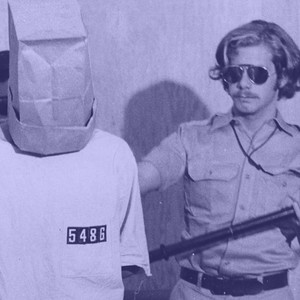
They were given uniforms, batons and reflective sunglasses to wear, along with the instructions on their role, to maintain order in the prison.
The prisoners, however, were told to wait at home for further instructions.
What they didn't know was that their participation would begin with a surprise arrest.
Without any warning, real police officers, yes, actual police officers, showed up at their homes.
They were arrested, handcuffed and taken to a police station.
There, they were fingerprinted, photographed and charged with offences like armed robbery.
Of course, the charges weren't real and the participants knew they were part of an experiment.
but the realistic nature of the arrest was designed to make them feel as though they had truly lost their freedom.
After this mock arrest process the prisoners were blindfolded and transported to the basement of Stanford University's psychology building which had been transformed into a makeshift prison.
When they arrived their blindfolds were removed and they were made to stripped down, sprayed with what was described as a delousing spray, and given prison uniforms to wear.
The uniforms were simple, but designed to be humiliating.
Prisoners wore smocks, which were long, shapeless dresses, and on their heads they had to wear a nylon stocking cap.
Around their ankles, they had chains that rattled as they walked, a constant reminder of their lack of freedom.
Each prisoner was assigned a number, which was sewn onto their uniform.
From that point on, they were no longer addressed by their names, but only by their numbers.
This was all intentional.
The idea was to make them feel like they had lost their identity and their individuality.
Now, on the other side of this prison were the guards.
The guards were dressed in khaki uniforms.
They had reflective sunglasses to make eye contact impossible and were carrying batons, though they were told not to use them for physical punishment.
The guards had been given a very simple instruction, maintain order in the prison.
Beyond that, they were largely left to figure things out for themselves.
And at first, things were relatively calm.
The prisoners followed the guards' instructions, the guards kept watch, and Zimbardo and his team observed everything from behind hidden cameras and microphones.
But it didn't take long for things to spiral out of control.
On just the second day, the prisoners rebelled.
They tore off their numbers, refused to leave their cells, and shouted at the guards.
The guards, who had been unsure of their authority at first, suddenly became much more aggressive.
They used fire extinguishers to force prisoners back into their cells.
They stripped some prisoners naked as a form of humiliation.
and they began to enforce strict rules, rules that seemed to come out of nowhere.
For example, prisoners were only allowed to go to the toilet at certain times.
If they broke the rules or annoyed the guards, they were punished.
Some were forced to do physical exercises like push -ups.
Others were put into solitary confinement, a tiny, dark closet that could barely fit one person.
And as the days went on, the punishments became more creative and cruel.
One guard made prisoners clean the toilets with their bare hands.
Another forced them to simulate sexual acts as a way of degrading them.
What was shocking is that none of this was planned.
The guards came up with these punishments on their own, as if the power they had been given unleashed something darker inside them.
As for the prisoners, they quickly fell into the roles that had been assigned to them.
Some became passive, obeying every command without question.
Others broke down emotionally, crying and screaming to be let out.
One prisoner, referred to only as Prisoner 8612, began to have what seemed like a complete mental breakdown after just 36 hours.
He screamed at the guards, yelled that he wanted to leave, and even told Zimbardo that he felt like he was losing his mind.
Instead of ending the experiment, Zimbardo initially tried to convince him to stay, saying that leaving would disappoint the others.
But eventually, Prisoner 8612 was allowed to go.
After Prisoner 8612 was released, you might think that things would have settled down.
But instead, the opposite happened.
The guards became even harsher.
It was as though they felt their authority had been challenged, and they needed to reassert control over the prisoners.
One of the ways they did this was by targeting the prisoners who they saw as leaders, those who were more likely to resist.
The guards singled them out for extra punishment, like longer periods in solitary confinement, or forcing them to do degrading tasks.
And while some prisoners resisted, others started to turn on each other.
Zimbardo and his team had planted the idea that some prisoners might be secretly working with the guards, acting as informants.
This led to paranoia and division among the prisoners.
Instead of uniting against the guards, they became suspicious of one another, which made them easier to control.
Now, let's stop for a moment and remember that all of the participants, both the guards and the prisoners, knew that this was a simulation, that they weren't really inside a prison, and it was all an experiment.
But on both sides, something about this situation and its power imbalance, one group in control and the other being subjugated, this seemed to flip something in their minds.
and make them almost forget that it wasn't real.
And day by day, the prison environment became more and more oppressive.
The guards introduced something they called privilege cells.
Prisoners in these cells were given slightly better treatment.
They could eat better food, or they didn't have to wear chains.
But to stay in the privilege cell, prisoners had to obey the guards without question.
This was a psychological tactic.
It created jealousy and mistrust among the prisoners, breaking down any sense of solidarity they might have had.
By the fourth day, the situation had grown even darker.
One prisoner, referred to as Prisoner 819, had an emotional breakdown.
He cried uncontrollably and refused to eat.
Zimbardo and his team decided to let him leave the experiment.
But, as he was preparing to go, something strange happened.
While Prisoner 819 was in another room, one of the guards made the other prisoners chant, Prisoner 819 is a bad prisoner.
Because of what Prisoner 819 did, my cell is a mess, Mr Correctional Officer.
Hearing this, Prisoner 819 broke down even further.
He felt overwhelming guilt and begged to return to the prison to prove he wasn't a bad prisoner.
Zimbardo had to step in.
He reminded Prisoner 819 that he wasn't a real prisoner, that this was just an experiment, and that he could leave whenever he wanted.
Only then did Prisoner 819 agree to walk.
For Zimbardo, this moment was a wake -up call.
The line between reality and the roles they were playing had become dangerously blurred.
The final turning point came when one of Zimbardo's graduate students and his future wife, Christina Maslach, visited the prison on the sixth day.
Maslach had come to observe the experiment, but what she saw shocked her.
She watched as the guards humiliated the prisoners, screaming at them and making them perform degrading tasks.
She confronted Zimbardo and demanded to know how he could allow this to continue.
Maslach told him that the experiment was unethical and that the prisoners were suffering real harm.
At first, Zimbardo resisted.
He argued that the experiment was revealing important truths about human behaviour.
But then, he realised that he had become part of the problem.
He wasn't just an observer.
He was acting like the prison warden, and it was he who was enabling and encouraging the guard's abusive behaviour.
As the designer of the experiment, he should have been a neutral observer, but he was an active participant.
That same night, Zimbardo made the decision to end the experiment.
It had been planned to last for two weeks, but it was stopped after just six days.
When the experiment was over, Zimbardo and his team reflected on what they'd seen.
The results seemed to show that ordinary people could quickly conform to roles of authority or submission, even in a short period of time.
The guards, many of whom had never shown signs of cruelty before, became aggressive and sadistic.
The prisoners, who were healthy and confident at the start, became passive, anxious, and even traumatized.
Zimbardo called this the power of the situation.
He argued that it wasn't that the guards were bad people, but that the situation itself brought out bad behaviour.
It was a convenient explanation, and would help rationalise the behaviour of things like prison guards in Nazi concentration camps, and later on would be used to explain the atrocities at Abu Ghraib prison in Iraq.
It was not the people who were fundamentally evil, but that the nature of the situation brought out this capacity for evil that exists within us.
But not everyone agreed with Zimbardo's conclusions.
And especially in recent years, the Stanford prison experiment has faced a lot of criticism.
First of all, many people have questioned the scientific validity of the experiment.
For an experiment to be scientifically valid, it needs to be carefully controlled with clear instructions and procedures.
However, critics argue that Zimbardo didn't do this.
For example, the guards were not given strict guidelines on how to behave, and some say that Zimbardo encouraged them to act more aggressively.
One former guard, in an interview years later, said that Zimbardo had given them the impression that they were supposed to make life difficult for the prisoners.
This has led some to argue that the experiment wasn't really observing natural behaviour.
It was almost like a performance, with the guards trying to live up to what they thought Zimbardo wanted.
Another related criticism is that the participants knew they were in an experiment.
They were university students, not professional prison guards or actual prisoners.
Critics argue that the participants might have been exaggerating their behaviour, because they felt like they were playing a role, like they were expected to behave in a certain way, and therefore that's what they did.
Given that they had no criminal record, and no direct experience of prison, their only point of reference would probably have been prison movies, so one criticism is that they would have based their behaviour on what they had seen in films, which, of course, is not a truly accurate representation of prison life.
And on the subject of truly representing real life, there is the criticism that the participants in the experiment didn't accurately reflect real -life prisons.
Real guards and prisoners come from very different backgrounds and have very different motivations.
All the guards and all the prisoners were white, middle -class, psychologically healthy university students.
And that simply isn't a representative sample of a prison, let alone society more widely.
And then there's the question of ethics.
Today, the Stanford prison experiment would never be allowed to happen.
Modern ethical guidelines for psychological experiments would see it as far too harmful.
The participants were subjected to extreme stress, humiliation and emotional trauma, all things that researchers today are required to avoid.
In fact, after the Stanford Prison Experiment, the field of psychology tightened its rules for what could and couldn't be done in experiments.
Researchers now have to ensure the safety and well -being of their participants, and they must get approval from ethics committees before starting any study.
Finally, there's the question of what the experiment actually tells us.
Zimbardo argued that it showed how ordinary people could commit cruel acts when placed in certain situations.
However, critics have said this conclusion is too simplistic.
Human behaviour is complex, and the experiment doesn't account for other factors like personality, individual morality or personal choice.
Yes, this experiment shows that people can behave in unusual ways in unusual situations, but it is not definitive proof of anything.
Despite its flaws, the Stanford Prison experiment has had a huge impact on how we think about human behaviour, power and authority.
It is still widely discussed in psychology classes around the world, often as an example of both the power of social roles and the dangers of unethical research.
The experiment also raised important questions about the systems and structures we create as a society.
It highlighted how institutions, whether prisons, workplaces or even schools, can shape the behaviour of the people within them.
So, to wrap things up, what can we take away from the Stanford prison experiment?
At the very least, it's a reminder of how much our environment and social roles can influence the way we act.
It shows us that even ordinary people can behave in extraordinary ways, sometimes for the worse, when placed in situations of power or control.
but it's also a reminder to be critical.
Not everything we see, even in famous experiments, is quite as straightforward as it seems.
Okay then, that is it for today's episode on the Stanford Prison Experiment, one of the most famous psychological experiments of all time, but also one of the most controversial.
As always, I would love to know what you thought of this episode.
what conclusions do you think we can draw from this experiment, if any?
Does it tell us anything we didn't know already?
Or is it yet another reminder of how complex human behavior is, and we shouldn't read too much into it?
I would love to know, so let's get this discussion started.
For the members among you, you can head right into our community forum, which is at community .lionardoenglish .com, and get chatting away to other curious minds.
And as a final reminder, if you enjoyed this episode and you are wondering how to more than double the number of episodes you can get, plus learn with our interactive transcripts, subtitles, and key vocabulary, then the place to go for that is leonardoenglish .com.
You've been listening to English Learning for Curious Minds by Leonardo English.
I'm Alastair Budge.
You stay safe, and I'll catch you in the next episode.
you