Hello, hello, hello, and welcome to English -Learning for Curious Minds by Leonardo English, the show where you can listen to fascinating stories and learn weird and wonderful things about the world, at the same time as improving your English.
I'm Alastair Bodge and today we are going to be talking about space mining.
It's the idea that we can mine valuable minerals, not from Earth, but from space.
So in this episode, we'll talk about why some people are so excited about it, how and why it could work, some of its major challenges and ask ourselves whether it will ever go from the realm of science fiction to reality.
But, before we get right into all of that good stuff, let me quickly remind you that you can become a member of Leonardo English, and follow along with the interactive transcript and subtitles over on the website, which is LeonardoEnglish .com.
Membership of Leonardo English gives you access to more than double the number of episodes, plus all of our learning materials, including instant translations in 12 languages, study packs, and much much more.
So, if you are ready to take the next step on your English learning journey, the place to go is liennadoenglish .com!
Okay, then, let's get started and talk about space mining!
The 19th century was an exciting time in terms of space observation.
The first asteroid, Ceres, was spotted in 1801 by the Italian astronomer, Giuseppe Piazza.
Half a century later his countryman, Annibale de Gaspares was working in his observatory in Naples.
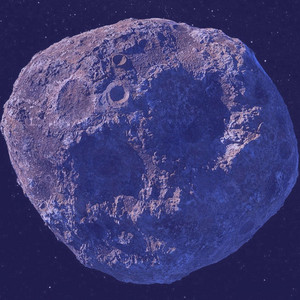
He saw an asteroid that he named 16 Psyche, after the Greek Goddess of the soul.
Now, this was just one of nine different asteroids that he discovered.
To him, it probably probably looked like a giant rock—an important scientific discovery, but not much more than that.
However, modern astronomers believe 16 Psychae to be immeasurably more valuable than was first thought.
To be precise, this asteroid is thought to contain precious metals worth $10 quintillion.
A quintillion might sound like a made up number, something that a child might say, like a gazillion, or a bazillion, which I should add, are not real numbers.
But, a quintillion is not made up, it is just so big that you've probably never heard of it.
Ten quintillion is ten, followed by or, to put it another way, it is 10 ,000 trillion.
100 times the value of the entire global economy.
And, it is right up there, in space, floating around, with nobody guarding it.
And not just 16 psyche, there are millions of astronauts, some large, some small...
many of which are believed to contain enough precious minerals to supply humanity for literally millions of years.
So, what if there were a way to go out there and simply take them?
This is the story of space mining, or asteroid mining to be precise.
space? To some, it seems like science fiction.
A fixation on looking to space where we have more than enough problems to deal with back on earth.
But to others, it is something that can – and will – become reality, and a way to solve many of the problems we have on earth by taking what already exists in space.
space. So, let's start with some definitions.
Asteroids are objects that orbit the Sun, much like planets, earth, mars, Jupiter and so on.
They are essentially remnants of the early solar system, chunks of rock and metal, that never formed into planets.
The difference between an asteroid and a planet mainly comes down to size.
main things. Planets are much bigger, therefore have a larger gravitational pull and are circular in shape because of gravity.
Asteroids are smaller, typically ranging from a few hundred metres or so through to the largest known asteroid which is almost a thousand kilometers in diameter, around the same width as France from its most northern to most southern point.
It's pretty big, but it's much smaller than a planet.
And, because they are much smaller, they have a much lower gravitational pull, so they're not typically round but more like a rock.
Most known asteroids are in the asteroid belt, which is between Mars and Jupiter.
But not all. There are others that come closer to Earth.
Some come too close, like the one that is thought to have hit Earth and wiped out the dinosaurs 66 million years ago.
Fortunately, we humans are better than dinosaurs at spotting potential threats in the sky so, in the event of an asteroid looking like it was on a collision path with Earth, we would know about it pretty quickly, and be more capable than a Cotton Diplodocus of changing its trajectory.
So, we know where asteroids are, and because they all bit the sun, it is fairly easy to model their position at any point in time.
And, while 19th century astronomers might not have known much about the consistency of an asteroid, or what it has actually been made out of, we now do.
Some asteroids are thought to contain incredibly high levels of precious metals.
When the solar system was formed, heavy elements like gold, platinum, nickel and iron were distributed throughout the massive cloud of gas and dust that eventually became the sun and the planets.
These elements were created during supernova explosions, and collisions of neutron stars, cosmic events that forge the universe's heaviest and most valuable materials.
When the Solar System began to take shape, gravity caused much of the heavy material to sink towards the cause of the newly -forming planets.
On Earth, for example, most of the gold and platinum we know of is thought to be buried deep within the planet's core, out of reach for humans.
But not all of this material ended up inside planets.
Some of it remained as loose chunks of metal and rock scattered throughout the solar system – what we now call asteroids.
asteroids. These asteroids are essentially the left -over building blocks of planets, and many contain high concentrations of metals that didn't make it into planetary cores.
But what makes these asteroids so appealing isn't just their high metal content.
It's that the metals are often much more accessible than on Earth.
Unlike Earth, where heavy metals have sunk to the core, asteroids haven't undergone the same process of differentiation.
This means that their metals are distributed throughout their structure, making them, in theory, at least, easier to extract.
As I'm sure you'll know, mining almost anything on Earth, and especially mining precious metals, is a dirty, intensive, and expensive activity, often carried out by people, sometimes in pretty awful conditions.
Cobalt, for example, is a vital part of electric batteries, and 70 % of all cobalt is produced in the Democratic Republic of Congo.
And conditions in the Congolese cobalt mines have been likened to modern day slavery.
Cobalt and Congo are just one example.
whole, getting anything out of the Earth's crust is an intensive polluting process.
So, wouldn't it be better, the argument goes, for us just to take it from an asteroid?
There would be no pollution, no child labour, and no destruction of forests to make way for the mines.
In theory, it all sounds very positive – a lifetime supply of precious metals floating around in the sky, fortune to be made for anyone who can find a way to go out there and get them?
Of course, it's more complicated than that.
First, let's talk about the practicality of getting to an asteroid.
They are a long way away.
In late 2023, NASA did actually send a mission to the asteroid Psyche, the one I mentioned at the start of the episode.
Its scheduled arrival date is 2029, so it will take six six years for it to get there.
It's travelling at something like 50 ,000 kilometres an hour, incredibly fast by Earth standards, the problem is that it needs to travel almost 500 million kilometres.
And it isn't on a space mining mission, but rather a fact -gathering one.
No space craft has ever been to psyche before, so the The plan is to go and observe it.
Given the cost of getting to an asteroid, any mission needs to be fairly sure that it will find what it's looking for.
And given that not all asteroids are created equal – some are rocky, others are icy, and others contain high levels of precious metals – you need to send a fact -finding mission first before committing to a mining mission.
Now let's talk about costs.
costs. A large proportion of the cost of any space mission is getting out of the earth's atmosphere and then returning safely.
send something to space is expensive but is considerably cheaper than it used to be.
During the first 30 years or so of space launches it would typically cost in the region of $25 ,000 per kilo to send something to space but some projects were upwards of $100 ,000 per kilo.
Companies such as SpaceX have been hyper -focused on reducing the cost of going to space, so that it now costs around $1 ,500 per kilo.
But with reusable rockets and increasing efficiencies in every part of the launch process, there There are some estimates that this could be brought down to around $10 per kilo — less than it would cost to send a 1 kilo parcel within the UK.
So, yes, going to space and therefore getting to an asteroid is very expensive.
But, while a few decades ago, it would have been so expensive that it simply wouldn't have been economically viable, now it very well might be.
So let's assume that costs have gone down to such an extent that the first asteroid mining mission is ready for liftoff.
How would it work?!
Well, there are several fundamental differences between Earth and space that mean an asteroid mine certainly wouldn't bear much resemblance to any mine on Earth.
Obviously, there is the problem of how to get all the equipment there, so it simply wouldn't be possible to boost large trucks and heavy equipment into space.
And anyhow, this kind of equipment would probably be of little use on an asteroid.
There is no gravity on an asteroid, so everything would need to be tied down to the asteroid.
Most probably there would be some kind of great canopy, a tent -like structure, that was put over the area that was being mined.
otherwise all of the dust and precious metals would simply blow away into space.
And in terms of the mining process there are several different ideas about how this could work.
Perhaps it would be lasers that would vaporise material, robotic arms that grind and collect it, or even specialised bacteria, as they do in terrestrial bio mining, that break down rock and release valuable metals like nickel or cobalt.
Another significant challenge is that asteroids typically rotate, often unpredictably and at varying speeds.
This constant movement makes it very difficult to safely land equipment, maintain stability or accurately mine materials.
To address this the mining team would need to find some way of stabilising the asteroid, keeping it in position.
Maybe this would be using thrusters to slow or stop its rotation, maybe it would be by using large nets or tethers to anchor it ,or by synchronising mining tools to match the asteroid's rotation.
And then there is the question of who would work on a mine.
This is not a question of whether there would be thousands of astronauts with hammers and shovels physically digging the surface themselves, and lugging large sacks back at the end of the day, but rather whether the mind would be 100 % automated, controlled from back on Earth or from a space mission closer
to Earth or whether there would be human astronauts monitoring the situation from the site, just in case anything went wrong.
And there is also the legal question, one of the very first episodes we ever made more than five years ago now was about the question of who owns space.
Five five years on that question still remains largely unanswered.
The first principal of the 1967 Space Treaty is and I'm quoting directly, "...The exploration and use of outer space shall be carried out for the benefit and in the interest of all countries and shall be the province of all mankind." And, it is shortly followed by, outer space is not subject to national
appropriation by claim of sovereignty, by means of use or occupation, or by any other means.
In other words, nobody owns space.
But, there is a grey area over what this means in terms of asteroid mining.
if a company successfully mines an asteroid, who owns the minerals they mine?
Is it a bit like fishing?
Where any boat can fish in international waters, and they're free to use and sell what they catch?
Or, is it not? In 2015, Barack Obama signed something called the SPACE ACT, which gives US citizens the right to engage in the commercial exploration and exploitation of space resources, including water and minerals.
In other words, US citizens can do it, according to US law at least, but how does this law play with international law?
It hasn't been an issue so far because nobody has done it, but if asteroid mining turns From the theoretical to the practical it is a question that will need to be addressed.
Now, let's assume that it is addressed and that companies are able to build cost -effective ways of getting mining equipment to space and successfully mining an asteroid.
What happens next? Well, there is also the question of where the minerals go?
One option is to bring them back to Earth and use them here.
We need the minerals found on asteroids, especially the platinum group metals.
We need them here on Earth for everything from batteries to solar panels to electric cars.
So there is a clear demand.
Whoever can bring them back cost effectively will become spectacularly wealthy.
But the other option is to leave them in space for use in space.
The more activity there is in space, the more stuff is needed and this currently all needs to be brought from earth and then sent to space which is expensive.
No matter how plentiful and cheap something might be on earth, in space it suddenly becomes very expensive.
One obvious example is water.
A taking a kilo of water to space costs the same as taking a kilo of anything else to space.
And in space, water is incredibly important and in short supply.
Water is needed to keep astronauts hydrated, as well as for cooling and regulating the temperature of a spacecraft and as a radiation shield.
but perhaps even more important than this are the component parts of water, hydrogen and oxygen.
The oxygen can be separated from the water and can be used for breathing on a spacecraft.
Liquid hydrogen and liquid oxygen are the primary propellants of many modern rockets, So if water can be found on an asteroid, for example, it becomes incredibly valuable.
There are no petrol stations in space.
All fuel needs to be brought up from earth.
But if a source of water in the form of ice or water -rich material could be found, and this could be processed in space into rocket fuel, and left in space where it is most useful and valuable, Then, this would be like a petrol station in space.
It would bring down the cost of space launches, because they wouldn't have to take so much fuel up from Earth and it would allow for longer and faster journeys within space.
And perhaps veering even more into the realms of the ultra -futuristic, in a universe in which there were settlements on other planets—Mars, for example—it makes much more sense to manufacture what is needed in space rather than on Earth.
If you need to build a settlement, it could be a lot much more cost effective to take the raw materials from a nearby asteroid than shooting them up from a rocket on earth.
So one option is to leave the mined materials in space.
But what would happen if these rare minerals were brought back down to Earth?
Earth. You heard at the start that just one asteroid contains precious metals worth 100 times the entire global economy — enough for every person on Earth to receive around 1 .25 billion dollars.
So, what would be the impact of that?
Everyone on Earth wouldn't receive 1 .25 billion dollars.
This 10 quintillion dollar number is the estimated total value of all the precious metals in that asteroid at current market prices.
If it were all brought back to Earth at once, it would flood the market, and the price would come crashing down because we would have more iron, platinum and cobalt that we knew what to do with.
But that ain't going to happen.
Because of the timelines of getting there, the cost of a mission and the fact that a spacecraft craft is limited to how much it can carry back, it would take hundreds if not thousands of years for even a fraction of the precious metals on an asteroid this size to be mined and brought back to Earth.
Still, there are some commentators who have pointed out that even with a relatively small haul of precious metals, asteroid mining could be very detrimental to lower income countries that have so far relied on natural resource extraction.
Mines back on Earth would be closed.
Millions of people would be out of a job.
And there would need to be some sort of mechanism for these countries to be compensated by the countries or companies that enjoyed the spoils of asteroid mining.
There are also environmental concerns...
but these are mainly the concerns about space pollution, of debris from the mines floating around in space.
In terms of environmental concerns on Earth, it seems pretty clear -cut.
Yes, sending a rocket into space and then bringing it back into the atmosphere releases a lot of CO 2, but these are the only significant emissions that would be caused by space mining.
According to one study, mining a kilo of platinum from an asteroid would result in around 60 kg of CO2, and this is against 40 ,000 kg of CO2, to get every kilo of platinum out of the Earth's crust, like we do today.
In other words, yes, you might think of a rocket blasting off into space and think that must be very environmentally unfriendly, but it is approximately 700 times better for the environment than the way we currently do it.
So, if it all sounds so good in theory, why is it not already happening?
It comes down to money.
Building all of the technology, actually figuring out how to do it and then doing tests after tests after tests, will require hundreds of billions of dollars in investment – and with no certain return.
them. Several companies have started this process, but none have made the progress they had initially promised.
Most investors aren't very good at being patient, especially when there is no guarantee of any return.
And despite the huge potential prize, there is a lack of funding for asteroid mining companies.
still. As you listen to this episode, assuming that it isn't the year 2029 yet, a NASA spacecraft is on its way to an asteroid that was first spotted in 1852.
16 Psyche. It will return with news, news that might just change the world.
Okay then. That is it for today's episode on space mining.
I hope it's been an interesting one, and that it might have given you a new perspective on the night's sky.
As always, I would love to know what you thought of this episode.
Did you know much about asteroid mining before?
Do you think it is something that we will see in your lifetime?
For the members among you, you can head right into our community forum which is at community.
Death, Leonardo English dot com and get chatting away to other curious minds.
And as a final reminder, if you enjoyed this episode and you are wondering how to more than double theaj number of episodes you can get plus learn with our interactive transcripts, subtitles and key vocabulary, then the place to go for that is Leonardo English .com.
And, if you aren't yet ready to become a member, but you'd like to do something to support the show, then I'd love for you to think about leaving a review or a star rating on your favourite Podcast app.
It takes less than 30 seconds to do, but they are so helpful and each one brings a smile to my face.
You've been listening to English Learning for Curious Minds by Leonardo English.
I'm Alistair Butch, you stay safe, and I'll catch you in the next episode.