Hi there, Alastair here.
Before we dive into today's episode, a quick shout -out to ElsaSpeak, the app that helps you improve your pronunciation.
As you probably know, pronunciation is one of the hardest things to master in English, especially on your own, because you don't know when you're saying something right and when you're saying something wrong.
That's where Elsa comes in.
It gives you feedback on your pronunciation, and creates personalised lessons to help you with the sounds you find hardest.
I've tried lots of apps that claim to do this, but none of them work as well as Elsa.
And here's the best part.
If you sign up through my special link, you can get up to 85 % off the cost of an Elsa subscription, but only until midnight on Sunday, December 15th.
So, if you've been looking for a way to improve your pronunciation, now is the perfect time to try Elsa.
OK, that's it. Now it's time to enjoy the show.
Hello, hello, hello, and welcome to English Learning for Curious Minds by Leonardo English, the show where you can listen to fascinating stories and learn weird and wonderful things about the world at the same time as improving your English.
I'm Alastair Budge, and today is the start of another three -part mini -series, this time on the theme of nuclear power.
In part one, today's episode, we are going to talk about the early years of nuclear power, how it developed side -by -side with the proliferation of nuclear weapons, and how this set the stage for what was to come.
In part two, we are going to talk about the greatest disaster in the history of nuclear power, the meltdown at the Chernobyl power station.
And in part three, we are going to bring it all together and talk about nuclear power today, why its proponents believe it plays a key part in reducing climate change, why its critics believe it remains a dangerous red herring, and what this all means in practical terms.
As with all of our mini -series now, parts two and three will be member -only episodes.
So now is the time for me to quickly remind you about our membership, in case you haven't checked it out already.
Membership of Leonardo English gives you access to more than double the number of episodes, like parts two and three of this mini -series, plus all of our learning materials like study packs with vocabulary lists, interactive transcripts, instant translations in 12 languages, and much, much more.
So, if you are ready to take the next step on your English learning journey, the place to go is leonardoenglish .com.
Ok then, let's get right into it and talk about early nuclear power.
On December 8th 1953, US President Dwight Eisenhower stood before the United Nations General Assembly in New York and presented a candid truth to the delegates.
The world had moved into the atomic age.
Eight years before, with the detonation of the atomic bombs at Hiroshima and Nagasaki, the destructive power of atomic weapons had been clearly demonstrated to the world.
Cities destroyed in an instant.
Tens, if not hundreds of thousands, dead.
This technology now existed.
There was no way of putting it back in its box.
And the truth that Eisenhower presented on that day was that atomic technology had developed to such an extent since then, that the bombs that were dropped on Japan would look tiny in comparison.
The hydrogen bomb, which was developed shortly after, was literally hundreds of times more powerful.
And it wasn't just the United States that had this technology.
So did Britain, and so did shock horror, the West's arch enemy, the Soviet Union.
He then set out the reality of what we now know as the Cold War.
Countries stockpiling ever more powerful nuclear weapons and pointing them at each other, knowing full well that launching just one attack would result in a counter -attack, a huge loss of life, and very possibly an escalation that would spell destruction on a global scale.
But Eisenhower pointed out there was hope.
For in the destructive potential of the atomic bomb lay opportunity.
As Eisenhower put it, The United States knows that peaceful power from atomic energy is no dream of the future.
That capability already proved is here, now, today.
If you didn't catch that, he said, The United States knows that peaceful power from atomic energy is no dream of the future.
The capability already proved is here, today.
He was, of course, talking about nuclear power.
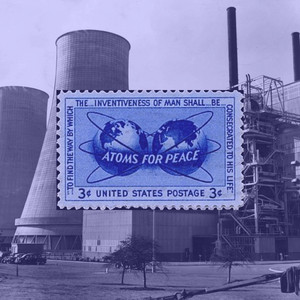
Now, at the time of this speech, which would later be called the Atoms for Peace speech, there were no nuclear power plants.
The first one would only be completed a year later.
But scientists knew that generating power from nuclear sources was possible.
It was a very similar principle as used when creating a nuclear weapon.
As a side note, we did do a three -part mini -series on the atomic bomb a couple of years ago.
Those are episodes 284, 285 and 286.
And they cover the history of the discovery of atomic energy and how it works.
So, I'd encourage you to listen to those if you haven't done so already.
I'll put a link in the description so you can find them easily.
But, as a brief recap of how nuclear energy is created, the chemical element uranium is mined and then enriched, separating out an isotope called uranium -235.
Then, a neutron is fired at the nucleus of a uranium -235 atom, splitting it.
This releases huge amounts of energy and results in more neutrons hitting other nuclei and the chain reaction continues.
Imagine a row of dominoes.
When you knock over the first one, it hits the next, and so on.
In a similar way, when a neutron hits a uranium atom, it splits and releases more neutrons, triggering a chain reaction that releases enormous amounts of energy.
In an atomic bomb with a large concentration of highly enriched uranium -235, this causes a huge destructive explosion.
But, if it could be done with uranium that was less enriched, then the energy given out by the reaction could be controlled and converted into usable energy.
In practical terms, the nuclear reaction would give out large amounts of heat, which could boil water, turning it into steam, which could power turbines and generate electricity.
And, ta -da, that is a very simplified version of how nuclear energy works.
Now, back to Dwight Eisenhower.
His words marked a dramatic turning point.
What had once been a source of unimaginable destruction was now a technology that could fuel cities, power industry and even bring light to places that had never seen electricity before.
He spoke of the need for collaboration, of bringing together the world's brightest minds to work together on nuclear energy, and how knowledge should be shared, not kept in isolated government agencies.
A year later, he passed the Atomic Energy Act of 1954, which allowed the US government to share previously secret nuclear information with private companies.
What's more, it allowed for information and knowledge sharing to be global, or at least between the United States and its allies.
The Pandora's box of splitting the atom had been opened, so the world should at least reap the benefits of what was inside.
And it did seem revolutionary.
The promise of nuclear energy was one of limitless clean energy.
Nuclear power stations would have no ugly black smoke coming out of the top.
There would be no dusty coal trucks driving in and out of the plant every day.
There would just be harmless water vapour coming out of a large chimney.
They could work day and night.
They needed to be built next to a river, or sea, or some sort of water.
But other than that, they could be built anywhere.
And unlike coal or oil, it seemed, at least initially, that there was no limit to the amount of uranium.
Before long, nuclear power plants had sprung up in the USSR, the UK, and the United States, and were beginning to pop up all over the developed world.
In 1972, the world passed 100 active nuclear reactors, most of them located in the United States, the Soviet Union, and Europe.
And a year later, there was a shock that would send this number climbing even higher.
On 6th October 1973, at the start of the Jewish holiday of Yom Kippur, Egypt, Syria, and a coalition of Arab countries launched an attack on Israel, primarily in an attempt to regain the Sinai Peninsula, which had been captured by Israel during the Six -Day War of 1967.
Israel's allies rallied in support, and Israel proved victorious.
Now, why this is important in the context of nuclear energy is that in the aftermath of the Yom Kippur War, OPEC, or the Organisation of Arab Petroleum Exporting Countries, announced that it would impose an embargo on any country that had supported Israel in the war.
As you may know, OPEC members are almost exclusively Muslim countries, with Venezuela being the only exception.
And this organisation that effectively controlled the world's supply of oil sought to punish countries that had supported Israel.
The US was the primary target, as it had sent $2 .2 billion worth of arms to Israel.
But several other countries were formally embargoed, meaning that they could not buy oil from any OPEC member state.
And even those that weren't specifically targeted by the embargo felt its impact.
The price of oil skyrocketed, going from $2 .90 a barrel before the embargo, to $11 .65 a barrel in January of 1974, a more than four times increase.
This sudden spike in oil prices sent shockwaves through economies around the world.
Factories, transportation, and entire industries had been relying on cheap oil, but now costs were skyrocketing.
Everyday people were hit too.
Drivers in the United States and Europe suddenly found themselves paying double, triple the price to fill up their tanks, if they could even find petrol.
Governments everywhere began to realise just how vulnerable they were to the whims of oil -producing nations.
This was really the first time many Western countries saw how deeply they depended on oil, and how quickly that reliance could become a weakness.
In other words, energy security became of vital importance.
Suddenly, the idea of an alternative energy source, one that didn't depend on oil and seemed almost limitless, became extremely appealing.
And this is where nuclear power seemed to offer an answer.
Unlike coal, oil or natural gas, uranium was not controlled by a single group of countries.
Nuclear reactors, if well designed, could run almost indefinitely without interruption, providing a consistent, stable source of energy.
Across the Western world, governments doubled down on nuclear energy as a path to energy independence.
France, which had been pretty much exclusively reliant on foreign oil to provide its entire energy supply before 1973, decided to launch a nuclear energy program, dubbed the Mismar Plan, after the Prime Minister at the time.
This ambitious program set a goal of 80 nuclear plants by 1985, and a total of 170 plants by the year 2000.
Now, we'll talk more about how they did and the impact of this in part 3 of this miniseries.
But, as you may know, in terms of meeting France's goal of energy security and independence, it has worked.
France, despite having relatively low fossil fuel reserves, is the largest energy exporter in Europe.
In other words, it produces more energy than it uses.
And this is thanks to nuclear power, which is responsible for around 70 % of all French energy.
Again, we'll talk more about this in part 3, and look at how the situation in France is very different to the situation in several other European countries.
But the point you remember is that the 1973 oil crisis shook the French so much that it set the wheels in motion for the energy security that France enjoys today.
In the United States too, the government invested heavily in nuclear infrastructure.
By the 1980s, the US was starting up a new nuclear reactor every 17 days on average.
It seemed as though nuclear power would indeed fulfil Eisenhower's vision of atoms for peace, giving the world a clean and almost limitless energy source.
But, as the reactors went up, so did the voices of protest.
In West Germany, grassroots protests started to emerge, not only questioning the safety of nuclear power, but also its environmental impact.
People worried about radiation leaks, accidents and the long -term effects of nuclear waste.
These protests would grow into a major movement and eventually lead to the formation of the German Green Party, one of the most influential environmental movements in Europe.
And it wasn't just Germany.
Across the world, people were beginning to question the wisdom of building so many reactors.
For all its promises, nuclear energy had its risks.
In 1979, an incident at the Three Mile Island Nuclear Plant in Pennsylvania, in the United States, seemed to confirm the worst fears.
Although there was no significant release of radiation, the partial meltdown captured global headlines and rattled public confidence in nuclear energy.
It seemed like a disaster had been ever so narrowly averted.
By the 1980s, these concerns were beginning to slow down the construction of new plants, particularly in Western countries.
The momentum behind nuclear power had started to shift.
And yet, at the same time, countries that had already invested in nuclear energy had seen its potential.
For instance, by the early 1980s, the US had the world's largest fleet of reactors, which were producing just under 20 % of the country's power.
Even more impressively, these reactors had become a lot more efficient and were running at nearly full capacity most of the time, which is something that few other countries had managed.
But for all of the enthusiasm there might have been for nuclear energy, and the improvements in safety and productivity, in 1986 something happened that would fundamentally change public opinion – the Chernobyl disaster.
Chernobyl showed the world that nuclear energy, while powerful and clean when it worked, could also be incredibly dangerous when it didn't.
The explosion and subsequent fire at the Chernobyl plant spread radiation across Europe and caused untold health, environmental and social impacts.
It became a symbol of the dangers of nuclear energy, and cast a long shadow over the nuclear industry.
And that, my friends, is what we have to look forward to in the next episode.
Ok then, that is it for today's episode on early nuclear power.
I hope it's been an interesting one, that you've learned something new, and if you'd never heard Dwight Eisenhower speak before, well you have now.
As a reminder, this was part one of a three -part mini -series on the theme of nuclear power.
Next we will be trawling through the rubble of the Chernobyl disaster, and in part three we will be looking at the state of nuclear power today.
Parts two and three will be member -only episodes, so let me remind you one last time that if you'd like to unlock all of the member -only episodes, so that's more than 250 different episodes, and learn with all of our accompanying resources like interactive transcripts, subtitles, vocabulary lists and study packs, then I'd love for you to check out our membership.
The place for that is leonardoenglish .com.
You've been listening to English Learning for Curious Minds by Leonardo English.
I'm Alistair Bodge, you stay safe, and I'll catch you in the next episode.