Every little thing you think that you need.
Every little thing you think that you need.
Every little thing that's just feeding your greed.
Oh I bet that you'd be fine without it.
Yes, welcome to The Minimalist Podcast, where we discuss what it means to live a meaningful life with less.
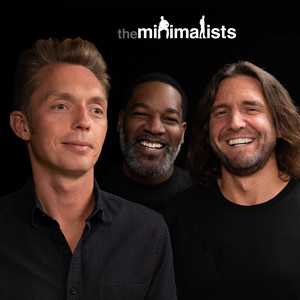
My name is Joshua Fields Milburn, and joining me here at Earthing Studios in rainy West Hollywood California, is my good friend TK Coleman.
It's rainy, but it's still a holiday in my heart.
Today we're joined by one of the world's best-selling living philosophers.
His books about Stoicism have been translated into more than 40 languages and have sold more than 5 million copies.
He's also the author of a new book called Wisdom Takes Work.
Please welcome back to the show, our returning champion, Ryan Holiday is here.
When was it?
I want to say 2019-ish.
We were in our old studio space.
Maybe it was even 2020.
No, I think it was 2019.
Yeah.
Yeah, it was a while ago.
We were talking about stillness as the key back then.
That would have been 2019.
Yeah.
Yeah, that was a great episode, one of my favorites that we've done, and we'll put a link to it in the show notes.
But today we're going to bring you into our world a bit.
We have a bunch of questions we've curated that are stoicism-adjacent, minimalist questions from our audience, audience.
We're going to be talking about how the Stoics dealt with sentimental items, or maybe how they would have dealt with them.
The potential virtue of holding on to things.
Also, some stoical insights about values, regrets, and mental clutter, and much, much more.
Plus, on page three, we'll discuss seven things minimalists would never put in their living room.
Let's start with our callers.
If you have a question or a comment for our show, we'd love to hear from you.
406-219-7839 is the phone number, or you can just email a voice recording right from your phone to podcast at the minimalistscom.
Let us know if you're a Patreon subscriber so we can prioritize your message.
By the way, big thanks to our patrons.
Your support keeps our podcast 100%.
Advertisement free because sing along at home, y'all.
Advertisements suck.
Yes, they do.
Our first question today is from Carlin in Seattle, Washington.
Every time I do the minimalist challenge, I come up against a huge roadblock.
I...
I'm stumped at what to do with my cherished childhood items, such as my dollhouse that my father built and my children and I redecorated, and all of the expensive dollhouse furniture, because I ultimately holding on to them for future grandchildren.
Unfortunately, when I get to this point in the challenge, I also start wondering whether this is a good idea and how to deal with these kinds of of items.
If you have any insight or resources, I would really appreciate it.
Thank you so much.
And I really appreciate your podcast.
I've listened for years and I'm hoping that you'll answer this question.
Thanks.
So, Ryan, let me set some context here for you.
She's talking about the 30 day minimalism game.
It was featured in our last Netflix film.
And it's basically how I started simplifying because I had so much stuff.
I was so overwhelmed by my things.
I was like, I want to get rid of some of this.
I don't even know where to start.
It seems overwhelming.
I just throw my hands up and we don't do anything. procrastinate is maybe the only thing that we do.
And so the question I asked myself was what if I got rid of one material possession each day for 30 days?
What would happen?
And it turns out I got rid of way more than 30 items in 30 days.
You just start getting that momentum you need.
And we eventually turned into this thing called the 30 day minimalism game and it escalates.
So day one, you get rid of one item.
Day two two items, three items.
On the third day, so forth, and so on.
So it gets progressively more difficult.
I often encourage people to never start with sentimental items, because that's the thing that has this story behind it.
It has all of this sentimentality attached to it.
Although I love what TK often says.
He says, there are no sentimental items, only sentimental people.
And I'm wondering, how would the Stoics have handled or thought about sentimental items?
Well, that's an interesting distinction, right?
Because the item isn't sentimental.
The item is the item.
You have just projected the feelings on it which, of course, is something that Stoics talk quite a bit about.
One of the best lines from Epictetus is it's not things that upset us, it's our opinion about things.
The same could be true about the things that we like, right?
Like the item isn't special.
We've just decided that it's special.
But uh, i can very much relate to this because i'm i have kids and then my parents are, so i have all their stuff, all my stuff, and then my parents are constantly sending me my stuff from when i'm a kid and and um, I think they think they're doing something nice, but they're basically just saying they're saying two things.
One, they're like, we don't want this anymore.
It's yours.
And then they're also saying to me something that existentially terrifies me, which is that do I have to keep all this stuff in my house for 30 years?
If they're sending me something that I had when I'm eight and I'm 38 now, does that mean I have to keep this thing for 30 years before I voiced it back onto them?
That's the hardest thought.
That's a terrifying thought because we're going to die under all this stuff.
It's really difficult.
In some ways, it's easier to just accommodate the stuff than to make the hard decisions.
In some ways.
Yes.
Yeah.
Like to just go like hey, I'll get a storage unit, or hey, I'll just feel claustrophobic in my space.
It's easier to make more money and pay for the stuff than to have the sort of hard decision of like do I actually need it?
I guess, obviously, there are some things that are worth keeping, right?
Don't get rid of everything.
And I would say probably One of the reasons we don't have room for some of the bigger, more sentimental stuff is we're keeping a lot of stuff that isn't sentimental at all.
Like, why are you keeping this box from an iPhone you bought six years ago?
You know?
I...
I don't know.
Keeping stuff to give to a person at a later date is quite a rationalization you're making.
You're not saying, I like this.
If this is meaningful to me, we're using it now.
You're just saying hey, I would like to be the kind of person that in 30 years, I can say that I kept it.
And some of the stuff.
Like My parents sent me a high chair, a wooden high chair that you're not allowed to use.
Like, not only do they keep like it's cannot put a kid in this one anymore.
It's not it's like not safe.
This isn't what we do anymore.
So you're holding onto stuff because you're telling yourself this story, that in the future they'll use this or they can use this, but you don't know that.
That's not true necessarily.
Yeah.
When I was going through my mom's stuff when she passed.
That's when I first sort of stumbled into minimalism.
And I realized I was going to keep all of it.
And I couldn't fit it in my house because I already had a full house and a full basement full of stuff.
I couldn't co-mingle mom's stuff with my stuff.
So I rent a storage locker back in Ohio.
I asked for the largest one they had and I got the largest truck that I needed.
And mom had about three houses worth of stuff crammed into one tiny bedroom apartment.
And she wasn't a hoarder.
She was super well organized, although I can make the argument that we're all hoarders at some level.
You know, there's the five stages of hoarding.
Most of us are hoarders. stage one or stage two.
A stage one hoarder just has light clutter and two or more rooms.
It's like, well, doesn't that describe everyone?
Yeah, it's called a house.
But TK, when I was going through that stuff I realized like oh, if everything's sentimental because I'm holding on to all of it.
If everything's sentimental, then nothing is sentimental.
And that was my key to start letting go.
I realized that if I let go of some of the things that I was just gonna selfishly cling to in a storage locker, which was really like a mausoleum for stuff, it wasn't, I wasn't gonna go there and visit it and pay homage to it and like light a candle there once a week.
No, it was just going to sit there.
And I was going to pay the 240 every single month on auto draft and every month it's just going to come out of my bank account.
That's the cost of not dealing with the things.
That is the cost of clinging.
That's not simply holding on.
That is the cost of clinging to these things.
That might have some value, as Ryan said, in this non-existent hypothetical future.
Like, oh, maybe I'll pass this on 30 years from now.
But there's no real plan behind that.
But then I realized if I let go of most of the stuff, not only could I contribute to other people who might need these things, but I got more value from the few sentimental items that i kept than if i were to water them down with just hundreds of thousands of extra trinkets.
Yeah, you know what a great burden we place on our children and grandchildren by giving them things without running it by them first, right.
When it comes to money, we all love that.
I inherit money because money represents my power to choose.
You leave me a million dollars.
That means I get to create my life and facilitate that with these resources in whatever direction I want.
But you leave me a dollhouse.
Well, now I'm married to something that was important to you, but it may not be important to me.
And on this show we've had lots of situations, from talk aboutables to call-ins, to even guests who have inherited things that they just didn't like.
Here's this furniture my mom loved and I feel terrible because it's ugly, but throwing it away feels like I'm throwing my mom away.
Here's this typewriter that was so important to my grandfather because he used it to write all of his papers.
I don't want this thing, and no one uses it.
But if I throw it away, I feel like I'm throwing him away.
What pressure is being placed on them to appreciate it?
What if they break it?
Are they in trouble?
What if they don't value it?
Do they get to be bad people now?
What if they look at it and say, I don't even want this?
Does that end up hurting you?
Does that disappoint you and change your perception of them?
I think the most valuable thing we can leave for the future is the power to make decisions.
Leave behind things that represent a sense of possibility.
You have the right to hang on to those dollhouses.
But I like the idea of leaving people with an enhanced power to choose because of the way that you lived your life.
What's something that represents that?
I'm going through this because, you know, your kids, they just produce endless amounts of art.
What do you do with it?
They bring it home.
They're very proud of it.
And then you, okay, you can only hang so much of it up, but you don't want to throw it away.
It feels weird to just wad it up.
So I did one of those things where we stacked up a whole year of it.
We did one of those things where you mail it in and they turn it into a book.
Right.
And, uh, Awesome.
Okay.
But then they mail me the art back.
Like I, first off, it was stressful just to be like, Hey, I got all this.
I currently possess it.
Right.
But now I'm putting in the mail.
What if it gets lost in the mail?
Whatever.
So you take the leap, you make the decision.
You're like, I'm getting rid of the art and I'm going to swap it for this book.
That's like my possession, you know?
And then they mail me the art back.
So now I have the book and the art.
And now I got to make this decision again whether I'm going to throw it away.
And it's like I used up all my willpower to get rid of it the first time.
And now it came back like a boomerang.
Also a book.
So so but I do think what I liked about that idea, though, was like, hey, I'm going to.
It as the art is not worth anything to me because I can't use it.
Right.
Like like it's just a stack of things.
It's not frameable, but like, hey, it pictures us.
Whether it's on my phone or in a Google Drive or it's in a book.
Now it at least exists as some physical manifestation, but it's a lot more storable.
I can put it on the shelf.
And I even can see that with my kids.
Like, you're shopping.
Like, I want this.
And you go, well, we're not going to get it.
And then they're upset.
And you go, okay, let's take a picture of it.
And then there's something about the well, I'm capturing it.
It is recorded.
It didn't disappear forever like a dream or a memory.
But it, but it.
But it doesn't have to take up space in our house.
And most of the time that's enough, right?
Like how many thousands of pictures do I have in my phone that I've never looked at?
But if I had to keep the physical reminder of each one of those things, I mean, there'd be no room.
Yeah.
Yeah.
The digital clutter in some ways is less problematic because it's not taking up all the space.
In some ways, it's more pernicious because it's easier to sort of clutter that up as well.
And so you get to a point where the camera log is just not functional.
Yeah.
300 pictures of the same piece of art.
It just doesn't. do anything.
But TK, you brought up something.
There was an implicit message, what you were saying there about here, I'm giving this to you.
You should like this as much as I want you to like it.
Because part of it is like, I'm not valuing this sentimental item anymore.
But I think Ryan Holiday will.
So and by the way, I don't really like it that much, but he should like it.
So now I'm going to hand that down to him.
I'm not just handing him the item.
I was holding on to how he should feel about this thing.
Yeah.
And so I'm wondering, we're looking at like Epictetus or Marcus Aurelius.
If everything just went up in smoke, whether it's your camera roll or all the sentimental items, what insights would Epictetus?
So he has this shrine in his house and it's got a silver lamp in it.
And he comes home one day and it's been stolen.
One of the versions of the story is he hears something rattling around in his house.
He comes out, he sees the thief leaving with his lamp.
And so It's a lamp that's supposed to honor the gods.
And so the first part of him is upset.
And then the second part of him is like, this is why you don't have fancy things.
You know, this is the cost of having fancy things is that people try to steal it.
So he says you know, tomorrow I'm going to go back and get an earthenware lamp, a cheaper lamp, so I don't have to be so stressed about it, right?
It's less sentimentality attached to it.
It's like from Ikea, basically.
It's the equivalent, right?
So he goes and he gets a clay lamp and burns it in his house for the rest of his life.
He dies and we're told that one of his students buys the earthenware lamp for like a lot of money, because it's now Epictetus' lamp.
And so the irony of the philosophical teacher getting the cheaper item as a reminder of impermanence and of not having physical possessions.
By then, nature of him doing that, him touching it, it becomes an extra valuable thing.
And I'm guilty.
In my podcast, the Daily Stoke podcast, we do it at a table like this, but it's a table that I bought from auction when Joan Didion died.
And so it's like it's a table that one of my favorite writers used to sit at.
Like there's pictures of her.
You can look at her just sitting in the chairs.
But it's like why it's a table.
The same table someone else didn't sit at or someone else sat at is garbage.
But here it's like I'm furiously bidding on my phone, hoping to get it.
And now it means something to me.
And now, you know, when people come and clean, I have to go like, don't touch the table.
You're not just giving them the sentimentality and the responsibility, but also the burden of like, as you said hey, what if I break this?
Is it actually a dollhouse you can play with?
Or is it a dollhouse that takes up space but can't be played with precisely because it's special?
And so in many cases, what you're foisting on them is Worse than just an item.
It's a wholly unfunctional item.
And then the existential attachment to it that burdens you in more ways than one.
PK.
It's fascinating that if you found out all of a sudden that oh, this is Joan Didion's table, it's not going to make you write like Joan Didion.
Although we're kind of buying that sometimes.
If you buy Stephen King's pen or Jimi Hendrix's guitar.
Yes, it's a beautiful artifact, I'm sure.
And it was special to them and now it's special to you.
But then let's say you've had that table for several years now.
Yeah, okay.
Well, if you found out today, it was a knockoff.
Right.
And all of a sudden, the story you would tell yourself would be considerably different.
Why is that, TK?
I think that's a beautiful aspect of our humanity.
The existence of bad stories doesn't negate the power and the beauty of storytelling, right?
It's just that we're capable of telling stories that disempower us.
But I love that fact that we're willing to bid a lot of money on that table being used by a particular person, because that points back to something that we can do really well.
And that is we can imbue an object with meaning by narrating around it in a particular way.
And so that gives us a lot of options, because now I have this dollhouse and I say well, this means something to me because of the story.
And so if I get rid of it, I'm not getting rid of the value.
The value is in me, right?
I'm the goose that lays the golden egg.
There you go.
This is a golden egg and that has its value, but I'm the goose that lays them.
And I can recreate that value by telling a different story with something new.
And I just love the idea of creating with our children and saying hey, here's what meant something to me.
And that was really awesome.
But that was my time.
What we're gonna do now is we're gonna create our own thing together and we're gonna tell our own story, and that'll mean something to us, rather than me forcing you to fit into your narrative a story I told myself that you yourself might not even value.
And it also the story is not only in the item itself, right?
So uh, we live in this little town in texas and and the this bakery down the street from from where we live, it just it was going out of business.
My kids were really upset, you know, like their favorite place.
They loved going here And they were like can we go today?
It was closing for a month and they wanted to go every single day.
And you could tell they were just working themselves up into being extra devastated when it closed.
And like, as it was closing, they started selling, like the stuff in the store, like you know, like the chairs are for sale and the tables are for sale and this is for sale.
And my kids just wanted all the stuff.
And it was like, we can't fit a bakery inside our house.
And, and, um, the, the lady that ran it, she was awesome.
They had this giant.
It's like outside their big things like this is giant cupcake.
You know that you would pass on the way.
And just like this giant company, almost as big as this table.
And, um, And my kids were like, can we get the cupcake?
And I was like, no, we don't have room for a giant cupcake in our house.
But on the day it closed the lady that ran it, she took them over to it and she broke off one of the sprinkles from the top of the cupcake.
And she was like, you can have this.
And they took it home and it's, like you know, now one of their prized possessions in their room and they love it.
I'm sure at some point they'll throw it at each other, forget it and lose it.
But the point is, like, the dollhouse has the story.
But so does one of the chairs in the dollhouse.
And so does one of the dolls or a roof shingle.
Or, hey, you can take a piece of it and make a little paperweight.
Like...
I think one of the things that I try to do is I go.
This meant something to my grandfather, it meant something to me.
Okay, but what is the smallest version of it that I can have?
It doesn't have to be the whole thing, right?
It's like the house you grew up in, your parents are finally selling it.
Well, maybe you're gonna take the numbers off the address and you're gonna use that for something, or the little wind chime in the backyard.
You don't have to keep the whole thing.
If there is this sort of narrative significance, significance in the object, it's also in the smallest part of the object.
And we can just sort of be practical, like what's the minimal effective dose of the memory in the object?
Holographic minimalism.
Well, sometimes the minimal effective dose is also zero.
And we don't think about that quite often.
It's like, what's the appropriate number for me?
It could be nothing.
Obviously, if my daughter started bringing home dead raccoons, the appropriate number is zero.
I don't care how good the story behind the dead raccoon is and how sentimental it is and how she's going to use it.
The answer is no, and I'm going to set a boundary.
Now that one's pretty easy.
That's a parodic exaggeration of someone bringing clutter home.
But don't we do that with other things that are just more acceptable?
Of course, the raccoon is unsafe in a health sense.
But how many of our things are unsafe in like a sort of mental health sense, that are causing all this chaos and turmoil inside us.
Carlin, i'd love for you to download, if you haven't already if you're playing, the 30-day minimalism game, maybe you already have, but the minimalistscom slash game you can download our free calendar.
Uh, you can play the 30 day minimalism game.
You could follow along there.
Anyone else who's listening to this who wants to play the 30 day minimalism game.
A new month is in a few days.
So the minimalistcom slash game you can download that calendar for free and you can see exactly how to play the 30 day minimalism game.
Partner up with a friend, a family member, a coworker, someone else in your house and you let go together.
But also, you hold on together.
You can start telling stories about the things that we are holding on to.
Here's why I chose to keep this, and here's how it's going to add value to my life.
Before we get back to our callers, let's do a lightning round here.
This is where we...
Answer the Patreon community chat's question of the week, and we attempt to answer questions with a short shareable, less than 140-character response.
We call them minimal maxims, although we can maunder on as much as we want Ryan, so don't worry about keeping it too pithy here.
You can find this episode's maxims in the show notes at theminimalistscom slash podcast, and every minimal maxim ever at minimalmaximscom.
We'll also deliver our weekly show notes directly to your inbox, including a bunch of new maxims, every Monday for free, if you sign up for our email newsletter at theminimalistscom.
We'll never send you spam or junk or ads, but we will start your week off with a dose of simplicity.
All right, Ryan, the question of the week this week is, when is it virtuous to hold on?
Now, before we get to our pithy answers here, let's check in with some of our listeners.
Jenny said, for me, holding on is virtuous when I'm holding on to my core values.
How do the Stoics think about values?
Yeah, I mean, if we're talking about holding on to stuff, that's probably not what we're talking about when we're talking about virtue.
It's funny.
Someone once distilled talking about Maxim.
Someone once tried to distill all of Epictetus' teachings down to basically two words.
And he said those two words are persist and resist.
So sometimes it's holding on to the thing, continuing to do it in the face of adversity difficulty, et cetera.
And then sometimes it is resisting, not holding on to the thing, letting it go, not doing it, not indulging in the impulse.
When we're talking about values, that's where it comes in, right.
So stoicism, I have them here, and these are the four virtues of stoicism.
So you know of courage and discipline that might be the sort of the holding on part of things right.
But to what and why, what cause, what for, this is where we get the virtues of justice and wisdom.
So they kind of balance each other out.
So courage in the abstract And persistence holding on.
You know, clinging to things in the abstract may be admirable, but really it all depends on the context.
Yeah, yeah.
To what extent will this continue to add value to your life?
And that's why I think we posited the question that way.
At first, we often think about things, but...
For us, minimalism is the things of the Trojan horse.
For us to talk about the philosophy behind what's going on with our stuff, with all of these things that adorn our walls and our halls and our homes.
Yes, we often own too much stuff.
But what else am I holding on to?
And what is holding on virtuous?
Gary says, seeing virtue as a quality of usefulness.
I ask myself.
Is it useful to hold on?
If yes, then I hold on.
If no, then I joyfully let go.
In reality, it depends on the day which I ask myself and what story I'm holding on to.
There's those stories again.
What stories...
We're holding on to that brings me to my pithy answer here.
My minimal maxim is letting go of a thing always involves letting go of the story behind the thing.
The material possessions that are difficult to let go of, they often create yeah, they create the physical clutter, but they create a lot of mental clutter.
Lots going on here in our head because it's difficult to let go.
What does this say about the person I am?
If I own the right things, will I impress the right people?
And is that part of my identity?
There's almost like this identity clutter that's stuck up in that.
Yeah, right.
And again, I think, when we're talking about holding on, sometimes you're holding on too much to stuff, but sometimes you're holding on too much to an identity or a position or a level of activity or a vision you have of what success is or isn't what other people are doing.
And so yeah, sometimes the holding on is the hey, I'm going to do this, even though I'm taking criticism for it, even though Everyone else has given up, you know, and the sort of the virtue is in the hanging on.
And then other times the virtue is in the letting go.
Oh, this doesn't actually matter.
Oh, this actually is an important thing.
Oh, actually, I have enough.
It's actually selfish to want more and more.
And so it all comes down to knowing what's what, which is sort of my definition of wisdom, right?
I think, you know, what's the right amount?
What's the right thing?
What's the right way?
You know, the who, what. when, where, why of it all.
That's what wisdom is.
Yeah.
Fascinating.
Because when we talk about wisdom, we often get it conflated with like information, TK.
Sometimes we'll talk about on the show.
We think that you know we're in the information age.
The more information we get, the more wise we'll become.
But it seems to me that the opposite is often true.
One of the words that's used sometimes interchangeably with wisdom is insight.
I know that it's also practical application of knowledge, but insight is about seeing deeply into a thing.
And we all know what it means to Think we have read a book.
Think we've engaged with the concept.
And then you talk to somebody else and you go oh, I really haven't engaged that idea very deeply at all.
You're not seeing deeply.
You have access to the information.
You know, you've kind of run some circles around it, but you haven't truly penetrated it.
Well, we certainly think about this, how many people think their job as a citizen is to be informed?
They take that to mean, I watch a lot of news or I scroll on Twitter a lot.
But is that really understanding what's happening?
You know, is that really what an informed person would do?
Or do the people that you admire tend to go much deeper than that and have a wider, more historical perspective, sort of psychological, human understanding of what things mean and why they matter and how they fit together?
So oftentimes you could be much more informed by consuming less real-time information and studying things more historically.
You'd be better off booking a trip to a foreign country and like seeing where things began than watching the evening news shows.
Yeah, yeah.
And there's an ephemerality to it that feels so urgent in the moment.
And our brain tricks us into thinking that's almost like an emergency because it is urgent.
But then, a week from now, I don't even remember the thing I was scrolling through.
That seemed so urgent in that moment.
Eileen said, holding on to your sense of self and ethics when overwhelmed by others' expectations, demands or needs.
As a mother, I didn't hold on to my sense of self, but I have let go of the regret that followed.
Ryan, how do the Stoics think about regret and maybe the expectations of others?
So you feeling bad about it, you wishing that you hadn't done it, you wishing that you'd done it differently In some ways obviously look, you did something wrong.
You shouldn't be like, well, it's in the past.
You know, I'm a flawed person.
That's not what we're talking about.
Guilty and thus paralyzed in a way that's that is a way to let yourself off the hook because now you don't have to be thinking about what you're doing right now.
Like, what are you going to do?
Like, what you control is, are you making that mistake again?
Are you making a different decision now?
How are you going to do it better now?
And so this kind of obsession we have with the past and is probably not a virtue in the ability to let go what's happened, whether that's something that was cringe worthy or something shameful or something stupid or whatever it was.
The ability to be in the present moment and to try to make the right decision now, in the present moment.
That's philosophically, what it's supposed to be about.
What about expectations from other people?
Because that could be crippling, especially if we have a dozen people who expect 12 different things from us and they're all like the things don't overlap.
In fact, the thing you recommend for me or expect from me could be completely the opposite of what TK's expectation is of me.
When anyone that's making work in public.
Chances are, if you are lucky enough to be successful at it, you're going to have a large audience and a percentage of that audience is not going to like what you do or not going to like every choice that you make.
It's a statistical certainty. that you're not going to meet some people's expectations.
And the more successful you are.
Even if that percentage stays the same, the quantity of people goes ever bigger.
So if you make something that sells a million copies, are one million people gonna be satisfied with it.
Of course not.
So even 10% or even 1% is a large amount of people.
1,000 people, 10,000 people, 100,000 people. very much don't like what you just did.
And can you deal with that?
And one of my favorite lines in Marx's Meditations.
He says we all love ourselves more than other people.
But for some reason, we care about their opinions more than our own.
You're doing the thing.
You made it, right?
You know what you like.
You have the taste.
That's the reason you're in this position.
And then you're like, well, some random guy says it sucks.
So I got to take that seriously.
And you don't.
And so the ability to sort of decide who you're going to take feedback from and who you're going to let in is one of the hardest things to do.
As a person, yes, because you liked this shirt, you picked it out, and then...
You know, you show up at school and someone says, dumb shirt.
And now you're like, I hate this shirt.
Right.
But you don't.
You liked it.
And now you're letting this random person say that it's not good.
It's true there.
And then it's also true if you're doing any kind of work in the world that is received by other people, which is, by the way, basically everyone.
Yeah yeah TK, I think it could be.
It's not just someone who sells millions of books, but it's like someone who works at the local school district and they have a dozen coworkers.
Those dozen coworkers are likely gonna have different expectations of them throughout the day.
Whereas if you teach 30 kids, you think every parent is gonna think you're the best teacher?
Like your style is not going to be universally.
So he has this great exercise in meditations.
I've extended it out to other things, but he goes.
Look He goes.
Is a world without shameless people possible, right?
So is a world without jerks or people who don't like you, plug in anything, right?
Is a world without those people possible?
No, right?
So he goes, okay, so you just met one of those people.
Why are you surprised?
Yes.
Right.
So it's like statistically one out of 10 people doesn't like your face, you know, or whatever it is.
You just met the person that said they don't like it.
Why? you're surprised, it was literally a foregone conclusion that this would happen.
And the more you can kind of run those numbers in your head, you can start to get a sense of because that's really the problem is, you do have to take feedback and criticism in this life.
So how do you separate the signal from the noise, right?
Some people like this, some people like that.
Your chances are you're hearing most of the time from the people that I have to like.
We have someone who does customer service at Daily Stoic and her job is to, you know, be the canary in the coal mine.
Wow.
But when she comes in, a lot of people are upset.
A lot of people are mad about this.
And my first question is always, how many is a lot of people?
Because 20 people on something you sold 20 of is a very large number and something went wrong.
20 people is something you sold 20,000 of.
It's probably about right.
Now that doesn't mean those people don't matter and you shouldn't do your best to make them happy or refund their money because they are unhappy or whatever it is.
But you have to go, hey, it worked for 19,980 other people who didn't say anything.
And actually, by the way, They did say something.
They just don't say it to your customer service line.
They said it when they recommended it to other people.
They said it somewhere else.
And so how do you separate the signal from the noise?
That's what it's all about.
Yeah, I never call Verizon and say, oh, my coverage was great today.
Thanks so much.
I really appreciate it.
And I think that's true.
But also, TK, it's still like it hurts still, right?
And it's almost like that's part of the human condition, where it's like yeah, I know that mathematically that people aren't going to like me, but they don't like me.
Well, there's something to be said about having the humility or self-honesty to acknowledge what hurts and to minimize your exposure to it, so that you're not subjecting yourself to something that hurts in an undue quantity.
I mean, hey, being punched in the arm hurts.
If I wanna be a boxer, I'm gonna have to put up with a certain amount of that and accept that it comes with the territory.
At the same time, I still have to have a game plan for how I'm going to minimize the number of hits I expose myself to in practice as I prepare for a fight.
And I've got to have really good defense so that when I get in that ring I'm minimizing my exposure to the hits.
And so one of the things I talk about a lot is attention is like money.
And if you are willing to spend it on anything, you'll eventually be duped out of everything.
And so you have to have a standard.
What am I free to ignore?
Like, what do I choose to not pay attention to?
What are the standards for how I receive feedback and who I receive it from?
And you get to set that up in any way you want.
You don't have to be some snob who says, Oh, I would never listen to a homeless man.
You can learn something from anyone, but you have to decide what those standards are going to be, because we're all finite.
We all have a scarce amount of attention and time and you just can't take in all the world's feedback.
And you're never going to, you know, get to this place, like Ryan says, where everyone loves you.
Because even if you got there and you finally became the first human being to get everyone to love you, there would be plenty of people who would hate you just for becoming that.
So we have to stop telling ourselves these you know – airbrushed stories of these great people in the past who found a way to tell stories or communicate a message that everyone loved.
Be like Jesus.
He spoke to everyone and everyone...
Did you actually read the story?
There is no one who communicated in such a way that all of humanity gathered together and said oh, this is the one that we should all listen to.
I think this is the curiosity that Ryan is talking about in his new book, which is called Wisdom Takes Work.
Curiosity is a big part of this.
And the reason I love TK is he's the most curious person I know, but it's genuine.
It's not an affectation of curiosity.
But he's also curious about the quote unquote right things.
His curiosity doesn't lead him down a path of pain and suffering typically, but it is a path of wisdom.
And so maybe you could talk, shed a little bit of light on curiosity and its role in wisdom.
Yeah.
Have you ever heard that expression?
Their mind's so open, their brain fell out.
You do have to have a you're curious and then there's some doors you leave closed.
Yeah.
Or there's some questions you leave unanswered.
Yeah, I mean curiosity is wanting to know what's on the other side of the hill, which is what drives, I think, most accomplishment, most creativity, certainly most discoveries, and you have to cultivate that.
I think some people don't.
Then?
So what's on the underside of the hill?
Not only do they not know, but they don't know whether they themselves are capable of being the kind of person that does that right.
So then it becomes scary and then it becomes intimidating.
And then they become secure and maybe irrationally possessive where they are and what they know.
And so yeah, the ability to kind of go into areas that you're not familiar with, literally and figuratively, is what it's about, right?
Asking questions, picking things up, seeing how things work, that's what That's what drives it.
And what you could say, like the opposite of curiosity is like certainty.
You can't learn what you think you already know, something the Stokes would say.
And so the problem with being a know-it-all is that you can't know anything else, right?
Come on.
Tweet that, Sean.
You know the Zen story.
This master has a student sit down for tea and he starts to pour in the glass until it eventually overflows.
And he says you know your mind is like this cup.
You know you have to empty the cup if you want to sit down for tea with the master.
And so the more your mind is focused on what you don't know or what there remains to be known, the more you're going to learn, the more you're going to discover, and the more you go through the world with the sort of a strong identity, a strong sense of how things work and why they work and why they're this way and what your place is in them you know, the more closed off you're going to be to all the things you can learn and know.
Yeah.
How about you listeners?
What is...
When is it virtuous to hold on?
Let us know your thoughts in the Patreon community chat or down in the comments.
Okay, give me something pithy, TK.
When is it virtuous to hold on?
You haven't let go if you're still holding on to your ego.
For every legitimate endeavor, there's a performative approach to it.
So there's a performative friendship of someone who would never visit you at the hospital, but they cry loudest at your funeral.
Uh, there's a performative sense of religiosity in my private life.
I don't meditate, i don't pray, i don't do any of that stuff, but you put me inside of a church or a temple and, oh lord, I lift my hands to you.
I pray to be seen, not to connect, right?
And so the same is true for minimalism.
There is a performative minimalism where I declutter and I simplify so that I can self-righteously look down upon all of those who do not minimize as well as I do.
And I think performative minimalism is pseudo-minimalism.
It's a form or a varied manifestation of martyr syndrome, where you make sacrifices Not because those sacrifices are life-giving or beneficial to other people around you.
You make sacrifices because you're trying to contribute to your own sense of self-importance.
Yeah, I had to take him to the airport and I had to do this for them.
And I'm going to let everybody know about all my sacrifices because I want you to see me as a saint.
And I think we're still holding on no matter how many possessions we've gotten rid of.
If we're treating our status as minimalist, as if it's something that makes us saints and is worthy of praise.
No, you do this for you because your life looks better and feels better and functions better when it's running on simplicity.
Is there a performative element to stoicism in some?
Is there a stoical way or is there a way to perform stoicism that is maybe disingenuous?
Yeah, I mean, I think people tend to when they hear the word stoic, they think it sort of has no emotion invulnerable, unfeeling emotion.
That's not my understanding historically of who the Stoics actually were as people.
I don't think it's about.
In the same way that minimalism is not the removing of attachment from things.
It's the discipline to go.
Yeah, I like this, I want it, but I understand at some level I don't need it.
And it's the hard work to go, okay, I'm going to make this decision.
And so I think the Stoics weren't these unfeeling, disconnected people.
It's...
How can you maintain a certain equanimity and poise in a world where you have attachments, in a world where Stuff happens, in a world where you don't like some of the stuff that's happening?
You know, can you can you be able to go, hey, I wish that hadn't happened.
I think it's unjust that that happened.
And my initial reaction was anger or frustration or fear.
But I'm not going to let that necessarily dictate or determine my behavior.
So I think sometimes people think because I write about this, that I'm this sort of perfect embodiment of it, and I'm not at all.
It's like, no, I'm writing and talking about it because I'm naturally the opposite of this.
Right.
And I'm working on getting better at it.
That's fascinating.
The performing stoicism or performing minimalism kind of gets in the way.
It's another kind of clutter of sorts.
Because, yeah, you're right.
When I think of a stoic person, a person who's behaving stoically.
It's like they have a stone face and they're unaffected.
And the truth is that we often hold on, even though we don't show what we're holding on to.
We don't show the suffering or the frustration or the anger, but And maybe in many cases it's better to not lash out in anger.
But it can still be there.
And I think the Stoics, they would have noticed that.
They would have said, hey, that the anger that I'm experiencing doesn't need to turn into rage.
Um, yeah, so we got a lot more to talk about, but it's almost the end of page one.
We still have an entire switchboard of callers to talk to.
But first real quick, for right here, right now, here's one thing that's going on in the life of the minimalist TK your clutter counseling calendar.
Say that five times fast. is now open for next month.
Tell us more about Clutter Counseling.
Yes, indeed.
Clutter Counseling is when you can book a one-on-one session with me to go deeper on whatever it is that's getting in the way of how you want to create your experiences in life.
We've got questions about career, career transitioning, getting that first job, progressing in the workplace, relationship clutter.
I've got people in my life that I need to get along with and we're having some serious difficulty on that front.
Emotional clutter.
I've got some internal stuff.
I've got a lot of baggage I'm carrying and I just need a new perspective on that.
It's a great opportunity for you to kind of open up and share where you are with me and for me to do some unpacking with.
A lot of questions and helping you sort of reframe things in a way where you can declutter not only the physical stuff there's a lot of that too but the intangible stuff behind the physical stuff that makes life unnecessarily complicated.
And TK is going to start doing some clutter counseling videos on our YouTube channel as well.
If you want to check those out, we'll put a link to it in the show notes.
YouTube.com slash The Minimalists.
Much more coming up.
But first, here is a quick minimalist tip for one of our listeners.
Hey, guys, it's Amy from South Carolina again.
I'm coming with a poem today by Celeste Davis.
It actually doesn't have a title, but she has a sub stack called Matriarchal Blessing.
And I really like it.
This poem is about the weight.
Of being buried by the needs of others when you give too much of yourself away.
I think this would be a fabulous topic.
And I think a lot of women slash moms can relate to this poem.
And here it is.
Okay, I said.
An hour of my rest, my attention, my problem solving skills, my home cooked chili.
I looked up for guidance, desperation in my eyes.
Smile, they said.
Be grateful.
Wow.
Amy, thank you so much for that beautiful comment.
For anyone else who has a listener tip or insight about this episode or any other episode.
You can send a voice memo to podcast at theminimalistscom.
We'll feature your voice on a future episode up next, page two and page three.
But first...
Let's take a quick pandiculation break.
We'll be right back.
All right, y'all, that's the first 38% of episode 511.
We'll see you on Patreon for the full two-hour maximal edition with Ryan Holiday, which includes answers to a bunch more questions.
Questions like...
How might living out of a suitcase help one's mental health?
What did the Stoics think about ego and identity clutter?
How can I live with someone who betrayed me?
Plus a million more questions and simple living segments over on The Minimalist private podcast on Patreon.
The link is in the description.
When you subscribe, you can listen to our private podcast episodes on Apple Podcasts, Spotify or your favorite podcast app.
Plus, you'll gain access to all of our archives all the way back to the very first episode.
It's over a decade of podcast archives.
Big thanks to Ryan Holiday for joining us today.
You can check out his daily Stoic newsletter and his podcast.
We'll put links to both of those in the show notes and his new book. is called Wisdom Takes Work.
That'll be in the show notes as well.
And that is our minimal episode for today.
Big thanks to Earthing Studios for the recording space.
On behalf of Ryan Nicodemus, TK Coleman, Post Production, Peter Spire, Jeff and Spire Dave, Jordan O'Moore, Tom Katt, Professor Sean Savvy D and the rest of our team.
I'm Joshua Fields Milburn.
If you leave here with just one message, let it be this.
Love people and use things.
Because the opposite never works.
Thanks for listening, y'all.
We'll see you next time.
Peace.
Every little thing you think that you need.
Every little thing that's just feeding your greed.
Oh, I bet that you'd be fine without it.