
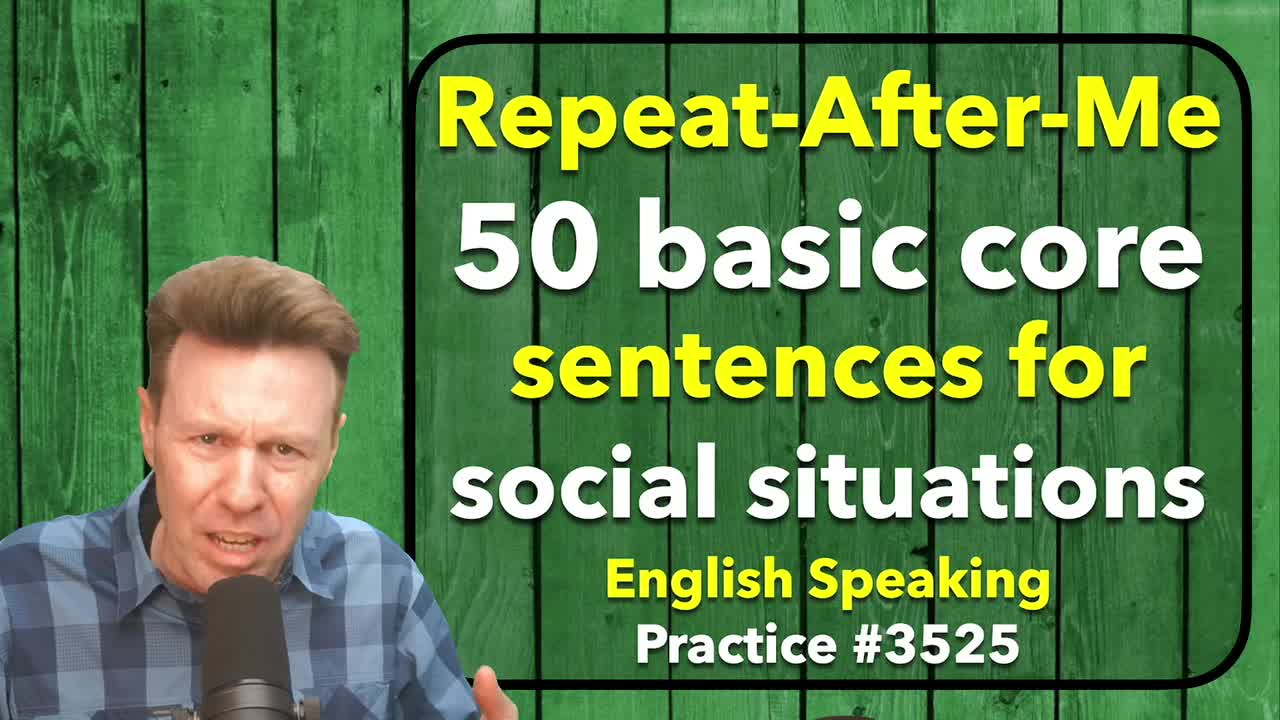
[Mastering Social Fluency: 50 Essential Core Sentences for Everyday Conversation]-[50 Repeat-After-Me Sentences for Speaking Practice]
📋 Summary
Mastering Social Fluency: The Power of Core Sentences
In this session, the host emphasizes a crucial aspect of language learning that many advanced students often overlook: the mastery of fundamental social interactions. While learners may feel that "this is easy stuff" and dismiss the need for practice, the podcast argues that consistent repetition of core sentences is essential for achieving native-like fluency.
The Necessity of Practice
Even for those who consider themselves advanced, the host insists, "You must practice." The goal is not merely to memorize phrases, but to refine one’s delivery. By focusing on these 50 basic sentences, students can work on their "pronunciation" and "accent reduction." The ultimate objective is to "enunciate" clearly and "sound more like a native speaker." The host models this by acknowledging his own errors—such as when he "messed up" the opening greeting—demonstrating that even native speakers benefit from mindfulness during speech.
Categorizing Social Interactions
To build social competence, the podcast organizes these 50 sentences into functional categories that facilitate smooth, natural-sounding conversations:
1. Initiating and Building Rapport
Starting a conversation requires ease and confidence. Phrases like "Hi, how are you doing?," "It’s great to see you," and "How’s your day been so far?" serve as perfect icebreakers. To deepen the connection, the host suggests asking open-ended questions such as "What have you been up to lately?" or "Where are you from originally?" to move beyond superficial small talk.
2. Expressing Interest and Engagement
Active listening is a cornerstone of social intelligence. When someone shares information, responding with "That’s interesting. Tell me more" or validating their experiences with "That sounds amazing" or "I totally agree with you" encourages the other person to continue. Showing empathy is equally important, as seen in phrases like "That must have been difficult," which helps build emotional resonance.
3. Navigating Social Logistics
Practical questions are essential for social coordination. Whether it is asking "Can I get you anything to drink?," "Is this seat taken?," or "Could you recommend a good restaurant?," these sentences allow for smooth navigation of everyday situations. Furthermore, maintaining boundaries and politeness is covered through phrases like "Excuse me, do you mind if I join you?" and "Sorry for being late."
4. Closing Conversations Gracefully
Ending an interaction is just as important as starting one. The podcast provides several ways to conclude gracefully, such as "I had a great time talking with you," "I hope we can stay in touch," and "Let’s catch up again soon." These phrases ensure that the interaction leaves a positive, lasting impression, culminating in polite sign-offs like "Take care" and "Safe travels."
Conclusion: The Path to Fluency
The podcast serves as a "good workout" for the tongue and the mind. By treating these 50 sentences as a repeatable training regimen, learners can internalize natural speech patterns. The host’s final advice is to "keep moving forward one step at a time." By consistently practicing these core building blocks, learners transform their ability to navigate social settings, ultimately achieving a more fluid and confident command of the language.
Deep Learning with ListenLeap


