Hi, I'm Vanessa from SpeakEnglishWithVanessa.com.
Are you ready to describe the world around you in amazing English?
Let's do it.
To become a fluent, confident English speaker, you need to be able to use daily life English to talk about the world around you and to talk about your daily tasks.
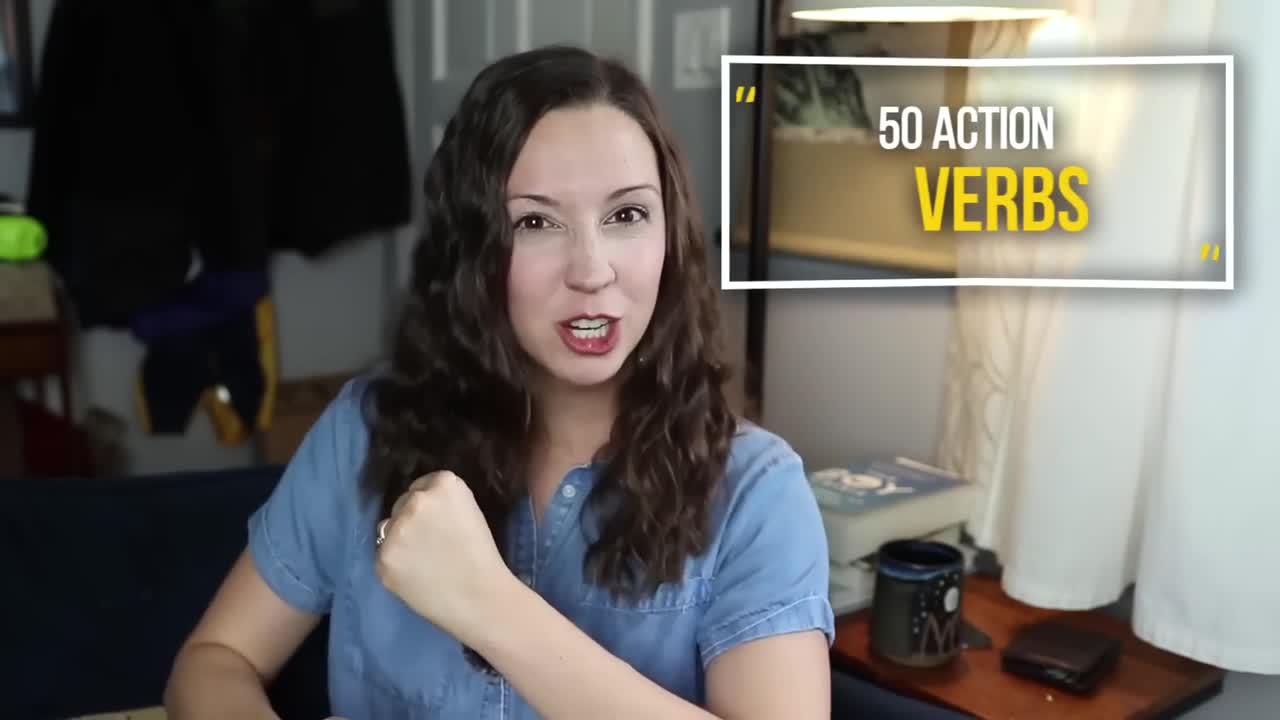
Today, I'm going to help you learn 50 action verbs for daily life around the house.
We're going to talk about 10 verbs in the living room, 10 in the kitchen, 10 in the office, 10 in the bedroom and 10 in the car.
Are you ready to get started?
Let's do it.
To help you never forget what you learned.
Today you can download the free PDF worksheet that I've created for today's lesson, with all 50 verbs, all of the sample sentences and tips that I talk about today.
You can click on the link in the description to download that free PDF and also answer Vanessa's challenge question at the bottom of the PDF.
Let's get started with the first 10 action verbs in the living room.
I chill on the couch at the end of the day.
I chill on the couch at the end of the day.
I look for the remote.
I look for the remote.
I give up and read a book.
I give up read a book.
I doze while I read.
I doze while I read.
I
Bonk my head on the couch.
I bonk my head on the couch.
I greet my husband.
Hi.
I greet my husband.
Hi.
We chat about the day.
We chat about the day.
So what did you do today?
Well, today I convinced my husband to rub my back.
I convinced my husband to rub my back.
Okay.
I thank him for helping me.
I thank him for helping me.
Thanks.
You're welcome.
What's that sound?
I think it's the washer.
Could you fix it?
Okay.
Well, he's going to fix the annoying squeaking sound.
He's going to fix the annoying squeaking sound.
Thanks, hon.
So, let's get started with 10 common verbs in the kitchen.
I turn on the hot water.
I turn on the hot water.
I pour the hot water into my mug.
I pour the hot water into my mug.
Then I add some cream to my tea.
I add some cream to my tea.
Then I squeeze in some honey, just a dot.
I squeeze in some honey.
And the last step is I stir my tea.
I stir my tea.
I wanna make sure that the cream and the honey are all mixed in.
I stir my tea.
Next, I toast my bread to make toast.
Actually, I don't have any bread in the house.
I only have pitas, but you know what?
It'll work.
Notice how we can use to toast as a verb and a noun.
I'm going to toast my bread and it will make toast.
Now I have toast, so I'm going to spread the butter on the toast.
I'm going to spread the butter on the toast.
Well, I didn't have any bread and I don't have much jam, so I'm going to scrape the jam from the jar.
Scrape the jam from the jar and look, I found some.
So I'm going to put it on the toast.
I'd like to eat some scrambled eggs, so I need to crack The egg into the bowl.
Crack the egg into the bowl.
Uh-oh.
Now I need to fish out a piece of the shell.
Fish out a piece of the shell.
Okay, now we're fine.
And now I scramble the eggs.
I scramble the eggs.
As some of you know, I have eight chickens that live in my backyard, but unfortunately we are only getting one egg a day because they're too young to lay eggs.
Hopefully they will start laying more eggs soon.
So we still need to buy eggs from the store, but I'm going to scramble the eggs from the store and eat them.
Now my eggs are finished and the final touch is I grate some cheese onto the eggs.
I grate some cheese.
Notice that this is spelled different than grate.
This is spelled G-R-A-T-E.
I grate some cheese onto the eggs, and that will make a wonderful breakfast.
Tea, toast, and eggs.
What about you?
What do you like to eat for breakfast?
Are you ready for 10 verbs in the office?
Let's do it.
I check my email.
I check my email.
I send a message to a student.
I send a message to a student.
I reply to an email.
I reply to an email.
I plan my lessons.
I plan my lessons for you.
I schedule a meeting.
I schedule a meeting.
Notice that the beginning of this word sounds like S-K, sk.
I schedule a meeting.
I schedule a meeting.
I scroll through the webpage.
I scroll through the webpage and I click on a link.
I click on a link.
I download the free PDF.
I download the free PDF.
I upload a new video.
I upload a new video.
Before I close the file, I save the file.
I save the file.
Next, let's talk about 10 verbs in the bedroom.
I stretch my arms.
I stretch my arms in the morning.
I yawn when I'm sleepy.
I yawn when I'm sleepy.
In the US, it's polite to cover your mouth when you yawn.
Is this the same in your country?
I go to bed around 10 p.m.
I go to bed around 10 p.m.
I lie down in bed.
I lie down in bed.
I don't snore when I sleep.
I don't snore when I sleep.
Do you snore?
I toss and turn when I can't sleep well.
I toss and turn.
Notice that this expression uses two of pretty much the same words, to toss and to turn.
They both have the same meaning, but we use them together in this verb.
I toss and turn when I can't sleep.
I oversleep when I forget to set my alarm clock.
I oversleep when I forget to set my alarm clock.
I have to rush now so that I'm not late.
It feels so good to sleep in on the weekends.
It feels so good to sleep in on the weekends.
But I have kids, so the reality is that I never sleep in.
Do you sleep in?
Notice the difference between oversleep and sleep in.
Oversleep is always negative.
Maybe you're gonna be late for work.
You probably forgot to set an alarm clock.
Something bad is gonna happen because you slept for too long.
But when you sleep in, it could be positive or negative.
I slept in and then I was late for work.
But it could be positive too.
I love to sleep in on the weekends.
Not a negative thing.
It just means that you can relax and you don't have anywhere to be.
I hope you get a chance to sleep in sometime.
I lean against the pillows to read.
I lean against the pillows to read.
To read a good book.
If you would like any of my book recommendations children's books, books for beginners, books for nonfiction readers.
There's a link in the description of this video to my Amazon shop where I have different pages where you can see my top book recommendations, including this book for kids, Brown Bear Brown Bear.
What do you see?
I fling off the covers because I'm late for work.
I fling off the covers because I'm late for work.
I gotta go.
Now let's talk about 10 verbs in the car.
First of all, I open the car door.
I open the car door.
Come on inside.
Now that I'm in the car, I buckle my seatbelt.
I buckle my seatbelt.
And because I'm the driver, I need to adjust my seat and the mirror.
I need to adjust the seat and the mirror.
And now I start the car.
Or we can say I start the engine.
I start the car, I start the engine before I start to drive.
I back out of the driveway.
I back out of the driveway.
To go faster, I accelerate.
That means that I push the acceleration.
That is the pedal that helps me to accelerate.
I accelerate.
And when I get to a stoplight or a stop sign, I need to push the brake or we can use the verb to break.
I break the car.
This doesn't mean that I break the car.
Notice the difference in spelling.
I break or I break the car.
I am not the Hulk.
I cannot break the car, but I can break the car.
When I want to turn, you must use your turn signal, but we use a great verb for this, which is to signal.
We can use it as a verb or a noun.
I signal with my turn signal so that other drivers know where I'm going, and it's much safer that way.
I signal with my turn signal.
And if someone is an awful driver, I honk the horn.
I honk the horn.
When I see my friend, I roll down the window to say hi.
Hi!
I roll down the window.
Now a while ago, cars used to have something where you really rolled down the window, a handle that you turned.
Now that there's just a button, we still use the same verb, to roll down the window.
So there you have it 50 verbs that you can add to your daily life vocabulary and be able to express yourself completely.
Don't forget to download the free PDF worksheet for today's lesson so that you can review everything that you've learned.
Never forget it.
You can download it, print it, Put it under your pillow when you sleep.
Use it as much as you want.
I hope that the free PDF will be useful for you.
You can click on the link in the description to download that free PDF.
Now, I have a question for you.
Were any of these action verbs in this lesson new for you?
If there was something that was new for you, try to use it in the comments.
This is a great way to be able to remember what you've learned.
I can't wait to see what you have to say, and thank you so much for learning English with me.
I'll see you again next Friday for a new lesson here on my YouTube channel.
Bye.
The next step is to download the free PDF worksheet for this lesson.
With this free PDF, you will master today's lesson and never forget what you have learned.
You can be a confident English speaker.
Don't forget to subscribe to my YouTube channel for a free English lesson every Friday.
Bye.