Ted Audio Collective.
You're listening to Ted Talks Daily, where we bring you new ideas to spark your curiosity every day.
I'm your host, Elise Hugh.
In this time of war, invasions, and global threats like climate change, understanding international relations is vital.
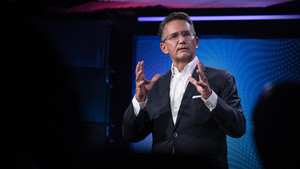
Today, geopolitics navigator, Nicolaus S.
Lang, lays out what he believes is the likeliest scenario for the modern world of the future, and what it means for companies that operate globally.
It's all coming up after a break.
And now our Ted Talk of the Day.
Have you been sleeping for the last 30 years?
Well, if we believe former Polish Prime Minister, Matthias Morjaweczy, we all have been napping since the early 1990s.
At least geopolitically speaking.
Why? Well, join me at the Munich Security Conference, one of the world's foremost conferences on national security and defense, on the 19th of February, 2022.
Five days before the Russian full -scale invasion of Ukraine, with 190 ,000 soldiers waiting at the border, leaders such as Kamala Harris, Ouzola van der Leyen, Anthony Blinken, and Volodymyr Selinski are discussing the future of war and peace in Munich.
In this unique historic and tense situation, Prime Minister Morjaweczy urges the world to wake up from years and decades of geopolitical napping.
So you will get a wake -up call.
In fact, when we look at our realities, personal, business, political, we see the outsized impact of geopolitics on all our lives.
Now, what is interesting is that while companies are struggling with the challenges of AI revolution, of high interest rates, of labor shortages, of climate change, they tend to overlook geopolitics.
Luckily, I think that we have a window of opportunity to really up our game, to develop what I call the geopolitical muscle.
No worries, I have no shares in any gem chain, but I think that developing a geopolitical muscle, meaning having the possibility to understand the challenges and the navigation of new realities is key.
Now talking about new realities, I lead the BCG Henderson Institute and BCG's Center for Geopolitics.
And in this role, I have spoken over the last two years with 500 CEOs, executive committees, and boards around the world, literally from Southern Chile to Northern Japan.
In these discussions, my counterparts ask me, Nicholas, how will the world in the 2030s be?
How is our future? Well, I'm not an oracle, but I like to work with scenarios.
What are scenarios?
Scenarios are images of the future.
And you know what's really beautiful about scenarios?
They are precisely wrong, but generally right.
So what's the most favorite scenario all over the world?
From Southern Chile to Northern Japan.
It's a scenario which we call Back to the Future.
It's actually the world of the 1990s, the early 2000s, time where democracy was prevailing, free trade was flowing, international organizations like the UNWTO, World Bank were functioning.
And of course, many of us grew up in this period.
So no wonder that we want to be in a scenario like this one.
But I have bad news for you.
This scenario is very unlikely.
Then there's other extremes.
People saying, we will end up in a global escalation of conflicts.
We have seen huge conflicts with huge humanitarian toll and macroeconomic impact in Ukraine, in the Middle East, in Sudan.
And we see here obviously the worry of these people to say, well, will we see a proliferation of conflicts?
Notably in the Indo -Pacific.
Which will lead to an economic Armageddon?
Well, here, I tend to be slightly more optimistic.
And I believe that this scenario of global escalation, notably because of the deep interlinkages in the Indo -Pacific, political and economic, is not likely to happen, at least in the short to medium term.
So now you will ask me and say, Nicholas, okay, so no back to the future, no global escalation.
So what's happening?
Well, I think the most likely scenario for the 2030 is the multipolar world.
What does it mean? Well, since 1945, we had a world that was dominated by one or two superpowers.
I believe that the 2030s, we see many powers, many spheres of influence.
And let me go through a few of them.
And now back to the episode.
First, there is what I call the Western block, United States, Europe, allies in North America, allies in Asia Pacific.
This block is characterized by democracy and market economy.
This block is collaborating technologically in topics such as AI, renewables, Medtech and so on.
Even militarily, this block has evolved.
We have seen the re -evacining of NATO as a response to the war in Ukraine.
And the US has developed a very interesting network of alliances in the Asia Pacific, including countries such as Japan, Korea, India, Australia and others.
Under interesting acronyms such as AUKUS or QUOT.
Then there is a second block, which I describe as the new Eastern block.
And that's actually China and Russia growing together with countries such as North Korea and Iran joining this block.
The economic reality is that Russia is pumping gas into China via pipelines with the name Power of Siberia 1.
And China is sending cars to flood Russian roads.
But also technologically, this block is trying to become independent, be it space exploration, semiconductors and so on.
The most interesting part of it is that technologically and militarily, this block is going to a completely different level.
If you see the Iranian kamikaze drones in the skies over Kiev, or the joint naval drills of the Iranian, the Russian and the Chinese navies in the Gulf of Oman March of this year, military cooperation has become reality.
And then there's a third block and I don't call it block, I don't want to call it block because I think it's more of a grouping of countries where we have a series of middle powers, regional powers, such as India, Indonesia, the GCC countries that are playing a role of staying in balance between those
two blocks. These countries have huge assets, be it natural resources, abundant talent, interesting geographical position.
And they leverage these assets to develop a non -aligned path between the two other blocks.
And they develop spheres of influence across Asia, Africa, the Middle East and Latin America.
So we are in this multipolar world.
What does this mean for companies and corporate leaders?
Companies and corporate leaders need to navigate and they need to develop a geopolitical muscle.
Remember, corporate workout.
So let me go through five exercises that companies need to do.
First, build resilient supply chains.
The operating model where you used to have a large factory at the lowest possible cost location on earth is dead.
We have seen how pandemic war and tariffs are destroying supply chains overnight.
The new reality is you need to have a network of small factories all over the world.
You need to have flexible supply chains that are able to respond to external shocks.
Exercise two, prepare for continued inflation and price volatility.
I know no one wants to hear it, but I think the current discussion of price cuts is interesting.
But the reality is that the cheap money of the 2010s is gone.
Much more real is a continuous inflationary pressure we will see through geopolitical shifts, increased military spending and the cost of energy transition.
So companies need to prepare in their investment and pricing decisions how to handle this continued inflationary pressure and pricing volatility.
Third, design your organization for a fragmented world.
The time where you were handling a company and a multinational company from one headquarter is gone.
In a world, in a multipolar world, where you have different economic systems, political ideologies and technical stacks, you will need to set up your company as a collection of regional command centers that are agile and independent and can perfectly adapt to the new realities.
Fourth, prepare for cybersecurity.
In a multipolar world where AI and asymmetric warfare are likely to become the new normal, companies need to prepare for cyber attacks, both on a system level, but also on an employee level and a culture level.
Fifth, and this is the core of it, develop the geopolitical muscle.
So what is it? It's about talent, it's about decision -making and it's about leadership.
Talent. Companies need to hire and develop talent that is able to sense geopolitical shifts, that is able to think in scenarios, that is able to redesign supply chains, that is able to define new strategies.
Second, decision -making.
While investment decisions and project decisions and strategies need, of course, to consider dimensions in finance, in legal, and HR, it is critical to inject a geopolitical perspective in the way how you make decisions.
And last on leadership, let me dream a little bit.
I still think that managers continue to be good managers, but I would hope that their decision is also influenced by the way how historians, economists, and politicians decide and think in order to pivot their strategies to the new realities.
So let me conclude this wake -up call with a simple alternative.
Either you continue with your geopolitical napping, or you build your geopolitical muscle.
Thank you very much.
Thank you. That was Nikolas S.
Lang at TED at BCG in 2024.
If you're curious about TED's curation, find out more at TED .com slash curation guidelines.
And that's it for today.
TED Talks Daily is part of the TED Audio Collective.
This episode was produced and edited by our team.
Martha Estefanos, Oliver Friedman, Brian Green, Autumn Thompson, and Alejandra Salazar.
It was mixed by Christopher Faizi -Bogan.
Additional support from Emma Toppner and Daniela Vallerezo.
I'm Elise Hugh, I'll be back tomorrow with a fresh idea for your feed.
Thanks for listening.
PRx.