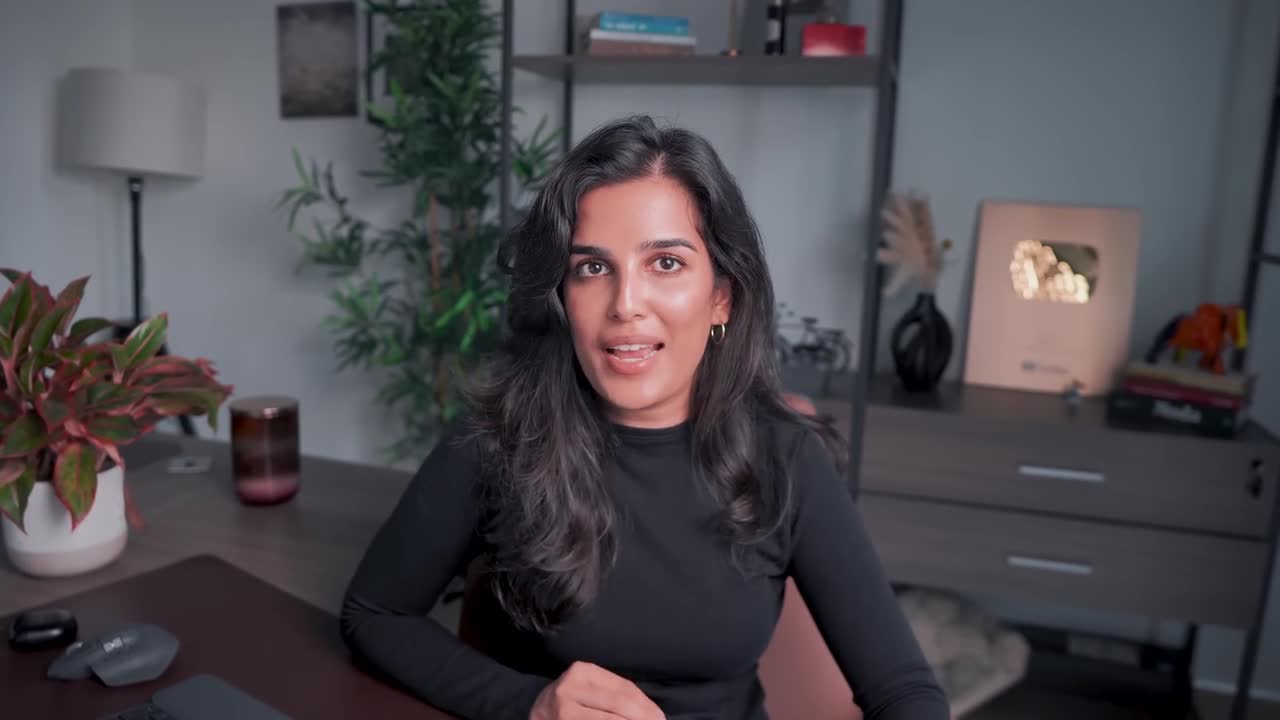
A year ago, my days looked full.
I was busy from 7am to 10pm.
Emails, calls, filming, admin, research.
But when I actually looked at what I'd built at the end of each month, it did not match the effort.
And I spent nearly a decade in banking, working like that.
And I thought that's just what hard work looked like.
Then I made five tiny changes.
None of them were revolutionary.
None of them required an app or a course or a 5am alarm.
Together they completely changed how I spend my days, and that changed how quickly everything else started compounding.
Let me start with the one that felt the most counterintuitive, especially as someone who makes content for a living.
And that is, I stopped consuming so much content.
Not completely, I just put a harsh cap on it.
And that one change gave me back more time and focus than any productivity system I've ever tried.
My mornings used to start with reading the financial news, watching other creators' videos podcasts, in the background, whilst I was doing something else.
And I justify it all by telling myself I was staying informed.
By the time I actually sat down to do work my best, most focused energy was already gone and my head was full of other people's ideas.
So I changed one thing.
The input into my brain now has windows of time.
There are specific times in my day where I'll read, where I'll watch, where I'll catch up, and it's only after I've done my own work.
So no listening to new podcasts first thing in the morning, unless it's directly tied to the work that I'm about to do or motivates me to get started.
No watching new YouTube videos before I filmed my own because, after a while, consuming more advice becomes a substitute for acting on the advice you already have.
It feels productive.
But then the day goes past and nothing actually moves.
That was a trap I was in for a very long time.
Every extra hour of input was just delaying the one thing that would actually change my position, which is doing the work.
And what made it even harder to break was that this habit felt productive.
It was ingrained from my banking days, where the first hour of every morning was just news markets updates.
So stopping that felt wrong.
But the moment I did stop, my mornings became more focused.
I was finishing more by 10 am than I used to by lunch and I suddenly had time.
I didn't even realize I was losing.
But then I had to figure out what to do with that extra time.
And that's where the second change comes in, and it is embarrassingly simple.
I call it the single priority.
You've probably done this before. and it was my default for a very long time.
I'd sit down in the morning, I'd write down everything I need to do and I'd skip straight past the one that actually mattered.
I'll do it after lunch, I'll tell myself, and then lunch would come and I'd find five smaller things to tick off first.
And weeks later, that same task was still there.
But that was the one task that usually was more valuable than everything else combined.
Then I came across something called the Ivy Lee method.
And that is when it clicked.
Back in 1918, a consultant named Ivy Lee was asked by Charles Schwab how to get more done.
His advice?
Super simple.
Write down six important tasks.
Rank them in order of importance.
Start with number one and don't move on to the next task until that task is finished.
That was it.
A few months later, Schwab paid him 25000 for that advice, which is nearly half a million in today's money.
So I took this and I stripped it down even further.
Not six tasks, just one.
I call it the single priority.
Every day, before I even open up my emails, I write down one thing.
If that one thing gets done today, that day counts.
Today, it was script and film this YouTube video.
Every single day, it either has a priority or it doesn't.
The list of things will always exist, but always ask yourself what's one thing that will actually move my life forward, that will actually make a difference if I do it or not.
That's not done by an accident.
That is done by serious intention.
The third change was arguably the hardest one for me on the list, and I call it the ugly first draft.
I spent nearly a decade and in banking, especially early on my career.
Nothing leaves your desk until it's been reviewed four times, until it's been spell checked, sense checked, approved by a senior, then approved by their senior.
Polish was the entire job.
So when I left banking and started building my own thing, I brought that same standard with me and it nearly killed the whole thing before I started.
I spent entire days on things that never went anywhere.
I'd rewrite an email four times before I sent it.
I'd delay a video for one more edit pass before it went out.
I'd sit on an idea for months because I hadn't accounted for every variable.
And the days I worked the hardest were usually the days that nothing actually went out.
And the worst part is perfectionism, it doesn't look like procrastination.
It looks like effort.
It looks like care.
It looks like we have high standards, which is why most people don't even realize that they're stuck in it.
From the outside, you look productive.
You look thorough.
Really, nothing is moving.
And the founder of LinkedIn, he has this line that I think about a lot.
He says, if you're not embarrassed by the first version of what you build, you launched it too late.
The whole point of version one isn't that it's good, it's that it exists.
Because once it exists, you can learn from it.
You can hear what real people actually using it think.
You could fix it.
But until it exists, you've got nothing.
You're just polishing something that nobody has seen, based on your interpretation of what's good and what's not.
Then i changed the default.
My first youtube video was extremely rough.
The lighting was off.
I wasn't happy with the way i was saying or explaining certain sentences.
I was mixing up my words.
It took four hours to record a five minute video, but i uploaded it anyway because at some point i realized that another week of editing wasn't going to change my life.
But publishing, putting it out there, might
And the only reason why any of my videos since got better is because that first one existed for me to learn from.
And now I apply a similar concept to a lot of areas in my life, including something that I'll talk about later on.
That might use me some credibility.
But my point is if you think about it, what's the one project that you've been polishing for three months that nobody has even seen yet?
And then ask yourself would it be more valuable if you just got it out and refined it whilst it was live?
Because the thing you actually get out and share is the only thing that you can get other people to react to.
And well and truly, you learn by doing.
The fourth change is what I call close the loop.
And this one completely changed the amount of mental space I had, because what I used to do was say yes to almost everything in the moment and then figure out how to say no later on.
So someone would invite me somewhere that I knew I didn't really want to go to.
I'll say oh, let me check and come back to you if there was a partnership opportunity that i knew wasn't right.
I'll say oh, let me circle back, and at the time that felt polite, it felt thoughtful, it felt like the nice thing to do.
But what i eventually realized is that every maybe stays open in your mind and open loops.
They're exhausting, because now, instead of an uncomfortable conversation that lasts two minutes, you carry that decision around for a week or so.
You think about it randomly in the shower or whilst you're working or before bed, and or you forget about it and leave the other person hanging.
And neither of those is kind on the other person either, because now they're managing uncertainty too.
The most respectful thing you could do to someone is be really direct and just say no.
Say, I'll get back to you next week.
I really do believe being direct and letting someone down is nicer than blurring the lines and not letting them know where they stand.
So now I've changed the default.
There's no, I'll get back to you next week.
It's a very clear answer sent as soon as I see the message or the email.
And weirdly it made me respect my own time more, because five pending maybes don't look stressful on paper, but mentally it can feel heavy.
You feel overwhelmed without really knowing why.
And protecting your time isn't just about productivity and what you do physically.
It's also about closing mental tabs too.
And the next one which might make me lose some credibility as an accountant, And that is I don't track every purchase.
I don't budget weekly.
I don't have a spreadsheet open judging me in the background 24 seven.
I just look at my money once a month for 20 minutes.
That is it.
I call it the 20 minute audit.
And I know how that might sound from someone who spent years in finance.
But what I realized is there are really only two ways most people relate to money.
Either they obsess over it they check their accounts every morning, they track every coffee, they react to every market dip like it's personal or they completely avoid it and they don't open their bank account app for weeks.
They're not sure what accounts they have.
They leave the financial decisions piling up in the background.
Both camps probably think that their version is better, but they're both spending constant mental energy on money without necessarily improving it.
And you might think the person who's meticulous about their finances is improving it.
But actually there's a study that found that people who check their finances too frequently tend to make worse long-term decisions because every small fluctuation it feels really urgent.
The more often you look at it, the more often you react.
So now what I do once a month, one evening, 20 minutes.
That's how much I spend looking at that month's finances.
And if you're someone who is really looking to get out of debt or you're really looking to save more money, I highly highly recommend using a manual tracker for this.
The exact one that I used when I was trying to fast track my savings, I've linked below.
It's completely free.
You can also grab it on nisha.me forward slash tracker.
It comes with a video description on exactly how to use each of the columns and also the most common mistakes people make when using a tracker and how you can avoid them.
So the question for you is are you checking your money too much or not enough?
Because both are likely costing you not financially but mentally.
Your money doesn't need constant attention.
It just needs the right kind of attention.
And that is it.
Those are five changes.
But there is one system I haven't shown you yet, and it's the actual financial framework that makes all of this compound into real money.
And that's in this video you see right here.
Thank you so much for watching and I'll see you there.