When voters talk during an elections season, we listen.
We ask questions we follow up, and we bring you along to hear what we learn.
Get closer to the issues that people and your vote at the NPR Elections Hub.
Visit npr.org slash elections.
You're listening to LifeKit.
From NPR. Hey everybody, it's MaryL.
I think if my dread could talk, she would sound kind of high-pitched.
Like it would be just like a buzzzy little bee.
You know what next to my ear?
Oh I love that. I love that.
It's so distinct because in my head my dread is actually if I do a voice it's like, Hey Seleme, you're probably gonna mess this up.
I'm talking to Seleme Rushamwalla, and we're not just acting out our dread for fun, although it is kind of fun.
Yeah, and mine would be like, you know you're probably gonna mess this all up.
I'm like, go away. Very carcassly pairing, yeah.
Seleme is the host of more than a feeling, a podcast that dives deep into emotions, and he's doing a whole series about the feeling of dread.
So, in this episode of LifeKit, I talked to Seleme about how we can all dread better.
Support for this podcast and the following message come from Wise, the app that makes managing your money in different currencies easy.
With Wise, you can send and spend money internationally at the Mid Market Exchange rate.
No guesswork and no hidden fees.
Learn more about how Wise could work for you at Wise.com.
It's a high stakes election year, so it's not enough to just follow along.
You need to understand what's happening so you are fully informed on November.
Every weekday on the NPR Politics Podcast, our political reporters break down important stories and back stories from the campaign trail.
So you understand why it matters to you.
Listen to the NPR Politics Podcast, wherever you get your podcasts.
In this country, some truths aren't self-evident.
An NPR's Black Stories Black Truth.
The collection of stories is wide-ranging and real.
It's the people who tell them we celebrate the Black experience for all its soul and richness.
Search NPR Black Stories Black Truths wherever you get podcasts.
This election season you can expect to hear a lot of news.
Some of it meaningful, much of it not.
Give the up-first podcast 15 minutes, sometimes little less, and we'll help you sort it out what's going on around the world and at home.
Three stories, 15 minutes, up-first every day.
Listen every morning wherever you get your podcasts.
One quick note before we jump in here.
We're about to share a lot of ideas and exercises, but these are in no way a substitute for working with a mental health professional.
If you or someone you love is struggling with difficult emotions, we want to remind you that the suicide in crisis lifeline is available 24 hours a day.
Just dial 988 to connect directly with support.
That's 988. So the Dread Project started when Selim and his show got an email from a listener who was thinking about the concept of Dread.
It makes me wonder how many of us there are and if everyone feels it and just doesn't talk about it, or is it an anomaly to wake up in the middle of the night feeling like you fall into the endless space between stars?
I wonder if Dread is a universal feeling, or if it's different for everyone.
Is it fear writ large and strange or something else?
Yeah, so that's a great point.
I feel like Dread is when you say, you know, I just really don't want to do this thing.
Yeah, you know, we've been thinking about it like fear plus time.
So, you know, if there's a spider right in front of you and you have an action you can take, you can run out of the room.
That's not really something you're dreading down the line.
But if somebody was like, there's going to be a spider in the room with you in 10 minutes.
Oh my god. You really don't want that to happen.
And that's something in the future.
You might build up a whole story in your head.
You feel like excited about it.
But you also, in the moment, might feel like you can't do anything about it.
So, yeah, all those Dreads that are anxieties or fears about the future are what we've been diving into.
It does feel like underneath Dread are a lot of other feelings or reasons for it, right?
Yeah, like a lot of emotions.
There's all these other emotions kind of riding around it and it could be so many different things.
There's like the Sunday scaries of not wanting to go to the office of Budday or take a Zoom call on Monday morning as it is now.
The kind of worries about the holidays, the worries big picture, like about the climate.
There's a lot of things that can cause Dread and a lot of them have a ton of other accompanying feelings with them.
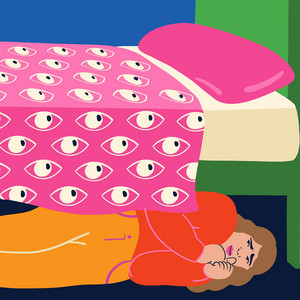
I wonder what does Dread actually look like?
Like how does it show up in people's lives?
I love that question because I've been straight up asking a bunch of people what Dreads looks like to them and people describe it as kind of a cloud.
A lot of times hanging over them.
Getting up in the morning and having to deal with whatever problems that Dreads is going to bring.
An impending sense of doom.
It's not the distant future that scares me as much as the immediate tomorrow scares me.
And as far as what they feel, it can be a full range of things.
A lot of them are sort of similar to what you might think of with anxiety.
I dread communicating how I feel.
Oh God. What's going to happen in the future?
What if I don't have a job at all?
People avoid the thing that they are dreading.
And then in their body themselves, they might be feeling almost like a pressure in their chest or sweaty palms or one person we interviewed talked about how it just makes them want to go to sleep and take a nap, which I could really relate to.
So we started talking to a lot of other people about it.
And it really was a recurring theme that there's something like a dread pockleps right now.
People are feeling dread from so many different sources.
So we decided to do this new thing for us, which is releasing five episodes over the course of five days.
Each one with a different action that people could actually take, could actually try out and try to do.
There are each different little ways to manage dread you might be feeling.
Okay. Well, the first one is writing about it, right?
What is the prompt itself or like what are you supposed to write?
So there's a lot of different ways to approach this.
What clinical psychologist and poet, Hala Alihan walks us through is actually an imagined dialogue with dread where you pretend to be your dread and think about what your dread might say to you, how it might describe itself.
And the idea is to kind of humanize that feeling and turn it into a bit of a person itself.
Something about writing can help you keep a thought from looping.
Like you're probably not going to write the same sentence again and again and again.
You get it out of your head and it's on a page.
You know, it was interesting talking to a poet about it.
She mentioned writing a bit about what your fearing or dreading allows you to see it as something outside of yourself and not equal to yourself.
Here's clinical psychologist and poet Hala Alihan.
If I write a poem, there's an element of me in that poem.
I've engaged in that poem.
I've helped bring it into the world.
But that poem does not contain all the multitudes of Hala, right?
It's not all Hala. And so I think there's something about that that helps people.
So is she saying that you should really try writing a poem?
I mean, not everybody's a poet, but it seems like another prompt.
I'm just envisioning writing a haiku or something about my dread.
You know, or like a limbic.
To me, if that structure helps you get it out of your head and makes it easier to get it on paper, I would totally go with a haiku or a limbic or anything you could do to get it out onto paper.
She's not actually saying that you have to write a poem, but you're really completely welcome to.
Yeah, I think especially something that rhymed.
Like if I could make my dread a little funny, you know?
Oh, I would love for you to write this and post it online.
I really want to read your dread poem.
Okay, I'll come up with something.
So that's one day of the series is putting your dread into words.
What's next? So we found someone who told us about a technique that actually involves zero words.
And that's drawing or for most of us kind of doodling your dread.
Hmm. I'm going to have to ask, do you have to be good at this because I am the worst at drawing.
I'm really bad at it. The person we were talking to is clinical art therapist Naomi Cohen Thompson.
And I asked, I was like, can I get stick men in here?
Can I, you know, I'm just big pen and lie notebook paper scribble?
Is that going to be okay?
And it totally, totally was.
Oh, good. And yeah, one of the benefits of drawing is you actually turn off your analyst.
You're analytical mind for a bit.
You know, you don't have to constantly engage with the kind of intellectual thinking through of a feeling.
I think that's exhausting.
So if you use something like drawing or painting or whatever it is, it allows you to kind of have that time to decompress of it.
Yeah, that makes a lot of sense.
So, okay, what does your dread look like?
So during the call in Naomi, I actually had to draw my own dread very rapidly.
And it looked like this.
Dread is these little beasts underground lurking beneath the sometimes happy things we're doing.
The idea that all of this exists like kind of underneath and nobody can see it.
Like I have a feeling that a lot of people manage to like make it work and muscle through and smile.
And nobody ever knows that they're actually feeling a fair amount of fear.
I'm picturing the beasties are like how I would draw them being really bad at this would be like little spiky balls.
Like they would have eyes and they'd be like, like can you see what I'm doing?
That's really close. Like the eyes and like, rawr, like kind of mouth.
And I'm like, I'm just like, I'm just like, I'm just like, I'm just like, I'm just like, I'm just like, I'm just like, I'm just like, I'm just like, I'm just like, I'm just like, I'm just like, I'm just like, I'm just like, I'm just like, I'm just like, I'm just like, I'm just like, I'm just like, I'm just like, I'm just like, I'm just like, I'm just like, I'm just like, I'm just like, I'm just like, I'm just like, I'm just like, I'm just like, I'm just like, I'm just like, I'm just like, I'm just like, I'm just like, I'm just like, I'm just like, I'm just like, I'm just like, I'm just like, I'm just like, I'm just like, I'm just like, I'm just like, I just like, I'm just like, I'm just like, I'm just like, I'm just like, I'm just like, I'm just like, I'm just like, I'm just like, I'm just like, I'm just like, I'm just like, I'm just like, I'm just like, I'm just like, I'm just like, I'm just like, I'm just like, I'm just like, I'm just like, I'm just like, I'm just like, I'm just like, I'm just like, I'm just like, I'm just like, I'm just like, I'm just like, I'm just like, I'm just like, I'm just like, I'm just like, I'm just like, I'm just like, I'm just like, I'm just like, I'm just like, I'm just like, I'm just like, I'm just like, I'm just like, I'm just like, I'm just like, I'm just like, I'm just like, I'm just like, I'm just like, I'm just like, I'm just like, I'm just like, I'm just like, I'm just like, I'm just like, I'm just like, I'm just like, I'm just like, I'm just like, I'm just like, I'm just like, I'm just like, I'm just like, I'm just like, I'm just like, I'm just like, I'm just like, I'm just like, I'm just like, I'm just like, I'm just like, I'm just like, I'm just like, I'm just like, I'm just like, I'm just like, I'm just like, I'm just like, I'm just like, I'm just like, I'm just like, I'm just like, I'm just like, I'm just like, I'm just like, I'm just like, I'm just like, I'm just like, I'm just like, I'm just like, I'm just like I'm just like, I'm just like, I'm just like, I'm just like, I'm just like, I'm just like, I'm just like, I'm just like, I'm just like, I'm just like, I'm just like, I'm just like, I'm just like, I'm just like, I'm just like, I'm just like, I'm just like, I'm just like, I'm just like, I'm just like, I'm just like, I'm just like, I'm just like, I'm just like, I'm just like, I'm just like, I'm just like, I'm just like, I'm just like, I'm just like, I'm just like, I'm just like, I'm just like, I'm just like, I'm just like, I'm just like, I'm just like, I'm just like, I'm just like, I'm just like, I'm just like, I'm just like, I'm just like, I'm just like, I can accept that they're there, but I can also focus on what's in my control here.
That seems to be the most effective way to overcome death.
I'm death things I'm not death itself.
That would be that. That would be that.
Definitely call me. There are a lot of different ways that people have approached death meditation and allowing one to think actively about death instead of it being a passive fear.
One really simple one that we talk about in the episode is just taking a moment to look around you and notice all the objects that had a life and died.
So for me right now, that's a sound of me knocking on a desk that was once a tree.
I see some paper that was once trees.
When you start looking around, you might notice the cloth in your clothes used to be a plant.
It used to be a plant. It started hitting you like, oh, this is a cycle that's happening all the time around me.
Yeah. Well, how often do I have to do this?
That's a great question.
I would emphasize the idea is that you could actually schedule time that you're doing this.
Talk to Dr. Ali Mato from the psych show.
He talked specifically about the benefit of carving out worry time.
These aren't activities that you have to constantly be doing all day.
You can actually schedule into your calendar when you want to, for example, worry.
The first thing you want to think about is what is a time and place where I can open up Pandora's box a little bit where I can open this up and be able to deal with the consequences.
I would do this sometime where you've got a little bit of flexibility that you can sort of deal with the elevated anxiety that's going to naturally come about from it.
The other beauty of this is your next worry time you look back at what you wrote down.
And sometimes you're like, that's what I was worried about.
Oh, man, guess I didn't have to be worried about that thing.
Hold on a minute. Are you telling me that I'm not supposed to worry right before that I'm not supposed to lay in bed for an hour?
Tossing and turning before I fall asleep and thinking about every mistake I've ever made in everything that I'm going to have to do in the next six to 12 months.
I would just say that Dr.
Ali Batou is offering us this other option, which is scheduling dread, picking a time to actually actively worry, gives your mind the freedom to be like, cool, I'm definitely going to process that.
I'm definitely going to dive into that.
Just not right now. Okay, so it feels like we've been talking about dread that is super personal and existential.
But then there's also this big universal existential dread that hits a lot of people, for instance, about climate change.
There's actually a name for this dread around climate change.
Some people call it eco-dread.
And it is one of the most overwhelming emotions that listeners were struggling with and talked to us about.
We talk to a somatic therapist named Patricia Adams.
One of the things she does is help listeners understand that the environments immediately around them can help them build up emotional resilience.
Ecosyropy to me is the idea of embracing our relationship to nature, or sometimes it's called the more than human world, to understand ourselves as part of it, as not separate from it.
There are some really healing and soothing things that just happen to our physiology, you know, like those systems in our bodies, the physiology that respond favorably to looking at beautiful trees as they just do.
Beautiful trees as they change colors in the fall or to hearing the sounds of birds or to smelling plants.
There's just all these sensory ways that we don't even have to have an intellectual relationship to it.
Just our bodies know what to do with that information.
So when we go and connect with nature, even if it's one minute on our back porch feeling the sun and looking at our potted plant, it literally invites us to slow down in a way that is actually medicinal is actually an antidote to some of the overwhelm.
Okay, yeah. So it sounds like just being in nature and remembering that we are a part of nature in our environment is one way to be a little more at peace here, right?
Yeah, and you know, not everyone's right next to a forest or a stream, but she had this really specific tip, this thing she calls sunset bathing that is really accessible.
And it's a good time of year for it.
Sometime around sunset, if you can go outside just for like literally a minute 30 seconds, it doesn't matter how long, the longer the better probably, but not if that's an obstacle.
To me, it's about reconnecting with the rhythms of the natural world, which then hopefully stimulates this idea of meaningful action, right?
What you love you serve.
Being in nature, according to Arilia and other folks, we talk to kind of moves you to an observation of the positive things that still exist.
She mentioned finding assets, not deficits everywhere she goes, finding ways to connect with nature, and how seeing those assets instead of deficits is both calming, brings you connection and makes you more likely to take action.
If people walk away from this series with one idea, what would you want that to be?
Yeah, and one of the conversations I had with Dr.
Alima too, he was just kind of playing with the ideas we were chatting out loud that sometimes he thinks of action in some cases as the opposite of dread, you know, just finding some way to take a small action can make you feel less overwhelmed.
That was just a recurring theme in the conversation we had.
It's not to say that like, oh, you got to flip this switch and you can't dread anything now.
You got to be super happy and jolly even though there's all this terrible stuff.
So it was more about finding little tools that help us get those pieces of joy, these pieces of distance from our problems, and getting a little space to think and process and be alive.
So, Alima, thank you so much.
This has been such a fun conversation about dread.
No less. I know. I know. I'm telling you what you get talking about it.
Everything starts feeling a little better.
Thank you so much. For more life kit, check out our other episodes.
We've got one on mindfulness and another on how to deal with headline anxiety.
You can find those at npr.org slash life kit.
And if you love life kit and want more, subscribe to our newsletter at npr.org slash life kit newsletter.
Also, have you signed up for life kit plus yet?
But coming a subscriber to life kit plus means you're supporting the work we do here at NPR.
Subscribers also get to listen to the show without any sponsor breaks.
To find out more, head over to plus.npr.org slash life kit.
And to everyone who's already subscribed, thank you.
This episode of life kit was produced by the what's the episode of dreadful?
The awe inspiring anti-tagel.
Our visuals editor is the amazing back Harlan.
Our digital editor is the majestic Malika Gareeb.
Megan Cain is our magnificent supervising editor.
Beth Donovan is our marvelous executive producer.
Our intern is the spectacular Jamal Michelle.
Our production team also includes the wonderful Audrey Wynn, the formidable Clarem Rishnider and the sublime Sylvie Douglas.
Julia Karney is our amazing podcast coordinator.
Engineering support comes from the Splendid Frist, Gilly Moon, the superb Tray Watson and the terrific Valentina Rodriguez.
I'm Mary El Segara. Thanks for listening.
Black perspectives haven't always been centered in the telling of America's story.
Now we're taking center stage.
Introducing NPR's Black Stories Black Truths.
A collection of Black led stories from NPR's podcasts.
Search NPR Black Stories Black Truths wherever you get your podcasts.
This is my voice. It can tell you a lot about me and I'm not changing it for anyone.
In NPR's Black Stories Black Truths, you'll find a collection of NPR episodes centered on the story.
NPR's Black Stories Black Truths centered on the Black Experience.
Search NPR Black Stories Black Truths wherever you get podcasts.