

[Mastering Primary Stress in English: A Guide to Clarity and Confidence]-[498. Can you guess the primary stress? (Pronunciation Quiz)]
📋 Summary
Mastering Primary Stress in English: A Guide to Clarity and Confidence
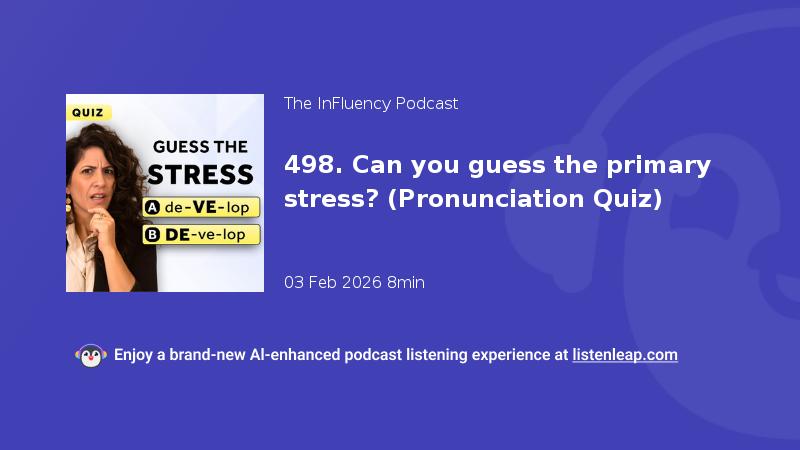
In this episode of the InFluency Podcast, host Hadar Shemesh, a dedicated pronunciation expert and fluency coach, dives into the critical yet often misunderstood concept of primary stress in English. For non-native speakers, placing stress correctly is not just about technical accuracy; it is the key to speaking with "clarity, confidence, and freedom."
Understanding Primary Stress
Hadar defines primary stress as the specific syllable in a word that receives the most emphasis. This emphasis is characterized by being "longer, louder, and higher in pitch." Using examples like interesting (stress on the first syllable) and understand (stress on the final syllable), she illustrates that stress patterns are fundamental to natural-sounding English.
Common Pitfalls and Practice
Many English learners struggle with multi-syllabic words where the stress pattern feels counterintuitive. Hadar guides listeners through several frequently mispronounced words:
- Comfortable: A classic challenge. Hadar emphasizes that the primary stress falls on the first syllable. It is "not comfortable, not comfortable," but rather "comfortable."
- Secretary & Vegetable: Both words often suffer from over-enunciation of middle syllables, but in standard pronunciation, the primary stress is firmly on the first syllable.
- Photography: This serves as a vital example of how stress shifts within word families. While we say "photo," the stress shifts to the second syllable in "photography."
- Necessary vs. Necessarily: Hadar highlights a nuance where the stress pattern can change based on the suffix, noting that while it is "necessary," the adverbial form "necessarily" carries a different rhythmic flow.
The Complexity of Regional Variations and Context
Language is dynamic, and Hadar acknowledges that geography and part-of-speech play significant roles in stress placement.
Regional Nuances
Using the word frustrating, Hadar explains that while the U.S. pronunciation typically places stress on the first syllable, the U.K. pronunciation often shifts it to the second. She reassures listeners that "both options are correct," suggesting that learners should choose the version that aligns with their environment.
Noun vs. Verb Distinctions
One of the most profound lessons involves words that change meaning based on stress, such as address. Hadar explains that for many words like present or record, the rule is straightforward: noun stress falls on the first syllable, while verb stress falls on the second.
However, she adds a "little caveat" regarding address. While the verb is strictly "to address," the noun can be pronounced as either "address" or "address" in the United States. This highlights that while rules are helpful, English often requires flexibility and an awareness of common usage.
Final Thoughts on Fluency
Ultimately, mastering primary stress is an ongoing journey. Hadar encourages learners to practice these words aloud, focusing on the "longer, louder, and higher in pitch" qualities of the stressed syllable. By moving away from flat, monotone speech and embracing the natural rhythm of English, non-native speakers can significantly improve their communication. As Hadar notes, consistent practice is the only way to internalize these patterns and achieve the confidence required to "show up" in English effectively.
Deep Learning with ListenLeap


