Hello, hello, hello, and welcome to English Learning for Curious Mines by Leonardo English, the show where you can listen to fascinating stories and learn weird and wonderful things about the world at the same time as improving your English.
I'm Alastair Budge and today we are going to be talking about the Haitian Revolution.
It is one of the most interesting and important revolutions in world history and brings together colonialism, slavery, the French, the Spanish, the British, the Americans, Napoleon, sugar, extreme violence, revenge, human rights and more.
As a warning, today's episode is longer than usual, but it's an important one, so I hope you'll enjoy it.
But before we get right into today's episode, I want to remind you that you can become a member of Leonardo English and follow along with the interactive transcript and subtitles over on the website, which is LeonardoEnglish.com.
Membership of Leonardo English gives you access to all of our learning materials, including instant translations in 12 languages, study packs, all of our bonus episodes and much, much more.
So if you are ready to take the next step on your English Learning Journey, the place to go is LeonardoEnglish.com.
OK, then, let's not waste a minute and talk about the Haitian Revolution.
If you have some knowledge of English poets, you will have heard of William Wordsworth.
He was the father of the English Romantic movement, and is probably most famous for writing poems about the English countryside.
But in 1803, he turned his attention to another subject in a poem titled Tussard L'ouverture.
The poem started with the line, Tussard, the most unhappy man of men, and continued to pay tribute to its subject.
Wordsworth never met or knew the man he dedicated the poem to, and the two men couldn't have been more different.
William Wordsworth was born in England, enjoyed a privileged life, studied at Cambridge University, and died at home, surrounded by his family, at the ripe old age of 80.
Tussard L'ouverture was born on a slave plantation in Sandalman, in modern-day Haiti, and died at the age of 59 in chains in a freezing French prison, just months after Wordsworth's poem.
The fact that this Romantic English poet dedicated a poem to him gives you some idea of the global impact of Tussard L'ouverture.
And we can see this, poignantly, in the last few verses, as Wordsworth wrote about how L'ouverture would be remembered by generations to come.
There's not a breathing of the common wind that will forget thee.
Thou hast great allies, thy friends are exaltations, agonies, and love, and man's uncomfortable mind.
In other words, what you have done will be remembered forever.
So what exactly is the story of Tussard L'ouverture?
Well, to understand his story, and the story of the Haitian Revolution, we need to go back several hundred years.
In the middle of the Caribbean lies its second largest island, Hispaniola.
The indigenous inhabitants of the island were the Tino people, but the name for the island, Hispaniola, gives you a clue as to who they were greeted by on December 6, 1492.
Christopher Columbus and the Spanish.
The Spanish were initially quite interested in the island, and its potential as a source of gold.
But their interest soon waned, after it became clear that greater riches could be found on the mainland, in Central and South America.
The island turned into a sort of trading and piracy outpost, a place where Caribbean pirates would go to sell their stolen goods, or stock up on food.
The western part of the island, in particular, was left practically abandoned.
And, less we forget, the native Tino population had been pretty much wiped out by a combination of forced labour and diseases brought in by the Spanish.
Fast forward to 1697, and the Spanish agreed to hand over the western part of the island to the French, who renamed it Soundbleman.
And the French did not neglect it.
They turned it into a huge colonial outpost with masses of plantations, producing sugar, coffee, cotton, indigo and cacao.
It was a particularly important centre for sugar production, and soon this western part of hispaniola, the now French colony of Soundbleman, was producing 40% of all of the sugar consumed in Europe.
And as you might expect, it was not the native French who were toiling away in the plantations.
This grueling work was being done by the hundreds of thousands of African slaves who had been brought to the island, with the sole purpose of working in the plantations until they dropped dead of exhaustion, disease or malnutrition.
And dropped dead they did.
Most slaves in Soundbleman didn't live past their 21st birthday.
And slaves who arrived on the island typically wouldn't last more than two or three years.
It's hard to overstate quite how brutal this regime was, but the fact that it was considered a waste for slave owners to spend any time caring for their slaves because it was cheaper to buy a new one to replace a dead one.
Well, this gives you an idea of the level of inhumanity on the island.
It was a brutal system, but to portray it simply as French whites as slave owners and African slaves toiling on the plantations is a simplification.
There were really four main groups of people on the island.
And as we will see, they all had different goals and different perspectives.
At the top of the tree were the slave owning whites, the so-called big whites or gruel blonde in French.
These were the people who owned the plantations, the people who profited from the slave labor.
Some of them lived on the island, while others lived back in France and simply collected the money from the plantations.
Below them were the small whites or Tiblong.
These were the French people who had come to the island to work.
They did managerial or administrative work, or they would work on the plantations as field managers.
They didn't own plantations, but they were still considered superior to the slaves given their skin color.
Below them again, but in some respects they equal, were the Jean de Couleur Libre, the free people of color in English.
These were people who were of mixed race, typically children of a French father and a slave mother, or people who at some point in their family history had slave ancestry.
There were few French women in Saint-Domaink, and unfortunately this meant that rape and sexual assault by the whites on slaves were common.
And if this resulted in a child, the white plantation owner would typically free or even marry the female slave, and she and her children would become free.
Importantly, this class, the Jean de Couleur Libre, were free.
They could even own plantations and keep slaves themselves, but they were not granted rights like the ability to vote or hold political office.
And right at the bottom of the pile were the most unfortunate of the lot, the slaves who had absolutely no rights at all.
They were property and lived in the most abominable of conditions.
So you have this unusual system of these different groups of people, all of whom interfacing with each other to a certain extent, all of whose interests will complicate matters as this story develops.
And just in terms of numbers, the grand and petit blanc, the whites essentially, were in a serious minority.
They made up about 8% of the population.
The mixed race population was around 5%, and the remaining just under 90% were the African slaves.
And these slaves were almost all African.
They were born in Africa, transported to Haiti, lived for a short period, and died there.
At the time of the Haitian Revolution, so the late 18th century, practically all of the slaves were born in Africa, for the simple but awful reason that the life expectancy of a slave in Haiti was so short that they had to be constantly replaced.
And to give you an idea about the number of people we're talking about here, there were around 500,000 slaves and fewer than 50,000 whites.
Now these conditions created a dangerous powder cake, a bonfire ready to explode in flames at the drop of a match.
You had a tiny minority that controlled a majority and subjected it to the most terrible of conditions based on skin color alone.
And what's more, you had these two other groups, the petit blanc and the Jean de Coulier Libre, the small whites and the mixed race population, who were stuck in between the cornblanc and the slaves, and they despised each other.
That might well have been enough to trigger a revolution, but these conditions were not so different to those that existed in other slave-earning countries.
What pushed things over the edge, the final spark that lit the fire, in fact, came from across the seas in France.
The French Revolution started in 1879 and continued on and off for 10 years.
One of the main ideas of the revolution was freedom and equality for all men.
And indeed, on August 26, 1789, the Declaration of the Rights of Man and of the Citizen set out clearly what these rights were.
They were 17 in total, and the first one set the tongue.
Men are born and remain free and equal in rights.
Social distinctions may be founded only upon the general good.
It is a simple idea. It might have been controversial at the time, but it was easy for anyone to understand what it meant.
And this revolutionary idea of equality and freedom and news of the French Revolution spread quickly.
It didn't take long for word of it to arrive in Sandomang, which let's remember was a French colony.
And it was received in different ways by the four principal groups on the island.
For the slaves, clearly it was a message of hope.
Free was incompatible with men remaining free.
So surely this must mean that their freedom would soon be declared.
For the Jean de Couleur Libre, the free mixed race population, it was encouraging news because it would mean that they could do things like vote and stand in elections, which their skin color did not allow them to do.
But it was also slightly concerning as much of this mixed race population owned slaves.
So if slavery was abolished, this would result in a major loss of earnings.
For the Bdblanc and to an even greater extent the Gomblanc, it was a frightening prospect.
The entire society of Sandomang was structured on men not being free and equal, on the blood, sweat and tears of African slaves.
And if suddenly these people were declared equal, well the good times would be over for the white population.
And they presumably knew that liberating the black slave population would not be as simple as declaring their freedom and everyone shaking hands and being friends again.
The whites had subjected the slaves to the most horrendous treatment over hundreds of years.
The treatment of the slaves by their white masters in Sandomang was particularly brutal, even by slavery standards.
Punishments were awful, arms and legs chopped off, whippings were common, control was maintained by an atmosphere of constant fear.
The slaves would surely want revenge.
Even the idea that the black slaves could think that one day they might be free was a scary one.
The whites were grossly outnumbered by more than ten to one and they feared the potential for an uprising if there was even the whiff of freedom, the slightest sense that freedom was possible.
The white slave owners, the Gomblanc, hadn't previously believed that the slaves were even capable of rising up on mass.
They understood that there would always be a few that would try to run away or fight back, but they would be publicly executed as an example to others.
They didn't believe that the slaves were capable of organising themselves.
For starters, there really weren't many examples of a wide-scale slave rebellions.
Secondly, they believed that the slaves were mentally incapable of organising themselves.
The white slavery requires you to believe that one person is inferior to another by dint of their race.
The whites believed that the African slaves were just not capable of organising themselves, that they lacked the mental capacity to do so.
As you will see, they were grossly mistaken.
They vastly underestimated the people they thought years of slavery and abuse had turned into docile, incapable, subhumans.
The first act of rebellion came not from the slaves, though, but from a Jean de Coulier Libre, a mixed race citizen of Sandberman.
A man called Vincent Ogey had been born in Sandberman, and he was a member of the colonial elite.
He was a rich and powerful man, but he was mixed race, which automatically disqualified him from certain rights.
He was actually in France at the time of the revolution, and he petitioned the new Assembly General in France to allow mixed race people the same rights as white people.
The Assembly General granted this, passing it into law.
But when he returned to Sandberman in 1790, he found that the Governor-General simply ignored it, he said, no.
Vincent Ogey enlisted a group of mixed race soldiers, and they rose up in protest.
Now it's important to underline that what Ogey was requesting wasn't the abolition of slavery, or equal rights for slaves or independence from France.
He was a plantation owner himself, he owned slaves.
All he wanted was the same rights as white people, for people like him, mixed race people, not the abolition of slavery, or improved rights for slaves.
And not of course that it should matter, but Ogey was much more white than he was black.
His father was a white Frenchman, his mother was mixed race, so she was half white and half black.
And if you look at a portrait of him, he was inseparable from any other white French aristocrat.
But this really gives you a sense of quite how much race underpinned everything in Sandberman.
There were detailed measurements of how black someone was, and if you were anything less than 100% white, you didn't have the same rights as the white population.
Now back to Ogey. Although what he was asking for, and indeed what had been approved by the French Assembly General might not have seemed like such a big thing, it was rejected by the colonial administration, and his uprising was swiftly put down.
A month after he rose up, he was captured, and then in February of the following year, February 1791, he was brutally publicly executed by being broken on the wheel.
All of his bones agonizally broken before his head was chopped off and put on a pike for all to see.
If the white colonial administrators thought that this would be sufficient to quash the uprising, they would be wrong.
Six months later, on the evening of the 21st of August 1791, everything would change in Sandberman.
There was a secret voodoo ceremony led by a slave and religious leader called Dutty Buchmann.
During the ceremony, he called for a full-out rebellion against the plantation owners.
And as he made this plea, there was a tropical storm, thunder and lightning filling the sky.
This was seen as a sign to take action, that change was a foot.
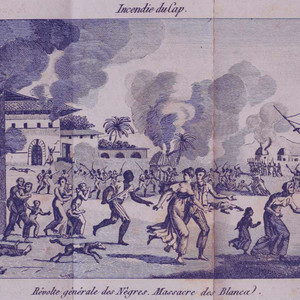
Slaves rose up, slaughtering their colonial masters in their bet.
They set fire to the sugar plantations, burning the crops, and destroying the sugar plants that they had been forced to harvest day in, day out.
Sandberman was a small place, and fires could be seen all over the island.
Look and screams filled the air, as slaves in their thousands rose up against their former oppressors.
Within a couple of weeks, more than a hundred thousand slaves had joined in their ev'lt, and the island was split into areas controlled by the slaves and small patches to which the whites had retreated.
And when they met, the violence was extreme on both sides.
In, women and children were killed in the most awful of ways.
The slaves, perfectly understandably, were out for blood, after being so hideously mistreated by their white colonial masters.
And the whites had always been extremely violent towards the slave population, and were even more so now that they had risen up.
But, risen up against what exactly?
It's here that it gets a little complicated, and again we must remember the different groups and their different interests.
What did the slaves want?
Well, they wanted to be free, and they believed that a declaration of the rights of man had declared them to be free.
They weren't demanding independence from France, they weren't demanding that the white population leave the island, all they wanted was not to be enslaved.
But what did the grand blanc, the slave owners want?
Well, they didn't want the end of slavery because it was a vastly profitable enterprise for them.
Similarly, the Jean de Couleur Libre, the free people of colour, they weren't opposed to slavery per se, but they wanted the right to vote.
And the tiblan, the professional white class, certainly didn't want the end of slavery, nor did they want the Jean de Couleur Libre, the mixed race people to be granted the right to vote.
And there was also this curious relationship between Sandomang and France.
Sandomang was part of France, but the different groups of the colony looked at France in different ways.
Initially, most of the slaves looked at France in a similar way to Vançois-Oigir, as a potential savior.
France had declared itself to be a republic that respected the universal rights of man, and the idea that no one man was superior to another based on the colour of his skin.
The grand blanc, on the other hand, looked to France as a dangerous republic.
The revolution had resulted in this dangerous declaration, and it looked like France was going to give mixed race citizens the right to vote.
This was a dangerous stepping stone, and they were powerful voices among the colonial population that sought to declare independence from France, turning Sandomang into an independent country.
And then, as if things weren't complicated enough already, in 1793, France declared war on Great Britain.
Now why is this relevant to the Haitian revolution?
Well, firstly, it meant that France's military resources were stretched.
They were now fighting a full-on war in Europe, which was expensive and labour intensive.
It also presented an opportunity for the British, who found an unlikely ally in the white French, the grand blanc of Sandomang.
The grand blanc wrote to the British and requested them to come and declare sovereignty over Sandomang, essentially turning this French colony into a British colony.
The reason for this was not a military one, but because they thought that the British were less likely to abolish slavery.
It seemed like a good deal for the British.
They would take control of a lucrative trading outpost, the so-called Jewel of the Caribbean.
It would result in a large loss of revenue for France, and if they could put down the slave revolt in Sandomang, it would also reduce the probability of a similar slave revolt in British slave-powered colonies.
Britain went along with this and sent troops to Sandomang, but it was a disaster.
The British troops couldn't handle it and died in their thousands, primarily from tropical diseases, not in combat with the rebel slaves.
But to make matters even more complicated, the Spanish also declared war on France.
And let's remember that the eastern side of the island of hispanola was still under Spanish control.
So, let's pause and take stock for a minute.
There are the British and the Spanish who are at war with France in Europe, and are both fighting with and fighting against France in the Caribbean, in hispanola.
We have the Gorblanc, the plantation owners, who are French, but have attempted to ally with the British because they think they are more likely to put down the rebellion.
We have the slaves who are in control of most of the island, seeking the abolishment of slavery.
And at this point, the slaves are not particularly organised.
Their advantage is in number.
They outnumber the whites by a factor of 10 to 1, but they don't have a particularly coherent vision or strategy.
Nor do they have one single leader, a force to rally behind.
There are some leaders at the moment, but they all want slightly different things.
They aren't able to unite every slave in Saint-Bermain, but it's here that we need to meet, again, a man who will give them one.
Toussane l'ouverture, the subject of the Wordsworth poem, at the start of the episode.
Importantly, Toussane l'ouverture was not a slave at the time of the revolution.
He was born into slavery.
Both his parents had been sold into slavery and been transported from West Africa, but Toussane was born on a plantation in Saint-Bermain.
He was born a slave. However, he showed intelligence and skill from an early age and was freed, most probably in his early 30s, so he became a Jean de Couleur Lib, a free person of colour.
And he did what many free people of colour did if they had the means.
He managed a plantation and was a slave owner himself.
In the early days of the revolution, the early years, in fact, Toussane l'ouverture played quite a canny game.
He didn't try to put himself forward as a leader, and instead supported several other people who were jostling for power.
But by the mid-70s, so almost five years into the revolution, he started to emerge as a key military leader.
He was sharp, charismatic, and an adept military commander.
In fact, his surname l'ouverture, which means opening in French, is believed to have come from his ability to find openings in his enemy's lines.
But if you are thinking that now under the promising leadership of Toussane l'ouverture, the timeline of the Haitian revolution was going to get simpler.
I'm afraid I have some bad news for you.
L'ouverture was a skilled diplomat, but this meant a ping pong-esque flipping from one side to the other in terms of who the slaves were allied with.
First, it was the Spanish, because they provided military support against the French colonial administration.
Then, in May of 1794, he switched allegiance to the French Republic to France.
The key reason for this switch was that the Republic of France, had in February of 1794, done what the slave population of Sandbermank were fighting for.
They had formally announced the abolition of slavery.
And let's remember, Sandbermank was part of France.
So with one stroke of the pen, the half a million slaves of Sandbermank suddenly became, theoretically, free citizens of France.
By switching allegiance from Spain to France, he was allying himself with the home country, with freedom and with the emancipation of the slaves of Sandbermank.
Now, he was fighting the Spanish and the British.
Fortunately, for L'Uvartier, the Spanish were not so interested in Sandbermank, and a peace treaty was signed in July of 1795.
And as for the British, yes, Sandbermank was still of interest, but there were more important wars to be fighting back in Europe.
And by August of 1798, after repeated losses to L'Uvartier by now well-drilled forces, the British cut their losses and left Sandbermank for good.
But, if you are thinking that that was it, no, no, there is more.
In 1799, a then 30-year-old Frenchman called Napoleon Bonaparte declared himself to be the first consul of France, essentially the leader of the country.
And passed a new constitution declaring that French colonies, such as Sandbermank, would be subject to special new laws.
He assured L'Uvartier that this wouldn't mean the reintroduction of slavery.
But not everyone bought this, not everyone believed him.
L'Uvartier then took steps to consolidate his power in Sandbermank.
He invaded the eastern half of the island, the Spanish bit, in January of 1801.
There was practically no Spanish resistance, and L'Uvartier immediately declared it to be part of France, meaning that he was now in control of the entire island of his Spaniola.
And later on that year, in July of 1801, he appointed a new assembly and announced a new constitution.
In this, he declared himself to be not just governor general of the island, but governor general for life with special power to appoint a successor.
This was a clear affront to central power, to Napoleon.
Although L'Uvartier professed his loyalty to France and to Napoleon, Napoleon proceeded to send 20,000 French soldiers to take control of the island and restore it fully under French control.
The idea was for this to be a show of force and for negotiations to be peaceful.
After all, this was France against France, in theory, L'Uvartier had professed his loyalty to Napoleon and to France, so a diplomatic resolution should have been possible.
It was not to be. A French general ordered his troops to attack a major port, and what resulted were months of violent guerrilla fighting, side-switching, trickery and more.
And when two of his key left-tenants defected to France, L'Uvartier handed himself over to the French.
Or rather, he negotiated a settlement in which he acknowledged the authority of the French generals, and received assurances that he and his generals would be given amnesty.
Unfortunately, they weren't.
In the summer of 1802, L'Uvartier was deported to France and imprisoned in a mountain fortress in Eastern France.
He didn't last long, and within a year he would be dead.
But what of Sandemagne?
The fighting continued, and the cruelty and viciousness of the punishments ratcheted up a notch.
Whenever the French managed to capture some Sandemagne forces, they would execute them on mass.
Sometimes it would be by firing squad.
Sometimes it would be by tying them in a bag and throwing them into the sea.
They even started locking them in the homes of ships and killing them with poisonous self-agasse.
But the residents of Sandemagne had one thing on their side, something that had been extremely helpful in the fight against the British, tropical diseases, and in particular yellow fever.
It was killing the French in their dozens, and before long the French were down to only a few thousand troops.
And the violence increased to almost unimaginable levels.
The French imported a reported 15,000 attack dogs from Jamaica, dogs that had been trained specifically to attack black people.
On his deathbed, the French military commander, Charles Leclerc, gave an order for all black people on the island to be killed.
And there was the most atrocious violence.
The rebels, naturally, responded with similar violence, publicly executing any Frenchman they got their hands on, chopping them up and putting their heads on sticks.
By the autumn of 1803, it was clear that this was an unwinnable fight for the French.
And on the evening of November the 30th, 1803, they retreated from the island.
And on January the 1st, 1804, the general in charge of the rebels, Georges de Selin, officially declared Sandemagne to be an independent country, named not Sandemagne, but Haiti.
It was, as you may know, the first free black-led nation in the world.
And to this day is the only country to successfully come from a slave rebellion.
The story of Haiti since then, as you may know, is not so rosy.
And indeed our next episode, a member only one, is going to be on the various reasons that Haiti has remained in such an economically precarious position.
But as to the story of the revolution of Haiti, it is nothing less than inspiring.
It costs tens of thousands of lives, many of which were lost in acts of unspeakable violence.
It involved treachery and side-swapping.
And was of course all centered around the grisly question of the morality and legality of the business of slavery.
But the slaves emerged victorious, a new country was established, and an example was set to free and enslaved people around the world.
Okay, then, that is it for today's episode on the Haitian Revolution.
I know it was a lot longer than normal, but it could have been ten times longer and we would still have missed out on some important parts.
But I hope that it gave you some useful background and you might now feel inspired to explore this fascinating story in greater detail yourself.
We will be dealing with post-revolutionary Haiti in detail in the next episode and trying to answer the question of why Haiti has failed to live up to the promises and hope of the revolution.
That is going to be one of our member only episodes, so here's my opportunity to remind you about our membership, it gives you access to all the bonus episodes, so that's almost 250 juicy new episodes, as well as all of the learning materials like study packs, transcripts and quizzes to turn our episodes from an interesting thing to listen to into a hands-on practical learning resource.
You can find out more about that over on the website which is LeonardoEnglish.com.
You'd be listening to English Learning for Curious Mines by LeonardoEnglish.
I'm Alistair Budge, you stay safe and I'll catch you in the next episode.