Hello, hello, hello, and welcome to English Learning for Curious Mines by Leonardo English, the show where you can listen to fascinating stories and learn weird and wonderful things about the world at the same time as improving your English.
I'm Alistair Bunch and today we are going to be talking about a period of British history that is perhaps too recent to really call in history.
It is the story of cool Britannia, where 1990's Britain saw a cultural awakening involving politics, rock stars, artists, fashion designers, and a supposed rebirth of the swinging 60's of 1960's London.
But before we get right into today's episode, I want to remind you that you can become a member of Leonardo English and follow along with the interactive transcript and subtitles over on the website, which is LeonardoEnglish.com.
Membership of Leonardo English gives you access to all of our learning materials, including instant translations in 12 languages, study packs, all of our bonus episodes, and much, much more.
So, if you are ready to take the next step on your English learning journey, the place to go is LeonardoEnglish.com.
OK, then, cool Britannia.
The March 1997 edition of Vanity Fair magazine had a provocative cover.
It featured the lead singer of Oasis, Liam Gallagher, and his girlfriend, the actress Patsy Kenseth.
The pair, Leigh and Bed, staring up at the camera, with Patsy Kenseth in particular not wearing many clothes.
The duvet cover on the bed was a union jack, the flag of the United Kingdom.
And the headline on the front cover was London Swings Again.
The magazine then went on to dedicate 27 pages to a celebration of all things British, informing its predominantly American audience about a new cultural Renaissance that was happening across the pond in Britain, a movement that would come to be known as Cool Britannia.
It was a movement that united musicians, fashion designers, restaurants, and even politicians the magazine proclaimed, and was built as a revival of the cultural phenomenon of the swinging sixties, London in the 1960s.
So where did this come from?
How did it get started? And to what extent did it really happen?
And to what extent was it a load of fluff pushed by politicians, spin doctors, and journalists?
As always, it's helpful to start with a bit of background.
The 1990s were a period of seismic political change for Britain, both on a domestic and international level.
Margaret Thatcher stepped down as Prime Minister after almost 12 years in power, ending the so-called Factorite Years.
In November 1989, the Berlin Wall had come down, and in 1991, the Soviet Union was officially no more.
The American political scientist Francis Fukuyama proclaimed the end of history, as it seemed clear that after almost a hundred years of experimentation, capitalism and democracy had emerged as a superior system to communism.
Back in the UK, in 1994, Tony Blair became leader of the British Labour Party, and proudly announced that this was new Labour.
No longer would the Labour Party be the party of flat caps, coal miners and factory workers, predominantly in the industrial north of the country.
No longer was it all about trade unions.
He was about business creativity, and doing whatever needed to be done to position Britain as an example to follow of a modern, dynamic global power.
He became Prime Minister three years later in a land-slide victory against the Conservatives, achieving the greatest electoral success in Labour Party history.
Now, you may know Tony Blair today for his involvement in the Iraq War, and for co-zing up to George W.
Bush, but it is hard to overstate how popular he was when he was first elected.
He was a breath of fresh air.
He seemed different to other politicians.
For starters, he was young, only 43 when he became Prime Minister.
His main opponent, John Major, wasn't that much older, only 54 at the time of the election.
But he seemed like he was of a different generation.
John Major had grey hair, big glasses, wore business suits and gave dull press conferences.
Tony Blair didn't have a speck of grey.
He talked about how he used to have long hair when he was younger, how he played in a band.
He would be photographed playing electric guitar and would happily talk about his favourite bands.
He was even mentioned by Noel Gallagher, though isis, at the Brit Awards ceremony in 1996, as being a person who was giving hope to young people in the country.
He was, deraiseis, cool.
And as any teenager knows, the ultimate barometer of how cool or uncool you are is who you can get to come to your party.
And so it was that on the 30th of July, 1997, just a few months after his landslide electoral victory, Tony Blair decided to throw a party at 10 Downing Street, the residence of the Prime Minister.
But this wouldn't be a normal party with political allies and grandies from the world of business.
Tony Blair decided to invite a who's who of British cultural talent.
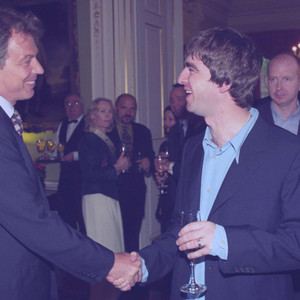
Noel Gallagher, the lead singer of Oasis who had endorsed him the year before, was there and was photographed champagne flute in hand, sharing a joke with the new British Prime Minister.
He was followed by people from the world of film and comedy, like Eddie Isard and Lenny Henry, fashion designers such as Vivian Westwood and an extensive list of celebrities.
For the first time ever, really, people from the world of film and music were happy to be associated with a sitting Prime Minister.
And the sound track for the evening, which was reportedly playing practically on repeat, those dreams, things can only get better.
There was a sense of optimism in the air.
Things were getting better, at least for the people at the party.
After the deregulation of the late 1980s and early 1990s, London had become a global financial hub to rival New York, with hundreds of billions of dollars flowing through the city every day.
The economy was back on its feet after a recession at the start of the 1990s.
England had even almost won the Euro 1996 tournament.
Well, not really almost won.
They were knocked out in the semifinals by old enemies Germany, but there was a national sense that we could have won.
And on a cultural level, Britain was punching above its weight.
Typically, Britpop had been a great success, with bands such as Oasis, Blair and Pope topping the charts.
The Spice Girls were hugely commercially successful, and they also seemed to be talented, smart business women who were in control of their own destiny.
There was a new generation of British artists, the so-called Young British artists, which included figures like Tracey M.
and Damien Hurst. And the centre of all this activity, where most of it was happening, was London, the capital.
Rockstars were buying up houses in trendy Primrose Hill.
New restaurants and clubs were opening up every night.
It was the place to be. Of course, eager young creative minds flocked to the city.
Young artists, young writers, musicians, and people who just wanted to be a part of what felt like it could be the next 1960s.
Compared to now, the city was affordable.
As an art student, you could live in a flat in central London and pay your rent with a part-time job in a pub or a gallery.
It was a far cry from today, where rents are sky high, and nobody can afford to live in those areas on a student budget.
To give you some sense of perspective, the average house price in London in 1996 was £79,000.
Today, it is £720,000, and almost tenfold increase, and rents have increased at a comparable level.
This affordability, increasing cultural activity, and melting pot of creative talent, this all combined to form the perfect storm for what journalists would call Coul Britannia, a sort of cultural revival both of the London of the 1960s and a celebration of all things British.
The British flag, the Union Jack, was suddenly cool again.
You heard the start of the episode that Noel Gallagher of Oasis was photographed in a Union Jack Dove.
Jerry Hallowell, a ginger spice from the Spice Girls, wore a Union Jack dress during the 1997 Britter Awards, and the lead singer of the Smiths, Morrissey, would pull out Union Jack flags at concerts.
There was this new sense of British identity, all centered around this idea of being proud of British culture and the music art and really everything that was coming out of Britain.
Or was there? Ever since this period, people have asked themselves how much substance there was to it, and questioned the extent to which this was a genuine bottom-up movement, or whether it was one manufactured and encouraged by politicians, journalists, and spin doctors.
The term Coul Britannia, which is a pun on the British patriotic song, rule Britannia, was encouraged mainly by journalists and politicians.
It wasn't a phrase that you would hear Noel Gallagher or Damien Hurst using about themselves.
It was a politically useful term, and it certainly seems that the main beneficiaries of the so-called Coul Britannia movement were new Labour politicians, in particular Tony Blair.
It gave him a sense of legitimacy, and an appeal to a section of the population that might not necessarily have voted for Labour.
It was also just good business.
The UK is objectively speaking a cultural powerhouse, and the so-called creative industries are worth 150 billion euros annually to the UK, making up around 6% of the British economy.
Celebrating the burgeoning creative industries was simply a sensible economic choice for the country.
It showed that there was more to Britain than a divided dual economy, with manufacturing and manual labour on one side and bankers and lawyers on the other.
There was a third way, an outlet that allowed creative talent to flourish and generate huge value for the country.
But how much of this value did the average person in Britain actually receive?
Yes, there was great music, art and culture.
But this was concentrated in the capital, and really only in tiny pockets of London.
And to state the obvious, life in 1990s Britain was not all champagne parties at Downing Street, football tournaments and a booming economy.
Perhaps most famously, there was the racially motivated murder of a black teenage boy, called Stephen Lawrence, and the failure of the police to properly investigate it.
There were race riots in London, and outside of London, especially in former industrial areas in the north of the country, few people felt the supposed benefits of Britain's booming cultural economy.
According to its critics, Coul Brutania did very little to address the systemic problems facing the country.
Failing schools, long-hospital waiting lists, high unemployment, these were the very real problems that Tony Blair should have dedicated his time to, not quawthing champagne with rock stars.
But with time, these voices seem to fade.
And what we are left with is the music, photos and memories of the period.
And it is a period which many people look back on with great nostalgia.
The pictures of Noel Gallagher and Jerry Hallowell, the songs and the stories.
These are some of the most powerful images that we have from that period.
And we humans have a tendency to look back on the past with a sense of hope and optimism.
And perhaps one of the reasons that many British people are so nostalgic for this period is because it might just be the last in which there was a strong sense of shared national culture and identity.
The 2000s saw the arrival of social networks ubiquitous internet and hyper-personalization of interests.
Two people of the same age could have completely separate cultural lives in a way that they couldn't in a pre-internet era, like in the 1990s, the Coul Brutania years.
Things like which band was number one in the musical charts was an important weekly announcement.
The news came out at a set time on the TV every evening or in the morning newspapers.
People's experience of the world was much more homogenous than it is now, when we are constantly connected to the global culture of our choice via our smartphones.
So the argument goes, Coul Brutania was the last big shared cultural movement.
And that's the reason why there is often such a nostalgia for this.
Among the people who lived through it, either the musicians, artists such as Noel Gallagher and Tracey Emin, or people like me, who were children and teenagers at the time, and grew up with some sense that this was a time of optimism and change, but not truly understanding why.
So to wrap things up, Coul Brutania was a defining period in modern British history, a period in which bands made great music, politicians seemed different, London was cool again, and anything seemed possible, even England winning a football tournament.
OK, then that is it for today's episode on Coul Brutania, a period of recent British history that you may well remember yourself.
I hope you've been an interesting one and that you've learned something new.
As always, I would love to know what you thought about this episode.
Did you visit Britain in the 1990s?
What are your memories of it?
Are there similar cultural relationships that you would like us to make an episode about?
I would love to know. So let's get this discussion started.
For the members among you, you can head right into our community forum, which is at community.inarlingush.com and get chatting away to other curious minds.
And as a final reminder, if you enjoyed this episode and you are wondering where to get all of our bonus episodes, plus the interactive transcripts, subtitles and key vocabulary, then the place to go for that is leanarloenglish.com.
And if you aren't yet ready to become a member, but you would like to do something to support the show, then I would love for you to think about leaving a review or a star rating on your favourite podcast app.
It takes less than 30 seconds to do, but they are super helpful and each one brings a smile to my face.
You've been listening to English learning for curious minds, by leanarloenglish.
I'm Alistair Bodge, you stay safe and I'll catch you in the next episode.