Sometimes prepositions don't make sense.
Like you might use for instead of of, and logically, it may not make sense to you, but when you just look at the language, this is how it is.
This is the common usage of this word or this preposition, and then you just need to learn it as is.
Hey, you're listening to the Influency Podcast.
I'm Hadar, your host, a pronunciation expert, fluency coach, and a proud non-native speaker.
With over 16 years of experience teaching, I am here to share with you all my secrets on how to show up in English clearly, with confidence and freedom.
On this podcast, I'll provide step-by-step strategies lessons, stories and practical tips to keep you inspired and motivated on your English journey.
Are you ready?
Let's do it.
Hey everyone, it's Hadar.
Today we're going to talk about common preposition mistakes.
Common phrases that are usually or often said with the wrong preposition.
So today we're going to talk about those common phrases and common mistakes and What is the right preposition to use.
Now, before we go into the lesson and the examples, I want to talk about why prepositions are so confusing.
To begin with,
Every language has a different set of prepositions and when we speak we usually think First of content.
Words like the nouns verbs, adjectives and adverbs, everything that carries the content.
And we don't think of all the connecting words in between.
So when we don't think about it and we're not used to it, we tend to just translate the preposition that we use in our first language.
And therefore we might use the incorrect preposition in English, even though it makes total sense if you were to translate it to your first language.
And the second reason is that sometimes prepositions don't make sense.
Like you might use for instead of of, and logically, it may not make sense to you, but when you just look at the language, this is how it is, this is the common usage of this word or this preposition, and then you just need to learn it as is.
I know it gets to be a little frustrating, but I think that when you surrender to this idea that you don't always make sense of it and you don't always need to translate it and just to copy paste what you hear and get used to saying it in the way, that is the right way.
So almost like remembering it as a word, depending on, and not depending of, right?
Like, and you always remember it as a unit, it makes it easier.
And here's a quick tip.
Once you learn the no preposition or the correct form, the best way to remember it is just to say it again and again, and again in context.
That way you kind of like brand it in your brain.
You create new connections in your brain rather than just repeating old patterns or what you've been used to saying, because we're trying to make new connections and build new habits.
Okay.
This is why the repetition in context is absolutely critical for this type of work.
All right, so let's go into the common mistakes and the alternatives.
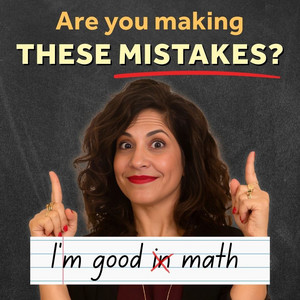
So the first mistake is good in something.
She's good in math.
No, when you talk about someone who is good at something, we use at.
For example, and say it out loud with me.
She's good at math.
He's good at writing.
We're good at listening.
Good at, good at, good at, good at.
Good at.
Good at.
She's good at math.
Good.
Now I want you to think of three additional sentences with the phrase good at and say it out loud.
You can even write it in the comments.
The next mistake is discuss about.
Let's discuss about the plan.
No.
After the verb discuss, we don't need a preposition.
We can just eliminate it and say, let's discuss the plan.
Let's discuss the plan.
Let's practice a few more phrases.
Please discuss any issues with your manager.
Repeat after me.
We discussed moving the meeting.
I'm not ready to discuss the details yet.
Discuss.
Just discuss.
Alright, the next mistake is when we say arrive to.
For example, I arrived to the airport.
This is a mistake.
We can either say Arrive at or arrive in.
We say arrived at when we talk about a specific point, right?
Like a point on the map, like the exact GPS, a specific location, then we use at.
I arrived at the airport.
I arrived at the bank.
I arrived at the crime scene.
Okay?
This is when we use at, a specific place, right?
You can visualize it.
You can see it on the map, arrived at.
When we arrive in a city, a country, or a big area, we say arrive in.
For example, I arrived in London.
I arrived in Brazil.
I arrived in Bangladesh.
Arrived in, arrived in.
Now think of three sentences with the phrase arrived in.
Next one, he's afraid from spiders.
Okay, not afraid from, afraid of.
Afraid of, afraid of, afraid of.
What are you afraid of?
She's afraid of spiders.
He's afraid of heights.
I'm afraid of losing my passport.
Afraid of, afraid of, afraid of.
Now you.
Three sentences with the phrase afraid of.
Say it out loud and write it in the comments.
The next one.
I'm responsible of the monthly report.
Responsible for.
I'm responsible for something.
She's responsible for leading the team.
Responsible for, responsible for.
She's responsible for leading the team.
They were responsible for delivering the training.
They were responsible for delivering the training.
Responsible for, responsible for.
We weren't responsible for the delay.
It wasn't our fault, we weren't responsible for the delay.
Responsible for.
Responsible for, responsible for.
Good.
Now I want you to come up with three more sentences with the phrase responsible for.
The next one is reason of versus reason for.
A last minute change was the reason for the delay.
Reason for, reason for, reason for.
A last minute change was the reason for the delay.
Helping people is the reason for why I do what I do.
Helping people is the reason for why I do what I do.
Reason for, reason for, reason for.
Okay, that's it.
I hope this was helpful.
And more than just teaching you how to say correctly these phrases, I want you to understand the concept of understanding the mistake, not feeling bad about it because you're doing it subconsciously, because of your first language or because maybe it doesn't make logical sense to you.
But whatever it is, you need to understand that the new form needs to be repeated intentionally, again and again, and again, out loud.
And then for you to come up with two, three sentences with this new phrase out loud, until you can start changing old patterns, changing mistakes and shifting into more accurate English.
Remember, mistakes is not the end of the world.
It's okay if you make mistakes, everyone will still understand you.
But there comes a point in your English journey where you might feel like this is time to be more accurate and be more consistent with your grammar.
And this is a good method to use to help yourself speak more accurately, clearly, and confidently.
Thank you so much for joining me.
Have a beautiful, beautiful rest of the day.
If you want more resources on how you can speak more clearly and confidently, check out all the links in the description below, or the show notes, if you're listening to the podcast.
Thank you so much for watching and I'll see you next week in the next video.
Bye.