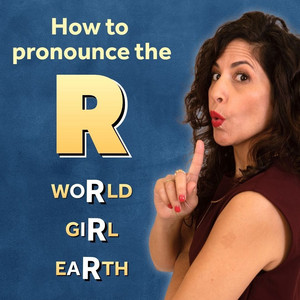
The STIR sound that we're going to talk about today is an R vowel, where the vowel right before the R is practically neutral.
So you don't really hear a vowel sound and the R takes over the sound.
Just like in the word STIR.
Even though it's spelled with an I, you don't hear E. It's ST-ER.
STIR.
You're listening to the Influency Podcast.
I'm Hadar, your host, a pronunciation expert, fluency coach, and a proud non-native speaker.
With over 16 years of experience teaching, I am here to share with you all my secrets on how to show up in English clearly, with confidence and freedom.
On this podcast, I'll provide step by step strategies lessons, stories and practical tips to keep you inspired and motivated on your English journey.
Are you ready?
Let's do it.
Do you struggle with some words with R more than others?
For example, maybe it's easier for you to say run, but harder for you to say girl.
The reason is the placement of the R in the word and the sound itself.
So today I'm going to teach you a specific sound that is going to make the pronunciation of these trickier words a lot smoother, And it's probably going to help you with some mispronunciations you probably don't know you're making.
I think you are going to love this sound.
It's called the er as in stir, and it's going to be a super effective lesson.
So let's get started.
The R as in stir is basically an R sound.
What does that mean?
You need to bring your tongue to the position of the R.
You lift the tongue up, the sides of the tongue touch the sides of the teeth.
You point the tongue forward or slightly up and you round your lips.
We have it in words like red, that's the R sound, right, and around.
The tongue is not touching anything, not in the front and not in the back.
It's not .
It's not .
It's not .
And you want to make sure that you hear that nice quality of the R sound.
Don't forget to round your lips.
When the R is at the beginning, it's usually easier for most speakers to pronounce the correct R sound.
Red, right, result.
Now, there's also a group of words where the R appears after the vowel.
Then you first hear a vowel sound and then the R. Car.
Hair.
Fear.
Now this R is pronounced only in American English.
In British English, you actually don't hear the R here.
So right now we're going to focus on the American pronunciation of this sound.
Specifically, the stir sound that we're gonna talk about today is an R vowel where the vowel right before the R is practically neutral, so you don't really hear a vowel sound and the R takes over the sound, just like in the word STIR, even though it's spelled with an I, you don't hear E, it's ST-ER, STIR.
So when we think of this particular sound and the group of words that have that sound, Even though it's an R vowel, we want to think of it as if it's a strong R sound.
Stir.
Learn.
Girl.
Her.
It's not hair.
It's not girl.
It's not even girl.
We don't add a vowel in between.
The R takes over the vowel sound.
Okay?
And you basically want to connect the consonant before to the R. Terms.
Not terms, right?
T, r, t, r, ter, ter, terms.
Firm.
Not ferm, not firm.
F, r, f, r, firm.
Girl.
Not girl, not girl.
So you anticipate the R, the R comes in really quickly after the first consonant.
So it feels like there is no vowel sound here.
Now, the R as in stir has several spelling patterns.
The first one is IR as in stir, dirt, flirt. and virtue.
We also have the ER spelling pattern, as in term.
Notice, dirt and term, they sound the same, even though the spelling is really different.
Term, germs, certain.
Okay, certain.
Here we also have the nasal T. Certain.
You also have the E-A-R spelling pattern.
Earn.
Search. earth.
Again.
Er, er, earn, search, earth.
When the er is at the beginning of the words, just round your lips and think of making an R sound.
Er, er, er.
It's not air, okay?
Er, er, er, earth.
Then we also have UR, like Urgent, burn, purse.
P-ur, p-ur, purse.
We also have O-U-R.
Courage, nourish, journey.
Now, this is specifically for American pronunciation, because in other dialects you might hear it pronounced with a cup, sound courage or nourish.
But in American English, usually in most dialects, it's pronounced as er, courage, nourish, journey.
And I'm all about simplifying.
So when you have a certain word that could be pronounced in different ways, but you already know how to pronounce it in one way, you don't need to learn all the other ways, as long as it's Acceptable.
And my favorite spelling pattern is the W-O-R because this is so confusing for so many people.
Just like the word, word, work, and world.
So what I want you to think about here, it's like, it's the same pattern.
It's not W-O-R, it's not ward, it's word.
So just like you did with a purse.
And the terms from one consonant to the R. This time it's from a W sound.
Were.
Again.
Per, ter, were.
Even though the W is really close to the R and it might be perceived as the same sound, it is just a consonant and an R Were were were.
Again.
Per, ter, were.
Work.
Word.
Worth.
World.
Okay?
Very good.
So, let's do a quick recap about this R as in stir sound.
It can be spelled with almost all vowel letters, maybe except for A, A-R.
Whenever you'll see an A-R, you can bet that it's not going to be the stir sound.
But E-A-R-I-R-U-R-E-R-O-U-R and O-R, especially W-O-R.
Yes, like it has the R as in stir sound.
And the thing you need to remember is that you want to skip from the consonant before the vowel to the R directly and do not pronounce a neutral vowel in between.
G-E-R-L-F-E-R-M.
Or the vowel letter, firm, terms.
No, you just want to think, as if you're eliminating that vowel sound and you're going from the consonant to the R directly.
Now, if we want to go a little deeper here, and if this has been enough for you, then don't worry about it.
You don't need to go deeper with me.
But for people who have some experience in learning pronunciation, here's something interesting about the ers and str.
The ers and str is always positioned as the primary stress of the word.
For example, urgent or certain.
Or virtue.
Okay, it's always the primary stress.
Now you could hear this R sound appearing in unstressed syllables, but then it's considered to be a schwa R, For example.
Writer right the ER.
Suffix that it's not stressed, it's a schwa R.
The R takes over the schwa.
A schwa is a very neutral vowel sound uh uh, and when it's connected to an R right after, then it the R eats up the schwa er and you just hear an R writer stronger.
Bigger, grr, grr.
Okay, so technically what you're doing with your mouth is exactly the same.
But the difference is the stress.
Unstressed syllables are short, softer, and usually lower in pitch.
Stressed syllables are longer, louder, higher in pitch.
For example, if we take the word burger, we have the stir sound at the beginning burr, and then we have a schwa R at the end, ger.
So it's going to be shorter and softer and lower in pitch, burger.
But I'm not changing anything here. burger, server, murder.
Okay?
So it does sound a little muffled and strange, but don't worry about it.
This is how this word is pronounced or these words are pronounced.
Okay?
So the R sound as an R vowel could be a stir, and then people tend to mispronounce it, because they want to pronounce that vowel sound or they want to emphasize it, so they add a vowel.
And that is the focus of today's lesson.
But also when we have a schwa R bigger, we want to make sure that the R takes over the schwa, the neutral vowel sound bigger.
And it's not, again, you're not adding a vowel sound there, like .
Okay?
There is no vowel.
It eats it up.
Now, again, in British English, .
We're just going to pronounce the schwa.
.
In American English, .
So the R takes over the schwa and you hear an R sound.
Okay, good.
So now I have a special gift for you.
I have a PDF with words, phrases and sentences of the stir sound that you can absolutely download and practice along.
You can see the words, you can practice with my audio so that whatever you've learned today, you put it into practice.
Because the idea is not just to listen, but also to implement and to practice saying it again and again and again.
So it's absolutely free.
You can go ahead and download it today.
The link is in the description or the show notes.
If you're listening to the podcast right now now, if you liked this pronunciation video and you want to learn more pronunciation with me, i have a 14-day plan to help you learn and practice pronunciation regularly.
It's absolutely free, so you can go ahead and click on the link below and download it today.
It's on my app so you can go through the lessons and listen to the audio practice along.
Super accessible and effective.
People love it.
And like I said, it's free and ready for you to download it today.
Thank you so much for joining me.
Have a beautiful, beautiful rest of the day and I will see you next week in the next video.
Bye.