This message comes from Capital One.
Banking with Capital One helps you keep more money in your wallet with no fees or minimums on checking accounts.
What's in your wallet?
Terms apply. See capitalone .com slash bank for details.
Capital One N -A. Member FDIC.
1 -2 -3 1 -2 -3 1 -2 -3 1 -2 -3 1 -2 -3 Sometimes things aren't what you think they are.
and people aren't who you think they are.
That's what we're talking about today on IRA Glass.
That is really weird to hear you do that.
I'm here. This is actually IRA Glass.
I'm sitting here with Fred Armisen.
Hi, hi. Who's probably best known for Saturday Night Live, but also Portlandia.
And I knew that you had worked up an imitation of me because we just happened to meet once and then you said something like, but you're not famous enough.
so I have no use for this on television." I might have said that exactly.
Yeah. And, yeah. Well, after that, this writer at SNL, Christine Mangel and I, we figured out a way to turn it into a sketch that we could put on Weekend Update, the news segment on Saturday Night Live.
By chance, NPR came up in the news.
I think this was around the time that they were talking about cutting some of the funding.
Here to comment on NPR's troubles, the host of This American Life, Ira Glass.
So I came out and I'm wearing your glasses and like a wig to look like you.
It's this American life.
I'm Ira Glass, Act one.
Yeah, I was thinking the other day in the joke being a tourist, you were interviewing people at Weekend Update.
Ira, look, you can't bring other people on as your guests.
You're my guest. It's just your CEO just resigned and now the Republican budget proposes cutting your funding completely.
I mean, aren't you afraid that NPR might start laying people off?
Act two. Oh, boy. Laid off.
No guts. So this never made it to air.
This is just the recording from the dress rehearsal.
Why didn't it make it to air?
Who knows? It might've been a little unwieldy.
So if people want to watch that, the entire video is...
We have a link at our website.
Anyway, so, we invited you here today Because the theme of this week's show is doppelgangers.
The show is about doppelgangers, about people who are doubles or look -alikes.
And I realized that because you worked up this imitation, you could co -host as my doppelganger in this room, in this studio, during this broadcast. This is an audience who will actually know who you're playing.
This is the right venue for it.
So if you're ready, that's what we'll do.
Another way to look at it is you're co -hosting with me.
that this is my show.
Exactly. And that's what we're talking about today.
I'm Ira Glass. So let's go to this copy.
So we have some copy for today.
This one. And let's go to there.
And let's just... Lizzie, why don't you start?
Today on our show...
I'm just thinking about how I would do it.
I would go like, today on our show.
Oh yes, that's better, okay.
Today on our show, we have two stories of supposed doppelgangers.
We have two stories of supposed doppelgangers.
And we try to figure out the truth of them.
Do I sound that nasal?
Maybe. And we try to figure out the truth of them.
And we try to figure out the truth of them.
One concerns two men who've never met.
The other two animals who never meet.
I think you should do the next part.
because it's so, like, do you want to hear me do it first or you just want to do it?
From WBEZ Chicago, it's This American Life.
Distributed by Public Radio International.
Distributed by Public Radio International.
I feel like a Muppet.
Why does it make me feel like a Muppet, Fred?
Seriously, why? I think you could be a Muppet.
I don't know why they don't have a Muppet of you.
From WBEZ Chicago, it's This American Life.
From WBEZ Chicago it's This American Life, distributed by Public Radio International, distributed by Public Radio International, a minor glass, an on -minor glass, an on -minor glass.
Stay with us. So where did this American life and the following message come from data IQ?
AI can be a kind of raw power, take control of AI with data IQ, the universal AI platform.
It's built for business teams and AI experts alike, designed for trust and engineered to scale to fit your tech stack today and tomorrow.
From analytics, models, and agents, make AI flow through your enterprise.
Don't just keep up with AI.
Control it with Dataiku, the universal AI platform.
Find out more at dataiku .com slash this American Live.
This American Live, today's show is a rerun from back in 2013, when Fred Armisen was still in Saturday Night Live and doing Portlandia.
And our show at the time is distributed by Public Radio International.
Let's get back to the show.
So, Fred, do you want to start Act 1?
Act 1, dead ringer, we start today with a story of physical resemblance.
Not of a person, but of a food.
A quick warning that if you're squeamish or adversed to graphic images of food, there's going to be some of that in this report.
Here's Ben Calhoun.
I first heard about this whole thing in an email.
It came from a listener, a woman named Emily Rantzer.
She works in the food industry.
And the letter Emily wrote was about a story she'd heard from a farmer.
The farmer who told her this is apparently a person of some standing in the pork industry.
And admittedly I don't know the first thing about the pork industry.
But he's in charge of a pork producing operation that spans several states.
The story he told Emily went something like this.
A while ago, he was visiting a pork processing plant in Oklahoma.
He's walking through it with a friend, a guy who managed the plan actually.
And at some point he saw boxes stacked on the floor labeled artificial calamari.
He stood there, wondering for a second.
And then he asked his friend, What's artificial calamari?
Bung, his friend, replied, It's hog rectum.
Rectum that would be sliced into rings, deep -fried, and boom.
there you have it ok if I can let me just narrate for you what this would mean it would mean that in restaurants everywhere right this second people are squeezing lemon wedges over crispy golden rings dipping the rings into marinara sauce and they're eating hog rectum now they're chewing satisfied and and deeply clueless.
It's payback. It's payback for our blissful ignorance about where our food comes from and how it gets to us.
It's amazing. And it's perfect.
But it also seems like it couldn't possibly be true.
So I called up the farmer to talk to him personally.
I wanted to hear it firsthand.
And the farmer confirmed the story, the entire thing, the boxes, the bung, But when I asked him to go on the record, to tape an interview and give his name here on the radio, he very politely declined.
Which seemed suspicious, right?
When I asked him why, he said he'd spoken with his girlfriend about it, and she suggested that he should think about the words that he wanted to come up when somebody googled his name.
This was all fine, though, because he referred me to the real expert, the guy who gave him the tour of the hog processing plant.
And that guy, he agreed to talk.
Hello? Hi, is this Ron?
Yeah. Yeah. This is Ron Meek, meat processing plant manager presently residing in Mountain View, Missouri, where he runs an organic beef processing plant there, called Beyond Organic.
If the story really were true, Ron would have been the guy who explained to the farmer what was in those boxes.
The boxes are 10 pound boxes and they were all, they cut off so much like maybe a 10 or 12 inch piece of the bone.
And you know what it looks like after they're cleaned and washed and everything, they just look like a bunch of big noodles in a box is all it looks like.
but but the specifically the labels that said imitation calamari where did you personally see the imitation calamari labels?
I've never seen a label say that that's all I was told by the the people that told me that the people I worked for they told me that.
Oh the people that you worked for told you that it was used for imitation calamari Right.
And is there any possibility that you think that the when they were explaining this to you that they were having you on a little bit?
Oh, for having me on....
Yeah, like uh... Bullsh**ing me?
Uh, well I wouldn't think that but you know, it could be 5 % it could have been that, you know but I seriously doubt it.
Okay, just to give a little better a pork bung, and bung is the actual industry term for it, is long and floppy and ugly.
At one end it widens out into this more bulbous shape, like a pink wrinkly pear.
That's the rectum. At the other end it narrows into a soft, pinkish -white tube.
I know, it sounds gross.
But also, consider, we are a nation that eats more than a billion pounds of sausage every year.
a billion with a B.
Maybe you like liverwurst or capicola or summer sausage with a natural casing.
Then you, like me, have eaten Bong.
Stuffed dried Bong.
A lot of brats and Italian sausages are stuffed in intestine, so if you eat those regularly, you pretty much live up the street from Bong.
So, why does the idea of a fried ring of bung just feel grosser?
Partly it's the visual, right?
When you see that little ring of calamari, you don't want to picture it in the context of a pig's behind.
Then, there are all the people who don't eat pork.
Period. Ron said there's also another reason.
But the big question, the question you've been thinking about since we got on this topic.
Have you or I eaten imitation calamari?
Bong dressed up as seafood.
Well, Ron didn't know.
He said his plant exported a lot of their bong to Asia, but he just didn't know much about whatever happened after it left the door, so he could only speculate.
Anything, he said, would be a wild guess.
So I turn to people who would know, is pork bong being falsely peddled as calamari?
I called the USDA. Today, the USDA's Food Inspection Service issued the following statement to me.
Products we inspect, including those derived from pork, must be accurately labeled and cannot purport to be a product of another species.
So, it's against the rules.
But people break the rules.
A recent study of seafood by a group called Oceana used DNA testing and found that all across the country, fish is regularly being labeled as other species in restaurants and in grocery stores.
Escolar sold as white tuna.
Pacific Rockfish being fraudulently sold as snapper.
In Miami, more than 30 % of fish was being sold as something it wasn't.
In New York, the number was 39%.
Boston, 48%. Los Angeles, are you ready?
55%. 55! That means if you order fish in LA, you are most likely eating a species you did not order.
In other words, seafood substitution is rampant in this country.
And depending on where you live, from what I can tell, you can get cleaned hog bung for about half the price of cleaned squid.
So there would be money in it if you could pull off the switch. And as best I can tell, were you to do this, you would not be caught.
A lawyer who's familiar with this area of law and regulation told me, Once Bunk leaves the plant, there's a variety of agencies and entities that would be in play.
USDA, FDA, state, and local government.
But ultimately, he said, the regulation we have is not designed to catch an offense like this.
It's aimed mostly at sanitation and food safety.
So, bottom line, the lawyer said, if somebody wanted to do it, chances are they'd get away with it.
So is someone out there doing this?
Well, for weeks I looked for an answer.
The USDA says they'd never heard of anyone trying to pass pork bung as squid, or any other species.
I contacted the National Restaurant Association, the National Pork Producers Council, the National Pork Board, a squid fisherman's association, Cisco, and other big food and restaurant supply companies.
It's hog what? Uh, bung.
Hog rectum. — Oh my gosh.
That's the executive director of the California Wet Fish producers' association.
But the answer was pretty much always the same.
Nobody had heard of it.
But almost to a person, they added that that doesn't mean it's not happening somewhere.
Ron Meek said a lot of the beng from his plant got exported.
So my next call was to the U .S. Meat Export Federation, which confirmed that, quote, The main destinations for pork buns are China, Hong Kong, Japan, Taiwan, Korea and the Philippines.
They are mainly used for processing, but we are aware of some uses in soups and certain entrees.
We are not aware of them being used as a substitute for calamari." But it's not impossible.
Unquote. So over the past few weeks I've called Asian food suppliers, people who live in, work in, and eat in those countries.
I talked to a woman named Carine Trang, who's written an overarching compendium of Asian cuisines, I've talked to academics at NYU and Haverford and USC and Harvard, I've reached out to chefs who know Asian food.
The answer, again, always similar.
Never heard of it, but it's possible.
Partly because bong doesn't have such a complicated reputation in Asia, where it has to be some kind of secret ingredient, like it does here.
On the other hand, though, people pointed out that, in Korea and Japan, you can't get more than a few hours from the ocean.
Squid is cheap and readily available.
You'd only eat a substitute if you wanted the substitute.
Generally, people said, if the switch was happening somewhere, they'd guess China.
Eventually, I found my way to this guy who I was really excited about, someone who I thought might have my answer.
He was, get this, an anthropologist who lived and worked in China for 40 years, where he studied food and specifically meat.
When I talked to him though, he made two points.
Point one, my question about this happening in Asia was racist. Even just asking the question was racist because it plays on ignorant stereotypes about other cultures eating things that we perceive as weird. Point two was that Ron Meek, my guy from the pig plant, Ron was pulling my leg.
And he was getting away with it because I was a dumbass.
He told me more than once that I should, quote, find something worthwhile to do with myself.
When we ended our conversation, he told me that he was refusing to even dignify what I was doing by appearing on the radio or by letting me use his name.
Okay, so to respond to his points one by one, First, am I racist against Asians?
Well, I'm half Chinese.
My mom's Chinese. Like anyone, I've had the occasional issue with my mother.
But this has not been one of them.
We grew up eating chicken feed and fish eyes, and I think it's possible to raise the question of who eats what without being racist. His second point, though, that Ron Meek was pulling my leg.
I mean, the guy was still an expert on meat in China, so I called Ron back.
All right shoot me some questions dude.
I told them the whole thing about the anthropologist about what he said I Guess I mean the only thing I want to ask you is is are you are you messing with me no?
I mean that was what my boss told me I was like what the hell we say These hog buns, and they use them for imitation squid stuff like that But so in your in your heart of hearts you believe it Yeah man, I mean, I mean, I ain't gonna sit here and tell you things that there's bullsh** in play with you when, when, uh, I'm just going off of my knowledge of saving, uh, hog bugs.
I mean, you gotta think about, uh, how far advanced slaughterhouses are, especially big ones that want to make every penny count.
Like the one I worked at, you bring the pigs in, you stun them, then you stick them and the blood goes off into the trough and it goes down and it's vacuum sucked out of there with a vacuum into centrifuges and they separate the blood from the blood plasma.
And they saved that.
I mean they saved the lungs, they saved the pancreas, they saved the spleens, they saved the heart.
The only thing left by the time it's all said and done is a skull and jaw bones.
I mean you can be an anthropologist all you want if you don't work in a processing plant you don't know s***.
I contacted the plant Ron worked at where this happened, and for what it's worth, they backed him up.
They said their sales team had heard of people eating pork bung as imitation calamari, though they hadn't witnessed it firsthand, or heard it directly from a customer.
It was all hearsay.
So at the end of all this, I still had no proof that anyone was passing off bung as squid, And then I realized I hadn't asked the more basic question here.
Could bung do it? Could it pass?
As calamari? And that question led me to a guy named Eddie Lin.
Eddie Lin has eaten a lot of bung.
At least a hundred times he said.
Probably more. Eddie has an extreme food blog called Deep End Dining and an online TV show called Kamikaze Kitchen.
I can definitely see a resemblance texture -wise.
Oh really? Yeah, yeah definitely, there's sort of a rubbery texture, sort of like a calamari.
But you would really have to get rid of that, needless to say, foul flavor and odor from the bung.
Somehow I hadn't figured that the bung, once it was scrubbed and rinsed and cleaned with that it would still taste like, you know?
Um, so yeah, you would definitely have to do some major, major blanching.
Or brining, I meant brining, yeah.
Uh huh. To just try to leech those flavors out of there.
Yeah, I mean, that, those flavors have been marinating in that pig for quite a while, so.
A lifetime. Yeah. Haha.
He thought it wouldn't be easy but he thought it could be done, and there was only one way to tell if he was right, to cook up some bungh and eat it, and if the taste was overwhelming and the texture was all wrong, well then I'd have my answer.
And at this point, I'll be frank, I started to root for the bungh.
I realized that this is not a story about fraud.
it's not a bait and switch story.
it's a story about possibility, it's classic rags to riches.
it's about whether a cut of meat, perhaps the lowliest, most malignable cut of meat in America, might somehow, in at least one place on the planet, be dipped in the redemptive oils of the great culinary equalizer that is the deep fryer.
and it might emerge transformed, no longer an outcast. but instead, hair combed, clean -shaven, in a suit and tie.
It might walk reborn onto a table.
Through sheer force of resemblance it might be loved.
It's history, years of drudgery and hardship, doing the body's least glamorous job, all washed away.
No, this is not the story of a con man like Bernie Madoff.
It's pretty woman. This is It's whether Good Will Hunting finds his way out of Southie.
It's whether Charlie, on that very last chocolate bar, really can get a golden ticket.
["My Little Sister, Lauren"] To do all this, to try it, I called my little sister, Lauren.
She's a chef, trained abroad at the Cordon Bleu, worked at Michelin Star Restaurants.
She's that kind of chef.
Soon we were standing in front of a deli case.
And I don't know why I feel hesitant about saying this because I don't think it's racist. It was in Chinatown.
Pork pong, there it is.
Look at it, it looks like a sphincter.
Wait, what do you mean it looks like a...
This one up here that's cut up, it looks like a butt hole.
And Lauren had theories about pulling it off.
Brining, soaking, maybe brazing.
But once we got to the store, once she'd seen the meat up close, her doubts got worse.
I think after looking at it, I don't think that, I don't think it's gonna...
You don't think it's gonna work?
No. It's too thick.
There's too much muscle tissue.
You'd have to use a ring cutter to make it the right thickness.
— What do you think those bits are in there?
— Oh, you know, poo.
— My sister said Eddie Lin was definitely right.
The giveaway would be the stubborn flavor of poo.
That flavor, she said, it's tough to get rid of.
The Earth revolves around the sun and bung will always taste like f***.
But there was no backing out now.
We would eat. We would eat our way to the truth.
And so what if it didn't look good?
So what if Bung was destined to taste like bung?
You know who it didn't look good for?
And he still put up a fight?
Rocky Balboa. That's who.
This was it. The bung vs calamari.
Squid vs tail. Well the rumble in the bunghole.
We set up the tasting at a restaurant in the lull between lunch and dinner.
In the dining room there was just a few tables eating and all around the restaurant the morning shift was wrapping up as we walked in with a red cooler filled with squid and hog buns.
So originally, I'd recruited some half a dozen people from our office at This American Life as tasters.
The final group the day of the tasting included, from the office, Seth Lind and Brian Reed.
So when's the last time that you guys had calamari?
Um, I had calamari probably like a month ago.
And what about you, Brian?
Um, I haven't had it since we got this tip.
about the possible.
Oh my gosh. Have you been avoiding?
Yeah, no, totally. And to be honest, like, I ate calamari pretty, you know, I'm a regular eater of calamari.
Not, like, all the time, but it's something, a routine in the order, if it's on an appetizer menu.
You know, yeah. I mean, I grew up in an Italian -American family where my grandparents were also born here.
I feel like calamari is just big among that sector of people at Olive Garden and stuff like that.
So I just grew up eating it, you know?
I hadn't realized this.
For weeks, Brian had been avoiding calamari.
He'd been living in fear.
— Brian, if you find out they're indiscernible from each other, will you ever eat calamari again?
— No, I don't think so, that's why I wanna do this.
Just to know, going forward. — Back in the kitchen, things were looking bad.
I'd given up on the idea Bung would taste the same as calamari.
Now I'd hung my hopes on the idea that, at least visually, it would look the same.
But as my sister dropped the flowered rings of hog bong into the fryer, they had turned into this kind of big, ugly, tangled wad, nothing like the jiggly squid rings.
They're very scraggly looking.
But then, as if by a miracle, they changed.
My sister gave a shake to the fry basket, and as they sizzled, the bung just seemed to gracefully snap into rings.
Oh look at that though it's like magic.
They're like turning into circles.
Yeah so I'm going to pull these first ones.
Soon we were face -to -face with the plate.
On it there were two piles of rings similar in size, similar in shape.
The bung had more of a frizzly edge to it.
Kind of like a fancy onion ring.
The calamari was smoother.
I asked Seth and Brian to just give a first impression.
I have a guess but I could tell it's one of those things where you're like, you're pretty sure but you could totally be wrong God I thought I would be more sure I don't I'm waffling now My gut reaction My gut reaction is that this was this was calamari and this was not Okay before you eat it.
See I totally thought this was calamari the other one — Okay.
— So I'm gonna do it at the same time.
— Okay, just to be clear what's going on here, Seth has chosen one pile of rings, which he thinks is calamari.
Brian has done the same thing, only Brian is choosing the other stack of fried rings.
— Okay, so we're about to bite into these simultaneously, which we both think this is calamari.
— But they're the opposite ones?
— They're the opposite ones.
— Okay. So in actuality, Seth is right.
Seth is eating calamari.
The chewing you hear from Brian's mic, that is the sound of a calamari lover eating fried pig rectum.
I should also add, there were actually two varieties of bung on the plate that day.
One bung that my sister had blanched over and over to mellow any organifical flavour, and then untreated, straight -up bung, unfiltered, unchained, uncut, 100 % pure bung.
That one. The latter one.
Bung at its purest. At the height of its bunginess.
This is what Brian was eating.
As they ate, Seth still looked confident.
I think I was right.
I think I was right.
Really? Yeah. I totally think I was right.
Game. Set. Match. Bong and it wasn't just Brian.
I thought so. Damian who manages the restaurant, he also thought it was passable.
A few of us picked up a faint flavor of pork rind, but if you weren't really looking for it, you wouldn't notice it was there.
One of the restaurant staff, a guy named Ethan Van Buren, had the simplest, clearest explanation.
I think that when you slice something up really thin and deep fried, it's gonna taste like something that's been deep fried.
If if a plateful of the bun came out, how many people do you think would would even?
Like do you think you'd notice if you were in that setting?
I'd say top scenario is somebody says this calamari tastes funny and keeps eating it And s for Brian.
Oh Brian Brian was reeling a bit trying to figure out just what this was gonna mean for him I'm sure I've been fooled in the past. I'm just like sure of it — You're thinking that you've been places in the past that you've had, Bunk.
— I just imagine, like, seeing a plate with this food that looks like this on it, like, sitting with my family growing up.
We'd definitely have eaten something that tasted like this, and just thought it was calamari for sure.
— Not only wasn't he sure if he'd ever eat calamari again, he didn't want to eat the calamari on the plate in front of him.
Calamari, I guaranteed him, was real.
Just to repeat one last time, I have no proof that anyone anywhere has ever tried to pass off pork bung as calamari in a restaurant.
All I know is if you wanted to do it, it would be easy.
And I'm choosing to believe that it's happening somewhere.
Because at some point in working on this story, I stopped identifying with Brian and anyone who might feel ripped off or grossed out by getting imitation instead of the real thing.
Now, I identify with the bung.
And I'd like to think that somewhere out there, right now, under a heat lamp, a platter is sitting.
It's warm, full of promise, transformation and redemption That's the world that I'll choose to live in for me for you for the bung For the bung and all of us Ben Calhoun he's one of the producers of our program or anyway He was back when he made this story in 2013 today show is a rerun these days he is the executive producer of the New York Times podcast, The Daily.
Thanks for the restaurant, Aurora in Brooklyn for letting us use their kitchen for our taste test. Okay.
Who was this? Wait, who am I?
Well, coming up, Philadelphia and Afghanistan doppelgangers.
It's in a minute from Chicago Public Radio and Public Radio International.
When our program continues.
So we're gonna start here.
So we're coming back from the ID break.
Just American life, I'm Erik Glass.
Each we're gonna show, of course, we choose a theme, bring in different kinds of stories on that theme.
Today's show, doppelgangers.
Stories of things that have a double, an evil twin or a not so evil twin.
Oh wait, I should just explain.
Oh right, so um what that was just a note to myself I should explain.
Oh, that was a note to me So this is why Fred is here Fred Armisen is co -hosting the show as as me Because this show about doubles and lookalikes Right, but we're both creating the same person and in a sense and and that's kind of what the fun is of Oh that was really good the way you just did that.
Finish your thought?
I didn't have an end to that thought.
I like when you did the little self -discovery.
Well, we've arrived at Act Two of our program, Act Two in country and city.
So for decades now the writer Alex Kotlowitz has been writing about the inner cities and especially the toll of violence on young people.
He's probably best known for his book, There Are No Children Here, he appears in our show from time to time.
recently heard about an unusual program at Drexel University in Philadelphia where they're giving guys from inner city neighborhoods counseling for symptoms of PTSD.
And it's interested Alex because for a long time he has wondered whether the violence that he was reporting on in Chicago and its effect on kids and adults was comparable to the effects of trauma that a person experiences at war.
So he knew, and we know, how strange that sounds, you know, to compare being in Afghanistan or Iraq to working in a street corner in Chicago or some other city.
So Alex tried to see if it was really comparable by doing a pair of interviews.
He talked to this vet from Afghanistan and also a guy from Philadelphia who's lived in some pretty bad neighborhoods his whole life.
Alex wanted to see if they were doubles of some kind for each other.
One of these guys is 28.
One is 30. And both of them are trying to make sense of what they experienced.
Quick warning that this story includes descriptions of violence and discussions about suicide.
Here's Alex. Here's the first of these two guys, Brandon Caro.
Brandon spent a year in Afghanistan.
His roughest time was the six months he spent in the eastern part of the country, near the Pakistani border.
He was a Navy corpsman, a medic who worked with the Marines.
As a teenager yeah I I certainly lacked discipline.
I've been thrown out of my house more times than I could remember.
And I was 21 when I enlisted and really I enlisted because I had up to that point not finished college and it didn't seem as though I was going to finish college anytime soon.
Then there's Curtis Jefferson.
He grew up in a rough neighborhood in north Philly where he oversaw a small group of guys who sold drugs.
He made his first drug sale when he was still in high school.
I was 16, and my aunt gave me some money for school and I purchased some weed and some crack with that, never bought my clothes.
After that I sold all the drugs and I guess From there, that's where it started.
I seen their money come in, and I wasn't asking the wife for no money, like, especially when I wasn't bagging forth in her pockets and all that.
So, from there, it was all she wrote.
Okay, they're two completely different people who made very different choices in their lives.
But I spoke to each of them, looking for similarities in their experiences.
And honestly, they were more than I expected.
Here's the first similarity for Curtis on the street and for Brandon in Afghanistan.
They could never let their guard down.
During his tour Brandon was charged with training Afghan soldiers and in May 2007 he heard about Afghan soldiers who attacked their American trainers.
They had weapons around us all the time.
On convoys we would have to line them up in the morning and collect their cell phones because we couldn't trust them not to inform us to Taliban fighters.
It was exhausting trying to keep an eye on the Afghan soldiers and look out for IEDs or snipers.
Because you trying to focus on one thing, you're trying to get money, but at the same thing, you know, eventually somebody gonna come up and test you, somebody gonna test you.
See if somebody gonna rob you, somebody gonna send something to your boys.
they gonna get robbed, somebody gonna send shots through your way, it's something.
It felt like a piano could fall on you at any time, you know.
That's what it felt like to be on patrol and especially to be on patrol with the Afghans.
The way you out there, you notice different things.
For one, people with the hands in their pockets.
You're looking for someone that doesn't look right, that doesn't feel right.
Another thing, people who got hoodies on, especially black.
There's a certain look, put the hoodie on their face, you can't even see their eyeballs, like come on, this daytime, I can't see your face.
Let me see your eyes or something.
I would watch the way they looked at me, you know, if they would stare back at me, if they would smile at me, you know.
If a person always got to keep touching their side, like you're not going in your pocket, you touching something.
And I've been out there so long I could tell if somebody got a gun on them or not.
For some reason it was always like a white Toyota Camry that was packed with explosives and driven into a convoy or driven into a checkpoint.
Grand Marquis or whatever, Crown Victoria, that's a dope boy car.
When I seen cars when I was on the streets, it's either get ready, go for the straps, go for the guns, or get out of the way.
That might be the Hop Out Boys come stick you up.
Here's something else they shared.
They both saw people killed, and then had to figure out how to keep going.
The first fatality Brandon ever saw came when a convoy, which he was originally scheduled to be a part of, was hit.
They brought the casualties into our base.
And when we swung open the two doors that opened up into the cab of the truck, I was looking at just a heap, a mass of flesh, and that grey digital pattern army uniform.
But there was no form to what I was looking at.
I knew that what I was looking at was human but I didn't know what position the body was in because it had been so badly damaged and so we got in into the cab and we started to put him into a bag and I tried not to look at his face I remember thinking like Don't look at his face.
Don't look at his face.
But I had to, inevitably.
It was, by far, the most intimate, goriest thing I've ever experienced in my life.
My first time seeing somebody shot was my own mother.
I was 5 years old, going on 6.
We was living in a projects, Bloomberg projects.
My mom, she just got her degree in nursing.
and she was a nurse.
A nice little job, she was working to get us out the projects.
Then one morning she was going out to work, gave my mama a kiss from the lips and she told my grandma, I see y 'all later, I'm going to work.
Soon as she was out of work, I just heard all this shooting.
By that time I knew what shooting was, but there it was.
She just got caught up in a shootout.
Somebody knocked on the door.
And she told my grandma.
She said, Barbara, paying on the ground.
All I know is my grandma was screaming and hollering, and she ran outside and there she was, veering on the ground, just red blood, nothing but blood.
Just looking at it, like five years old, like what's wrong with mom?
And my grandma was like, she's strong.
My grandma's crying and screaming, she didn't even say anything, she just keeps telling me, I was going to house, going to house, going to house.
I was angry a lot, like every day, every day, because I thought about my mom every day, every day, every day, I still think about her every day.
From that point on, it was very difficult for me to sleep, to focus.
I didn't realize how much those things really had made an impact on me, but they did.
I saw a lot of people get shot.
I saw people get shot by cops.
I saw best friends shoot each other.
I didn't see all types of crazy stars.
I don't know. There was a convoy that went up to Neure in which there was a sniper attack that killed my old sergeant and his sergeant there was the rocket -propelled grenade attack on a tent inside our FOB followed up by machine -gun fire.
I can say I've seen like a dozen and for me to not even be like no cop or no doctor and nothing like that's a whole lot to see somebody killed and dead like that's a whole lot.
This brings us to the third parallel, they buried their feelings.
After my mom got shot, I didn't get no counseling.
I didn't get no counseling at all.
My aunt asked me too, like my aunt gave me a decision.
And she asked me when, and I had been like 12, she was like, do you remember the counselor?
And I told her nah, for what?
I don't need to talk to nobody.
I was so much in denial.
I don't think I can handle everything by myself, but I really couldn't.
I think at that point, I was probably still in denial.
I knew that I was toting around a lot of emotional baggage.
As much as I wanted to talk to people about how I really felt, I also didn't want to talk about it at all.
The more I'd give it air, the more real it would be.
And I didn't want it to be real, I just want it to be over.
I can't show no weakness, you know what I mean, my homies need me out there.
And I've been doing that for years.
To the point where I start getting adapted to it.
But at the same time, I'm still scared.
Like, don't nobody want to die like that.
The fourth shared experience, raw unfiltered rage.
I was definitely looking for revenge for my mom.
When I was 10 years old I told mine I was going to look for the people.
They killed my mom.
And I was going to go back down into the projects and I was going to kill them.
That's how I always thought like that.
I mean the way I felt about the Afghans I began to just hate that whole culture entirely.
I hated them. There was one time we were driving on an extremely, extremely dangerous road and we had come very close to falling off the cliff, which would have killed us.
The truck to our front was a truck filled with Afghan soldiers.
And they were pointing and laughing at us for almost falling off.
And in that moment, more than any other moment, I wanted to open up on them and kill every one of them.
I have realized how much anger and resentment I have And how dangerous that is.
Yeah, I shot my, I shot my sister's boyfriend.
I mean, he, I don't know, I was just, I think I had one of the moments like, it hadn't been because every, it just took one word and it just set me off for no reason.
Like, I was just thinking about everything and I just shot it.
I felt some type of way I made the situation deeper than it wasn't, you know what I mean?
It wasn't even that deep but I've been holding a lot of stuff in.
You know? Because he was always trying to discipline me.
That's what it was I ain't like about.
He's always trying to discipline me.
Like my sister is way older than me, like 40, pushing 50.
See what I'm saying?
Like I'm the youngest and I'm the only boy.
So her boyfriends, you know, they just don't even need to stop getting in the streets.
But it's just how he was saying it, like, don't raise your voice at me, like, and he talking about yeah, I'm going to take you out in the street and fight you and all.
You going to learn your lesson.
It just was the part when he was like yeah, I'm going to knock you the fuck out.
Like, and that's just within my head.
Like, what? First thing I do is grab him, I can come around the corner.
He was outside too, like, and I'm thinking the whole time, like, I hope he ain't really outside.
That's how he think I'm going to fight him.
Like, I'm not fighting this man.
I'm gonna kill him.
I didn't even get him a chance to get put his hands up.
He was, as soon as I got around it, he was just all on my face and just backed up and shoddy.
Shoddy right in his stomach. I thought I was gonna kill him.
I thought he was dead though.
I guess everything worked out in its ways, like, he ain't, any person at all, he ain't tell.
You know, he still survives, so.
Here's something I didn't expect with either of them.
The toughest times weren't when they were on the battlefield or in the streets.
It was when things were quiet.
That's when they struggled the most. The worst times for me were the times where we weren't out on patrol, because that's when I was alone with my thoughts.
I would try to clear my head.
It was impossible. These thoughts would just appear, I would worry.
I thought about what it would be like to be shot.
I might daydream, just look at my cell in the summer, watch TV, like, dang, just imagine bullets going, ripping through my body.
Like, you know, mother bleep just come out with a gun, just start shooting everything.
I'm getting hit, everybody getting hit.
I would think what it would feel like to be blown up in an IED, to be pinned down and have the vehicle set ablaze and to burn alive, to be trapped in the truck because the doors were too heavy to cut through or to pull open.
Seeing it, seeing it with my own eyes, just seeing blood and me just falling to the ground Like, and is it too late for the ambulance?
Will I still be alive when the ambulance come get me?
Or that crazy kind of stuff.
You just sit and think about that stuff.
That kind of stuff drive you crazy.
For both, reality eventually caught up to their fears.
In the spring of 2006, Curtis told us he got caught in a shootout with rival drug dealers.
The first bullet to his back spun him around.
He got hit four more times in the stomach and in the arm.
as a result he walks doubled over, like an old man.
Because of permanent nerve damage he falls a lot, and when he's under stress or eats the wrong food he has bleeding from his intestines.
Brandon too was hurt in a rollover when his Humvee fell off a small cliff.
Brandon had been manning the turret and fortunately another soldier pulled him in just as a vehicle rolled.
He suffered three fractures of his vertebrae and two herniated discs and the pain kept him up nights, even after he left Afghanistan.
Both men were on a lot of medications after their injuries, and our sick similarity may not be so surprising.
They self -medicated.
I had started to drink again, and on the weekends, I would drink heavily.
It makes my body just feel a little better, like just a little basic Mary Jane, that's all.
Usually a Crown & Coke was my drink of choice, And I would probably drink at least 5 up to 8, 9, 10 in the night.
But, you know, sometimes it do give me the opposite effect.
When I was very, very drunk, I would start to cry, because of how upset I was.
Because, you know, when I smoke it put me on a mellow.
Then, you know, you just start thinking then that's when all the thoughts come like, oh where the hell that just come from?
And I be like oh, some thoughts I think since I don't know what to think about.
pensive music Echo number seven.
They lashed out at friends and family.
Curtis had night terrors and would wake in the middle of the night thinking his girlfriend was someone who was trying to shoot him.
He'd push her, he'd hit her in the head, he'd call her names.
I just was like, dang, I know I'm hurting this girl.
Like I'm really putting my hands on her.
Like a man, like, putting marks in our arms and he said, I'm going, I'm losing it and I was like shhhh.
Brandon had a difficult relationship with a girlfriend too.
They'd get into huge arguments and she'd get scared.
One time Brandon got so agitated, a friend intervened and tried to calm him down.
Brandon punched him.
His girlfriend locked herself in her room and called the police.
Police came, and I was inside, and the police rang the doorbell and I opened it up and it There was two cops, a guy and girl cop.
I asked the guy, is your weapon loaded?
He said, why would you ask me something like that?
I said, because I want you to shoot me in the head.
I just sit in my bedroom and I had my gun under my bed under the sneaker box.
I had a 40 mag, big old cowboy gun.
And that's when my grandma caught the gun in my mouth.
And she just opened the door to make sure I was cool.
And just as one of them did, she opened the door, and no gun in my mouth, like… She didn't know what to do.
She didn't know to come closer or stay back, like she didn't know what to do.
So she looking at me, start hope and crying and she didn't want to come next to me.
And that's why she just talking to me the whole time.
Like, come on baby, it's all right, I love you.
You're my grandson.
Like, you know, your mom ain't leave you out here on earth for this.
Are you blessed? You just got shot 5 times.
Like, why are you, it's going to be all right.
We're going to get some help for you and everything.
Like, I just took it out, decocked and put it back in the box and just sat there.
It's like. and called my homie up and bring some weed around the corner and got high.
And that's how that went.
Both Brandon and Curtis have gotten help.
Brandon's in AA and went through a writing program for veterans at NYU.
Curtis is receiving counseling through the program at Drexel that offers help to guys is coming off the street.
But finally, it's here where their stories diverge.
Brandon's tour ended, and he's now thousands of miles from the dangers of Afghanistan.
Curtis still lives in his old neighborhood where the danger's ongoing.
When I get my money, I'm definitely moving.
I'm done with move.
That's the priority I'm working on right now.
I'm out. I'm going to live somewhere comfortable, that I know I can walk the neighborhood.
You know, I could sit out there on my step all day if I want to." Not long ago, a guy was shot and killed down the block from where he lives and Curtis happened to see the body on the ground.
And I just was thinking about a lot of that.
I was paused. I was like, yo in shock, that bull was on the ground.
And that was me, just I'm living like he died.
And I'm like, dang, and it just felt like I felt all them bullets all over again.
Curtis worries that because of the way he walks perpetually bent over he looks weak and that people will target him.
Rob him, beat him up, shoot him, take revenge.
I wonder for someone like Curtis if it's really post -traumatic stress since really there's nothing post about it.
Brandon, meanwhile, says that he doesn't talk to his friends or family about his anger and his nightmares, which he still has regularly.
He tried counseling but didn't like it.
So he sought out other veterans who understand what he's been through, and Curtis now attends group counseling with others who like himself were once running the streets.
That's the final echo.
They've both come to realize that they're not alone.
Alex Kotlowitz. Alex's books and documentaries include the book An American summer about gun violence and one summer in Chicago.
Since we last aired this episode Curtis Jefferson has died.
Brittany Caro has continued writing.
He has a novel, Old Silk Road, which tells the story of a medic in the Afghan War.
Okay, so should we do the credits?
Yeah, let's do it. Are you ready?
God, you do this whole thing at the end of every show?
Yeah. OK, ready? We gotta hire someone to do that.
Hu -huh. Well, our program was produced today by Miki Miek and myself, with Alex Blumberg, Ben Calhoun, Sarah Kandek, Jonathan Manhevar, Brian Reed, Robin Semien, Alyssa Shipp, and Nancy Updike.
Our senior producers Julie Snyder, helping this rerun from Stone Nelson and Angela Gervasi.
Seth Lind is our operations director.
Emily Condon's our production manager.
Elise Burgerson's our administrative assistant.
Music help from Damian Gray from Rob Geddes.
Special thanks today to Jack Chen, Maris Gillette, Katie Conner, Nat Henningen, Mike Reed, Chris Waldrop, Damien Gray, Fisk Kitchen crew, and everyone who ate the bong, Ted Corbin, and Tony Thompson of the healing hurt people program at Driscoll University, May Beaver, Amy Drosdowska, Olanare Mano -cella, Kevin Miller, Zachary Sussman at NYU, and Michelle Harris, our website where you can watch the videotape of the Saturday night live dress rehearsal of Me Doing I Require.
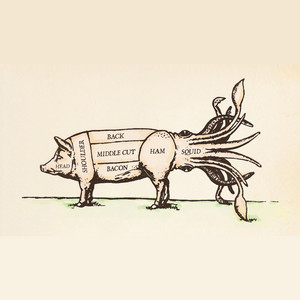
That address, ThisAmericanLife .org, also at our website, T -shirts and prints inspired by Ben Calhoun's Kalamari Story.
They show basically an illustration of a pig like you would see at a butcher and then coming out of its butt is a squid.
It turns into a squid at the butt and they're awesome.
And you can buy them as a T -shirt or as a print at ThisAmericanLife .org.
This American Life is delivered to public radio stations by PRX, The Public Radio Exchange, WBEZ management oversight for our show by our boss, Mr. Torrey Malatea.
After a hard day at the radio station, he always declares on his way out the door.
Man, I'm going to eat me some buns tonight.
You know, I mean...
that's just the way it is.
I'm Ira Glass. And I'm Ira Glass.
He's actually Fred Armisen, by the way.
You can check him out on the latest season of Wednesday on Netflix.
Back next week, more stories...
of This American Life.
Not us soul can bust this team in two We stick together like glue Okay, I think we're done and I think we should cut I think we are I think—are we okay?
I think we're good I think we're good I'm not too worried about it I think we're pretty good, I think we got it I wouldn't worry about it for my shadow and me.
Next week on the podcast of This American Life, we visit a hospital in Africa, complete with beautiful operating rooms and flying drones that carry snakebite anti -venom.
They treated a big chunk of its country's people for absolutely free.
In February, their funding was shut down when the Trump administration closed USAID.
Now the people running this hospital are pondering what was good and what was bad about what they built here.
That's next week on the podcast on your local public radio station.