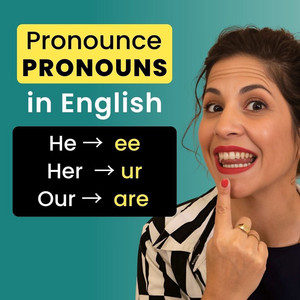
Pronouns are one of the first things you learn in English, but are you actually pronouncing them correctly?
So today I'm going to teach you the correct pronunciation of pronouns and along the way we are going to practice connected speech. Hey, you're listening to the Influency Podcast. I'm Hadar, your host, a pronunciation expert, fluency coach, and a proud non -native speaker.
speaker. With over 16 years of experience teaching, I am here to share with you all my secrets on how to show up in English clearly, with confidence, and freedom.
On this podcast, I'll provide step -by -step strategies, lessons, stories, and practical tips to keep you inspired and motivated on your English journey.
Are you ready? Let's do it.
Hey everyone, it's Adar.
Today we are going to talk about pronouns.
Pronouns are one of the first things you learn in English.
But are you actually pronouncing them correctly?
Because when it comes to pronouns, it's not about the proper pronunciation.
pronunciation. It's about how you pronounce them when you connect words together, which is what we usually do in English.
So today, I'm going to teach you the correct pronunciation of pronouns, and along the way, we are going to practice connected speech. If you're new to my channel, then hi, my name is Hadar.
I'm a non -native speaker of English, and I'm here to help you speak English with clarity, confidence, and freedom.
You can check out my website for a lot of free episodes and resources and pdfs and audio practice absolutely free so go to hadarshamish .com and explore away you can also follow me on social media so today we're going to talk about the pronunciation of pronouns so you can speak faster link words more easily and understand other speakers better let's start with he him his and himself so third -person singular male the word he is pronounced with an H on a high e he he he well when it's unstressed or in the middle of the sentence which is usually the case we drop the H and we just pronounce it as E
for example izzy is he izzy izzy coming coming over?
Is he coming over? Is he?
Is he? Is he? Is he coming over?
But he doesn't like the movie.
But he. Buddy. The T becomes a flap T, the H drops.
Buddy, buddy, buddy.
But he doesn't like the movie.
Now, yes, if you hear the word buddy, hey, you're my buddy, or buddy, my favorite guy in the world, it does sound the same, because a D between two vowels and a T between two vowels sound the same in American English buddy buddy buddy but he doesn't like the movie so when you hear that it could be but he doesn't like the movie or buddy my friend buddy doesn't like the movie how do you know context when we use pronouns it's usually when you already know who we're talking about so this is when you'll know it's he and that's someone named buddy but he doesn't like the movie I didn't know he was there.
I didn't know he was there.
No we. No we. No he was there.
I didn't know he was there.
Now, you can absolutely pronounce the H here.
I didn't know he was there.
I didn't know he was there.
That's good. Okay, but the reason I teach you that, is first because sometimes when you drop the H it's easier to connect, and for some speakers the H is actually difficult to pronounce.
So, if you can drop it and you're still gonna sound clear.
Why not? I didn't know he was there.
Now, here's the thing.
You can only drop the H when it's unstressed, okay?
If you want to indicate that he is John and not Mark, then you definitely want to pronounce the H.
For example, I didn't know he was there.
So when the word he is emphasized in the sentence, you've got to use the H.
You can't say, I didn't know he was there, because then it's just not going to sound great, great, okay?
I didn't know he was there or I didn't know he was there.
Now, the word him is pronounced as in.
I met him, I met him, I met him, I met him last week.
Again, the Flap T, I met him last week.
Or I know him from school, know him, know him, know him, I know him from school.
His is pronounced as is, is, is.
I couldn't find his hat.
I I couldn't find his hat.
Now, something interesting about connected speech. If a word starts with a vowel and the previous word ends with a consonant, here in this case, it's the D of find, and the next word is is because we dropped the H, then the D of find becomes the beginning of the next word, the beginning of D.
That's what happens when you connect words together.
He couldn't find his hat.
It's just easier. He couldn't find his hat.
Find is. Find his. Find his.
He couldn't find his hat.
Or I spoke to his mom.
I spoke to his mom.
I spoke to his mom.
Now, sometimes even if it's the beginning of the sentence, you will still drop the H.
His dog is out of control.
His dog is out of control.
However, when it's at the beginning of the sentence, sometimes you will hear people pronouncing the full H.
His dog is out of control.
His dog is out of control.
Even when it's not stressed.
Okay, let's move on to she.
I have nothing interesting to say about the word she.
She is always pronounced as she, she, she.
She is always right.
And she is always right.
You know that anyway, right?
She. It's a sh sound and an e.
She's, she's, she's.
No reductions here.
year. However, when we say her, that's when we drop the H.
So if you want to say, I called her on the phone, you can drop the H and it becomes, I called her on the phone.
I called her, called her, called her.
I called her on the phone.
Or, can you let her in?
Letter, let her, letter.
Yeah, just like the letter you write.
Can you let her in?
Can you let in or her car broke down her car broke down if you say it quickly and the her is not pronounced you can drop the h but again when it's at the beginning of the sentence sometimes you might want to pronounce the h for clarity so it's easier to drop the h when you connect words together but you can choose herself same thing she did it herself herself herself she did it herself so here or the T, again, connected speech becomes the beginning of the next word because the next word herself starts with a R sound.
It's a, it's a vowel.
So, this is what it sounds like.
She did it herself.
The T sounds like a light D.
She did it herself.
She did it herself.
She needs to be honest with herself.
With herself. With herself.
Everything's connected.
She needs to be honest with herself.
She's not always taking care of herself.
She's not always taking care of herself.
Care -a -ver -self. Of -er -self.
So, the V of the word of, yes, it's a V, not an F, becomes the beginning of the word herself when you drop the H.
Care -a -ver -self. Care -a -ver -self.
Care -a -ver -self. Care -a -ver -self.
Now, even if it might be hard right now, to follow all the sounds and to pronounce it correctly.
Don't worry. The idea here is to say these phrases again and again, focus on the actual sounds and the sequence without thinking about how you're going to do it out there when you speak.
Don't think about it just yet, okay?
What we're doing now is building pronunciation confidence, is allowing you to understand what to do, is training your mouth to pronounce it differently in a new way.
And you're doing it again and again and again, building pronunciation confidence, and then you'll start noticing that you're using it without even thinking about it.
That is the idea of pronunciation work that you don't have to think about it that you're actually able to use it spontaneously.
By the way, this is why I created for you a PDF with drills used for pronouns with an audio practice so you can just listen to it and repeat it with me again and again and again because I really want you to be able to implement it and to see how it impacts your day -to -day speech. Next up, we have the word our.
The word our is rarely pronounced as our, it's usually pronounced as just the letter R.
R. Ah -er. R. R. R. This is our place.
This is our place. Welcome.
This is our place. Now, this is how you pronounce it when it's unstressed if it's stressed it's going to be pronounced as our this is our place not yours our versus yours when these words are stressed full pronunciation no reductions whatsoever when it's reduced in in this case the place and this are stressed then hours pronounced as our this is our place I I think this is our room.
I think this is our room.
Our room, our room, our room.
Let's plan our weekend getaway.
Let's plan our weekend getaway.
So excited. Now, the word ourselves is pronounced as ourselves, ourselves, ourselves.
Honestly, even when this word is stressed, I hear it as ourselves.
So when it's reduced, when it's stressed, ourselves.
We need to push ourselves harder.
We need to push ourselves harder.
Ourselves harder. This is a little tricky, right?
I feel it. Ourselves harder.
Ourselves harder. So, we need, my friend, we need to push ourselves harder to pronounce this phrase.
Let's remind ourselves of the goal.
Let's remind ourselves of the goal, speaking English with clarity, confidence, and freedom.
Let's remind ourselves of the goal.
We're doing this for ourselves, not for anyone else.
We're doing this for ourselves.
ourselves, for ourselves, for ourselves.
Good. Next up we have your, your.
And how is it pronounced?
Yer, yer, yer. Is this your bag?
Is this your bag? Is this yuh -er, yuh -er, yer?
Yer. Not a lot is happening here.
Yer. Some of you will tell me, no, there's a lot happening in my mouth right now pronouncing both a yuh sound and an R sound, Hadar.
What are you talking about?
YUR. But no vowels really.
YUR. Is this your bag?
Keep it small. Effortless.
Effortless is the secret here.
I like your style. I like your, your style.
Round your lips a little bit.
What's your plan for the weekend?
What's your plan for the weekend?
Your plan, your plan, your plan.
Yourself, yourself, yourself, yourself.
Think like there's an E maybe between the Y.
the R. Did you do that yourself?
Did you do that yourself?
Did you do that? Did you do that?
Did you do that yourself?
You should treat yourself to something nice.
You should treat yourself to something nice.
Take care of yourself, okay?
Take care of yourself.
Okay? Now we have the word them.
Them. And I really like this word, but it can get a little tricky.
When it's stressed, Unstressed, it's pronounced with a voiced T -H, th, tongue out, then a, as in red, and an M, them, them, them.
When it's unstressed, you can either pronounce it as th, th, th, no vowel, it's a schwa, it's reduced, the a is reduced to a schwa, th, but I like to think of it as if there is no vowel in your transitioning between the T -H and the M, th.
them. And sometimes you even drop the TH, and then it sounds like I'll send them the details.
I'll send them, send them.
Or send them, send them, send them the details.
I'll send them the details.
Or I saw them at the store.
I saw them at the store.
I saw them, them at the store.
But, you can also say, I saw them at the store.
I saw them at the store.
Now, if you drop the th, it really has to be pronounced quickly.
You don't want to say, I saw them at the store.
Right? Because then it's going to be unclear.
It's weird, but it's only clear to reduce when it's said fast and quickly.
Otherwise, just pronounce the full word. I saw them at the store.
If you want to slow down, if you want to take your time, if you want to enunciate every word to be clear, that is fine, especially if you don't have a lot of experience with connected speech, especially if you feel like you're still struggling to speak out full sentences.
That is okay. Depends on your stage.
And then just pronounce the full word. Don't use reductions and use this exercise to improve your listening so you understand what people say.
But as you gain more experience and practice connected speech more, you can definitely try it and then you want to make sure that you say it quickly i saw him at the store earlier now tell him when i say tell them could be perceived as two things it could be tell them just like we learned because we dropped the th but it could also be perceived as what tell him because him is reduced to im and sometimes even to um okay so sometimes we don't even pronounce the is sound but just like um So, him can be pronounced as .
And, them can be pronounced as .
So when you hear tell them, without any other context, you won't be able to know if it's tell him or tell them.
So, just something to be mindful of, especially when you listen to other people.
Last but not least, we have it, it.
So, the it doesn't change much, but often it can be reduced to a schwa.
a schwa is a very neutral vowel sound and instead of you'll hear uh and more than the quality of the sound it's just going to be very very short takes up a little space and schwa is really short but it but it but okay and this is what we usually hear when we have the word in the middle of the sentence is it is Is it, is it, is it cold outside?
Is it, is it, is it, right?
You don't hear it. Is it cold outside?
Is it, is it, sometimes it's just zit.
Is it cold outside?
Yeah, it sucks. Yeah, it sucks.
Yeah, it, it, it, yeah, it sucks.
Now, don't get me wrong.
You can still hear people say, yeah, it sucks, eh.
So here, it really depends on your speed, and the speaker, and the dialect they're using, but it's just something for you to be mindful of.
It's gonna rain later.
It's gonna. It's gonna.
It's gonna. It's gonna.
It's gonna. It's gonna.
It's gonna. It's gonna.
It's gonna rain later.
Right? It's not, it's gonna rain later.
It's gonna rain later.
It's great. It's your fault.
It is? Okay, that was it.
Ha! Do you get it? Do you get it?
That was it. Anyway, I hope you found this lesson helpful.
And if you did, make sure to, first of all, like and subscribe and all the things that you do when you watch a YouTube video or when you listen to a podcast, you can subscribe to the podcast. But most importantly, in the show notes, in the description, you will see a PDF link that you can download for free with audio and you can practice these sentences that I just practiced with you and more so you can turn it into kind of like a repeated practice so that it can get into your system.
You'll build pronunciation confidence and you will feel like you're able to use it spontaneously, without always thinking about it, which is what we want.
And if not, it's just going going to help us understand others better because to help you improve your listening, a lot of times, especially when it comes to connected speech and reductions, it has to go through your mouth.
And this is a great way to do that.
All right, my friends, thank you so, so much for being here.
I really appreciate you.
And like I said, if you want to find out more about me and my work and practice with all the resources that I have for you for free on my website, go to hadarshemesh .com.
Have a beautiful, beautiful rest of the day, and I'll see you next week in the next video.
Bye.