Hello, hello, hello, and welcome to English Learning for Curious Mines by Leonardo English,
the show where you can listen to fascinating stories and learn weird and wonderful things
about the world at the same time as improving your English.
I'm Alistair Bunch and today we are going to be talking about Venezuela.
Not specifically, how did this Latin American country go from a wealthy and prosperous
state to one of the poorest in the world?
This is actually going to be the first of three episodes all on the very loose theme of
Latin America.
Next up we are going to talk about a battle between a Wall Street hedge fund and the nation
of Argentina.
And then after that we'll be talking about the self-proclaimed world's coolest dictator,
Mayi Bukkeli, the president of El Salvador.
But before we get right into all of that good stuff, I want to remind you that you can become
a member of Leonardo English and follow along with the interactive transcript and subtitles
over on the website, which is LeonardoEnglish.com.
Membership of Leonardo English gives you access to all of our learning materials, including
instant translations in 12 languages, study packs, all of our bonus episodes and much,
much more.
So, if you are ready to take the next step on your English learning journey, the place
to go is LeonardoEnglish.com.
Ok then, let's get started with the claps of Venezuela.
A few years ago, while on a walk with friends in the countryside of Malta, I got talking
to a man in his 40s.
He wasn't from Malta, so I asked him about his life before he got here.
He had been a successful businessman.
He had worked in the property industry, and his business had provided him with a good
life, a nice house, a new car, everything he and his family could possibly want.
But he had chosen to leave his home country and had made the trip all across the world
to a tiny Mediterranean rock.
With a limited English, he was now washing cars to make ends meet.
This man was one of almost 8 million people who have left Venezuela since 2014, in what
is one of the largest exodus of people in modern history.
He left for the same reasons as almost 25% of his fellow Venezuelans.
His savings were worthless after hyperinflation, the economy was in terminal decline, supermarkets
had no food, there were electricity and water shortages, the hospitals did not have the
medicines or equipment that they needed.
As a father, as a parent, there was no hope for his children, he felt like he had no choice
but to leave.
This clearly was a very sad situation for him and his family, but the thing that I remember
most vividly from that conversation, and from conversations with my Venezuelan friends,
is the love that they have for their country, and the sense of loss that they felt about
what has happened to it.
Venezuela is clearly a wonderful country in so many ways, blessed by great weather, beaches
and landscapes.
It also has the biggest oil reserves in the world, more even than Saudi Arabia.
There are lots of things working in Venezuela's favour, many reasons that the country should
thrive and its citizens should live happy and prosperous lives.
But economically speaking at least, they do not.
By 2021, 77% of the population of Venezuela was living in extreme poverty.
So where did it all go wrong?
As we'll see, there is no one single answer, and a wide variety of points of view about
the root causes of the collapse of the state of Venezuela.
But before we get to pointing the finger, we need to do a brief historical recap, as
well as have a geographical refresher.
Venezuela is at the top of South America, Colombia to the west, Guiana to the east and Brazil
to the south.
And below the surface lies oil.
300 billion barrels worth, the largest proven oil reserves in the world, accounting for
almost 20% of the entire world supply of oil.
To state the obvious, there is a lot of oil.
And since the oil was first drilled in 1914, the fate of Venezuela has been linked like
a Siamese twin to the global oil market.
For much of the 20th century, Venezuela enjoyed a prosperity that most Latin American countries
did not.
But its prosperity came almost exclusively from oil exports.
And any keen student of history knows that this is risky business.
The price of oil rises and falls.
And countries with large oil reserves often fall into the so-called resource trap, or
Dutch disease, where the entire economy becomes so dependent on one commodity that it fails
to develop other sectors.
This is sort of okay when the going is good and the oil price is high.
But when it decreases dramatically as the oil price has done multiple times during the
20th century, that country's income decreases at a similar rate to the oil price.
And although Venezuela did make multiple attempts to wean itself off oil exports, or
at least to properly diversify its economy, it never managed.
It suffered from high levels of government corruption.
Funds were wasted or embezzled.
And by the end of the 20th century, there was an increasing gap between the haves and the
have-nots.
People typically close to government who owned or controlled land or businesses, and everyone
else.
One man thought this wasn't right.
Well, clearly lots of people thought this wasn't right, but one man in particular did something
about it.
In 1992, a then 37-year-old colonel called Hugo Chavez attempted to mount a coup and
overthrow the government.
It didn't work, and he was sentenced to two years in jail.
Just forward to 1998, and this man, Hugo Chavez, had put himself forward as a presidential
candidate.
His message was anti-corruption and anti-poverty, and his proposal was simple.
Vote for me, and Venezuela will become a more equal, more prosperous country.
It was a message that resonated with a public fed up with seeing the rich grow richer,
while their living standards had stagnated, fed up with seeing the waste and corruption
around it.
Chavez walked away with 56% of the vote to his closest opponent's 40%, and on February
2, 1999, he was sworn in as the president of Venezuela.
He was the most left-wing president in the history of the country, but he did not consider
himself to fit neatly into any particular political ideology.
In an interview shortly after the election, he said, if you're attempting to determine
whether Chavez is of the left, right, or center, if he is socialist, communist, or capitalist,
well, I am none of those, but I have a bit of all of those.
And he added that he would go, quote, beyond socialism and even savage capitalism.
This was nice rhetoric, but much of his policy followed the playbook of socialist populist
leaders, high levels of government spending, redistribution of wealth, nationalization
of private property and businesses, and mass state welfare programs.
In principle, a lot of this sounded very good, and indeed it had some commendable results.
Inequality reduced dramatically, and by 2011, Venezuela was the second most equal country
in the Americas, behind only Canada.
The poverty rate fell from 49% in 1999 to 32% in 2013.
In poverty fell by 71%, unemployment fell by 50%, university enrollments doubled, deaths
from malnutrition fell by 50%.
If you were an average Venezuelan, it's fair to say that life overall got better under
Hugo Chavez, at least for a bit.
But there was a problem.
This was all underpinned by oil exports.
The price of a barrel of oil went from $12 when Chavez was sworn in in February 1999, right
up to a high of $140 in June of 2008.
Throughout this period, there were minor crashes, falls in price, which forced the Venezuelan
government to borrow money to continue its large social welfare spending.
But overall, the price continued to rise.
And with the oil gushing and cash flowing into the country, there was little incentive
to invest in anything else, or to keep a careful eye on where the state funds were going.
One area that Chavez did keep particularly tight control over, however, was the Venezuelan
currency, the Bonavard.
In 2003, he implemented currency controls, meaning that the Venezuelan government decided
how much the Bonavard should cost.
The main idea behind this was to control inflation, as if the state set the price of a currency,
in theory, the prices of goods shouldn't fluctuate.
Emphasis on in theory.
The price it set was $1,600 for a dollar, and the only legal way in which Venezuelan
citizens could exchange their hard-earned Bonavards for dollars was through the government,
at the official government-approved rate.
The problem was that this rate massively overvalued the Bonavard.
It made the Bonavard seem stronger than it actually was.
The logic behind this was to make imported goods cheaper, to make it more affordable
for Venezuelan businesses to buy goods from abroad.
Although this might sound good in practice, it ended up being a disaster.
It discouraged the production of local goods for export, because it was expensive for foreigners
to buy them at the official rate.
A vibrant black market emerged, as it was difficult for average Venezuelans to get their
hands on foreign currency, given that this was controlled by the government.
It also encouraged mass corruption, as officials who controlled the exchange could make huge
profits by buying dollars at the official rate, and then selling them at the unofficial
black market rate.
To give you a working example, a Venezuelan official could arrange for a company to buy
$1 million US dollars at the official rate of $1,600 Bonavards to the dollar.
But this company could turn around and then sell these US dollars on the black market
for almost double the price.
What ended up happening is to put it simply, mass fraud.
Companies would manipulate invoices to claim that they needed dollars to buy foreign goods.
But these goods never existed.
It was one huge scam.
According to one estimate, more than $300 billion was stolen in 10 years, $30 billion
every single year, which went into the pockets of government officials and their friends
in business.
Pretty awful stuff.
And that wasn't all.
While these currency controls made imports cheaper, they hurt Venezuela's main export, oil.
The government sold oil in US dollars, but because the Bolivar was artificially strong,
when these dollars were converted back into the local currency, the revenues were significantly
less than they would have been with a more realistic exchange rate.
This financial discrepancy led to substantial economic losses, further exacerbating the
country's financial distress.
Once more, there were controls on the maximum prices that a business could charge for certain
items, like essential foodstuffs, medicines, and even rent.
This might have sounded good, because who likes paying more for anything.
But the reality was that this disincentivized businesses from producing these goods, as
they wouldn't be able to make a profit if they were forced to sell it at below the cost
of production.
There is a good reason for almost every economist looks at price and currency controls and says,
hmm, bad idea.
And Venezuela was a prime example of what happens when these are implemented.
You will no doubt have seen pictures of empty supermarket shells in Venezuelan towns and
cities, or huge queues outside, as Venezuelans waited in line to buy basic foodstuffs.
And the irony of these price and currency controls is that they had the complete opposite
effect in terms of controlling inflation.
During Hugo Chavez's 10-year as president from 1999 to 2013, inflation went from as low
as 12% in 2001 to 40% a year by the time he left office in 2013.
The annual inflation rate was an average of 23% during his presidency, meaning that the
Bolivar lost almost 95% of its value during Hugo Chavez's 10-year.
But this was nothing compared to what was to come.
In 2013, after suffering a series of health problems, Chavez handed over the presidency
to Nicolas Maduro and the economic situation went from bad to worse.
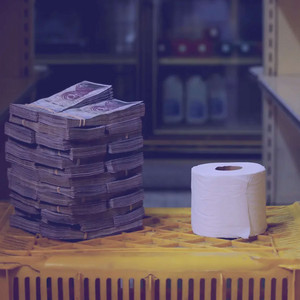
Inflation went from pretty bad to crippling, reaching 130,000% in 2018, making the currency
worthless and practically unusable.
The Venezuelan economy shrunk by 86%, poverty rose to 96% by 2019, and one-third of the
population was malnourished.
And almost 8 million people voted with their feet, like the man I mentioned at the start
of the episode, leaving the country with nothing more than the t-shirts on their back.
After all, if they had any savings in Bolivars, the Venezuelan currency, they were worthless,
literally not worth the paper they were made out of.
And when it comes to pointing fingers, assigning blame, there are, of course, conflicting
views about who and what ultimately caused the collapse of this country that once had
a GDP per capita of 80% of the United States, and was the richest country in Latin America.
For some, particularly on the political right, Venezuela is a prime example of what happens
when a country implements socialist policies, from currency controls to price controls, from
taking land from businesses to increased state control, socialism will always fail.
For others, the blame lies squarely with chaffes, some point to particular policies,
like currency controls, while others point at his authoritarian tendencies, or failure
to control corruption.
For others, it is Maduro, who must take the line share of the blame, as it was under
his tenure that Venezuela went from failing to failed state.
For others, the blame lies with the United States, whose sanctions against Latin American
country, were the nail in the coffin of a left-wing regime that the US had been seeking
to destroy ever since chaffes was elected president back in 1998.
For others, we need to go further back to the colonial past of Venezuela, and the fact
that oil was discovered before the country had developed a robust enough democracy to
withstand the financial windfall that oil brought.
From the dozens of articles, papers and interviews I read while researching this topic, the thing
that struck me most was that the greatest criticism for the Venezuelan government came
not from foreign commentators, American policymakers or regional rivals, but from young Venezuelans
who had been forced to escape abroad.
There was this profound sense of both anger and sadness, anger for a future that had been
stolen from them.
Sadness about the thought that in all probability, they would never be able to return to a country
that had such promise, a country that should have been rich and prosperous.
Hugo Chavez was elected president in 1998 on a message of hope and prosperity.
The unfortunate reality is that this was the start of one of the greatest destructions
of hope and prosperity in modern history.
OK, then, that is it for today's episode on Venezuela.
To state the obvious, there is a huge amount to this subject, many elements that we didn't
have the time to go into today.
But I hope this gave you some idea about why Venezuela is in the situation that it is
now.
As always, I would love to know what you thought about this episode.
We've got lots of Latin American listeners and quite a few Venezuelan listeners, so I
would love to know who holds responsibility for the current situation in Venezuela.
And are you hopeful for the future?
For the members among you, you can head right into our community forum, which is at
community.lionadoenglish.com and get chatting away to other curious minds.
And if you're not a member, then I'd still love to know you can email me at highandleanadoenglish.com.
And as a final reminder, if you enjoyed this episode and you are wondering where to get
all of our bonus episodes, plus the interactive transcripts, subtitles and key vocabulary,
then the place to go for that is lionadoenglish.com.
And if you aren't yet ready to become a member, but you would like to do something to support
the show, then I would love for you to think about leaving a review or a star rating on
your favourite podcast app.
It takes less than 30 seconds to do, but they are super helpful.
And each one brings a smile to my face.
You've been listening to English Learning for Curious Mines by Lionadoenglish.
I'm Alistair Bunch, you stay safe and I'll catch you in the next episode.