Hello, hello, hello, and welcome to English Learning for Curious Mines by Leonardo English.
The show where you can listen to fascinating stories and learn weird and wonderful things
about the world at the same time as improving your English.
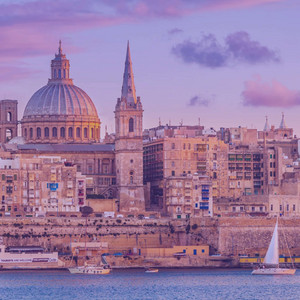
I'm Alistair Bunch and today we are going to be talking about a tiny Mediterranean island
called Malta.
It is a place I called home from 2017 to 2024.
So you could say that this is the result of seven years of research, conversations and
observations.
There is so much to say that I've actually split this into two episodes.
In part one, in this episode, I'll talk about Malta in general and in particular what
it is like as a place to learn English.
In part two, which is going to be one of our only episodes, I'll go a lot deeper into
some of the things that you probably wouldn't notice as a tourist and talk about my experiences
on everything from government corruption, Malta's relationship with the EU and the concept
of Malta's identity.
But before we get right into this more personal than usual episode, I want to remind you
that you can become a member of Leonardo English and follow along with the interactive transcript
and subtitles over on the website, which is LeonardoEnglish.com.
Membership of Leonardo English gives you access to all of our learning materials, including
instant translations in 12 languages, study packs, all of our bonus episodes, like the
second part of this one on Malta and much, much more.
So if you are ready to take the next step on your English learning journey, the place
to go is LeonardoEnglish.com.
Ok then, let's get right into it and talk about Malta.
In December of 2016, my then fiancé got a job offer.
It was for a job at the University of Malta.
Neither of us knew much about Malta or had ever been there.
All I knew was that it was very hot.
A boy from my school used to go on holiday there, and the year had become a destination
for British stagdews and school leaving parties.
My fiancé knew it was just south of Sicily, and her mother was worried that we would be
living in some deserted dusty village surrounded by only goats for company.
The contract was only for one year, but we both thought why not?
A year is only a year.
If it is a total disaster, then we can return to London, and you never know, it could be fun.
This was almost 8 years ago now, and a few months ago we left Malta for good.
So I thought it could be interesting for me to tell you about my observations and reflections
on life in Malta, and how the country has changed even in the relatively short time
that I was there.
After all, I get emails all the time from people who are considering going to Malta to learn
English, or even moving to Malta.
So if you are that kind of person, I hope that this will be helpful.
And if you are listening to this in Malta, or if you have already spent time in the country,
well perhaps it will be interesting for you to hear someone else's point of view.
Of course, this all comes with the caveat that it is based on my experience.
Malta might be a small place, but it is varied, and everyone will have different experiences.
Now, for those of you who know absolutely nothing about Malta, let me start with a few
basic points.
Malta is a tiny country in the Mediterranean, about 100 kilometres south of Sicily.
It is not part of Italy, nor is it part of the United Kingdom, although it was under
British rule until 1964.
One of the main relics of British rule is the reason that you might have heard of Malta,
or have been there.
English is an official language, and there are 35 English schools in Malta, welcoming tens
of thousands of students every year.
So, to answer a question that I receive almost on a weekly basis, should I come to Malta
to study English?
Clearly, the answer is it depends, but here are some things to consider.
There are broadly three categories of people who come to Malta to learn English.
First, the largest category is of the French, Italian or German teenager, who comes for
a week or two in the summer as part of a large language group, and returns home with a
sore head, some serious sunburn, perhaps some formative romantic experiences, and an ever
so slightly improved understanding of what a phrasal verb is.
This is the largest category in terms of student numbers, making up almost 50 per cent of all
students coming to Malta.
But it is especially concentrated in the summer, so outside of July and August, you will
be unlikely to find these types of students in your class.
The second category is people who are studying at an English school for purposes of immigration,
with most of these students coming from South America, predominantly Colombia.
The primary purpose for most of these students is to emigrate and live in an EU country
with better economic opportunities, so most will come, study English at a school for a
few months, and then get a job working in a bar or a cafe.
If you are from Colombia, you probably know already that Malta is a big destination for
Colombians, but if you didn't, it might surprise you if you arrive in Malta and hear
Colombian accents on every street corner.
In fact, there are so many Colombians now that at some English schools, they are not allowing
more Colombian students, so that there is a proper mix of nationalities in the classroom.
I have a good friend in Malta who runs a business exclusively for Colombians coming to Malta
to study English, and I can tell you first hand, it is a big business.
There are lots of Colombians studying English in Malta.
And then the third category of learner that you will find is the adult learner who is
taking a course for an extended period for work or professional reasons.
Someone who needs to quickly upskill their English and is often being sponsored by their
employer.
There are lots of people from places like Japan, Korea and Turkey in this category, people
who will take a career break to focus on their English.
And these kinds of people, in my experience at least, are by far and away the most dedicated
students.
Clearly, not everyone fits neatly into these three categories, but this is a helpful
way of thinking about the different types of people that you might encounter in an English
school in Malta.
So what factors should you take into consideration if you are thinking about whether to come
to Malta to learn English?
If you are looking for an immersion English experience, and you want to speak English
from the moment you wake up, until the moment you go to bed, then Malta is a good option.
Of course, you can also have this in somewhere like London or Oxford or New York or Boston
or Sydney, but those places might be a long way from home, and they are certainly more
expensive.
The cost of learning English tends to be lower in Malta than in the UK, North America or
Australia.
So if price is an important factor, if you are paying for it yourself, rather than your
employer, Malta could be a sensible choice.
And another perhaps blindingly obvious thing to mention is that Malta is a Mediterranean
island, and if you like the sun and lying on the beach, Malta ticks a lot of boxes.
The official tourist board boasts that the island has 300 days of sunshine, and this
is not a lie, for much of the year it is simply glorious.
Summers are incredibly hot, too hot for my taste, and the winters are cold because most
houses have no heating.
But outside those periods you will be blessed with blue skies and wonderful warm sun,
and because it is such a small place, you will never be much more than 20 minutes from
the sea.
The third factor to consider, which might be an advantage or a disadvantage, depending
on what you are looking for, is that Malta is, as I've said already, a tiny island.
It is 316 km², and although it is incredibly densely populated, it has a small town feel.
There is a lot to do for a small island, but at the end of the day it is a very small
place, and if you are looking for a vibrant cultural scene with different plays and shows
to go to every single evening, and opportunities to go on expeditions in the country every weekend,
Malta probably isn't the right place for you.
But one of the benefits of it being this small, and of having such a high concentration
of foreigners and people learning English, is that it is incredibly easy to meet people
and make friends.
There are meetups, sporting clubs, and in my experience at least, it is pretty easy
to take part in almost any activity you like, and make new friends along the way.
It is also very easy to get to almost any European destination.
There are cheap flights all over Europe, so that is a major advantage, especially for
non-Europeans, whose study visa would allow them to travel all over Europe.
So to summarize, if you want an international atmosphere, reasonable prices, and like the
idea of spending time on a Mediterranean island, or even using it as a launch pad for exploring
the rest of Europe, then I definitely recommend you consider Malta as a place to study.
Now what about Malta itself, from a non-English student perspective?
The first thing to mention is that Malta has been experiencing an economic boom over the
past 15 years or so, created principally through attracting online gambling companies
to the island, as well as selling citizenship.
I'll tell you a bit more about my opinions on this and experiences of it in part two.
But from a practical point of view, this has resulted in the country developing at break
next speed.
It's very noisy, there is constant construction, a lot of traffic, horns beeping, and especially
if you come from a more rural environment.
You will probably be struck by how many people there are, especially in the main tourist
areas.
And how crowded it feels.
And one thing that might surprise you coming to Malta is how few Malta might come across.
The population of the country, according to official statistics, is more than one quarter
non-Maltese.
So there is one foreigner for every three Maltaese people.
This is especially noticeable in touristy areas, where you can easily go from cafe to
supermarket to shop to hairdresser to restaurant to bar, and not a single person will be from
Malta, or will be able to speak a word of Maltees.
So where are all these foreigners from?
Historically, most foreigners in Malta used to be from the UK and Italy, but in recent
years, Brits and Italians have been overtaken.
There are still plenty of British and Italian people, but now three-quarters of all new immigrants
to Malta are from non-EU countries.
These tend to be people from places like India, Pakistan, and the Philippines, who have
often been drawn to the country to work in hotels or restaurants or in construction by
the promise of a simple visa process, decent wages, a good work-life balance, and the
possibility of sending money home every month.
The reality is that Malta simply doesn't have enough Maltees people who are prepared
to do this hard manual labour, and so the country has turned to imported labour to fill
the gap.
And as a result, the population has increased dramatically, increasing by 34% between 2002
and 2022.
Now what does this mean?
On a practical basis, along with very favourable legislation that encourages people to buy
apartments to rent out, the price of rent has shocked up, more than doubling even in
the seven years that I lived there.
And now, Malte is quite an expensive place to live.
In a desirable area, it would not be so unusual to pay €2000 a month for a two-bedroom apartment,
and it is very hard to find an apartment anywhere on the island for less than €1000 a month.
And salaries have barely increased.
The minimum wage is just under €900 a month, so for people employed in low-skilled jobs,
the situation is not particularly rosy.
And this is especially true for foreigners who are more likely to pay rent than Maltees
people.
So the result is that many foreigners simply leave.
According to a recent report, half of all foreigners who come to live in Malte leave within
a year.
And as you've heard by now, I have also left, although I did stay for seven years, six
and a half years more than the average foreigner.
So do you agree?
Not at all.
In any country, there are plenty of things to complain about, but overall, Malte has
many advantages.
It has great weather, beautiful villages, the sea, the sun, very friendly and welcoming
people.
And I am incredibly grateful for having had the opportunity to call it home for a not
insignificant period in my life.
So, if you have the chance to visit Malte, or even to study English there, my advice
to you would be the same as I thought over seven years ago now.
Just do it.
It's a Mediterranean island.
What's the worst that could happen?
Okay, then, that is it for this little taster of what it is like to live and perhaps study
English in Malte.
There was far too much to put into one episode, so keep a lookout for part two where I'm
going to go a level deeper and talk about political corruption, fraud, the EU and what
it means to be Maltees.
And if you haven't had enough Malte yet, we do have other episodes on this unusual little
country.
Episode number 143 is on the great siege of Malte and episodes 306 to 308 are a three-part
mini series on the murder of Daphne, Karawana, Galicia.
And episode number 358 is on how Malte became an online gambling hub.
So if you haven't listened to those yet, well, they are there waiting for you.
And a final point, if you enjoyed this episode and you are wondering where to get all of
our bonus episodes, like part two of this mini series, the one on the great siege of
Malte and over 200 others, plus the interactive transcripts, subtitles and key vocabulary,
then the place to go for that is LeonardoEnglish.com.
And if you aren't yet ready to become a member, but you would like to do something to support
the show, then I would love for you to think about leaving a review or a star rating on
your favourite podcast app.
It takes less than 30 seconds to do, but they are super helpful and each one brings a smile
to my face.
You've been listening to English Learning for Curious Mines by LeonardoEnglish.
I'm Alistair Vodge, you stay safe, and I'll catch you in the next episode.