Hello, hello, hello, and welcome to English Learning for Curious Mines by Leonardo English,
the show where you can listen to fascinating stories and learn weird and wonderful things
about the world at the same time as improving your English.
I'm Alistair Budge and today is part three of our mini-series on fertility.
In case you missed them, in part one we talked about the world's shrinking population,
how contrary to the fears of demographers and economists throughout history,
the world's population is set to get smaller, not bigger.
Then in part two, which was one of our member only ones,
we looked at the medical marvel that is IVF, in vitro fertilization,
and hinted at some of the ways in which this is changing the way that people think about having babies.
And in the final part, part three, we are going to talk about the future of fertility,
and explore some of the wackier plans and ideas that some people believe will become reality.
But before we get right into all of that good stuff,
I want to quickly remind you that you can become a member of Leonardo English
and follow along with the interactive transcript and subtitles over on the website,
which is LeonardoEnglish.com.
Okay then, the future of fertility.
If I were to ask you what novels, orcas, Gila Wales, and Baluga Wales had in common,
you would probably look at me with an odd look.
They all live in the scene. They breathe air.
They swim in a majestic fashion.
Or you might say, well, they're all whales. That's what they have in common.
But if I asked you what novels, orcas, Baluga Wales, and humans had in common,
you might have a bit more trouble finding a common thread.
Interestingly enough, the thing that we and these types of whales have in common,
something that doesn't affect any other animal to the same degree,
is that our ability to bear children decreases with age.
Unlike elephants or dogs or cats or any other mammal for that matter.
As we both know, a woman's ability to conceive a child doesn't last forever.
It starts to decrease after the age of 30 or so,
and decreases even more sharply after 40.
It is an unfortunate fact of life.
And as we talked about in the last episode, IVF, or in vitro fertilisation,
is one tool that can help us overcome this natural cliff.
It is wonderful and has led to more than 12 million births
that might not have been possible without it.
For the parents of IVF children, it is a miracle.
And, of course, when the first IVF baby arrived in 1978,
it did seem like a miracle for everyone.
An egg fertilised in a petrudeish and successfully implanted back into the mother.
It had never been done before.
But since that first birth, IVF has become mainstream in many developed countries.
And now there is more than one IVF baby born every minute.
IVF is almost undoubtedly the greatest gift to fertility in the modern era.
But, on one level, it is not revolutionary.
It helps pregnancy along.
It doesn't fundamentally change the way that humans reproduce.
For an IVF baby to be born, an egg needs to be taken from a woman,
combined with sperm from a man, and then implanted back into the womb of a mother.
Yes, the process is complicated and painful, physically and emotionally.
But it mimics a natural pregnancy, where the same thing happens,
just in a slightly different place, exclusively inside a woman's body.
Some of the ideas about future fertility technologies and procedures
are very different, completely reshaping our ideas about how humans can reproduce.
Most of these developments are tackling the biggest issue with human fertility.
That, a woman has a limited number of eggs, and with age, the quality and quantity of these decrease.
And, to make a baby, you need an egg, and that egg needs to come from a woman.
Or does it?
In 2016, two Japanese researchers managed to successfully create an egg cell
out of skin cells from the mouse's tail.
The egg cells were fertilized and then implanted into the uterus of a group of female mice.
The mice had babies, 10 in total, who came out and were perfectly normal and healthy mice.
These mice were able to reproduce themselves in a normal way, and all of their babies were perfectly normal.
Now, to get technical, this is called in vitro gamutogenesis, or IVG for short.
In vitro means in a test tube, or in some kind of dish outside a living organism.
And gamutogenesis refers to the process in which a cell turns into a gamut,
which are the male or female cells, which are able to unite with the cell of the opposite sex,
and reproduce.
Now, IVG has to date only been successfully accomplished in mice.
But, according to one Brown University professor, it is a question of when,
not if, the same can be accomplished in humans.
This would be revolutionary for all sorts of medical treatments.
You could grow new cells for areas of the body that have been damaged.
You could create tissues or organs in a laboratory.
It would be revolutionary in all manner of ways.
But, coming back to the matter at heart, it could, and almost certainly would, revolutionise fertility,
and the way in which people think about having children.
As we talked about in the last episode, IVF is fantastic, but it requires normal eggs from the mother.
If these eggs are either not of sufficient quality, or simply do not exist,
for all the wonders of IVF, a pregnancy cannot be magicked out of thin air.
But, IVG, creating an egg from a cell from your thumb or chest or leg,
well, that removes the need for an egg to be removed from the mother in the first place.
It would remove a painful step from IVF, and remove an age cap.
As theoretically, a healthy egg could be created from a skin cell of a 100-year woman.
Now, I imagine that the last thing a 100-year woman would want to do is to have a baby.
But, the technology to do so will almost certainly exist, whether that's in five years or 50 years.
It is coming. Another way that this could change the future of fertility is for same-sex couples.
At the moment, if a same-sex couple wants to have a child, whether it's a male male couple
or a female female couple, they need to get either the egg or the sperm from another person.
To state the obvious, women don't have sperm and men don't have eggs, and you need both to make
a baby. Theoretically, and let's take a female female couple here.
Sperm could be created from the cells of one of the women and implanted into the other one.
So, you would have a child that was the biological child of the two parents.
Of course, with a male male couple, you would have the additional complication of requiring a
woman who was willing to carry the child. But an egg could be created from one of the men,
while the other gave the sperm, and it was implanted into the host woman.
So, single-sex couples could have children and both be the biological parents.
And, in what might sound like a step too far to some people, this could theoretically allow
for a single parent to provide both the sperm and the egg, so that a single person can be both the mother
and the father. And if the technology also existed to strip out any potential complications given
the similarity in DNA between the two, well, some people believe that it is perfectly possible.
Ethically problematic, perhaps, and of course it would radically change society if a person could
reproduce without the need for a partner. But, perhaps in 50 or 100 years, this will be a reality.
Now, if technology will solve the problem of the sperm and the egg, what about the process
of actually taking a fertilized egg and turning it into a fully functioning baby?
To do that, you need a womb, and wombs are only found in women.
Well, that is also something that may not be the case in 10 or 50 years from now.
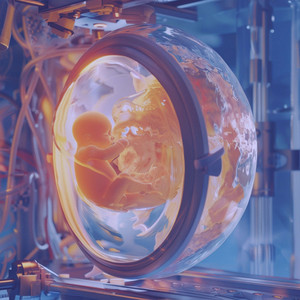
There is a lot of work being done at the moment on creating artificial wombs, and significant breakthroughs
have been made. These artificial wombs are aimed at solving a particular problem, and that is with
babies who are born prematurely. Premature technically means born before the 37th week pregnancy,
so three weeks early. Globally, this affects about 10% of babies, so that's 15 million babies a year.
But we're not talking about all premature babies. For many, especially those born only just
premature in the 36th week, let's say, survival rates are excellent. In fact, in the UK at least,
for a baby born at 34 weeks, the survival rate is exactly the same as for a baby born at term,
at 40 weeks or more. But, as you will know, the more premature a baby is, the worse their chances.
For babies born at 22 weeks, sadly, they only have a 10% chance of survival.
They will be put in an incubator given every possible chance at life, but their little lungs are under
develops and not ready to breathe air. Yes, they stand a significantly better chance of survival
in an incubator than anywhere else, but what they really need to be is back in the womb.
And this is exactly what an artificial womb is trying to solve. When a baby is in the womb,
their only source of nutrients is the umbilical cord. So, theoretically, if a baby could be put
into a womb like container and attached to a cord that supplied exactly the same nutrients as
the mother would supply, then they should be able to develop healthily as if they were in the womb.
This switch from the mother's natural womb to an artificial womb would need to be done very quickly,
via cesarean section, and the umbilical cord cut and immediately connected to the artificial one,
and the baby transferred into the artificial womb without ever thinking that anything had changed.
But, theoretically, it is possible. And, practically, it is working, or at least it has been tested on
baby lands successfully. To date, there have been no human trials, but in both the EU and in the United
States, there are discussions about how to move these forward. Of course, finding a parent willing
to give it a shot might be tricky. The survival rates of these extremely premature babies might
overall be low. But, as a parent, of course, you would always hope that your baby would be in that
10% that did survive. So, no doubt it would take a very brave parent to say, yes, I'm willing to
be the first, knowing full well that it was an experimental procedure. If it does work safely,
and becomes as routine as putting babies in incubators, or as IVF, then it will be wonderful,
and save the lives of an estimated 1 million babies who die prematurely each year.
It would save their lives, and, of course, save the parents the heartbreak of losing a child.
Undoubtedly, this would be a wonderful thing. But, there are those who fear where this could lead,
and imagine baby factories, where hundreds of thousands of fetuses were being farmed in artificial
wounds, forged from the cells of people who might never have known that their cells had been taken
from them. Or, perhaps even more dystopian, and thinking about what IVG may make possible.
Some mad despot, who has decided to have a thousand children, and has provided the egg and sperm
from his own skin cells. Now, to reiterate, the scientists working on these artificial
wounds have been very clear about the fact that they are designed to save the lives of
premature natural babies. Fears of them being used to create baby factories are completely
unfounded. Growing a fertilized egg into a functioning fetus is a completely different problem,
and there has been no mainstream, serious work done on making this possible outside a human womb.
But, many technological developments, including IVF, have been completely impossible
until they weren't. If pregnancies could happen outside the womb, and if a mother was no longer
required to carry a baby for nine months, how many people would opt not to do it?
If you are a woman listening to this, and you have been pregnant, or perhaps you are pregnant,
at this moment, you may well have very strong views on the subjects. I am clearly not a woman,
therefore I only have an outsider's perspective on what it's like to be pregnant,
but having watched my wife go through it twice, it is obviously very hard work,
and that's before we get to the actual process of giving birth.
What's more, it's dangerous. Provency still kills a woman every two minutes, almost 300,000
women a year. It is a health risk. It is a huge strain on a woman's body that a man doesn't
ever have to contemplate, so if a woman could opt not to carry their baby in their womb,
I for one can understand why. Now to wrap up this episode, and this mini series in general,
yes, there have been many amazing technological and medical advances, meaning that pregnancy
is safer than ever, and is more likely than ever before in history to lead to the birth of a happy
healthy baby. Despite all of this, people are having fewer babies than ever before. So what happens
next? Do humans simply stop reproducing or reproduce in a completely different way? In 2016,
a Stanford academic published a book called The End of Sex and the Future of Human Reproduction,
where he imagines the consequences of a society where people stop having sex for reproductive purposes.
The author believed that this would happen in the next 20 to 40 years, so as early as 2036,
12 years from now. If he is right, well, things are about to get very interesting.
Okay, then that is it for today's episode on the Future of Fertility, and with that comes the
end of this mini series on fertility in the 21st century. As always, I would love to know what
we thought about this episode and of this mini series more generally. For the current and future
mothers, if you knew that using an artificial womb was completely safe, would you do it?
What do you think some of the implications would be for a world where people didn't need to have sex
to have babies? I would love to know, so let's get this discussion started. For the members among you,
you can head right into our community forum, which is at community.leanarloinglish.com and get
chatting away to other curious minds. And as a final reminder, if you enjoyed this episode and you
are wondering where to get all of our bonus episodes, plus the interactive transcripts, subtitles,
and kiva cabri, then the place to go for that isleanarloinglish.com. And if you aren't yet ready to become a
member, but you would like to do something to support the show, then I would love for you to think
about leaving a review or a star rating on your favourite podcast app. It takes less than 30 seconds
to do, but they are super helpful and each one brings a smile to my face. You've been listening
to English Learning for Curious Mines byleanarloinglish. I'm Alistair Budge, you stay safe,
and I'll catch you in the next episode.