Hey everyone, it's Hadar.
Welcome to the Influency Podcast.
Today I have a fun, fun, fun episode for you.
I can't believe I haven't done it before because it's such a great practice.
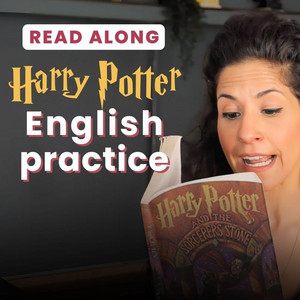
Today we are going to read a story together.
It's not really a story, it's a book, Harry Potter and the Philosopher's Stone.
And no, we're not going to read the whole book together, but we're going to read a small part and I'm going to walk you through some of the words, intonation, rhythm, stress, And of course, pronunciation.
And all you need to do is just shadow me as I read it out loud.
You can also find the text in the description.
So if you feel like reading it while listening to it, not a problem.
I got you. But also just listening and repeating, echoing or shadowing is an excellent practice.
And as a bonus, you get short explanations for me about different things.
If anything, by the end of this session, you are going to learn how to read in a dramatic way.
I'm kidding. You're gonna get more things out of it, I promise.
All right, so let's go ahead and listen to today's episode.
Hey, you're listening to the Influency Podcast.
I'm Hadar, your host, a pronunciation expert, fluency coach, and a proud non -native speaker.
With over 16 years of experience teaching, I am here to share with you all my secrets on how to show up in English clearly, with confidence, and freedom.
On this podcast, I'll provide step -by -step strategies, lessons, stories, and practical tips to keep you inspired and motivated on your English journey.
Are you ready? Let's do it!
Harry Potter and the Philosopher's Stone by J .K.
Rowling. By the way, the name Harry or Harry could be pronounced in two different ways.
In British English, it's more of an A sound before an R.
Harry, Harry. In American English, when the AA appears before an R, the AA sound becomes eh, hairy.
Same thing with the word merry, right?
I'm going to marry you.
In British English, marry, okay?
Because it's technically an AA sound.
Now I'm going to say Harry with an AA, but know that you can say both.
Hagrid raised a gigantic fist, huge fist, a big fist, and knocked three times on the castle door.
Castle. A castle. No T.
The door swung open at once.
Swung is the past tense of swing.
The door swung open at once.
A tall black haired witch in emerald green robes stood there.
stood, uh, stood there.
She had a very stern face.
And Harry's first thought was that this was not someone to cross.
So let me explain. Stern is severe or showing disapproval.
So if I were to read it, I would probably say it like this.
She had a very stern face, right?
Like making that face.
And Harry's first thought was that this was not someone to cross.
To cross someone is to annoy someone or get on their bad side.
You don't want to cross her.
Cross. Someone to cross.
The first years, Professor McGonagall, said Hagrid.
Notice what happens here.
You don't see the T in the script, right?
It's first years. And that's because it represents how people say it.
When the T appears between two consonants, usually it's dropped, just like here, first year's.
First year's. The first year's Professor McGonagall said Hagrid.
Thank you, Hagrid. I'll take them from here.
I will. You can reduce it to I'll.
I'll take them from here.
You can also put the stress on I'll.
I'll take them from here.
As you can see, the intonation of the storyteller or the reader is very subjective.
There isn't just one right way to tell a story, but what you do want to do is to recognize the words that shed a new light on the story or describe something in a way that you don't want the listener to miss, or words that drive the plot or the story or the narrative forward.
and those words are usually emphasized by pitch, usually they're higher in pitch, and by length.
And I want you to notice it as I'm reading the story.
She pulled the door wide.
The entrance hall was so big you could have fitted the whole of the Dursley's house in it.
What does that mean?
The whole of the Dursley's house in it means actually the entire house.
It means it was so big, and that's just like the entrance hall.
In stories, you use a lot of imageries that go beyond the basic description of something to make it more interesting, more imaginative, so that you could imagine it.
That's what I love about stories and plays.
I want you to reduce that you could have fitted to you could have fitted.
You could have, you coulda, you coulda, you coulda fitted, you could've fitted, so I don't actually pronounce the V of the have, you could have fitted the whole of the Dursley's house in it.
The stone walls were lit with flaming torches, like the ones at Gringotts, Gringotts, Gringotts.
The ceiling was too high to make out.
To make out is to see or to understand.
to make out. It was so high, you couldn't even see it or you couldn't even grasp it or comprehend it.
To make out is also to kiss, to make out.
But in this case, that's not the meaning.
So, let's do it again.
And you can just echo me.
So, as I say the sentence, you can just repeat after me.
You have the text in front of you.
If you're listening to the podcast, I'm going to add the script to the description so you can read it there.
The ceiling was too high to make out.
And a magnificent marble staircase facing them led to the upper floors.
They followed Professor McGonigal across the flagged stone floor.
That's a big phrase flagged stone floor.
Flagged in British English means a type of floor like tiles or big pieces of stone.
So flagged stone floor.
Stresses on floor because that's the noun, that's what we're describing.
Flag, stone, floor.
By the way, flagged is also marked for importance.
I flagged this comment so you can take a look at it, right, but in this case, that's the meaning, that's a type of floor.
Flag, stone, floor.
Harry could hear the drone of hundreds of voices from a doorway to the right.
The word drone in this context means a steady or constant sound.
Like the sound of a drone.
But in this case, drone means sound.
The drone of hundreds of voices speaking from a doorway to the right.
The rest of the school must already be here.
The rest of the, the rest of the, the rest of the.
So of oftentimes becomes just a.
But you have to connect it if you want to reduce it.
The rest of the. Let's take the tongue out for the th.
The rest of the school must already be here.
Basically we're saying his thoughts, right?
So, we want to say it in a different intonation than what we said before.
So, for example, if I was in my storytelling voice, Harry could hear the drone of hundreds of voices from a doorway to the right.
Now, Now, in the text, you can see that it's isolated in dashes, long dashes, but you need to do something with your voice to explain it.
So, change your voice a little bit.
The rest of the school must already be here.
A thought. But, going back to your storyteller voice, Professor McGonagall showed the first years into a small empty chamber off the hall.
Chamber is a room used for special or official purpose, off the hall is just not right in the hall but just like a little bit to the side of the hall, off the hall.
They crowded in, standing rather closer together than they would usually have done.
I stress the word usually to emphasize that that wouldn't have been the case unless they were feeling these feelings, probably stress, nervousness, peering about nervously.
So to peer about is to look around.
So they were kind of like looking around nervously.
They were nervous. Now when you're reading about someone in a certain emotional state, you might want to put that emotion into your voice.
They crowded in, standing rather closer together than they would usually have done peering about nervously, right?
You don't want to sound too cheerful here because then it would just not be aligned with what you're reading.
They crowded in standing rather closer together than they would usually have done, right?
That doesn't fit as well.
So what you want to do when you read a story is to try to understand the emotional state of the character that you're talking about, or the atmosphere and then put it in your voice.
Welcome to Hogwarts, said Professor McGonagall.
Here, here's what you can do with your voice.
First, there is the statement made by the character.
Welcome to Hogwarts, said Professor McGonagall.
And then the narrator tells you what just happened.
So usually when the character speaks, you can have one voice and then you can just use your narrator voice to tell it.
and it's different.
I used a lower voice and I said it a little faster.
So let's do it again.
Welcome to Hogwarts, said Professor McGonagall.
The start of the term banquet will begin shortly.
A banquet is a large formal meal for many people.
It's like a feast. So the start of the term banquet will begin shortly.
But before you take your seats in the Great Hall, you will be sorted into your houses.
We'll organize you into your houses.
Okay, so now we want to create anticipation.
So, we might want to use some pauses, and maybe change the voice a little bit.
Create more suspense.
We might want to sound more serious.
The sorting is a very important ceremony.
Because while you are here, your house will be something like your family within Hogwarts.
You'll have classes with the rest of your house.
sleep in your house dormitory and spend free time in your house common room.
Dormitory. Dormitory.
Now, feel free to pause and repeat any line whenever you need.
The four houses are called, pay attention to the pronunciation, Gryffindor, Hufflepuff, Ravenclaw, and Slytherin.
I -I -Sli -the, voice TH, Wren.
Gryffindor, Hufflepuff, Ravenclaw, and Slytherin.
Each house has its own noble history and each has produced outstanding witches and wizards.
So, the word noble means special importance or admiration.
So each house has its own noble history.
Noble is a big word.
You might want to slow down on this word.
And each house produced outstanding.
Outstanding is also a big word.
You might want to stretch it out change the pitch a little bit.
Outstanding. Witches and wizards.
While you are at Hogwarts your triumphs will earn your house points.
Triumphs. F -S. Triumphs.
Triumphs is wins and successes.
So he says while you are at Hogwarts, your triumphs will earn you house points, while any rule -breaking will lose house points.
So here you have this distinction between win or earn and lose, okay?
So when you read something, when there is distinction between two ideas, this juxtaposition where there is like this versus that, then we want to emphasize those words when we read them.
So, while you are at Hogwarts, your triumphs will earn you house points, while any rule -breaking will lose house points.
At the end of the year, the house with the most points is awarded the house cup.
At the end of the year.
At the end of the year.
End of the, end of the, end of the, end of the.
At the end of the year, the house with the most points is awarded the house cup, a great honor.
Honor no, H Oz and father honor.
I hope each of you will be a credit to whichever house becomes yours Be a credit be an advantage So now let's read it again.
I hope each of you will be a credit to whichever house becomes yours The sorting ceremony will take place in a few minutes in front of the rest of the school rest of the, rest of the, rest of the, rest of the.
I suggest you all smarten yourselves up as much as you can while you are waiting.
So to smarten up is to freshen up or to clean up.
Now, this pronunciation is a little tricky.
There are a few ways to say it.
First of all, you can say it with popping the T, like you would in British English.
Very appropriate. smarten or smarten with a small, light T.
Smarten. Smarten yourselves up.
Perfectly fine. You can pronounce it with a nasal stop.
Smarten, a nasal T.
You block the air and you release air through the nose.
smarten, and some people might pronounce it with a glottal stop.
smarten, smarten, smarten yourselves up.
You do whatever is easier for you.
I assume that the small t is the easiest.
Smarten yourselves up.
So, by all means use it.
I just want you to know the different possibilities here.
Her eyes lingered for a moment on Neville's cloaks, which was fastened under his left ear.
So, that whole thing is one phrase.
And then, and on Ron's smudged nose.
Smudged is dirty. Dirty nose.
So, her eyes lingered for a moment.
this is why she said you need to smarten yourselves up.
Harry nervously tried to flatten his hair.
It's probably a little puffy, just like mine.
I shall return when we are ready for you, said Professor McGonagall.
Please wait quietly.
She left the chamber.
Do you remember the meaning of chamber?
A small room used for official or special purposes good Harry swallowed how exactly do they sort us into houses he asked Ron okay try to try to add a little bit of curiosity and concern to your voice how exactly do they sort us into houses he asked Ron some sort of test I think let's try to lift the word
test because that's new information here.
Some sort of test, I think.
Fred said it hurts a lot.
Hurts a lot. Hurts a lot.
Hurts a lot. It's like someone's name.
Hurts a lot. Fred said it hurts a lot, but I think he was joking.
Harry's heart gave a horrible jolt.
A jolt is a sudden movement or a shock or it's kind of like his heart jumped.
Harry's heart gave a horrible jolt, O, jolt.
A test? In front of the whole school?
In front of the? In front of the, in front of the, in front of the, in front of the, in front of the whole school?
whole school, a lot of dark L's here.
But he didn't know any magic yet.
magic magic What on earth would he have to do?
would he you can reduce it to woody woody woody what on earth would he have to do he hadn't expected something like this the moment they arrived so let's emphasize the words expected this and arrived maybe a moment a little bit he hadn't expected something like this the moment they arrived so every
time we stress a word.
It's like lifted a little bit.
He looked around anxiously.
Anxious. Technically it's the a as in cat, but before the ng sound which we have here in the word anxious, it sounds more like an a sound.
Anxious. Anxious. He looked around anxiously and saw everyone else looked terrified too.
Terrified too. Make sure your tea's are clean and crisp.
No one was talking much except Hermione Granger who was whispering very fast about all the spells she'd learned and wondering which one she'd need.
She'd. She'd. She would.
She'd. Harry tried hard not to listen to her." Not to listen to her.
Let's think of the rhythm here.
Harry tried hard not to listen to her.
He'd never been more nervous.
He had, he had, he'd, he'd, reductions.
He'd never been more nervous.
Never. Not even when he'd had to take a school report home to the Dursleys saying that he'd somehow turned his teacher's wig blue.
Just for this part, I'm going to read and I want you to repeat after me, but I'll break it down into phrases so we have a better understanding as to how to connect it and how to read it and where to pause.
He'd never been more nervous.
Never. When you repeat a word, usually you might want to change the pitch a little bit.
Not even when he'd had to take a school report home to the Dursleys.
Saying that he'd somehow turned his teacher's wig blue.
Teacher's wig, connected.
So let's do it again.
He'd never been more nervous.
Never. Not even when he'd had to take a school report home to the Dursleys saying that he'd somehow turned his teacher's wig blue.
He kept his eyes fixed on the door.
On the. On the. If you want to take a shortcut here, place the tongue on the teeth for the N, on, and then release it to the TH.
On the, on the, on the, on the door.
Any second now, Professor McGonagall would come back and lead him to his doom.
Doom is death or destruction.
A bit dramatic, right?
Any second now, Professor McGonagall would come back and lead him to his doom.
Then something happened which made him jump about a foot in the air.
Foot in the air. You can connect it.
A foot in the air. Several people behind him screamed.
What the? He gasped.
That's what it means to gasp.
So did the people around him.
About 20 ghosts, ghosts, had just streamed through the back wall, pearly white and slightly transparent.
They glided across the room, talking to each other and hardly glancing at the first years.
Glancing is taking a quick look, hardly glancing.
They seemed to be arguing.
What looked like a fat little monk was saying, forgive and forget, I say.
we ought to give him a second chance my dear friar haven't we given Peeves all the chances he deserves he gives us all a bad name and you know he's not even a ghost I say what are you all doing here a ghost wearing a ruff and tights had suddenly noticed the first years nobody answered a ruff is a large
round collar this is what it looks like from the 16th or 17th century.
New students said the fat friar.
Friar is like a monk smiling around at them.
About to be sorted I suppose.
A few people nodded mutely.
Nodded. Mutely is quietly, silently.
Hope to see you in Hufflepuff said the friar my old house you know you know move along now said a sharp voice sharp is severe and harsh a sharp voice the sorting ceremony is about to start notice that here the phrase is the sorting ceremony is about to start but even in writing and of course in speaking
there is a contraction so we connect those two words together.
The sorting ceremony is about to start.
Professor McGonigal had returned.
One by one the ghosts floated away through the opposite wall.
This is not the end of the story, but it is the end of this lesson.
In this lesson we practiced telling a story.
I hope you were able to shadow me or to echo me.
Go back to the beginning of the video, pause and repeat.
The script is in the description and of course on the screen if you're watching the video.
Pay attention to voice changes in intonation, rhythm and stress, definitely pronunciation.
And of course, how sentences are structured.
Because you can learn so much, so much grammar and vocabulary and phrases, simply from reading, close reading, and paying attention to all of those things, which is what we have done.
All right, that's it.
Have a beautiful, beautiful day.
If you enjoyed this video, hit like, comment, subscribe to my channel, so you get notified about all the lessons.
and you can also check out my website at hadarshamish .com for hundreds of other lessons and resources.
Have a great day, and I'll see you next week in the next video.
Bye!