Hello, hello, hello, and welcome to English Learning for Curious Mines by Leonardo English,
the show where you can listen to fascinating stories and learn weird and wonderful things
about the world at the same time as improving your English.
I'm Alistair Budge and today is the start of another three part mini series on the sensitive
but important topic of slavery. In part one, in this episode, we're going to talk about slavery
in antiquity in the ancient world. Then in part two, which is going to be one of our member only ones,
we will look at the transatlantic slave trade. The period in history where over 10 million
Africans were rounded up, sold into slavery and packed off on boats to the Americas to labor under
the most unimaginable of conditions. And in our final part, part three, we are going to talk about
the unfortunate reality of modern slavery, of the slavery that still exists today.
And as a quick reminder, if you'd like to get all of the learning materials for this episode
and are more than 400 other ones, then I'd encourage you to check out our membership,
which you can do over at Leonardo English.com.
OK, then we have got a lot to be getting on with, so let's get right into it.
If you are a software developer or you have a technical background, you probably have experience
working with masters and slaves. This refers to a model of communication and control between two parts
of a computer system. The master controls, it issues commands, and the slave awaits commands
and does whatever the master asks it to. This master slave terminology has been in use for over
a hundred years with few people batting an eyelid, thinking that it was in any way problematic.
It made sense. Masters and slaves, those with power and those without, putting aside the ethics
for a minute. These are familiar concepts to all of us. In fact, this master slave terminology
has only recently come under greater scrutiny, with some prominent software companies pushing to
change the language. Of course, language matters, and using the terms master and slave,
reminds us of one of the oldest, cruelest, and most inhumane practices in human history.
The practice of reducing another human being to property, removing their freedoms and forcing
that person to work for free, for the personal gain of someone else. Now, perhaps you might think
it's surprising that it took so long for these terms to be considered inappropriate, but it reminds
us of the sad reality that the practice of slavery has been in existence for practically all of humanity.
There have been masters and slaves for much longer than they have not been.
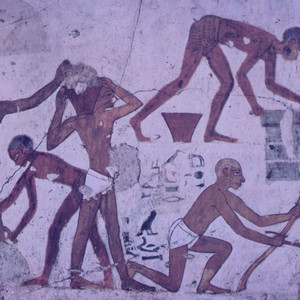
And evidence of slavery goes back as far as the first civilizations.
Mesopotamia, back in 300 BC, ancient Egypt, ancient India, and ancient China.
There is evidence of slavery in all of these civilizations, strongly suggesting that so long as mankind
has lived together in civilization, we have engaged in this most unscivilized of behaviour.
And this is the kind of slavery that we're going to focus on in this episode, slavery in the ancient
world. Now, the most dedicated listeners among you may remember an episode about slavery from our
mini-series on Ancient Rome, where we talked about slaves in Ancient Rome specifically. That was
episode number 318, and we even made another member-only episode on Spartacus, which was episode
number 193. So, if you haven't listened to those, and there isn't enough slavery in this mini-series
for your liking, then you can go back and listen to those ones too. Anyway, the reason I'm
mentioning this is to explain why this mini-series will be slightly lighter on ancient Romans'
slaves, and will be focusing elsewhere. Now, you may know the phrase, the old adage,
history is written by the victors. It means that historical records are normally told through the
eyes and from the perspective of the powerful, those who win wars and conflicts. This most certainly
holds true when talking about slaves and slavery, especially in the ancient world, as there are
virtually no accounts of what slavery was like from the perspective of the slave, no matter what
civilization we are talking about. So, we must look elsewhere. From accounts in stories and texts,
we can hypothesize about what life as a slave might have been like. But one of the best early sources
that gives us some idea about the lives of slaves, and how slaves fitted into a particular
society, come from legal codes, from how slaves were treated in the eyes of the law.
Going right back to the first legal code in known history, something called the Code of Urnamo,
there is evidence of how slaves fitted into society. This code comes from ancient Mesopotamia
in modern-day Iraq, and archaeologists believe it dates from around 2,100 BC, so over 4,000 years ago.
This code has various references for the punishments for different sorts of crimes,
both against normal members of society and against slaves. There are specific laws for what happens
when slaves marry other slaves, when slaves marry non-slaves, and even what happens to a man
who has found guilty of raping a virgin slave. Moving forward a few years, a Babylonian legal text
from the 18th century BC goes into even greater detail about the treatment of slaves,
including what happened to slaves that tried to escape, what happened if a man harmed the slave
of another man, and so on. The fascinating but disturbing thing about these ancient legal codes
is that despite the fact that slaves were afforded some legal protections, it is abundantly clear
that slaves were considered property with a monetary value rather than as human beings. They were
legally treated as possessions to protect, rather than humans with rights to uphold.
And this is the case for practically every civilization for which there are surviving legal
codes that refer to slavery. Slaves were the property of another man, and they should be treated
as such, more similar to a house or cow than another human being. Now as to the question of how
one became a slave in Babylon or Mesopotamia, or even ancient Greece's Rome or Egypt,
there were broadly five different categories of how someone had the misfortune to wind up as
the slave of someone else. And these categories perhaps helped us understand how it was possible
for human beings to treat their fellow humans with such inhumanity. The first and almost certainly
the largest was being captured in war. A victorious army might round up men, women, and children,
and bring them back as slaves. The second category is the poor children who were born into slavery.
The destiny for the children of two slave parents was, in most cases, to become a slave.
So this category of slave may never have known freedom, having the born into slavery and dying a
slave. The third category is of people who were forced into slavery because of debt. They would
either have to sell themselves into slavery to pay off their debts, or they would be sold by
their creditors. So this category of slave was a curious one, having previously been a free,
normal member of society, and being pushed into slavery because of debt.
The fourth and penultimate category is semi-related, and that's people who were forced into slavery
as a criminal punishment. This happened in ancient Rome and Greece, and is referenced in the
legal codes of ancient Mesopotamia, and there are multiple references to it in the Bible as well.
And the final category is of people who were kidnapped or sold by slave traders,
people who would raid towns or villages, and capture anyone who could be sold into slavery.
Now, I'm sure it is difficult for anyone today to imagine how human beings and entire societies
could have tolerated and embraced slavery for so long. But perhaps the fact that most of the slaves
were seen as either being from an enemy states or unknown country, or having committed some
crime and needing to pay for it, perhaps this helped people rationalise this behaviour to a certain
degree. And to state the obvious, we've been generalising here. While slavery was mostly tolerated
and enshrined in legal codes, there were clearly some people who opposed it and thought it was wrong.
Cyrus the Great, the 6th century Persian king, is often remembered as having great sympathy for slaves,
and is credited with freeing Jewish slaves in Babylon. But slavery still existed under Cyrus.
He may have shown some compassion towards a particular group of people who were enslaved,
but there is no evidence that he thought slavery to be morally wrong.
Even the great Greek philosophers managed to make slavery fit into their well-view.
Plato and Aristotle, two of the most well-known and respected philosophers in human history,
they both managed to reconcile slavery with a healthy and functioning civilisation.
In Plato's case, he saw slavery as part of the natural order of the world. Slavery should exist
– Plato wrote – and for it not to exist would be contrary to the natural order of the world. The only
concession he did make was that some people shouldn't be enslaved. But those people were, surprise,
surprise, the Greeks, who he saw as naturally free, as they were superior to non-Greaks. Plato's
student, Aristotle, was even more vocal in his support of slavery. In his work, politics, he
introduces the concept of the natural slave, someone who was naturally suited to be ruled over
and lacks the irrational capacity to govern themselves. He believed that some people were slaves
by nature, and it was beneficial for them to be ruled by a master.
Of course, we will see this idea of some people being inferior, and thus destined for slavery
in the transatlantic slave trade. But then it's based more on the colour of one's skin,
rather than where they come from. Now, Plato and Aristotle, these are two of the most well-known and
best regarded philosophers in history. And there you have them finding a way to rationalise a practice
that we today find despicable and inhumane. Perhaps you could argue that the fact that they
felt they needed to address the issue of slavery showed some kind of subconscious understanding
of the fact that it was morally problematic. But both of these world-famous philosophers
were able to look at the reality that their society was split between the free and the enslaved,
and say, yes, that makes perfect sense to us. Now, as to the day-to-day lives of slaves,
and what tasks they were given, clearly it was highly variable, but as a general rule of thumb,
slaves in antiquity, whether that be in ancient Egypt, ancient Greece, Rome or Mesopotamia,
they were charged with doing all the manual and often backbreaking labour that their masters
did not want to do. From farming to household labour, construction to working on ships,
slaves powered much of the economies of these ancient civilizations which we now revere,
which we look up to. But contrary to what many people believe, slaves in the ancient world
were not always limited to manual labour. Given that being taken as a prisoner of war was a
major way in which people became slaves. Teachers, accountants and other skilled professionals
could find themselves enslaved, and there is plenty of evidence of their new masters
making the best possible use of their new slave skills.
And as you might expect, when slaves were bought and sold, the price was determined by the perceived
value of their labour. If someone was old and sick and would be good for some basic manual tasks,
they would command a much lower price than a young and healthy slave, who might be put to work in
the fields if he was a man or sent into the household if she was a woman. And on this note,
the role of female slaves was often a dual one, being forced to act as sexual slaves for their
masters. Or perhaps even worse, given that slaves were the legal property of their masters,
a particularly cruel master could force a female slave into prostitution and would collect the
money that she made as a prostitute. As prostitution was legal in ancient Rome, there is evidence of
this being the fate for some poor female slaves. Now, what is abundantly clear is how ingrained
slaves were in many ancient societies. These economies were based heavily on slavery,
the relatively luxurious lives that one might imagine of ancient Greeks or Romans or Egyptians,
or we could even expand this ancient China. These were made possible by the unpaid and
enforced labour of the slave under class. It was how the world worked. Nobody had known anything
different, and even the most well-known philosophers and kings of the ancient world found ways to
rationalise it, and professed that it was the natural order of the world. In fact, not owning slaves
would put you at a large disadvantage. Having many slaves was often a sign of your high social
status, and it also meant that you had a fleet of people who would do your bidding for free.
It is, of course, hard to find a perfect modern comparison, but if we think of something that is
as instrumental to the smooth running of the modern world as slavery was to the ancient world,
perhaps we could take the extreme example of electricity. If, in 2024, you state that you have a
moral objection to electricity, and you decide to not use anything electric because you are concerned
about global warming, let's say, or some other moral problem with using electricity.
Clearly, this puts you at a large disadvantage to the rest of society, as electricity makes everything
easier. It powers our telephones, it heats our water, it cooks our food. People use electricity
before you are born. People have been using it all of your life, of course, you are going to use it too.
Now, this is obviously an imperfect comparison. Electricity has approximately 0% of the same moral
problems as slavery, but perhaps it gets us one step closer to understanding why there is so little
evidence of people in the ancient world taking issue with slavery, and also helps remind us how
pivotal this cruel behaviour was for the successful functioning of economies from Rome to Alexandria,
Babylon to Athens. So, to wrap things up, slavery powered the ancient world, and it would only
really be with the full of Rome in the 5th century that this cruel practice started to evolve, at least.
Die out, it would not, but for a thousand years or so, at least in Europe, its nature changed,
and the worst of the barbarity was over. Then, like a phoenix from the ashes, in the 16th century,
slavery would return in an industrialised and factory-like manner. Go on for hundreds of years,
and leave a mark that still defines much of the world today. That is the transatlantic
slave trade, and that is what we will cover in part 2 of this mini-series.
Okay then, that is it for today's episode on slavery in the ancient world. I hope it's been an
interesting one that you've learnt something new, and that it has laid some groundwork for what is
to come in parts 2 and parts 3 of this mini-series. As always, I would love to know what you thought
about this episode. Why do you think so many people were able to justify this for so long?
Are there any similar behaviours in the modern world that you think historians will look back on
in a similar way? I would love to know, so let's get this discussion started. For the members
among you, you can head right into our community forum, which is at community.linatowenglish.com,
and get chatting away to other curious minds. And as a final reminder, if you enjoy this episode,
and you are wondering where to get all of our bonus episodes, like part 2 of this mini-series,
plus the interactive transcripts, subtitles and keyboard cabri, then the place to go for that
islinatowenglish.com. And if you aren't yet ready to become a member, but you would like to do
something to support the show, then I would love for you to think about leaving a review or a
star rating on your favourite podcast app. It takes less than 30 seconds to do, but they are
super helpful, and each one brings a smile to my face. You've been listening to English
Learning for Curious Mines by Lionado English. I'm Alistair Bunch, you stay safe, and I'll catch you
in the next episode.