If you say practs instead of practice, where people expect to hear two syllables because there are two vowels there, practice, then what's going to end up happening is that people are not going to understand it because they're expecting to hear two syllables instead of one when they listen to the word
practice. you're listening to the Influency Podcast I'm Hadar, your host a pronunciation expert, fluency coach and a proud non -native speaker with over 16 years of experience teaching I am here to share with you all my secrets on how to show up in English clearly with confidence and freedom on this podcast
I'll provide step -by -step strategies, lessons, stories, and practical tips to keep you inspired and motivated on your English journey.
Are you ready? Let's do it!
What are syllables?
If you are new to pronunciation and if you are interested in doing pronunciation work or accent work, you are likely to hear the word syllable again and again and again.
I definitely use it quite a lot.
When you pronounce a word, you want to know where the primary stress is, which actually means where is the syllable that is stressed the most.
So to understand where the primary stress is, you need to understand what syllables are.
And this is what I'm going to talk about today.
Now I'm going to explain it in a very very simple way so even if you don't have any linguistic background or language learning background, this video is still for you.
Now before we start, let me introduce myself.
My name is Hadar. I'm a non -native speaker of English.
I'm a speech and pronunciation coach and I'm here to help you speak English with clarity, confidence and freedom.
On my website hadarshamish .com, you can find a ton of resources and lessons and free PDFs to help you do just that, improve your speaking, improve your confidence and fluency in English.
So definitely check it out.
All right, so what are syllables?
A syllable is the smallest unit in a word.
So if you take a word and you break it down into small units, you are likely to do it according to the different syllables.
So, for example, if I take the word contractions, contractions, then if I were to say it really, really slowly, I would say it syllable by syllable.
Contractions. I'm less likely to say something like c -un.
It sounds like I have contractions when I say that.
No, it doesn't. It sounds a lot worse when you have contractions.
Trust me. But anyway, contractions.
When you say it separately, syllable by syllable by syllable, you hear how it's organized.
Now, I'm going to explain the technicalities behind how you divide a word into syllables, but I want you to see that you can do it on your own because this is something that happens in every language not just in English not just English has syllables okay every language has syllables so let's look at a few
more examples let's take the word situation situation how many syllables are there in the word situation say it out loud count the syllables syllables.
And if you said four, you are right.
Sí -chu -ay -tion. Sí -chu -ay -tion.
You can also divide it differently, like sì -chu -ay -tion.
To me, it's less intuitive, so this is how I divide it.
S -I -T -U -A -T -I -N. Now, it sounds a little robotic when I say it's syllable by syllable.
That's not how people speak.
When I connect it, it sounds more united, more unified.
S -I -T -U -A -T -I -N. We glide from one sound to another.
But for now, it's okay if it sounds a little robotic.
Let's take another word.
empathy. How many syllables do we have here?
Sympathy. Sympathy.
Three. One last one.
Relationship. Re -la -tion -ship.
Four syllables. Relationship.
Now, Now why is it somewhat intuitive and simple for us to divide a word into syllables without knowing the rules?
That is because if you notice in every syllable there is one vowel sound.
right? So we can have several consonants.
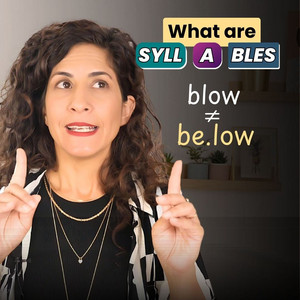
or no consonants at all but we have to have a vowel that is the center of the syllable and that is how we know that it's a separate unit let me give you another example let's take the two words below and below blow and below in the first word blow we have one syllable why because the Oas and go is one
vowel even though it sounds like two sounds, it's considered one sound, it's a diphthong -o -o -blow.
The B and the L are connected, so we have two consonants and one vowel.
Blow. And in the word below we have two vowels, therefore we have two syllables.
B -low or B -low. You can reduce it to a schwa as well.
Below blow. Below blow.
Now here's where it gets interesting.
Sometimes people struggle with connecting two consonants together because that's something that doesn't happen in their first language.
And they might just add a vowel to separate those consonants below.
But what happens is that they actually turn it into a different word with two syllables.
The number of syllables is really important for clarity.
So if you tend to add syllables or to remove syllables it's going to affect your clarity.
For example if you say practs instead of practice where people expect to hear two syllables because there are two vowels there practice but you kind of like merged it into practs and these are real pronunciations that I've heard, then what's going to end up happening is that people are not going to
understand it because they're expecting to hear two syllables instead of one when they listen to the word practice.
Let's look at another example.
Texts. How many syllables do we have in the word texts?
Try to say it slowly, break it down.
If you said one syllable then you are right because texts has only one vowel texts texts So even though it's a long word with a lot of sounds It's still one syllable Let's look at the word Management, how many syllables do we have here?
If you said four You are wrong Even though we have this number of vowels and intuitively when you look at the word, you want to say for, but listen to the word.
MA -NE -GE -MENT. One of the vowels is not pronounced, so actually we're saying MA - one syllable, nudge, another mint.
It's not management, management.
So, it's the number of vowel sounds, not the number of vowel letters.
Now, once you know what the syllables are, remember that there is hierarchy between syllables.
Some are longer and more stressed.
And some are shorter and reduced.
So, this is where we go into the stress of English and how each syllable receives a different rhythm, but each of them is still a unit in and of itself.
Now, I'm gonna link more videos to talk about the schwa, and the stress in English, and the primary stress if you'd like to practice more, but for now that is it because it's also really important to understand how many syllables we have in a word and what syllables are in general.
And I hope today it's a little clearer.
Now to help you put it into practice I created a few lists of words where you'll have to determine how many syllables are in each word and the answers are there, of course.
So click the link in the description to go to my website and practice and see if you got it.
Alright, I hope that this was helpful.
If you enjoyed it, please consider subscribing or sharing it with someone that might find it helpful as well and of course come back here next week because every Tuesday I release a new lesson and a new video have a beautiful beautiful day and I'll see you next week in the next video bye