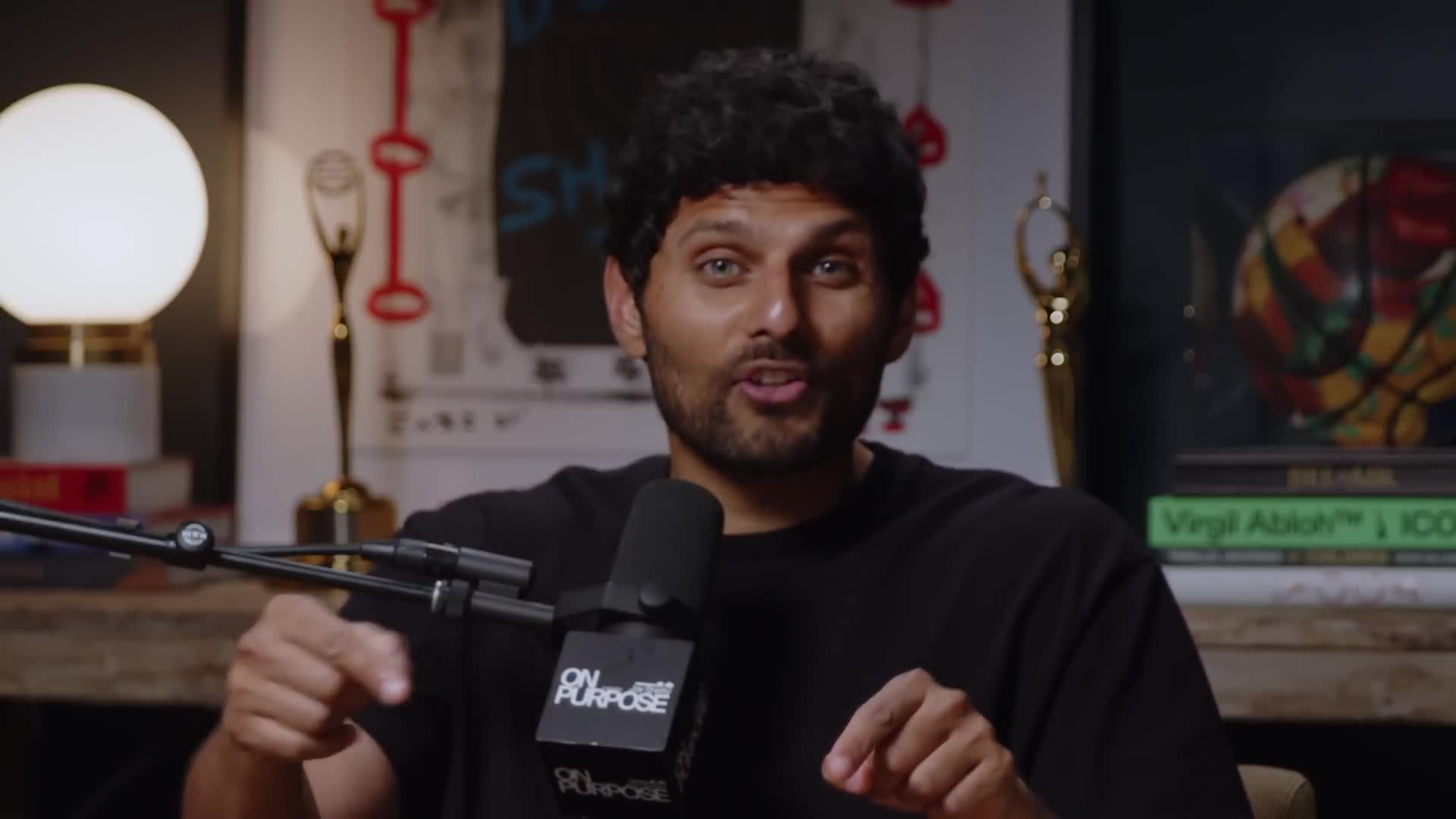
This is the biggest lesson you can learn in your 20s and 30s.
Most rejections are not about you.
When you stop personalizing rejection, you stop fearing it.
When something negative happens, we assume it's a reflection of us.
It's a cognitive distortion, a mental habit of turning randomness into self-blame.
In truth, rejection often says less about who you are and more about how many others were in line.
The number one health and wellness podcast.
Jay Shetty.
Jay Shetty.
The one, the only Jay Shetty.
If you're in your 20s or 30s, no one's going to tell you this.
Not your friends, not your parents, not even the people who love you.
But if you don't hear it now, you might waste the most important decade of your life chasing the wrong things.
I'm 38 and I'd do anything to go back and shake the younger me.
So before you scroll, just give me a few minutes.
This might be the conversation that saves you years of pain.
I'm going to share with you the lessons I wish I knew in my 20s.
And I really believe that if I knew these as conscious, intentional lessons, so many things would have shifted for me.
Now, the first lesson is results are overrated.
Obsession with outcomes is why you're miserable.
In your 20s and 30s, you're bombarded with highlight reels, followers, funding, six-figure salaries.
Everyone's chasing the trophy.
But no one asks, do I actually want the process it takes to get there?
I call it the 1% principle.
You see 1% of someone's life and you think you want it.
You see the vacations, the home, the parties or the car and naturally you think to yourself that is what I want.
But it's not how bad.
You want it.
It's about the systems you're willing to create and commit to in order to get there.
Michael Phelps, the unbelievable Olympic champion.
His training volume is five to six hours a day, six days a week, roughly 80,000 meters.
That's 50 miles weekly at peak.
He also did three strength training sessions weekly, weight training, core and stretching.
His rest time rarely took a full day off before the Olympics.
Michael Phelps said, it's not talent, it's repetition.
I swam every single day for six years, not one day off.
Cristiano Ronaldo, five sessions a week, 90 to 120 minutes each.
Recovery sessions include cryotherapy, stretching, hydrotherapy, cold plunges.
Sleep is seven and a half hours broken into five 90-minute cycles based on sleep science.
And his diet, six small meals a day, heavy and lean protein and complex carbs.
And Simone Biles training six hours a day, six days a week.
Two sessions per day, morning and afternoon.
Her recovery, Sundays off, prioritizing therapy, mindfulness, as much as physical training.
Simone Biles said, it's not just training the body, it's training the mind.
Here's what I've learned.
I've never met a strong person whose life went according to plan.
I've never met a strong person who didn't cry in private and still show up in public.
I've never met a strong person who didn't lose something a dream, a friend, a version of themselves to become who they are now.
I've never met a strong person who didn't have nights when everything felt pointless, but they still showed up the next day.
Sometimes it looks like surviving one more day.
When I first met the monks and admired them for their peace, I thought, I want that.
But then I saw their life, waking up at 4am, 48 hours of meditation, total surrender.
That's when it clicked.
You don't get their peace without living their process.
And suddenly, chasing only results felt like a trap.
Think of someone you admire.
Now ask yourself, would I be happy living their exact daily routine?
Not just their wins, but their work, their habits, and their sacrifices.
If the answer is no, stop idolizing their life.
Fall in love with your own path instead.
We live in a world right now where we see 1% of someone's life and we want that.
I also call it the work ethic.
If you want to be in the 1% of people, you have to have a 1% work ethic.
You can't want to be in the 1% and have a 50% work ethic.
It just won't add up.
Lesson number two.
Don't confuse noise for your own inner voice.
So many people in their 20s and 30s are exhausted, not from doing too much, but from trying to be what everyone else expects.
Parents, culture, friends, that noise drowns out your actual desires.
How many times have you ever chosen a partner or a career because your friends would approve?
That leads to you living a life they're proud of not a life you're proud of.
I remember I thought I had to get a safe job.
I thought I couldn't take risks after I got married.
I thought I shouldn't make content because that's not what I studied.
We create all of these barriers in our mind.
If you've ever felt stuck, lost or like you're falling behind in life, listen closely.
I created a free 21-day journal guide that's helped thousands rebuild their habits, find clarity and finally feel aligned toward a path of purpose.
You'll get step-by-step pages to reprogram your mindset, show up with confidence and become the version of you that actually follows through.
Click the first link in the description or scan the QR code on screen to grab it now for free.
Don't just watch others transform.
This is your moment.
Start yours.
Two questions.
What are you not doing because someone else doesn't approve?
Do it today.
And number two, what are you doing just because someone else approves?
Stop doing it today.
Whatever you're doing just for other people, it's probably not worth it.
And whatever you're avoiding because other people won't like it.
That's probably where all your meaning and purpose is.
You can't chase what looks good online and expect it to feel good inside.
You can't chase someone else's goals and expect to feel happy.
You can't live for approval and still feel at peace.
You can't keep climbing someone else's mountain and wonder why the view feels wrong.
Because fulfillment doesn't come from winning.
It comes from aligning.
When your actions match your values, peace follows.
I remember my math tutor once told me, you're not stuck because of the problem.
You're stuck because you're afraid of what your parents will think of you if you fail.
That line hit me so hard.
I realized I was chasing their goals and even that I was doing it poorly.
One of my favorite quotes is from Jim Carrey, where he said you might fail doing something you don't love.
So you might as well fail doing something you actually love.
It's better to fail doing what you care about than to fail trying to live up to someone else's expectations.
Here's what I want you to do.
Write down the three loudest voices in your head.
Parents, bosses, friends, whomever.
Then ask, if these opinions didn't exist, what would I actually want?
What would I actually do?
That's where your real voice lives.
Follow that.
Lesson number three, success and happiness are two separate roads.
Being successful won't make you happy and being happy won't make you successful.
This idea that if you're better, you'll attract more doesn't always work.
There are strategies for success and there are habits for happiness.
Do you know the strategies for success in your industry?
Have you watched other people and learned what they're doing?
Do you know the habits for happiness, rest, meditation, connection, belonging?
Of course, the two intersect, but knowing they're separate roads will save you time.
You go to New York to do business and you go to Bali on vacation.
They're separate journeys you take.
We think climbing higher will make us feel lighter.
We think more money means more meaning.
We think the finish line will finally bring peace.
But success and happiness don't live in the same place.
Success lives in the mind.
It's about achieving.
Happiness lives in the heart.
It's about feeling.
You can win the award and still feel empty.
You can reach the goal and still feel lost.
You can have everything people told you would make you happy and still wake up wondering why you're not.
Because success is external.
It's applause, recognition, achievement.
Happiness is internal.
It's alignment, gratitude, and peace.
In your 20s and 30s, everyone will tell you their definition of success.
Just make sure you take the time to come up with your own definition.
Learn to listen to your inner voice in your 20s and 30s.
It's the voice inside you that's quiet, that's whispering.
It doesn't force you.
It doesn't motivate you through fear.
It just speaks to you.
The difference between your intuition and And your mind is that your mind tells you what's right and wrong.
It's loud.
It makes you feel fearful.
Your intuition gives you choices and options.
It's quiet and graceful.
It's thoughtful.
And it really wants what's best for you.
So it motivates you through love, not fear.
In your 20s and 30s, you have the opportunity to start listening to that voice.
If you ignore that voice, it becomes quieter as you get older.
If you listen to that voice, it becomes louder as you get older.
Lesson number four.
You think confidence arrives after you achieve something.
But research from the University of Melbourne shows it's built by small acts to follow through.
It's not about being certain.
It's about believing you'll figure it out.
I remember this quote I once read.
It said, confidence isn't they'll like me.
Confidence is I'll be okay even if they don't.
Confidence isn't I know what I'm doing.
It's I can handle what happens next.
What's really interesting is that, when we believe that external success makes us more confident, the truth is external success can actually reduce confidence.
External success can actually reduce real confidence if it isn't built on self-trust.
You start depending on applause instead of integrity.
You feel powerful only when things go right.
Psychologists call this contingent self-worth.
Your value is conditional on outcomes.
People with self-trust, on the other hand, have non-contingent confidence grounded in inner consistency, not results.
External success builds ego.
Internal consistency builds confidence.
Here's the science behind it.
The self-efficacy loop by Albert Bandura from Stanford University.
Bandura's foundational research on self-efficacy showed that confidence is built not from success itself, but from the interpretation of success and failure.
When you interpret setbacks as data, not personal flaws, your self-efficacy rises.
Think about that for a second.
When you look at failure as something to learn from, as data, as insight, you actually feel more confident than even if you won.
This is why people with self-trust bounce back faster.
They see failure as feedback, not proof that they're incapable.
Every time you survive a challenge, your brain collects evidence that you can trust yourself, says the research.
Here are four habits that will change your life.
Number one, don't break promises you make to yourself.
Even micro habits count.
They train reliability.
Number two, do the hard things on purpose.
Voluntary discomfort like cold showers, workouts or difficult conversations build self-trust that you can survive stress.
Number three, track evidence, not outcomes.
Each time you act despite fear, record it.
It trains your brain to notice resilience instead of perfection.
And four, separate your identity from your results.
When things go wrong, say, this didn't work, not I failed.
That linguistic shift rewires attribution patterns and preserves self-efficacy.
Confidence doesn't come from winning.
It comes from learning through loss.
Confidence doesn't come from being right.
It comes from staying curious even when you're wrong.
The next lesson is most rejection isn't personal, it's statistical.
In dating, work or life, rejection often feels like a judgment of your worth.
But behavioral economists call it base rate neglect, ignoring probability.
Most no's aren't about you.
They're about timing, numbers, fit.
This is the biggest lesson you can learn in your 20s and 30s.
Most rejections are not about you.
When you stop personalizing rejection, you stop fearing it.
Here's the psychology of personalization.
Humans have what psychologists call a personalization bias.
When something negative happens, we assume it's a reflection of us.
It's a cognitive distortion, a mental habit of turning randomness into self-blame.
In truth, rejection often says less about who you are and more about how many others were in line.
You apply for a job with 500 applicants.
You pitch a book to 30 publishers.
You ask someone out who's emotionally unavailable.
That's not about your inadequacy, it's about math.
Economists call this base rate neglect, ignoring the statistical odds of an outcome and assuming it's uniquely personal.
If a company hires 1 of applicants, your rejection was 99 predictable before they even opened your resume.
Yet when we get the no, our brain doesn't think 99% odds.
It thinks, I'm not good enough.
We mistake statistics for self-worth.
Let me give you a dating example.
Rejection feels most personal in love, but even there, it's often situational, not personal.
A 2018 Stanford study on online dating found that only about 12 of matches led to a single date and only 2 led to something long-term.
That means 98% of romantic outcomes are statistical mismatch, not emotional failure.
Compatibility is a numbers game dressed up as fate.
Now let's look at it from the perspective of work.
Organizational psychology calls this person-organization fit.
You can be brilliant, but in the wrong environment, the fit's off.
Rejection is often just misalignment, not misperformance.
If you can detach rejection from identity, it stops being a wound and becomes data.
Data about timing, data about alignment, data about where your value is actually seen.
As the famous saying goes, it's not rejection, it's redirection.
It's the universe's filtering mechanism.
So how do we do that?
How do you actually prepare yourself to not take rejection personally?
Number one, name the bias.
Separate emotion from evidence.
When you're rejected, your brain's threat center, the amygdala, activates as if you're in danger.
That's because evolutionarily, rejection once meant exile, separation from the tribe.
To override that ancient wiring, you have to move from reaction to reflection.
Next time you get rejected, literally ask yourself, is this rejection about me or about probability?
That simple question activates your prefrontal cortex, the part of the brain that regulates perspective, and reduces emotional overreaction.
This is called cognitive reframing from I'm not good enough to this outcome wasn't aligned.
The next thing you can do is practice micro rejections.
Exposure therapy works.
Deliberately put yourself in small, low stakes situations where you might get a no, where it doesn't really matter.
Ask for a discount at a coffee shop.
They'll say no.
So what?
Pitch a small idea to someone new.
Post something vulnerable online.
Each time you survive a no, your nervous system learns, I can handle this.
Confidence is built through emotional repetition.
Don't take everything so personally.
Don't assume you did something wrong just because someone pulled away.
Don't read too much into a delayed text or a short reply.
Life gets heavy even for people who care.
Don't turn every quiet moment into a story about your worth.
Don't carry other people's moods like they're proof you failed them.
And the last one, but not least, healing doesn't always feel like healing.
Sometimes it feels like losing interest in things that once excited you.
Like being bored when you used to be busy.
That's regulation.
Your nervous system is learning peace, not apathy.
Healing is quiet, awkward, and often mistaken for emptiness.
When we picture healing, we imagine lightness, calm mornings, gratitude journals, peace.
But the reality?
Healing often feels like exhaustion, disinterest, grief, or emotional whiplash.
It doesn't always look like becoming better.
Sometimes it looks like falling apart in new ways.
This is why healing feels messy.
Therapists call this the disintegration phase.
It's when your old coping mechanisms stop working, but your new ones haven't fully formed yet.
You're not who you were, but you're not who you're becoming either.
During this stage, your nervous system is recalibrating.
That can feel like losing interest in people or habits that once energized you.
It can look like feeling tired or numb after years of running on adrenaline.
It can look like grieving a version of yourself that only knew survival.
This is not regression, it's recalibration.
You're not falling apart.
You're outgrowing the ways you held yourself together.
Let me say that again.
You're not falling apart.
You're outgrowing the ways that you held yourself together.
Your brain is rewiring.
Healing literally changes your brain.
When you break old patterns like people-pleasing, overworking or emotional avoidance, your brain's neural pathways weaken.
New pathways built on calm boundaries and self-trust start to form.
But here's the catch.
Rewiring the brain takes time and energy, and that process can feel fatiguing.
It's like learning to walk again.
You stumble, you tire, you question if it's worth it.
But every step strengthens a new pattern of peace.
Here's the emotional side.
Healing means you might actually feel worse before you feel free.
Psychologists call this the extinction burst.
When you stop feeding an unhealthy pattern, your brain resists.
You might miss the chaos you once complained about.
You might miss people who hurt you.
You might even romanticize the pain because it's familiar.
That spike in discomfort isn't failure.
It's the final gasp of an old habit dying.
Healing doesn't mean you're broken.
Growth and grief are twins.
You can become new without mourning what was old.
That's why healing can feel like sadness, boredom, or emptiness.
Your nervous system is detoxing from intensity.
If peace feels strange, that's because your body has been addicted to survival mode.
If calm feels foreign, it's because chaos was once home.
How to know you're healing when it doesn't feel like it.
Number one, you're triggered less often even if you still feel emotional.
Number two, you pause before reacting even if it still hurts.
Number three, you rest without guilt even if it's uncomfortable.
Number four, you don't chase closure, you create it.
You're finally feeling what you used to run from and that's progress disguised as discomfort.
Healing doesn't always feel like healing.
Healing is not the absence of pain, it's the ability to be present with your pain.
Healing doesn't always feel like healing.
Sometimes it feels like breaking all over again.
Sometimes it feels like getting worse before you get free.
Sometimes it feels like losing interest in things that once kept you alive.
Sometimes it feels like peace, but your body doesn't trust it yet.
And here's what I'll leave you with.
Your 20s are the decades of firsts.
Your first job, your first real heartbreak, your first apartment, your first rental payment, your first big mistake, your first time realizing your parents are human and so are you.
Your first real friend who drifts away.
Your first moment of feeling lost, alone and completely unprepared.
It's a decade that feels like a test. but it's actually a training ground.
Understand the psychology of firsts.
Every first triggers what psychologists call identity disruption.
It's the tension between who you were and who you're becoming.
Your brain literally rewires through neuroplasticity, forming new neural pathways every time you face uncertainty, failure or novelty.
So when you feel overwhelmed, confused, or unsteady, that is your brain growing.
It's not a sign you're broken.
It's a sign that you're building yourself.
Confusion in your 20s isn't failure.
It's the feeling of your mind expanding to fit your life.
You will make mistakes.
You'll fall for people who aren't ready.
You'll take jobs that look good but feel wrong.
You'll celebrate wins that don't satisfy you and losses that free you.
You'll mistake excitement for alignment and comfort for love.
That's okay.
You're just collecting emotional data.
Your 20s aren't about getting it right.
They're about getting the reps in.
Here's how you prepare and protect your peace.
Expect uncertainty, don't fight it.
You're not supposed to have a five-year plan that works in your 20s or 30s.
You're supposed to experiment, fail, and reorient.
Psychologists call this exploratory growth, trying things not to win, but to learn.
The second step, build emotional tools, not timelines.
You need boundaries more than a blueprint.
You need emotional regulation more than motivation.
And you need forgiveness more than blame, especially for yourself.
The next step is to anchor to values, not validation.
You'll get flooded with opinions from family, from social media, from your own fears.
When in doubt, return to what feels true, not what looks impressive.
Instead of seeing your 20s as the time to figure out your life, see it as the time to practice living it.
To try, to fail, to feel, to rebuild.
You're not late.
You're just getting started.
Every first is not a final exam.
It's an initiation into a wiser version of you.
You will be okay.
You'll chase people who see your potential but never meet you there.
You'll stay in jobs that drain you because quitting feels like failing.
You'll confuse being needed with being loved.
You'll confuse being busy with being fulfilled.
You'll say yes to things you outgrew because no still feels selfish.
You'll make choices to impress people who stopped paying attention years ago.
You'll try to prove your worth through productivity and burnout trying.
You'll think you're behind until you realize everyone else is pretending to be ahead.
You can learn these lessons at any age, at any stage.
I hope it sets you up for joy and success.
And remember, I'm forever in your corner. and always rooting for you.
Thank you so much for listening to this conversation.
If you enjoyed it, you'll love my chat with Adam Grant on why discomfort is the key to growth and the strategies for unlocking your hidden potential.
If you know you wanna be more and achieve more this year, go check it out right now.
You set a goal today, you achieve it in six months, and then, by the time it happens, it's almost a relief.
There's no sense of meaning and purpose.
You sort of expected it and you would have been disappointed if it didn't happen.