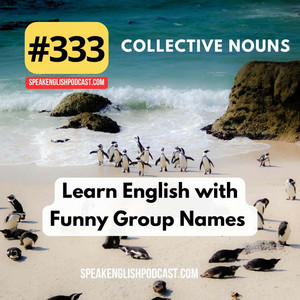
Hi, I'm Georgiana, and I'm back with a new episode.
I'm here to help you speak English fluently.
If you want to help me, share the podcast with your friends and family.
That would mean a lot.
Thanks.
On my website, you can find the five secrets to speaking English and my premium courses.
Get the transcript.
Visit speakenglishpodcast.com slash podcast.
Okay, let's start.
Today I want to teach you about collective nouns.
But first, what are collective nouns?
They are words we use to talk about a group of things or people as one unit.
For example, instead of saying many trees together, we say a forest.
Easy, right?
We humans love shortcuts.
It's much faster to say a flock of birds than a lot of birds flying together.
There's another collective noun that's similar.
Band.
A band can be a group of musicians, fighters, or even thieves.
So if someone says, I saw a band in the park.
Do they mean musicians or maybe a gang of thieves?
Some collective nouns sound very poetic.
Did you know a group of stars in the sky is called a constellation?
And a group of islands is called an archipelago.
Pretty cool, right?
But not all collective nouns sound nice and friendly.
If someone says, there's a pack nearby, you'd better be careful.
A pack can mean wolves, dogs, or coyotes that are ready to hunt.
A general group of animals is called a herd, and a big group of people acting wild or aggressive, that's a horde.
Another example.
A group of ships is called a fleet.
It can also mean a group of trucks from the same company.
Some collective nouns are especially beautiful.
A group of trees.
A forest.
A field of grapevines.
A vineyard.
We get grapes from these.
Let's talk about bees.
A group of bees is a swarm.
Sounds nice.
Until they sting you.
Wasps and hornets.
That's a hornet's nest.
If someone says, That meeting turned into a hornet's nest.
It means things got tense or dramatic.
A group of horses is usually a herd.
But if the horses are organized for riding by soldiers, like in old movies, they are called a cavalry.
Now let's look at a few fun and unusual examples.
A group of fish is called a school, just like the place where you learn.
Sounds powerful, doesn't it?
And this one is always a favorite.
A group of crowds is called a murder.
Don't worry.
It doesn't mean anything scary.
It's just an old word people used for crowds.
Of course, we humans have collective nouns too.
A big group of people is a crowd.
In a company, we call it a team.
In school, the student body.
At church, a congregation.
And the most important one, your family.
Because in the end, what makes a group special isn't just the name.
It's the connection they share.
Great!
Let's continue with a mini-story.
I will tell you a short story by asking simple questions.
I use this method in my premium courses because it's highly effective.
First, I say a short sentence with facts.
Then I ask you questions.
After each question, you answer.
Then I tell you the right answer.
That's how we make the story.
And if you want to improve your fluency much faster, check out my premium courses.
Visit speakenglishpodcast.com slash courses.
You will find several levels.
Okay, let's start.
Tristan started his first day working at the zoo.
He was confident, maybe too confident.
Was it Tristan's first day at the zoo?
Yes, it was his first day.
It was Tristan's first day at the zoo.
Was Tristan confident?
Yes.
In fact, he was too confident.
He was overconfident.
Where did Tristan start his first day?
At the zoo.
Tristan started his first day at the zoo.
How did Tristan feel?
Confident or insecure?
Confident.
Tristan didn't feel insecure.
He felt confident.
Without looking at the notes, Tristan wrote very strange names on the signs.
Did Tristan look at his notes before writing the strange names?
No, he didn't look at them.
Tristan didn't check his notes before writing the names.
Did he write normal names?
No, he didn't write normal names.
Tristan wrote very strange names.
Where did Tristan write the names?
On the signs?
Yes, he wrote the names on the signs.
Did he write the names on the signs or on the walls?
On the signs.
He put very strange names on the signs.
For example, he wrote swarm of horses.
And pack of penguins.
What word did he use for horses?
Swarm.
Tristan used the word swarm for the horses.
Did he use pack for the elephants?
No, he used pack for the penguins, not for the elephants.
Which animals did he call a pack?
The penguins.
The penguins received the name pack.
The director almost fainted when he saw the signs and took Tristan to his office.
Who saw the signs?
The animals?
No, no.
The director.
The director saw Tristan's signs.
Did the director faint?
No, he didn't faint, but almost.
What did the director do when he saw the signs?
He took Tristan to his office.
Did the director fix the signs or take Tristan to his office?
He took him to his office.
The director was probably very disappointed with the signs.
They had mistakes.
The next day, there were more people at the zoo than ever before.
They came to see the signs.
Were there more or fewer people at the zoo?
More people.
There were more people than ever before.
Was the zoo empty?
No, it was full.
The zoo was not empty.
Why did people come to the zoo?
To see the director?
No, no.
To see the signs.
People came to see the funny signs.
Was it a success or a disaster for the zoo?
It was a success.
Tristan's mistakes made the zoo popular.
The mistakes on the signs made Tristan famous without meaning to.
Did Tristan want to be famous?
No.
It was unintentional.
Tristan didn't want to be famous.
What made Tristan famous?
The mistakes on the signs.
Those mistakes made him famous.
Who became famous?
The penguins Peter and George?
No, no, not Peter and George.
Tristan.
The signs made him famous, not Peter and George.
Well, we're finished with our short practice.
Answering many simple questions can improve your speaking, just like talking in real life.
Today you've tried a small part of this question and answer technique.
Do you want to learn more?
Get my premium courses.
Visit speakenglishpodcast.com slash courses.
I'll be back next week.
Bye-bye.
Get the transcript now at SpeakEnglishPodcast.com.