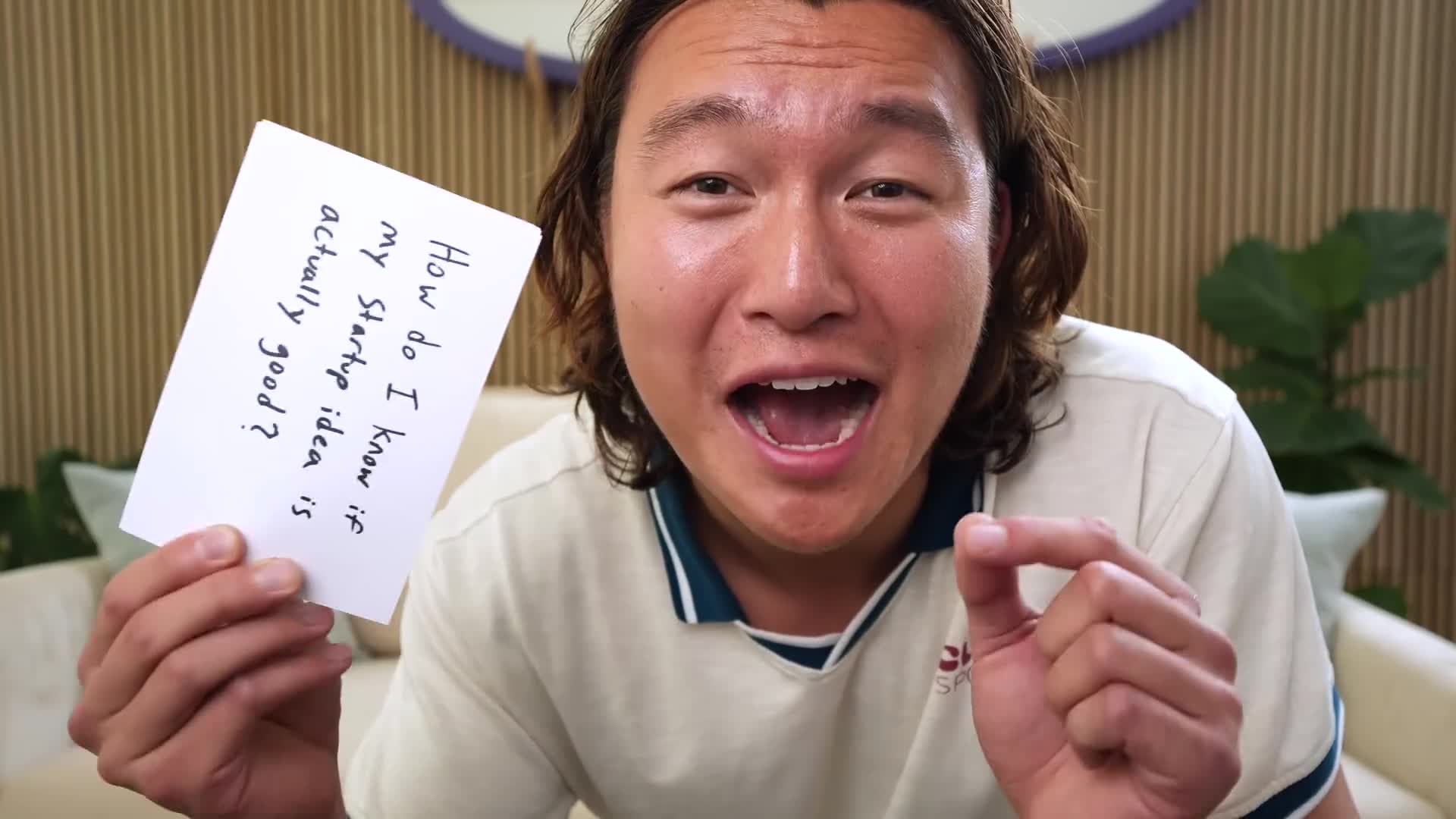
So in my hand here are all of the most common questions I get about how to build a successful startup.
And for those of you who don't know me, my name is Jay Hoovey.
I run a $30 million startup myself.
And I actually started my career in investment banking at Goldman Sachs, then worked at a VC firm, then went off to Stanford Business School.
All that to be said, I am a huge startup geek and I am super excited to answer these questions today.
All right, question number one and this is a really good one too which is how do i know if my startup idea is actually a good idea?
Now, the answer this is actually really simple, even though we tend to over complicate it, which is, you know, your startup idea is actually good if people actually give you money for it.
And i know that sounds ridiculously simple and obvious, because we're in the business of building a business, but for some reason, i oftentimes see first-time entrepreneurs make this mistake, where they come up with this big, grandiose idea, which is probably not a bad idea, and they'll go out and they'll actually pitch a bunch of people on it their friends, their family, maybe even investors and they'll say like hey, what do you guys think of this idea?
And the reality of that is is all of those people are probably gonna say yeah, it's a pretty decent idea.
But what I've learned through tons of trial and error myself is that there is a huge gap between someone saying yeah, that's like an interesting idea or a good idea, versus them actually going through the effort of paying you money for something and committing to it.
And so what I've actually seen for the very best startup ideas is that, even before they're actually fully built, people are like lining up out the door trying to give you money.
And one of my favorite examples here is actually DoorDash, which is now, of course, a multi, multi-billion dollar app.
But when those founders first started building DoorDash, they actually did something super clever to validate that their startup idea was actually a good idea, which is that they didn't build DoorDash because they knew that that idea, that app, would take them months, if not years, to actually build.
And instead they put up this really crappy HTML website that was super localized to Palo Alto, where they were, and they used that to validate and test the market where, just from the paper signs they put up all throughout Palo Alto, they were getting dials from potential customers trying to give them money to deliver services, and that's how they actually validated that.
Hey, I think we're onto something, because people are literally paying us money to personally deliver them food, and I think we can scale this.
All right, next question.
Oh, this is also a good one.
So this question I get a lot and I wanna dispel the fear around it, which is I wanna start pitching my idea to investors, but I'm worried about someone stealing my idea.
What should I do?
And to that I immediately say if you are worried about someone stealing your idea and out executing you on that idea, you are not the right entrepreneur for the idea.
And this is gonna feel like a cold hard reality, but the reality is that most people in your space, or someone out there, has probably thought of your idea before.
But the difference between a great idea and a multi-billion dollar or even a multi-million dollar outcome is actual cold, hard execution.
AKA, are you the right player on the field to be doing this idea?
And are you committed enough to put in the work to actually make it a success?
And so, all of that being said, if you're out there pitching your idea, there is a meaningful possibility someone could steal your idea, but that's no different from you actually launching and all of your competition looking at you launching as the rational human beings they are and stealing your idea.
Then
And so it really comes down to you and your ability to execute.
All right, next question, which is one I get all the time.
And also I was kind of in these shoes myself before, which is how do I build a startup if I don't know how to code?
And I would actually give you three different ways that you can solve this problem for yourself.
Number one being you can actually learn how to code pretty quickly nowadays with all the free content out there, especially now that ChatGPT and all the other AI models can literally spit out code for you.
But if you wanna move even faster, you can actually look at option number two, which is there are a ton of agencies and contractors you can actually use and source from freelancer marketplaces like Upwork or Contra, where people can actually build your MVP for you.
Now, of course, neither of those two options really holds a candle to number three, which is finding a really quality technical co-founder.
And that also happens to be the next question, which is how can I find a great technical co-founder?
And for this I'm going to tell you to get your dating hat on, which is you need to start building a network of really awesome technical people.
And so how I did this back in the day to find my awesome technical co-founder is I actually started asking everyone that I knew that I thought was smart who their smartest technical friend was.
And I asked for an introduction.
And so I'd be like, Hey Jimmy, I'm working on this startup idea.
I'm actually looking for a technical co-founder.
I know you're a superstar software engineer yourself.
Like, do you know anyone I can talk to?
And I'd actually compound those intros where I'd meet someone and let's say they thought it was a good idea, but we didn't necessarily vibe, or maybe they just weren't interested in doing a startup right now.
I would then ask them hey, can you introduce me to three to five of your smartest software engineering friends?
And over time, what you'll see is this kind of tree of relationships start to compound where ideally, you meet someone through that avenue.
But if that doesn't work for you, fear not, because there are tons of communities out there and established startup founder networks out there of people actually looking to find co-founders, whether it be through something like Techstars or Y Combinator or a bunch of other networks that I'll actually put right here.
All right, so let's say you have found your technical co-founder.
The next question is, should I bootstrap or should I raise VC?
And I'm realizing I get to be a little spicy here which is I would argue that time and time again, you should do everything possible to bootstrap as much as you can, with bootstrap meaning basically building a company without having to take on outside investors who end up buying a portion or percentage of your company.
And the reason I say this is because ideally, if you start this business, you want to own as much of that business and as much of that pie as possible, where there are so many founders out there from the old era of companies who raised so much money that by the time they actually had a successful business and they IPO'd, they owned just like five to 10 of their own baby.
Which does make sense in some cases where, let's say, you're building a business that's super capital intensive.
Let's say you have to kickstart a bunch of huge network effects, like Uber did back in the day, and you have a ton of competition, so you just need to raise a bunch of money.
Or let's say you're building an AI company that just needs a ton of compute and you can't afford it yourself.
But there's always a cost or trade-off to everything you do.
And the flip side of having VCs on your cap table is one, you have a boss that you have to be accountable to, but then two, you don't own or really control the full destiny of your own company.
And so ideally, you are bootstrapping your own company as much as you can, where you're doing everything you can to get revenue in the door immediately, so that your revenue today can actually fund the growth of your company over time.
Now, with all that being said, if I were to do it over again with Stan, I would actually do something pretty similar to what we ended up doing in our seed round, where I tried to get the best of both worlds, where I wanted to maintain full control of the company, aka the benefit of being bootstrapped but still having smart capital in the door, but not at a huge cost of dilution.
And so what I generally recommend founders, is that if you do think about taking capital, be super thoughtful about who you bring in where I actually think, early on especially, You don't need much more than a couple few strategic angel investors who know your industry really well or can really support you, because on average, those angels will care a lot more about your company than a large traditional institutional VC who has a hundred other companies that they're trying to take care of.
Next question, similar to bootstrapping how can I effectively market my startup with little to no budget?
So guys, the most fun part and the hardest and grittiest part about starting a startup in the beginning is generally how you actually get your first few customers.
And there's actually a ton of different ways you can do this.
Number one that I personally did is just cold emailing anyone that you think could possibly be a great customer, and you can do this without any money or any ad spend, where you just have to look up potential customers in your market and you can actually validate your idea through the process of emailing them and pitching them on the idea and seeing if they even bite in the first place, because if they're not, then clearly you're not solving a big enough of a problem for them.
And if they do, what they actually latch on to and what they're interested in, because that'll actually validate the product that you build over time.
And that's actually separate from one of my other favorite channels how you can actually build organic word of mouth for your company and for your product, which is just to leverage.
Where is it?
Which is just to leverage this thing right here, where technically in the palm of our hands, completely for free, we can just start making content about our story or our product or our company, whatever it is, and actually get millions of impressions completely for free.
And now to that, you might understandably be a bit skeptical where you're like, you know, John, I don't think I can make viral social media content just like that and get millions of views.
And to that I actually say, I actually bet you can.
Where, just like cold emailing, is a skill you develop over time.
I've actually learned myself from learning how to go viral over time that going viral on social media and making great content is also a skill you have to learn and grow into over time, because anything in life that has outsized success to it of course takes meaningful work and energy and commitment to actually be successful in.
And so, if I can come from a career in finance where I was never creative ever before, and slowly over time learn how to make really viral content, I promise you, if you have the hunger and hustle for your startup to actually break out of the noise, you can do it too.
All right, second to last question here, which is who should my first hires be?
And my answer to you is actually that it depends.
Specifically, it depends on who you are and what your skills are.
Where, for me, I was a pretty strong business co-founder where I was decently technical and knew product decently well, but I knew the thing that I could bring the most to a company that I was working on was actually the business side of things.
So the vision, the leadership, the storytelling side of things, the sales side.
And so, for me, my first hire was my technical co-founder, to actually compliment me in terms of his skill sets and then also mine.
And so, in terms of figuring out who your first hire should be, I want you to think about what are you best in the world at?
Because I want you to focus on that and then ask yourself where are the places that I need to shore up in order to build a holistically successful business.
And so maybe for you you're some genius engineer or technical savant but you don't really understand sales or people are kind of irrational to you or whatever it is.
I would suggest you and some of your first hires find someone who you trust to actually compliment you in those ways.
But there's one key caveat that I'll give you here that will hopefully save you years and years of trial and error and mistakes that I've made in hiring, which is that I want you to really thoroughly vet two specific aspects of these first few hires.
Number one being validating that the complimentary skills that you're hiring these first few hires for, they're actually really, really phenomenal at.
Because let's say you don't know how to code and you're trying to hire your first few engineers.
Well, how are you going to evaluate whether or not your first hire, or your co-founder, is actually really good at coding?
And so to vet my first few technical hires, I actually asked some of my smartest software engineering friends to actually interview on my behalf and have a conversation with our first few hires to actually make sure that they were the best possible people to fill in that complimentary skillset for the business.
Because the functional skillset that someone brings to your company is super important to vet, even if you can't do it yourself.
Because what you should be really focused on is actually the second aspect, which is that even if you have very complimentary skillsets to someone, you need to make sure that these first few hires have the same core shared values and principles that you do.
Where, for me, when I think about first meeting my co-founder, Even though we are very, very different people and we have very different skill sets, the thing that brought us together was actually our shared immigrant background, where he had immigrated from Russia when he was 18.
I had grown up here in the States. as an immigrant kid.
And there was something about our shared stories around immigrant hustle and persistence and coming from very little that just really brought us together and gave me trust that not only was he gonna be an absolute killer when it came to work, but that also was just gonna be a great partner to work with
All right, final question, the big Bertha.
What's the secret to building a billion dollar company?
I don't know.
But I can tell you the most consistent patterns that I've seen across all the most successful founders and entrepreneurs that I've met.
And it really comes down to three specific things.
Number one is that they are in a very large market where, if you think about building a billion dollar outcome, your market size needs to be able to sustain that large of a business.
But that also comes with another problem, which is that oftentimes large markets have a ton of competition.
And so that brings in attribute number two, which is that your product needs to over-deliver ideally 10x the value of everything else in the market.
And so, whether it's Uber with taxis, or DoorDash versus calling the delivery man and the pizza driver, or chat GPT versus anything we've seen before it, you need to find some novel value prop that solves someone's problem 10 times better than how it's currently being solved.
Now, lastly, and I actually think the most important attribute is just the quality of the people of that company.
Specifically, I've met so many really successful founders who have all of these different skill sets.
Some of them skew towards being technical geniuses.
Some of them are just marketing savants.
Some of them are fantastic all-around players.
But the number one key attribute I've seen across all of these successful entrepreneurs is just that they never ever ever, ever ever gave up.
Because the reality is, if you're watching this video, you have some dream or some vision of doing really hard things one day that accomplishes something awesome for yourself.
And I will be the first one to tell you that, if you're going to go, try to do that.
There will be tons of moments where life will just punch you in the face.
And the thing that separates people who truly, truly make it is that they persisted through all of the challenging times and they never, ever gave.
So, with all of that being said, I'm on this really, really hard journey, with y'all sharing all of my learnings along the way.
So make sure to like and subscribe.