Chat with Traders is brought to you by Trade the Pool.
Did you know that every decade the market reinvents itself?
Online brokers open the doors.
Mobile apps made trading seamless and commission-free trading erased barriers.
Now a new era has begun.
Meet Trade the Pool Limited Risk Trading.
And now you also have unlimited time to reach the profit target.
From now on, your trading risk is capped. and your trading opportunities are limitless.
Trade the Pool funds home-based stock traders with up to $200,000 in buying power.
That means you can trade larger positions and scale your strategies without risking your own savings.
It's time to trade with more capital, making it truly worth your time and effort.
Ready to trade the pool?
Click the link in the description and join the stock trading revolution today.
Chat with Traders is also brought to you by TastyTrade.
Ditch those rookie trading apps.
Get TastyTrade, the platform for serious traders.
Chart with 300-plus indicators, know your profit odds, and move fast.
Trade stocks, options, futures, and more all in one account.
See why serious traders choose TastyTrade.
Visit TastyTrade.com.
TastyTrade, Inc. is a registered broker-dealer and FINRA, NFA, and SIPC member.
Trading in the financial markets involves a risk of loss.
Podcast episodes and other content produced by Chat with Traders are for informational or educational purposes only and do not constitute trading or investment recommendations or advice.
There's not a single formula for this.
Either someone who's taken a small amount of money and turned it into a huge amount of money and, to take two extreme examples, in the current book, Two of the traders have literally gone from sub 50000 accounts to close to a half billion.
That's sort of a dramatic but real example of what I mean by a spectacular increase in wealth.
Then the other one is traders who just haven't made like a ton of money really, but they have an unbelievable return to risk.
So two other traders in this book, one of them has not had a losing month, but it's like steady.
He doesn't make a fortune.
He basically earns a living as a trader.
So he's like.
So when Jack and I met, we had this firm belief that there were some amazing traders out there globally.
And along the path we realized that it was one thing to find a talented trader, but if they were in a country where maybe they didn't have a regulatory jurisdiction or they didn't have the legal structure set up, they couldn't really properly have the institutional infrastructure to manage outside capital.
And so it became almost another barrier to entry for them to transition from a really good trader who's really focused to then aspiring to become the Stephen Cohen of the world, that they actually launch a fund in managing capital.
The idea of the accelerator was how do we find that talented trader, Let's say the market wizard, quality trader, and then come around them and provide them with the infrastructure, the mentorship.
It could be regulatory.
It could be marketing the distribution, the access to capital, so that they can be focused at what they're doing.
And then we can provide them with all the needed resources for them to potentially manage money and then compete against some of the largest hedge funds in the world.
Perhaps somebody who's listening to the show who is aspiring.
You know they want to manage money, but also they've been the risk averse and intelligent enough to know that they're not going to spend a lot of capital setting up a structure of a fund to potentially raise money from outside investors that they have no network from.
Right.
And so this is almost like legging into this opportunity.
Markets, speculation and risk.
This is the chat with traders podcast.
Oh yes, we're on episode 308 of the Chat with Traders podcast, and this is a special one.
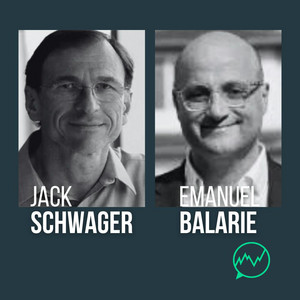
I'm Tessa Dow, co-host with Ian Cox, and we're joined by Jack Schwager, best known as the author of the legendary Market Wizard series and also co-founder of Fund Cedar, together with his partner and fellow co-founder, Emmanuel Ballery.
We dig into what it actually takes to be considered for a market wizard's book.
There isn't one formula, but Jack definitely looks for standout performance.
Traders who've achieved the kind of results most would think impossible, but it's not impossible.
Over the years we've had traders who were featured in market wizards.
That eventually appeared on our podcast.
But, as Jack described the qualities he looks for now, I couldn't help but think I wouldn't be surprised if some of our other guests that we've had on the show who've never been in the books before, might show up in a future volume.
That's an exciting thought and we shall wait and see.
One of the parts of our conversation that stood out to me as a developing trader was the razor's edge between surviving and blowing up, and why it so often comes down to position sizing and planning your exit in advance.
From there, the conversation branches into the kind of obsession with process and routines that Jack has consistently seen in the traders featured in his Market Wizards books, an obsession that allows them to keep adapting as markets change.
We also talk about whether timeless strategies like trend following can still hold up in today's markets.
And a surprising paradox Jack points out about fundamentals and risk that might change the way you think.
Then we shift to Fundseeder, a platform co-founded by Emmanuel and Jack, built to discover and evaluate undiscovered trading talent from around the world.
Emmanuel explains how it works, how they verify performance, evaluate capacity and process, and how through the fund seeder Rise Accelerator, now part of RQSI, a hedge fund and seeding firm with a long track record of backing emerging managers, they help top performers get the infrastructure and seed capital to scale.
And here's the part that should excite many of you listening.
They're actively searching for the next generation of talented traders.
People with the potential to move from trading their own accounts to managing outside capital as professional fund managers.
Very few will ultimately make the cut but every great manager starts somewhere.
And if you've been honing your craft and building a real track record, why not you?
So if you're serious about your craft, you'll love this episode.
More information and links are in the show notes.
So, without further ado, ladies and gentlemen, we are so pleased to present Jack Schwager and Emanuel Ballery.
Well everyone, I'd like to welcome both famous Jack Schwager, author of the Market Wizards books, and Emmanuel Ballery, who is the founder of Fundseater with Jack.
I'd like to start off with Jack.
Jack, welcome back to Jack with Traders.
I think it's been seven or eight years since you were last on here?
Yeah, it's been a number of years.
I'm not sure how many.
I
Yeah.
And you've written a lot of great books, part of the Market Wizard series of books.
Are you up to... How many has it been?
Six already?
I'm working on number six.
Oh, you're working on number six.
Okay, great.
I read your first Market Wizard's book back in 1994, and that inspired me to get into trading.
Do you have a release date for your book?
The release date is...
I think it's going to be around June.
Yeah, looking forward to it.
I don't remember the exact date, but it's early summer.
Okay.
Do you have all the slots taken up?
Have you found all the traders?
I've done all the interviews.
The actual confirmed list of who's going to be in the book.
Haven't officially confirmed that yet, you know.
So just waiting until the book is actually finalized in the manuscript before I kind of describe, you know, go into more detail on it.
And could you share with us kind of what are the criteria to get entrance into your books?
Yeah.
Okay.
So obviously, the first criteria is performance, you know.
And then the question is what kind of performance?
And there's not a single formula for this.
There's a And to take two extreme examples in the current book, two of the traders have literally gone from sub-50000 accounts to close to a half billion.
Half billion, yeah.
Right, or $500 million if you want to round it to millions.
So that's sort of a dramatic increase, but real example of what I mean by a spectacular increase in wealth, right.
Then the other one is traders who just haven't made like a ton of money, really.
I mean, they've made X millions, whatever it is, but they have an unbelievable return to risk.
So two other traders in this book.
One of them has not had a losing month and Well, 11 years now.
That can be shown because he went off on his own, but then he was a prop trader.
And I don't doubt him when he says he didn't lose money in those prior few years as well.
So he's probably gone 15 years without a losing month, without a single losing month.
But it's like steady.
He doesn't make a fortune.
He basically earns a living as a trader.
So he's like, making about, I don't know, 300 or 4,000 a year, sort of makes money every month.
But that type of consistency.
Another trader who's had a long track record was able to track back further I forget how many years now.
It was over 15.
But in his case, he's had five losing months, all pretty small.
In the first case you can't even calculate some return risk ratios because you get infinity, because you have no divisor.
That's negative, right.
And in the second trade, it was a few losing months.
You get these extraordinary return risk numbers that are just mind-boggling.
So it's either of those two as far as the performance side. and then there are other criteria in terms of that it can be it can be for a short period because you know anybody can have a good five years right or whatever i typically try to get a minimum of 10 in many cases it's 15 or 20 or even the official track record as is the case in this book as well sometimes can't go all the way back because they were prop traders before but they've traded for a long time so i'm getting people who have demonstrated it for lengths of time, very rarely will I make an exception to the 10-year rule.
Occasionally, for some compelling story, but it's always at least close to 10.
And 95-plus percent of the time, it's well more than that.
Wow.
Yeah, those are... outrageous returns.
In some of your previous interviews, you've mentioned that you were looking for the truths of the markets.
That will still be true 100 years from now.
And you brought up the challenges of human nature as one of the key sticking points and how human nature works against us.
And you referenced a funny image of a monkey throwing darts at a Wall Street page often do better than humans.
And my question is could these results be dramatically improved by just position sizing appropriately for each person's psychology?
Well, yes.
I mean, position sizing is an important element, and it is a downfall of many traders.
Well, there's a matter of cutting losses in terms of risk management right matter of cutting losses.
And then there's a matter of position sizing.
So if you size too large, you can cut your losses, but if you're going to be risking 10 of your capital on any given trade and here let me be clear I don't mean that you buy a stock that takes up 10 of your capital.
That is not, you know, that's only risking 10% of your capital if you're holding it to zero, right?
But I'm talking about you have a plan, you have either stopping or plan or some defined risk point.
So you may, you may allocate maybe 10% of your AUM, but you're only risking one or 2%.
So that's fine.
So the mistake if people put on a position too large, and then it can become a very damaging.
You know, one bad trade can become very, very damaging.
In fact, A number of the traders in this new book, as great as they are, as spectacular as they are, had some hair-raising episodes where position sizing was part of the problem.
People, before they get into trading and they have their jobs, they can treat their job seriously and know that they have to study and work hard and and follow rules.
So why do you think many new traders can't treat trading like a job?
I mean, they've got their skin and they got a lot of skin in the game their own money and hopefully avoid most of the pitfalls of human nature that has plagued us from the beginning days.
The reason is because I think maybe probably the majority and I don't know how large of a majority of people get into trading don't appreciate that to really succeed.
And you can see this again in this new book.
I keep on thinking when I'm answering these questions.
There's so many glaring examples to prove this.
Where these these people didn't just trading wasn't just a hobby.
It wasn't just a it wasn't even a job.
It was.
It was, you know, an overwhelming obsession and just kind of capitalizing all their time and energy and money.
The fellow I mentioned who never had a losing month.
He literally gets up at 330 to check the markets, goes back to sleep and then comes back at 530 and then doesn't wind up until 8 pm.
So I mean that's the kind of devotion that you get and types of intense analysis and study that some of these traders do.
One fellow just talking about going through thousands of cases, SEC filings, just becoming almost a walking encyclopedia and categorizing it.
SEC filing comes out figuring out what's important, what happened in each case, what's not important.
It's just the amount of work that they devote to this is sometimes staggering.
And one of the other traders.
Basically, not only would he be trading, he was a prop trader trading.
He no longer, now that he's made a fair amount of money, he's kind of eased off a bit.
But in his early part of his career, when he was a prop trader, he would not only spend the entire day trading He'd do the analysis afterwards but he would literally record key parts of his trading and then replay them and retrade those things out of market hours.
So that's the kind of devotion.
Now you think about people who get into trading because they want to be a trader and they want to make money.
They don't have that type of devotion, with exceptions, but for the most part, they don't.
And I think that people don't appreciate who really excel.
I mean, you have to have a talent for two.
That's another element.
But even if you have the talent, you really have to do the hard work.
Mm-hmm.
The hard work as in just investing time or learning everything there is to learn about it?
Because you mentioned the guy that looked at SEC filings.
And Well, the hard work.
First of all, you have to define what your strategy is and that it's what you want to do and what you feel you have an edge at.
But then it's just doing everything you can to hone that strategy and...
It goes beyond that.
It's not like learning a craft.
You know, you're a carpenter and you learn every technique and you get really better and better and you like get to a certain point and that's it.
And now you know how to do everything, any type of cabinetry, and do it perfectly, and you've devoted your life to being a perfect carpenter.
In trading, it's worse than that.
I mean...
Because you get to a point where you're skilled and everything's going fine, but markets keep on changing.
And in almost every case.
I can't think of a single interview in this book where a trader didn't go through adaption phases and change.
And sometimes where they end up could be quite different from where they started.
So it's not only a matter of devoting all this time and energy to whatever the technique is at the moment, but it's also a matter of being open to the need And the signals that that particular methodology is losing its efficacy and you now need to adapt into some other strategy.
One of the traders I mentioned, who had only five losing months and very high return risk who, by the way, is himself.
He runs a.
He runs a prop training firm.
He co-founded it.
And he estimates he's trained over 200 people in his day, trainers in his day.
But he emphasizes that the importance of always maintaining the mentality of a trainee.
In other words, even though he's got 25 years of trading experience, even though he's trained 200 traders, he still keeps himself at the mentality where he's like a trainee who's just trying to get in, trying to break in and trying to find stuff that works.
And so he tries to keep himself in that framework because –
He knows that whatever's working today, in many cases won't be working a year from now or five years, whatever.
So he tries to always be looking for new techniques or how his current methods have to change.
I see.
So it's almost like he's trying to anticipate the next change in market behavior.
Like if he was learning how to trade when the market was in a strong, trending bull market, and then the market goes choppy sideways for a while.
Is that kind of it?
He's trying to anticipate different market conditions and learn ahead of time?
It's more a matter of trying to in his case, trying to find different patterns or quirks or inefficiencies in the market.
And he gives examples in the interview where, for example, at one time, the idea of figuring out which stocks were going into the index let's call it the SP or any other index and which were coming out, trying to anticipate that and be long the ones that are going in and short the ones that are going to come out.
That was a great strategy for an edge because, once it goes in, all these institutions have to We balance their portfolios.
So, you know, you know, new stock comes into the S&P.
It's going to get a lot of.
I mean, it's an obvious thing.
So for a few years that worked, but then it became too well known and off the way and it's no longer works.
So and these things disappear for sometimes explainable reasons.
And sometimes for reasons which are a mystery.
He mentions he had this, that he used to trade the VIX.
He had a particular pattern he traded in the VIX, and it depended on the time of day.
And it was like a really reliable pattern.
It was an important strategy of his.
And then for some reason, and he couldn't explain it, but when Russia invaded Ukraine...
Right after that, the patents stopped working and never worked again.
You know.
So some of these things.
God knows what the relationship would be between the invasion and the VIX, but maybe it's just coincidental.
But the point is, things that work very often will stop working.
And sometimes they may come back, but sometimes never.
Yeah.
How much of that do you think is attributed to other traders hearing about it, and then that particular strategy gets crowded.
And have you found any particular strategies or ideas that maybe worked for a while and then were discovered, or didn't work for a while but then forgotten and then later came back into vogue, almost like an old style of fashion clothing or something like that?
Chat with traders is brought to you by Tasty Trade.
Tired of trading on rookie apps?
Then get the platform for serious trading.
Tasty Trade.
Tasty Trade gives you the tools to trade your way.
Chart your heart out with over 300 indicators, know your odds with probability of profit and move fast with QuickRoll.
Trade what you want and trade it your way.
Stocks, options, futures, and more, all in one account on one platform.
No wonder why serious traders choose TastyTrade.
Visit TastyTrade.com and see for yourself.
TastyTrade, Inc. is a registered broker-dealer and member of FINRA, NFA, and SIPC.
Have you ever watched a stock explode and thought if only I had the capital.
Or sat on the sidelines because your account balance felt too small to matter?
Good news with Trade, the Pool's limited risk platform, you don't need millions or even thousands to start trading the US stock market.
Bypass the PDT and tap into over 12000 US listed equities, from penny stocks to big caps ETFs, even the newest IPOs and short anything you like with zero locate or hard to borrow fees.
Start your evaluation.
Get funded with up to 200000 in buying power so you can go big without risking your own savings.
And now you can also have unlimited time to reach the profit target.
It's a game changer.
Not ready to trade yet?
Trade the Pool offers a free demo and educational resources.
Practice on live data.
Master the platform and build confidence risk-free, before you even pay a cent.
Click the link in the show notes to start trading with Trade the Pool's capital.
Ford Blue Cruise.
Hands-free highway driving takes the work out of being behind the wheel, allowing you to relax and reconnect while also staying in control.
Enjoy the drive in Blue Cruise-enabled vehicles like the F-150, Explorer, and Mustang Mach-E.
Available feature on equipped vehicles.
Terms apply.
Does not replace safe driving.
See ford.com slash bluecruise for more details.
Yeah, well, maybe the best example is trend following, right?
So I did the first Market of Wisdom book.
And so I'm interviewing people.
This is in.
I'm interviewing them in 88, but we're talking about careers which go back, in their cases to the 60s or at least the 70s, right.
And so back in the 60s and 70s, there was no, forget about supercomputers, forget about quant shops.
I mean, you didn't even have a PC, really, until into the 80s, which is the beginning of it.
I think his background was an engineer.
He got a job on Wall Street so he could use the mainframes.
And I knew exactly what he was talking about, because when I was in my senior year in college, I remember doing programming on the same mainframe, as an IBM 360 took up a good part of a small room and it was punch cards and it had the power I don't know what fraction of a iPhone power, whatever.
Anyway, but in those days, that's all.
So you just needed access to the computer.
And he did some basic trend following things.
And he did phenomenally well on that.
And also like somebody like Dennis is a classic example who used trend following to build a fortune.
And you know that all worked great in the 60s 70s, particularly the 70s, even into the 80s.
But at beginning in this then, as computers became more popular and platforms and software became available, it's sort of everybody and their brother could, could do trend following right.
So it it became too accessible, too easy, too popular and the the concept of trend following does have real rationale behind it.
And that is because for many, many markets, once a trend begins, there are very good reasons for it to continue.
So if the Fed changes its policy, rarely does the Fed change from tightening to loosening and then then three months later go back to tightening.
So typically, once they begin on a course of tightening and loosening, it often will just continue for a long time.
In terms of currency valuation, central banks trying to control their currency values, they decide or make an agreement to go in a given direction, like the plaza quarters and the temple, you know.
But once that happens it tends to go for years.
It just so.
There are real reasons why and and you take commodities, you get surpluses, and then it takes a long time for that surplus to to kind of work its way, to work its way down and then eventually you get to the point where it discourages expansion and production and whatever.
Uh, so i mean truth, for something like a copper takes takes a year.
You know, if copper goes into surplus and you discourage new mining and you discourage and some old mines close and whatever, it takes a while, a very long time, to open new mines if there's a shortage eventually.
So there's reasons why trends exist.
But what the market has done.
I mean, I don't know who said it, but the market sort of fools.
The greatest, paraphrasing here, will act in a way to fool the greatest number of people around the most time.
So, even though the trend will still occur, it will occur in such a way that it will cut to pieces some trend followers by just these whipsaw actions which look like complete changes of trend.
And not just minor pullbacks that, oh, I got faked out by this.
No, but these really big declines that and then the market may go right back.
You see more in stocks, by the way.
You see, in stocks you get this extreme volatility like that because of earnings and things of that nature.
But you get it in all markets.
So it becomes more difficult to profit from trend following because of that whipsaw action becoming more pronounced.
I think I haven't ever done the analysis, and I don't know anybody who ever has.
It would be an interesting analysis.
But I would bet that if someone measured how growing the markets were to, let's say, reactions in a trend of beyond a certain percentage size, different thresholds, I will bet that that has increased and become more frequent over time relative to what it was say, in the 60s, 70s and 80s.
You highlighted some of the examples of say, fundamental factors that are behind a strong trend, because there's some good reasons why a trend is in place.
In one of your previous interviews, you mentioned that fundamentals work in contradiction to risk management.
Why would that be?
That's, well, here's the crazy thing.
So you know, in technical, one advantage of technical analysis is that for most approaches in technical analysis, if you're wrong, it will indicate that your technical reason for being in the market is wrong.
And it will tell you to get out if you follow your own approach.
The trouble fundamentals is, let's say I do an analysis of the market corner, whatever.
Let's go to MarketX.
Let's say I say MarketX should be at $7 and it's currently at $5.
I've got my reason.
I've done the analysis based on supply and demand.
I think it needs to go up because it's not not enough supply to clear the man you know at this price.
So we need to bring demand down.
Price has to go up.
Okay.
So that's, that's fine.
But then, then the market goes down to 450, let's say for whatever reason.
And let's say it doesn't change the fundamentals.
So I'm sitting there.
Well, if it was a good buy at five, it's now a better buy at 450.
And that's, The key here is that's consistent with the methodology.
OK, it's not like I'm ignoring my methodology.
I've got my analysis and my analysis tells me seven.
Nothing has changed.
The market is going from five to 450.
So the only logical thing is not only to hold, but perhaps even to add.
So.
That's the intrinsic nature of fundamentals is such that the more it goes against you if nothing has changed in your analysis, the more you should add to the position.
So that's what I meant.
And that's what makes fundamental analysis difficult.
And the other thing is that fundamental analysis is very poorly attuned, generally speaking, to timing.
So there's not a consistency between fundamental.
Sometimes you get, you get a change and uh Okay, so you get a change, that some new information comes out and things change and the price changes.
I mean, earnings reports in stocks are a good example.
So surprise earnings report, okay, and the price adjusts.
So sometimes it's obvious which direction.
But a lot of times broad fundamentals.
There's no real timing to the shifting fundamentals and the actual price action.
Sometimes the fundamentals proceed, sometimes they lag.
It can be all over the place.
The only time Ironically, that fundamentals are good for timing and this is just my opinion is in a kind of contrarian way.
So if the market gets some bullish news and it goes up, starts to go up as expected, and then And then declines and, let's say, closes lower on the day, that can be indicative of a change.
You know, if the market has changed direction.
So in that case, when the fundamentals don't do what you expect them to do, that might be useful timing.
But that's ironically opposite to what the fundamentals said.
You've said multiple times in the past that one of the most important points is to know when you'll get out before you get in, since most traders are used to uh setting their, their exits at.
You know, one are, two are, two times what they risk, or three times what they risk.
Doesn't one run the risk of uh getting out too early and not capturing?
You know the trend is your friend and let your winners run and those other aphorisms.
That has helped some traders make great profits off of a few trades that overcame many of their smaller losses.
Yeah, I mean, of course, this is just a general point.
Obviously, if you're using any type of exit point for risk protection, you always...
It's not theoretical.
Traders who do that will get experience of being stopped out right before the market turns multiple times in their trading career.
It's unavoidable.
But the key is it also avoids any loss larger than what you've decided to allow in the beginning.
And that's a trade-off.
And it's a trade-off which is necessary in my opinion.
And, by the way that line, know where you'll get out before you get in.
That's give credit where credit is due.
That is a quote from Bruce Kovner in the First Market Wizard's book.
And it's the reason I like that quote so much and why I've used it so often is not only does it provide very effective risk management.
So it's different than if you stay with the position without any stop and the market starts going against you.
And now you have to make decisions, but your decisions can always be clouded by the fact that you're in the position.
That kills your subjectivity.
So your objectivity, I'm sorry.
So the idea of making that decision before you went to their position means you're making it from a rational, cool point based on what your approach is.
And you say, okay, I'm buying the market at 50.
If I'm right, it shouldn't go to 45.
And that's where you put your stop.
So you have a rational reason before you got into the trade, when you were fully objective for picking that stop.
And if it gets hit, well, that was your previous analysis that if it got, it shouldn't go there.
And if it did get there, you were wrong.
Even if it eventually rebounds, it goes higher.
So let's transition a little bit about and to the topic of fun theater and share with us how you got involved with that and kind of what was the inspiration, and also like to hear from Emmanuel as well.
Sure.
So I'll give my comment because Emmanuel is the one who should talk mostly on this topic.
But the idea was presented to me by Emmanuel at the time.
I was doing some consulting for a firm that he was with a brokerage firm and we were at a conference together and having dinner, I believe.
And he said, Jack, I want to pitch this idea to you.
And he pitched the idea of FundSeater.
And I said...
Yeah, you know, I'm one who's always prepared to shoot down ideas.
Emmanuel will tell you that.
But I said, yeah, that's a good idea.
And so that's why.
So my only involvement was via Emmanuel, who had the original idea.
Oh, great.
So Emmanuel, I'd like to hear from you kind of a little bit about your background and then what made you get involved with Fun Cedar, or create it for that matter.
Yeah well, jack's humble he's.
He was a true co-founder.
There would be no fun cedar with without him.
Um, we we were actually co-portfolio managers for a fund and we were aligned in terms of believing that we could give capital to emerging managers um, and we had traveled the world, um you know, we're portugal all over um finding some of these emerging managers, and so Really, the reason for fund seeder was where we wanted to have edge, to be able to discover undiscovered traders, undiscovered managers, and then somehow help them along the way in terms of becoming institutional or give them capital.
So our thesis was in a world where, like Jack was talking about when he was coding in a mainframe computer, it had rapidly evolved where people had access now to information technology.
But on the other side. the same big hedge fund managers were controlling a bulk of the assets.
And so FundSeater was looking to democratize how we can give access to talented traders from all over the globe, wherever they might be, and then provide them with analytics.
And Jack was involved in this in terms of metrics that we could quantitatively evaluate And then, if we found the good ones, we'd give them capital.
And so that was the idea behind FundSeater.
So how does it work?
How would you find these traders?
How would traders show you that, hey, I'm a good trader?
Well, first of all, we're giving them a shot and an opportunity, right?
So I think the last time I looked, we had over...
We had signups to FundSeater from over 120 countries.
So no matter where you're at, you don't have to be in New York City.
You don't have to be part in London.
You can sign up to FundSeater.
And the idea would be you would be connecting your brokerage account.
So we have connection with interactive brokers and adding others.
Or you can even upload your files, which we classify as unverified.
And and then we can see how you can, and you, as well, as a trader, can see how you stack up against your peers, or you can stack up against others.
And if you're really good enough or or you're not good enough.
And and so that's that that was the process.
Right.
Providing almost, if you think about the baseball analogy of a baseball farm system, opening it up to everybody and let the top one percent have an opportunity to potentially manage capital.
Have you been able to accumulate any stats on what type of assets they trade?
Are they systematic versus discretionary, or any information regarding number of trades drawdowns, that kind of thing?
Yeah, so the analytics that FundSeater provides.
They look exactly what you mentioned in terms of drawdowns, gain of pain ratio, which Jack is fond of.
Volatility correlation to other markets.
And so that gives us that initial viewpoint of potentially, does the trader have scale or edge?
And then, so that becomes something that is valuable to the traders who sign up to the platform.
And do you have any data on, like what percentage of traders can match or beat the SP 500, or how many end up losing money or blowing up their accounts?
Well, I think Jack, when Jack and I started this and it was initially just an idea we always thought that the top 1 wouldn't even be good enough to potentially manage money.
And so from a sourcing perspective, that's pretty accurate, right?
You know, earlier in this podcast Jack was talking about how I mean the top market wizards, you know are hardworking, you know extremely disciplined, are like almost, you know, they're so focused on what they're doing.
And that shows you, in terms of the data that we're seeing, of the talented traders that have top 1 in terms of risk adjusted numbers.
We haven't looked at the ones that have say, blown up, or you know how many of them churned through it, because our goal was really to find those top 1 that even before they signed up to FundSeater had, you know, had excellent metrics.
And that's really the reason we even kind of were talking, as you know, when we talked about the show.
A lot of I would imagine a lot of the traders that are listening to your podcast are are highly educated.
They're they're always looking to learn from other traders, and you mentioned three of them that ended up being are going to be in jack's book, so that's really the profile of of the traders we are looking to have sign up on funds here.
Sure.
Yeah.
In the final quantitatively.
You know it's.
We're looking for managers and traders that have high risk adjusted numbers, whether you know so that filters it.
You know return to risk levels.
We're looking to see if they're trading their strategy has capacity.
So if the trader could only trade on 2 million or just trading small cap stocks or some type of short selling, that's probably not a fit for them to be able to transition to manage other people's capital because the capacity is not there.
And they probably wouldn't want to take on that additional capacity as well.
So quantitatively, the data speaks for itself.
But then qualitatively, when we have conversations and Jack and I have had many over the years with these traders we try to understand where their edge is at right.
And how can they articulate their strategy?
What sets them apart from others that would say that they're doing exactly the same thing?
So we look at the person, we look at how they articulate what they're doing.
And then from a business perspective and this is the point of transition from someone who's just trading their own money, do they have almost that business desire to scale and grow their business?
And that becomes almost a different evolution in their trading history, if you will.
I understand that you have an accelerator called Funseater.
Is that or Emerging Wizards?
Yeah.
So if you think about the genesis of really almost what we have done with Funseater.
So when Jack and I met, we had this firm belief that there were some amazing traders out there globally.
And along the path we realized that it was one thing to find a talented trader, but if they were in a country where maybe they didn't have a regulatory jurisdiction or they didn't have the legal structure set up, they couldn't really properly have the institutional infrastructure to manage outside capital.
And so it became almost another barrier to entry for them to transition from A really good trader who's really focused to then aspiring to become the Stephen Cohen of the world, that they actually launch a fund in managing capital.
And so the idea of the accelerator and it was, you know, how do we.
Find that talented trader, let's say the market wizard quality trader, and then come around them and provide them with the infrastructure, the mentorship.
It could be regulatory.
It could be marketing, the distribution, the access to capital.
So that they can be focused at what they're doing and then we can have them, provide them with all the needed resources for them to potentially manage money and then compete against some of the largest hedge funds in the world.
And so an example I would give is.
If you're familiar with the Silicon Valley, where they had all these accelerators like Y Combinator.
You had Airbnb or other companies where there were strong founders.
They had some type of track record of success, but the network and the resources provided by some of these venture firms helped them accelerate, where they became the massive companies that they are.
We're trying to do the exact same thing for Perhaps somebody who's listening to the show who's aspiring.
You know they want to manage money, but also they've been.
They're really.
They're risk averse and intelligent enough to know that they're not going to spend a lot of capital setting up a structure of a fund to potentially raise money from outside investors that they have no network from right.
And so this is almost like legging into this opportunity.
So just to confirm so, initially they're trading with their own capital and their own accounts and their trades are verified.
Yeah.
So for FundSeater, we have two options.
If they connect their brokerage accounts, their trades are verified.
And if they're not part of a – their brokerage is not compatible.
They can upload an XLS file to use our analytics to see how they can compare.
Okay.
And then we can verify afterwards through statements or other means to make sure that their data is real and accurate.
How would you say, what are the differences of what you offer from the many online platforms that seem to be everywhere these days?
Sure.
There's copy trading platforms, and I'm not sure if you're referring to those where it's much more retail focused.
You can piggyback on a retail trader and follow their trades.
When we started FundSeater, we always felt that we're trying to find a handful of top traders and then help them become institutional so that they can compete against some of the bigger hedge funds out there.
So we're more focused on the institutional investors versus retail investors.
That could kind of copy or piggyback on a trader that's making money and then providing them with the infrastructure around it.
Excuse the last interruption here.
This is Tessa.
We hope you're enjoying this episode so far.
If you love the podcast, please give chat with traders the best review you can on whatever platform you're listening from.
This will help us to keep the episodes coming.
Also, if you haven't subscribed to our email list, please hop on to chatwithtraderscom and click on subscribe, so we can keep you posted of information that may be of importance.
Thank you.
Now back to the chat with our guests.
Tell us a little bit about RQSI.
What is that?
Yeah.
So, as I mentioned, you know, when Jack and I founded FundSeater, we had this idea of finding talent, but we found out that it was much more difficult to transition from even just finding the talent to creating a scalable business.
So RQSI acquired FundSeater and FundSeater is part of RQSI now.
The founder, Neil Ramsey, was an early seeder in many managers.
So he seeded, I think, just over 20 managers that went on to manage over $20 billion in PKUM.
Some of your listeners might know some.
Fort QIM was early with Crable.
And then he transitioned and built a StatArb model that went up to about over 2 billion and I've known him for five or six years and he's been working on a systematic global macro program.
And the returns just stopped working.
And when we reconnected, he said, look, I'm going to go back to my roots.
I really believe that there are talented traders out there and that we can help by giving first capital, providing seed capital to them.
And not only that, but mentorship and whatever infrastructure that they might need so that they have an opportunity to grow and scale.
So this was a big piece of the puzzle in terms of the fund seeder journey, because now you have capital that's being allocated and you have a person like neil ramsey and rqsi that has actually a history of seeding some managers that have gone on to manage billions of dollars.
So your main focus for investors are institutional investors correct correct okay, and then uh, kind of.
So then what's the main is, since they have access to lots of, you know, etfs and fund managers, mutual funds and so forth um, What's the selling point for them to invest with this group of kind of new trader, relatively new traders that are not nearly as well known as the people on Wall Street?
If you think about some of the largest funds out there, they're multi-pod shops, right?
The Millenniums of the World, the .72s, the Citadels.
And these firms are only allocating to the big established PMs.
Or you're hearing about the talent wars and one manager moves from one firm to another.
And so what we're trying to do is we're trying to create this baseball farm system, if you will, of the smaller managers and giving them that first capital and providing them with the ability to scale and grow at a pace that makes sense.
So, from an investor perspective, If you're an investor and you believe in emerging managers, you believe in traders that have edge and they don't have to be working for some of the largest firms.
That's something that makes this compelling.
So for all the traders out there, can you illustrate just a few benefits of signing up for your platform that they can get and perhaps maybe help improve their trading or the way they do things?
How can an average trader benefit?
Sure.
So there's two pieces.
The first is if you're just a trader and you're looking to have some analytics, they're free.
That you know you currently don't have at your brokerage firm.
You sign up to FundSeater.
Not only are you going to get these analytics, they could see how your performance you know compares and some of these metrics we talked about earlier.
But you could actually see how you can compare against other people in your peer group.
So extremely valuable.
Most traders that I know are trading in a silo.
They have no idea how they stack up against their peers.
Maybe monthly, they see how the hedge fund index performed.
But by and large, they don't have that comparison.
And FundSeater provides that.
The second piece and this is for the top 1, and I'm hopeful that there are some of your um listeners, or even some that have been on this show that if they, if they want to make that next step to to manage money um, that they apply to fund seed arise, which is the accelerator.
This is a much more curated exclusive program.
And the traders that we do accept.
We will work with them to help them scale and become institutional money managers.
Fantastic.
Is there a cost to sign up?
No cost.
Okay, great.
So to wrap up, how can our listeners reach both of you?
Jack?
Yeah, I do have on X, sometimes I'm creativity on that.
So just my name, Jack Schwager.
I have my website, but I really don't update it anymore.
There's some old stuff on there, which is jackschwager.com.
And I guess I could be contacted through FundSeater as well.
Fantastic.
Emmanuel?
Yeah, just go to fundseeder.com.
And again, the accelerator, we're opening it up for another few weeks or so.
So if you want to apply or if you know someone, we would appreciate any referrals or recommendations of the next market wizards, if you will, that also have aspirations of being the next hedge fund manager.
Fantastic.
Thank you very much for coming on Chat with Traders.
Thank you, Ian.
Thanks.
All right.
I hope you enjoyed Ian's conversation with Jack and Emmanuel.
And I also had the great pleasure of chatting with both of them for a few minutes after the interview.
Think about this.
Every fund manager who did started out, like many of us, at some point, trading their own account and steadily building their track record.
I told them how appreciative I am, on behalf of traders everywhere in the world, for their contributions, bringing to us this amazing opportunity and possibility and giving us something to aim for.
The great part too, is that even if you don't make it into the accelerator, you can still sign up at fundseedercom F-U-N-D-S-E-E-D-E-Rcom for free to get analytics on your trading and see how you can stack up against other traders around the world.
And that alone can be a powerful tool to help you improve in your trading journey.
And if you have been honing your craft and building a strong track record, Or maybe you're closer than you think.
Honestly, I know that some of you listening are ready right now for this next step.
And I say go for it.
We're rooting for you.
We'll catch you next time on Chat with Traders.