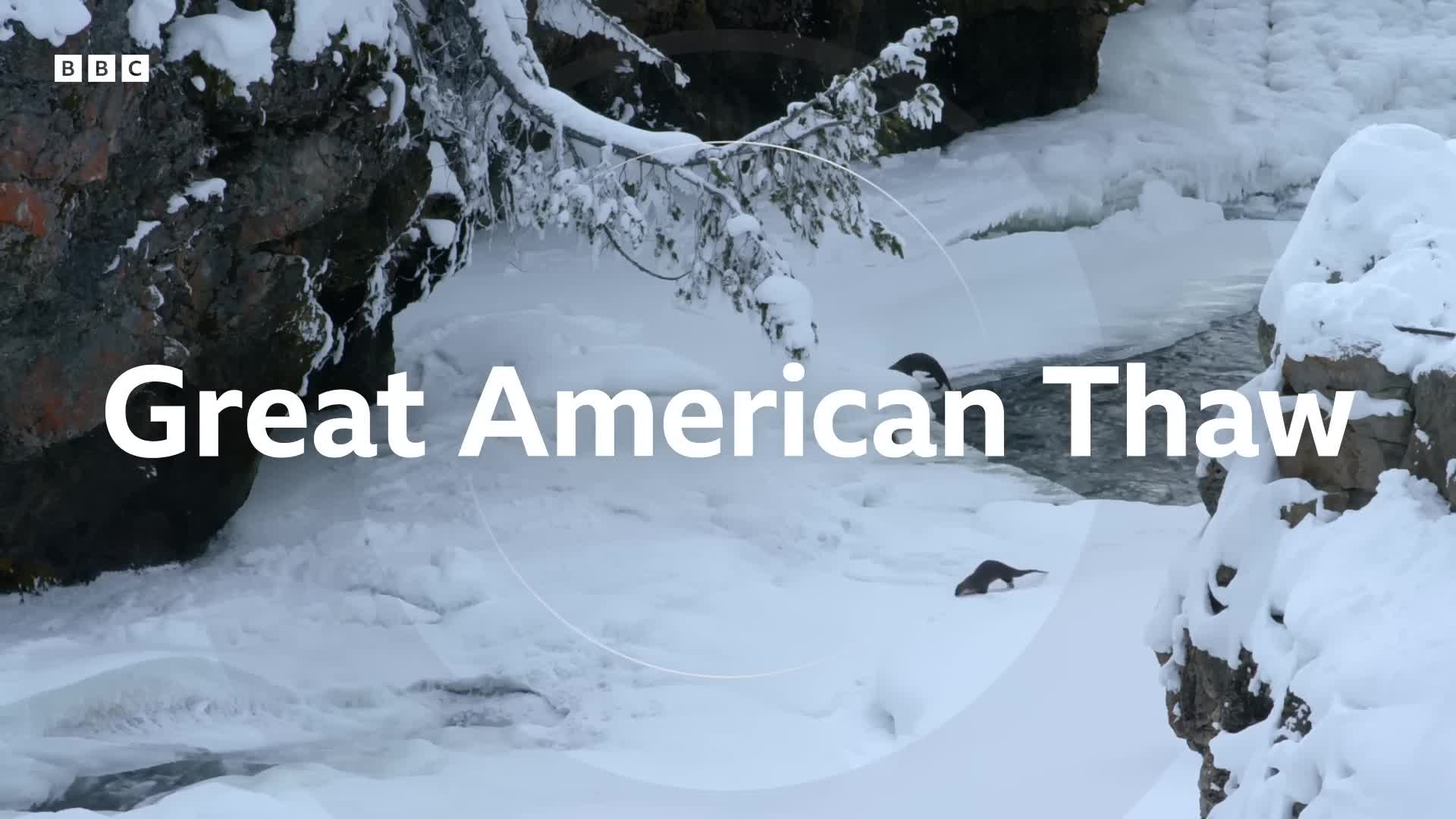
To stay warm and active, they must each catch at least a kilogram of fish every day.
As they enter the water, their dense oily fur traps air close to their bodies.
Like an underwater blanket, it insulates them from the icy water.
Ice now covers all but a few small sections of the river.
So many of the fish here are now out of sight.
Luckily, otters can hold their breath for eight minutes at a time, enabling them to hunt far beneath the frozen surface.
Throughout winter, as the wind blows and temperatures change, the ice holes on the river shift.
So every day the otters must check each opening one by one.
Their efforts eventually pay off.
They may be small, but these fish are packed with valuable protein and fat.
A nutritious meal that other predators cannot reach while the rivers are frozen.
But the otter's success hasn't gone by unnoticed.
Bald eagles look on jealously.
They too need fish to survive.
But they have no way to reach them under the ice.
Time for a new strategy.
Theft.
Bald eagles are armed with razor sharp beaks and strong talons that could easily injure an otter.
By traveling together, these two can work as a team.
As long as this river stays frozen, The otters will have to endure this aerial harassment.
To find a meal in these conditions requires some specialist skills.
Something has caught this fox's attention.
Unaware of the danger, a rodent tunnels under the snow.
To make a clean kill, the fox's next move must be perfect.
But if at first you don't succeed, try and try and try again.
Despite his best efforts, luck still plays a part.
And today just isn't his day.
There are easier meals available if you know where to look.
Yellowstone's lakes won't melt for at least another month.
Right now, they're covered by a solid layer of ice, at least a meter thick.
The fish below are prized by fishermen and foxes alike.
When it comes to reaching this food source, all of the foxes' hunting skills are useless.
Only man has the tools for this job.
But today, even the humans are struggling.
However, like foxes the world over, he has the power of cunning and charm.
It's not much, but every little helps.
There aren't many animals here that will get this close to people.
He's equipped with one of the most powerful noses in the natural world, able to detect food from over a mile away.
He's locked onto something.
Billions of receptor cells in his nose have led him to a small pond.
The early thaw has been enough to melt the surface.
There's something beneath the water.
He'd like to reach it without getting too wet.
But that's easier said than done.
It takes more than an icy plunge to put off a hungry grizzly bear.
Finally, he gets a grip on his prize.
It's a rotting bison carcass.
Most likely to have fallen through the ice at the start of winter.
It's been in the deep freeze ever since.
It's a huge windfall for this bear at this time of year.
Such a large quantity of calorie-rich protein will sustain him for several days, but only if he can keep it for himself.
The smell instantly attracts scavengers.
This is probably the first bear this coyote has seen for months.
Even a gang of coyotes can't challenge a bear for the carcass.
But they know it's always worth hanging around for the scraps.
In an attempt to keep the meal for himself, the bear tries to mask its scent.
This grass will also slow down the bison's decay.
It's vital to defend his treasured bounty.
This year's calves have made it through the first few weeks.
A quarter of baby bison don't.
Healthy bison are a difficult target for wolves.
But hunger is making them bold.
A single bison calf will keep wolf pups fed for days.
The bison are strong and stand their ground.
They have safety in numbers.
The wolves must work as a team.
They need to split the herd apart and separate a calf.
The chase is on.
But the bison are going nowhere.
The wolves only option is to go in and drag a calf out.
But a kick from an adult bison could kill.
It works.
The calf is out.
Its mother in pursuit.
But she's outnumbered.
Miraculously, the rest of the herd come to the rescue.
Closing back in.
And the calf is saved.
It's a risky move, which this time didn't pay off.
For now, the wolves and their pups remain hungry.
The beaver's survival relies on a string of dams that they've painstakingly built.
The beavers turn small streams into a series of deep, still ponds with a plentiful food supply.
The lodge is also protected from being washed away.
Inside, the family take refuge from predators.
Constructing this watery wonderland is an epic task.
Beneath the surface, the dam is roughly three meters wide.
It's a massive underwater wall built of logs and branches, reinforced with heavy rocks, mud and plants.
They make their own building materials, using their chisel-like teeth to fell whole trees.
Finessing their masterpiece is a lifelong project, but a crucial one.
Dams need to be watertight.
This year's early thaw has caused a problem.
The dam is leaking.
The faintest trickle needs investigating and fixing.
With five dams on this stretch of river, the beavers are literally beavering away.
Safe indoors, the young two are honing their skills.
When they reach around two years old, they'll have to leave the lodge to build dams of their own.
Outside, the water is still rising.
If the mountain snow melts too fast, the lodge and its kits could be in serious danger.
High up in the owl nest, away from the floods, the runt is still alive.
One month after hatching, one of her siblings has already left the nest.
He's safe in a nearby tree.
But fledging is a daunting prospect.
Their wingspan will eventually reach one and a half meters.
But for now, their wings are too small and weak to fly.
And their nest is high off the ground.
So the first leap takes courage.
The second chick is showing all the right signs.
Or maybe not.
Building up the nerve to jump takes days.
And days.
And days.
Whilst in the nest, they're still being fed.
But that will soon stop.
If they want mum and dad to keep feeding them, they'll have to take the plunge.
The pressure is on.
Finally, after 24 days, we have liftoff.
Of sorts.
It's one thing to launch.
It's another to land. he's not doing much to tempt his sister to follow.
But if she doesn't jump soon, she may run out of time.
Billions of aquatic insects are emerging from rivers all across Yellowstone.
Salmon fly and mayfly are taking to the air to breed.
Throughout the winter, they've been living in the water as nymphs.
Now, their adult lives will last just a few short hours.
Just long enough for them to pair up and lay their eggs.
But flies that linger on the surface are in danger of being snapped up.
Beneath the water, Hungry cutthroat trout have been waiting.
Insects are a vital food source for these endangered fish.
And the cutthroat are hungry.
This follows their long journey upriver to spawn in the shallow summer streams.
Their migration is triggered when rivers swell during the thaw.
And this year's early melt meant some of these trout began their marathon swim two weeks earlier than normal.
The arrival of the trout is a critical moment for the 23 species of predator who rely on them for food in summer.
So any change in the trout's migration schedule could have disastrous consequences.
Ospreys have flown all the way from South America to feed on Yellowstone's fish.
They have chicks in their nest who desperately need this protein-rich food.
Otters are also fattening up on the cutthroat trout.
This female is fishing to feed her two young pups.
The spawning trout are full of nutritious eggs, a perfect snack for growing youngsters.
Next year, these pups will be hunting for themselves.
But for now, they're still reliant on their mother to protect them.
Male otters have been known to steal food from the young.
So this male is quickly chased away.
Over 60 species of butterfly feed in Yellowstone each summer.
But they're not the only ones searching for nectar.
Hummingbirds are also fueling up.
Some have traveled from as far away as Mexico to be here.
This Calliope hummingbird weighs just three grams, making him the smallest bird in North America.
Rufous hummingbirds have also come here.
This female has traveled over 2,000 miles to raise her chicks in the Yellowstone summer.
But this year, even up at these elevations, temperatures have been higher than normal, leading to stunted growth and fewer blooms for some flower species.
Further up in the mountains, one very specialist mammal requires an abundance of this alpine vegetation.
The pika.
During winter, this whole area will be buried beneath three meters of snow.
Rather than hibernate or migrate away, the piker will tough it out.
So to make sure they have enough to eat, they spend the whole summer stockpiling food.
It's a race against time to get the harvesting done before the short growing season comes to an end.
Every journey means running a gauntlet of predators.
And at the first sign of trouble, the alarm is raised.
The pika's rather odd appearance is all about keeping warm.
Their plump, round shape minimizes their surface area.
And thick fur covers their entire body, even their toes.
But being dressed for sub-zero temperatures can cause pika to overheat during the height of summer.
So they can only survive at the very highest elevations.
This year, even the most robust dam may not be enough to ensure their pond stays deep enough.
The river level here has fallen to a record low, presenting Mum with a new problem.
By sheltering inside the lodge, her kits are protected from predators.
The only way in or out is under the water.
Like a moat around a castle, the water keeps out unwelcome visitors.
But with levels so low, the lodge's entrance may soon be exposed, leaving mum and her new kits vulnerable.
She decides to take an incredible gamble.
She's moving her kits to a safer lodge downstream.
But doing so in broad daylight is extremely dangerous.
Predators like bald eagles would happily snatch her babies away.
She must be swift.
But the same dams that she built now present a serious obstacle.
Going around them would waste precious time.
She has no choice but to go over the top.
This is a tense moment for mum and baby.
Safely over, they head up a nearby tributary towards their new home.