Chat with Traders is brought to you by Trade the Pool.
Becoming a funded trader means trading with a firm's money instead of your own.
At Trade the Pool, you first complete an evaluation by hitting profit targets while managing risk.
Once you pass, you get access to up to $260 ,000 of buying power.
You keep up to 80 % of your profits while the firm covers the risk.
It's the perfect way to trade big without risking your own funds.
Are you ready to become a funded trader?
Join Trade the Pool.
Chat with Traders is also brought to you by TastyTrade.
Ditch those rookie trading apps.
Get TastyTrade, the platform for serious traders.
Chart with 300 plus indicators, know your profit odds and move fast.
Trade stocks, options, futures, and more, all in one account.
See why serious traders choose TastyTrade.
Visit TastyTrade .com.
TastyTrade Inc. is a registered broker dealer and FINRA, NFA, and SIPC member.
Trading in the financial markets involves a risk of loss.
Podcast episodes and other content produced by chat with traders are for informational or educational purposes only, and do not constitute trading or investment recommendations or advice.
And I experienced how addictive it could be to just keep wanting to put on a trade and see what happens.
It's just like a slot machine really.
You get a dopamine hit from the wind and then it makes you want to just put on another one right away.
Markets, speculation, and risk.
This is the Chat with Traders podcast.
Yes, that's right. This is Chat with Traders, episode 281.
Hey, traders, this is Tessa.
What's going on? How are things with the markets lately for you?
We'd love to hear your thoughts, share it with us.
Feel free to email us at hello at chatwithtraders .com.
It would be so awesome to hear from you, or even better, get on the Chat with Traders website and leave a voice message.
After all, we are audio based and always love to hear your actual voices.
So don't be shy. Before we introduce our guest today, please allow me to take a few minutes to do a quick shout out to our Chat with Traders community members.
For those who don't already know, recently we made the difficult decision to close the online Chat with Traders community.
When we launched this space back in November, 2022, we wanted to create something truly special and different.
A home where listeners of the Chat with Traders podcast could come together, connect, share ideas, and lift each other up.
And we pictured a vibrant community of traders and aspiring traders supporting and lifting each other up.
Patrick, Peterson, Steve, Bee, a big thank you to you.
You have been a strong and positive driving force in the community.
You're not only amazing and talented traders, but you have also inspired many of us in the trading room and outside of the trading room to stay motivated and continually to learn and improve.
And building this community together has been an incredible journey and the lessons we've learned will stay with us.
So to everyone who's been part of the Chat with Traders community family, we hope with all our hearts that being here has added value to your trading journey, no matter how small, Moyes, Barlow, Tim, Marilyn, Tiffany, Daniel Stu, Peter, Michaela, Quinn, Chet, Murad, Yens, Nuno, Thomas, Brandon, Damiano,
Mr. Dip, and many more of you, please forgive me if I am not calling out all the names, but you know who you are.
Your presence has meant the world to us and we're so grateful for every contribution, every interaction.
This community has allowed us to connect with so many of you on a deeper level than we ever could have imagined, sharing the highs and the lows, the struggles and triumphs that make the journey of trading so unique.
So keep in touch with us.
Let us know how you're doing.
Thank you again for being a part of this very special experience.
And for those who haven't had the chance to be part of the Chat with Traders community, although we are closed now, who knows?
We may reopen again in the future, so make sure you are on our email distribution so we can keep you posted.
Just get on the Chat with Traders website.
Thank you again for allowing me some time to talk about the community.
Now, I am excited to introduce a special guest.
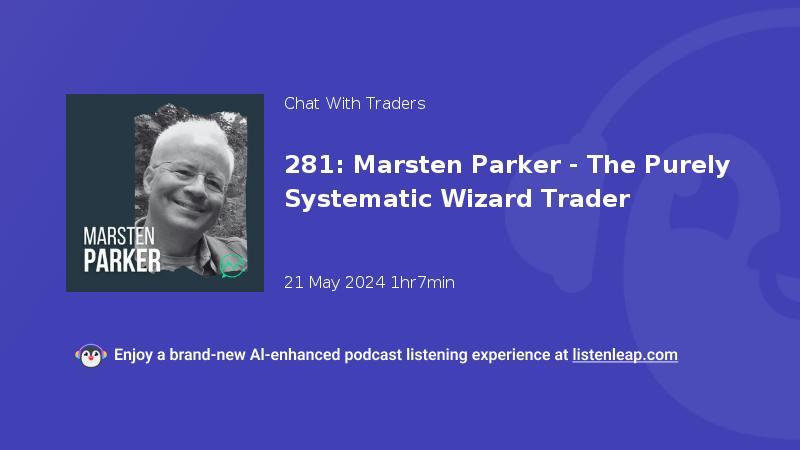
Today, Ian speaks with Marston Parker.
Starting in classical violin and computer programming, Marston's path took a transformative turn when he ventured into trading.
Despite a rocky start, his disciplined, algorithmic -driven approach led to consistent returns, earning him recognition in Jack Schwager's Unknown Market Wizards.
We get to learn about his transition from discretionary trading to systematic trading and emphasizing the importance of statistical analysis over emotional decision -making.
Marston used his programming skills to create fully automated trading systems to take advantage of breakouts, mean reversion, and IPO opportunities and other strategies.
Also, please note, this recording was made before the sad news of Jim Simon's passing.
Ladies and gentlemen, we are so pleased to present Marston Parker from Massachusetts.
Well, Marston, welcome to Chat with Traders.
Thank you. Where are you calling from?
I'm in Reading, Massachusetts, which is about 12 miles north of Boston.
Yeah, it's great to be here.
I actually had been in touch with Aaron Fifield about 10 years ago during the first days of the show and almost came on then, but I didn't have any kind of online presence.
So I thought, no, I don't think I'll do that.
So better late than never.
Yeah, well, you happen to be fortunate enough to be the only purely systematic trader whose performance over the decades was sufficiently superior to make it into the book Unknown Market Wizards by Jack Schwager.
How did you get known to him?
Yeah, I mean, I have a feeling there are probably a lot of systematic traders with better performance, but who just weren't known to him or weren't interested in being in a book.
But I was lucky enough to be recommended.
I didn't know he was making a New Market Wizards book at all or seek to be in the book.
I had been, I'm still a member of a community online called Stockbee, which I joined in 2013, I think, and the fellow who runs that community, Pretty Bond, somehow was in touch with Jack and was let known that Jack was looking for people for his new book and recommended a couple different people, including
me, the others who he recommended declined to be in the book, but I agreed.
So that's how that happened.
And then of course, as usual in Market Wizards, I had to send Jack all kinds of documentation about my track record.
Luckily I had all my old brokerage statements going back 20 years, so that was fine.
And as he wrote, my stats were really just barely qualified me, but somehow he decided to put me in.
So here I am. Oh, great, great, thanks.
Let's dive into your background, kind of where did you grow up and what were your early interests in life?
Yeah, well, I grew up here in the Boston area.
As a teenager, I had two main interests, classical music and specifically violin and computer programming, and they sort of competed for my attention throughout high school.
And I ended up deciding to try to pursue a career in music.
And I went to a conservatory in New York City and studied classical violin, but this was the early 80s when the personal computers were just being introduced.
And I got one, and so I ended up spending more and more of my time while in school coding and less time practicing violin.
So I graduated, but it was clear that I wanted to go in the computer direction by the time I finished.
So I moved back to Boston, took a job at a computer store and then eventually found employment at a software startup in 1984.
And yeah, worked for that company and two other companies.
The third one was called Segway Software, SEGUE.
And they ended up going public in 1996 on NASDAQ, a similar SEGU.
And I was one of the earliest employees, so I owned about 4 % of the company.
So I had some stock and that's what got me interested in trading.
What kind of job did you have at the software company?
That you - I was a software developer, software engineer.
That was my profession from 1984 through 1997.
Oh, wow, 13 years. And what kind of software did you write?
It was, I started out working on a VACS mini -computers and then transitioned to personal computers software.
And it basically was tools for other developers.
The first thing I built was an editor for a particular programming language that the company offered for a lot of the latter part of the career, I was involved in building tools to support testing of software.
So our customers would be QA engineers at other software companies.
Segway's main product was something called Silk Test, which I think was the leading thing in that category for a while.
Uh -huh, and did you get a lot of satisfaction from being a programmer?
I did, yeah. Yeah, I've always enjoyed building software and having people use the software that I build and so that was satisfying.
Yeah, so the famous Jim Simmons, he was involved in the buyout of the company you worked at?
Yeah, I think he pronounces it as Simon's.
Simon's, yeah. That third company, Segway Software, he was the chairman of the board and the largest investor in that company.
He at that time in the early 90s, he hadn't had, you know, he had some success in his hedge fund business, but not, you know, nearly as much as he did later.
And he was, or maybe just on the side, he had a venture capital fund that, so he was investing in, I don't know how many in total, probably five or 10 software companies, typically, and we happened to be one of them.
When the buyout occurred, were you itching to retire at that point or were you imagining yourself at just getting another software job?
No, I mean, it wasn't so much a buyout, it was an actual initial public offering.
So, I mean, the company did eventually get bought, but that was years after I had left.
So, no, I wasn't really itching to get bought or to do anything.
I mean, it kind of was surprising when it became a possibility that we could go public.
We were a very small company these days, it could not have gone public.
So, but yeah, at some point, we went public in the spring of 96 and then several months later, there was a fairly major correction in the NASDAQ, the tech companies were struggling.
And I kind of got tired of working there really.
And I just got more and more obsessed with watching our stock and then started buying books about trading and getting involved in other stocks and dabbling with trading strategies and just kind of thought, okay, I'm gonna leave for a while and try this as an experiment.
I could always go back to that company or get a job at a different software company if I wanted to.
But then I did fairly well fairly soon and the experiment went on for quite a while to the point where it was kind of too late to go back and get employed again.
Any books come to mind that influenced you in the early stages?
One of the earlier books I bought was called Trading for a Living.
What's the name of that author?
Yeah, Alexander Elder, right, right.
Yeah, yeah, yeah. And that I think just the very title was influential.
It didn't occur to me that anybody traded for a living until I saw that book.
And then I thought, oh, okay.
So that was one, but also that was just the time when some online resources were first coming available.
Like it was a site called thestreet .com that I would read and there were starting to be some early versions of kind of like online user groups.
I think Yahoo had a whole bunch of user groups.
So I would participate in some of those.
Oh yeah, there was a site called Silicon Investor, I think that sort of like I might've participated in.
So I don't know, I was getting inputs from all over the place and getting interested in trading, so.
Yeah, so tell us a little bit about your early trades, your early big winners and losers.
And how did it go early on?
Well, early on, I did some, I opened a brokerage account and had my restricted shares converted to regular shares.
So I could start to sell them and have some trading capital.
And just started dabbling in some, there was some, I don't remember where I, it must've been some other earlier book that I read that it was more of a fundamental angle of like, you know, kind of rotational investing based on things like PE to growth ratio or stuff like that.
You know, I found a way to do some scans for things like that online maybe, or with some, I think I had a piece of software on my desktop computer called Window on Wall Street or something like that.
So, you know, I would just put on a trade because I thought it met some criteria that I had heard recommended.
Oh, and I was also watching, I think CNBC was just kind of getting started at that time.
And so I would watch that.
I remember my first big loser, this was in 97 when I was still employed in trading on the side.
I heard on CNBC, what is it?
Herman Miller Company had beat their earnings expectations.
So I immediately bought the stock, like way larger position.
I was like, oh, they said it was good on CNBC.
So I better take a really large position.
And it was one of those sell the news situations apparently.
So I remember having a couple of sleepless nights on that one.
So yeah, that first year of trading in 97, I think I ended up losing about 50 grand.
And then at the end of that year, on that basis, I said, okay, I'll put my job in trade for a living.
I had no idea what I was doing.
Well, I was starting to get an idea that I could maybe take a more systematic approach.
And I was kind of, I somehow got included into the fact that some people had trading systems and followed them rather than just trying to make discretionary decisions and be right about things, which clearly wasn't working for me.
I started corresponding with one person who was sharing some aspects of his trading strategy in a series of articles on thestreet .com.
Guy named Gary B. Smith, and we just kept corresponding and became friends and eventually trading partners.
And so I followed his systematic, it was mostly systematic.
There was some discretion in the selection of which stocks to buy are short, but then the exits were 100 % mechanical.
Since you were doing this for a living, did you have any expectations as to a targeted annual income or total return goal?
I had a general concept of, and I remember corresponding with Gary about this and kind of doing a sanity check with him of, do you think I could consistently make 20 % a year?
And he said, yeah, that should be easy to do.
I had about a million of trading capital, so I thought if I could consistently make 20 % a year, even after taxes, be able to have more income than I had from my former job.
And maybe even grow the account a little bit.
So I kind of had a goal of being able to grow my account five or 10 % a year after taxes and living expenses.
Which now I understand, you can't really have an income type goal from trading.
It doesn't make any sense whatsoever.
You're gonna have big swings up and down and so on.
But compared to many, I think I was in a pretty stable situation because I had plenty of trading capital.
And also I had paid off all of my debts, like my mortgage and so on when the company went public.
So I had no debt, plenty of capital.
So, and a career I could go back to.
So it wasn't a huge risk at the time.
I just kind of viewed it as an experiment that I was doing.
That book that you mentioned, Trading For a Living, when I looked into that book, it appears to be a book about discretionary trading.
Did you kind of set aside those early books that you got into and then focused more and more on systematizing your approach?
Yes, I pretty much, I had gone through a lot of different books and looking for really clues about how to proceed.
And I found clues here and there, but like you said, most of them are about discretionary.
There weren't any books there that said, here are all the exact rules of a trading system that's highly likely to work.
I mean, I don't even think, I don't know when some of the first books about trend following came out.
I don't think that there were many yet back then, there may have been.
I pretty much set that aside and adopted the method that Gary Smith was using.
And then gradually tried to systematize that method.
In our pre -call, you mentioned that you hate trading.
Oh, why is that? Yeah, I mean, I may have overstated that some, but I don't really have the person, the typical personality of a trader who is kind of enjoys placing bets on things or likes the challenge of trying to make correct calls about the direction of things of price going or anything like that.
I mean, I do enjoy it and particularly did early on in terms of the, as a kind of puzzle of, how can you come up with a strategy that made money in the past and more importantly will continue to make money in the future?
So I enjoy the kind of research and of that aspect of it, of testing different strategies, trying to come up with ideas and so on.
But the actual process of trading, of placing trades and, I mean, I kind of, I went down that rabbit hole a little bit early on.
I even spent about a month doing very active discretionary day trading in NASDAQ stocks in 1997, during that losing period.
And I experienced how addictive it could be to, I just keep wanting to put on a trade and see what happens.
It's just like a slot machine, really.
You get a dopamine hit from the winds and then it makes you wanna just put on another one right away.
And fortunately I was self -aware enough to just observe myself in that process and realize that this was gonna be dangerous, slippery slope for me if I continued in that direction.
And so I said, no, at heart, I'm very conservative.
I'm not interested in losing a lot of money and I'm not the kind of person who will ever make a big bet on anything.
Do you think, if you had beginner's luck from the beginning, say in 1997, and had good gains early on, would you have still started the process of moving to a systematic approach?
Oh, probably. Is that just kind of in your nature?
I think it's in my nature.
Yeah, I mean, as I mentioned that, when I started trading with Gary, our method had a discretionary element in that we'd run a scan.
Well, not so much run, but get the Investors Business Daily newspaper and look at the table of stocks that had unusual volume the prior day.
So we would go through the charts of those and he would make, mostly him, would make some kind of subjective judgment of how the chart looked and kind of rank them on that basis for what are the best entries to take.
And I tried to grasp that, what he was doing there, and I always found it sort of arbitrary.
So right away, I wanted to, I wanted to be able to test it.
And I also wanted to be able to test the exits we were using and see if we could come up with better ones given the set of entries we had actually taken, what different exits would have worked better.
So yeah, even if I had succeeded initially with some of the discretionary -type approaches I was doing, I probably would have written code to test it fairly soon.
Chat with Traders is brought to you by Tasty Trade.
Tired of trading on rookie apps?
Then get the platform for serious trading.
Tasty Trade. Tasty Trade gives you the tools to trade your way.
Chart your heart out with over 300 indicators.
Know your odds with probability of profit and move fast with quick roll.
Trade what you want and trade it your way.
Stocks, options, futures, and more.
All in one account, on one platform.
No wonder why serious traders choose Tasty Trade.
Visit tastytrade .com and see for yourself.
Tasty Trade Inc. is a registered broker -dealer and member of FINRA, NFA, and SIPC.
Hey, I got a great update from Trade the Pool.
Now it's even easier to get funded.
As you know, Trade the Pool built a unique program to evaluate stock traders like yourself and provide you with the company's funds to trade with.
It's real shares and you no longer need to worry about the PDT rule, but that's not all.
Trade the Pool has introduced a new tier with $20 ,000 in buying power, making it easier to pass the evaluation and speeding up the process of getting funded much faster.
You don't want to miss this opportunity.
As a musician, do you see a link between musical, reading, and playing skills and systematic trading?
But the things I learned from trying to be a violinist, you know, concentration, the ability to stay focused at a task, which didn't come that easily to me, but I worked at it.
Just the discipline of practicing every day, there's some overlap there.
You know, there's a lot of structure or you might even say a system behind music, you know, some of which I learned about in school and so on, you know, they probably make some connections there.
I don't know if it's super specific.
Yeah, so let's dive into your early algo trading.
Can you share with us a little bit about some of your early algo strategies?
Well, you first started off as systematic, right?
Were you manually entering in your orders or how soon did you actually go to an algo approach?
So basically from, I started trading with Gary Smith in 1998, February 1998.
And we were trading one pair of strategies, basically long and short, kind of a symmetrical, not exactly symmetrical, but it's basically buying breakouts with unusual volume or shorting breakdowns and then setting a bracket, like a target and a stop and whichever one gets hit first.
And the only thing that was a little unusual about that strategy as opposed to classical trend following is that the stop is larger than the target, you know, and it had a fairly high win rate, like a 70 % win rate.
I think we were using like a 5 % target and a 7 % stop initially.
You know, later I discovered other ways to measure those things like ATRs, but that's what we were doing initially.
And I basically traded that exact system, that one pair of long and short strategies, just with minor variations all the way until 2015, I wasn't really doing anything else.
You know, I kept over -optimizing them and tweaking the parameters.
The basic concept was the same.
So I don't think all the optimizing and parameter changing, I did really made very much difference.
I could have chosen different parameters and maybe at random I would have had better results or worse results or whatever.
But the basic concept was the same.
You're buying breakouts on unusual volume and setting a target and a stop.
I think there was also a time stop.
So there's basically three components to the exit.
So to answer your question, when we first started this in 98, we would actually phone in our orders to a broker.
There wasn't even an online platform where like interactive brokers is now where you could actually do that.
Schwab maybe started to have a TD Ameritrade.
That came a year or two later, when we first started there really wasn't much.
So we were using this online broker.
I mean, it was kind of an agency, a small broker in New Jersey.
So we would call in the orders.
Then, since we were doing this every day, we asked if we could email them the orders.
So we started emailing them the orders instead.
And then I ended up writing code to generate those emails.
So that was, my first automation was actually code that generated and sent emails to a human broker who would then do the order entry.
I actually stayed with that broker until 2013.
They were called Trade Managed Capital.
And earlier than that, they had been called Yamner.
I think we were probably their only retail clients and all their other clients were hedge funds, but we were sort of behaving like hedge funds.
So they took us on and so they gave us the software and I changed my code to use that.
But, and then in 2013, I switched to interactive brokers just cause I was paying too much commissions, basically with the others and people.
And the slippages were getting worse.
They had been giving us, I think, very good fills early on, but the slippages were getting worse and decided to change from interactive brokers.
And then, coincidentally, I went kind of went through a rough patch for the next several years.
But I don't think it was cause I changed brokers.
I think it was because the strategies were winding down and not working as well anymore.
So to be clear for what, since 1999, 2000 era till 2014 or so, I mean, a good, long stretch that you were doing two basic strategies, correct?
Yeah, or really two sides of one strategy, you might say.
Two sides of one strategy.
So let's dive into that a little bit more.
What, so you're on one side, you're buying breakouts on heavy volume, like double the average volume.
I mean, in the early days when we would do the scanning, every day after the market closed, after data was available.
So you're basically scanning all common, US common stocks that meet like a liquidity criteria and price and liquidity filters for, yeah, kind of three things that unusual volume, like at least two times average or three times average volume, a significant move, not like up five cents on two times average
volume, but up several percent in one day.
And then prior to that, it should not have already been overbought.
So ideally it's like a flat congestion area and then a breakout from there.
So that's the basic set up.
I mean, it's probably the most well -known breakout set up in the universe, there's nothing original about it.
I think Gary got it.
He started by reading the works of William O 'Neill, how to make money in stocks and basically took the Kanslim method, discarded all the fundamentals and changed the profit target from 20 % to 5%.
And that was about it.
So that's essentially what we were running.
And then he added the short side, which O 'Neill wasn't doing any shorting and hadn't even published any, his book about shorting yet back then.
So those, I think the most innovative thing was that Gary had added the short side, which where he was looking for kind of an even more big breakdown.
He had to describe it as like, it should look like you just broke your arm and it was dangling.
So the criteria for entering shorts was more stringent and required a greater gap down on heavier volumes.
Yeah, basically he was looking for really a visible gap.
And the way he used to say is that the stock should look broken.
Most of these entries would be after a negative earnings surprise or a negative earnings pre -announcement.
I mean, that was typically in those days, that was the news that would lead to that pattern.
Yeah, and how long did you typically hold these positions both long and short?
Did you have targets when you get out?
Yes, the moment we play, initially we would basically place an order to buy or short at the open at market with an attached bracket of a target and a stop order, whichever comes first.
So, one cancels the other kind of situation.
And those would be calculated in advance as some 5 % favorable or 7 % adverse.
So in the case of a long, it would be 5 % up and 7 % down, vice versa for the shorts.
And that was it. And then you just leave them alone until they hit one or the other, which would typically be in those days, anywhere from that same day to a week or two later.
But mostly it was within a few days.
I mean, it doesn't take that long for a stock that just had an unusual move on, unusual volume to move another 5 % one way or the other.
So yeah, it was really a few days was the average holding period, maybe three, four days.
What were your thoughts about holding it for a relatively short amount of time, given the old adage, the trend is your friend and did you have a kind of a reasoning for, now let's get out earlier than normal.
Yeah, I mean, our reasoning was that we wanna be in what is moving right now and that that keeps changing every day or every few days.
Whereas if you buy a breakout and then just hold it until some longer term stop is hit, you might be tying up your money in that one stock for a long time, some of which it's not really going anywhere.
Gary's philosophy that I adopted is that your capital is sort of like inventory and you wanna just keep turning it over and putting it in where the action is within reason.
I mean, in those days, that kind of timeframe was about as small as you could get without trading costs totally overtaken.
Cause remember back then stocks were still priced in fractions and the tick size was a one eighth of a dollar which is pretty large spread.
And then the commissions were like, I mean, if we were trading one or 2000 share lots, the commission would be 50 or $60 per round trip trade.
So, there was kind of a sweet spot where I'm 500 to a thousand round trip trades per year.
It was workable. Gary was less conservative than me.
So that year, 1998, our first year of trading together, he made 80 % and I made 50%.
It was a good year for us.
You mentioned in a previous interview that you like to have large numbers of trades to be statistically significant.
Do you tweak your system so that it will generate a likely minimum number of trades per year?
You mentioned, I think 500 or a thousand trades per year.
Is that kind of the sweet spot to be statistically?
Yeah, I mean, if I look at a backtest, I wanna see, thousands of trades to believe that there's an edge to it.
I mean, if you see a backtest that only produces 50 trades and there's one or two outliers in there, it doesn't really tell you anything about the rules that led to those trades.
So that's what I was typically looking for, yeah.
Yeah, again, it's kind of, well, it depends on what data you have.
I mean, I've generally always worked with daily bars.
That kind of 500 to a thousand round trips a year, holding for a few days is kind of as low as you can go with daily bars.
I mean, obviously, you can't really model intraday trading on daily bars, or even a day trading.
There's one day trading strategy you can where you enter with a limit order and exit with MOC other than that.
How time consuming is coding everything yourself?
I imagine it's a big upfront investment, but later on, how much time do you spend both in the early stages and later on?
I don't know, I've probably spent many, many thousands of hours on the coding, but it's not like I'm starting from scratch every time I have a trading idea.
I mean, from the beginning, I built a general purpose backtesting program, and then later a general purpose automation program.
Most of that time, it was in Excel, but now I have a standalone program.
So now, I mean, given the software that I have, if I wanna test a new idea, I can do it in a few minutes.
And if I wanna start trading a new strategy, I can do it with very little additional coding because I have the infrastructure.
But early on, I mean, it just kind of evolved.
There wasn't some big task I had to complete before I could trade systematically.
It gradually evolved from mostly manual to semi -systematic to, I think I've started being fully automated from my Excel VBA code at the beginning of 2000.
I don't think I've placed a manual trade order since 1999.
Let's go back to kind of the timeline of you used your first system until, how long did you use your very first system without making major modifications to it?
I was always tweaking it.
So everything just kind of gradually evolved.
I mean, so we had that very good year in 98.
99, I was really getting much more systematized.
I had become disillusioned with the chart judgment process with our eyes and wanted to make rules for what the data should look like.
So I kept changing those rules and ended up having a fairly mediocre year in 1999, which is unusual because most traders had a fabulous year in that year, except for ones who were exclusively short.
I went back and looked at all the times I had changed the rules and realized I would have done better off leaving them how they were at the start of the year.
So I made this resolution of, okay, going into 2000, I'm going to trade one set of rules all year and not change it all year.
And I actually did that.
And as it happened, I had had my best year yet.
So that worked well.
After that, I had many periods where I would frequently tweak things.
You fall into, I think everybody's susceptible to this.
When you're in a drawdown, you say, well, how could I have avoided this drawdown or made it less severe?
And you find some rules that would have made it less severe and you put them in place that, I mean, I was totally naive.
I didn't know anything about overfitting or whatever.
I just did that. And sometimes it helped and sometimes it didn't.
My usual process would be, okay, I'm in a drawdown.
Let's retest and let's see if I can come up with a new idea that would have made the drawdown better or would have made recent performance better and put that in.
And then there were a couple of times when I couldn't find any parameters that would have done better.
And then I thought, oh, shoot, the whole approach it's broken now.
So what do I do? One of those was actually, I said I had this great year in 2000.
And so of course I kept running the same rules going into 2001.
And I immediately had a 20 % drawdown within the first month.
And I'd never had a drawdown that large before.
So that caused me to stop for a little while and reevaluate.
And I ended up putting something in place that was fairly similar, but I think I changed to that I would get a real time data service and do my entries before the close rather than at the next open.
Because in back testing, I had figured out that would have done a lot better recently.
So I made that change.
And then I did an analogous thing when things stopped working again in 2005 of switching to getting in even earlier.
So I would look starting about five minutes after the open for the stocks that seem to be making big moves on unusual volume and buy them then.
And so I ran it that way.
That did well in 06 and 07 were my other two best years besides 2000 and even NO8 was okay.
09, 10 was quite good, 11, 12.
2012, basically the short side, when we got into that decade, especially after starting 2013, the short side completely failed.
And prior to that, more than half of my total profit was from the short side.
If I had just been trading my long side all that time, I wouldn't have even beat the market at all.
I would have been better off buying and holding long and then just shorting against it.
But I didn't know that, maybe not in 08, but other than that, yeah.
I see, why do you think the short side was hurt in 2012?
What was it about the markets that made that year different?
Oh, I think more and more other traders started adopting the buy the dip approach.
Basically short term meaner version became a very popular strategy.
So the kind of sharp breakdown pattern that was my short entry signal became a long entry signal for many traders.
Oh wow. So that's what I kept seeing.
I would end up shorting it near the low and then having it go against me more and more often.
It wasn't like I suddenly got all these huge losses.
It just, the stats eroded.
The win rate got lower and the average loss got larger than the average win and so on.
That's what typically happens.
By the BTFD, by the dip phenomenon, did this phenomenon exist?
It is the technical term, BTFD.
Did this phenomenon exist in other roaring bull markets of the past or was it an additional nuance of that particular market?
Oh, I think it became, it was a fairly new thing that started in that around 2012, 2013.
I don't remember. I mean, of course, prior to that, there were value investors who would know what stocks they wanted to own and wait for them to be cheap in order to buy them.
So in a longer trading timeframe, you might say, sure, dip buying has always been part, buy low, sell high.
That's always been part of the investment landscape, but I think it became a popular short -term trading strategy mostly after, maybe even in 08.
I ended up adding meaner version to what I do in 2014.
And when I did the back testing, I found that even the long side would have done great in 08, the long dip buying.
So I think it was going on for a while, but it probably reached some critical mass where my particular shorting setup didn't just stop working.
But I don't know really, you never can know exactly why, you don't know who else is doing what in the market, so the best you can do is guess why something doesn't work.
Are there any objective or subtle indicators that start to appear when a strategy has stopped working?
No, it's very hard to pin that down.
It's really more of a judgment call.
Yeah, that's where I'm discretionary as in strategy level decisions.
I still have in the back testing software that I sell, I include one of my many example scripts is the long, essentially the long and short strategy that I traded from the late 90s through the mid 2000, like till after 2012.
And you can see when you run that back test all the way back to the 90s, how it did very well, and then went flat for a long time.
And then it mysteriously did really well in 2022 when most other short term stock trading strategies did poorly.
So you never know when something is gonna start working or stop working really, it's a judgment call.
So my understanding is that you added a mean reversion strategy to your repertoire of tools.
Yeah, I became aware of that concept in that stock before that I was a member of in 2013, 2014 and did a lot of research and back testing of it.
I think I also was aware of or became aware of the writing of Larry Connors who was probably Connors and Cesar Alvarez are the people who have done the most publishing on the topic of short term mean reversion.
Yeah, I found some strategies I liked.
And so in 2014, I divided my capital into and kept running my old strategies in half and my new mean reversion strategies in the other half.
The old strategies were flat and the mean reversion half had a very good year.
So then in 2015, I just decided to abandon the old ones and put everything in this long and short mean reversion strategy pair that I had built.
And I had a great start to that year and then a really nasty drawdown.
What was the cause of the drawdown and what was the catalyst?
So is it the mean reversion part of your strategy?
Well, I was only by, so from the start of 2015, I was just running long and short mean reversion with my whole account.
So each position was 10 % of my account.
No, I take it back.
I was still trading fixed shares, not fixed percentage then but it was on average around that size 10 to 15.
Really, I mean, all it takes for, in a typical mean reversion strategy, you're catching a falling knife.
You're buying a stock that's dropping or shorting a stock that's ripping higher.
Based on some calculations that it's already overbought or already oversold vice versa.
And if you try to put stops in those strategies, they don't work at all.
You basically have to rely on the stats of, if you take a thousand trades that are overbought in this way, on average, you'll make money.
But every now and then, you'll take a larger loss.
And you just manage that by keeping your position sizes small enough so that even if a stock went down like 50 % more from where you bought it, you might only have a two or 3 % drawdown on your account.
And that would only happen once or twice a year.
So the drawdowns and those strategies happen when there's some, typically there's some kind of market event going on where you get serial correlation of those bad trades.
So you've got several significant losers in a row.
And that's what happened in the second half of 2015, especially in August.
I mean, the market was very bad in August, 2015.
And that's when you had your big drawdown?
Yeah, it had started, I think it might've started in June or July.
A lot of it is random.
I mean, I think I had one chunk of the drawdown in June.
There was one where I was shorting Chinese stocks that were ripping.
There was one where I was buying biotech stocks that were plunging after, oh, I think like Hillary Clinton was running for president and made some announcement that she was gonna crack down on the pharmaceutical industry and the whole biotech sector fell apart.
But I kept buying the dip because that's what my rules said to do.
So basically when you have something like that where there's a news based catalyst or a feeding frenzy like the meme stock craze that happened later, you just end up having too many large losers next to each other.
Whereas when you back to that kind of strategy, you see some large outlier losses, but they're spread out most typically.
And so the stats still look really good.
But then in real life, when they happen one after the other, and then when you have several periods like that interspersed with flat periods, that all adds up to a significant drawdown.
So my drawdown had started in mid 2012 when that was my equity high the summer of 2012 all the way.
And I had some recovery periods and then some further losses and then some recovery periods.
So basically my equity was in a downtrend from mid 2012 all the way until 2015 and add it up to about 45 % total drawdown.
So curious. Yeah, curious, how much does a strategy have to erode in performance over time before you look to tweak the system or just dump it entirely?
I pretty much always set a 20 % drawdown as my kind of system stop or my off switch where we're all at least pause, if not stop for a while and reevaluate.
And then it's not, I mean, then that happens several times during that period.
And then at some point you either say, okay, well, I think I've got a new idea that'll do better.
So I'm gonna restart.
But of course, you're not back, you can't wait till you get back to an equity high before restarting by definition because you have to be trading to get back to an equity high.
So at some point, you just have to keep, at any given point, you either believe you have something that's gonna work and go back in or you throw in the towel and say, I'm done forever, which I thought I had done that in 2016 and I stopped for three months actually.
But then I said, hey man, I've got all this software, all these tools, all this experience, just see what I can do, put more conservative strategies with fewer parameters in place.
So that's how you got out of the 45 % drawdown is to simplify your system?
Right, simplify, make it more, take smaller positions and diversify more.
I had just been trading the two meter runes systems but then I went back and added, my old breakout systems were still no good but I found a new long breakout system by narrowing the universe to recent IPOs, which ended up being my best performing strategy for the next several years.
And then, and added a new, I did go back to something like my old shorting strategy, but with some differences.
In particular, rather than just shorting on the breakdown, I shorted on a little rebound after the breakdown to get a bit of a better price advantage.
So those four together are kind of like my core four strategies that I'm still running and that they did mostly wealth since then.
Do you program any of your systems to avoid either highly shorted stocks or any of the meme stocks?
And how do you screen these out of your system if you do want to avoid them?
I do have some, yeah, I have a, well, I have a upper volatility filter, actually use it on both sides.
Which, I mean, there's a couple of ways to approach that.
I mean, one way is to restrict your trading to a narrower universe like the, the constituents of a major index, for example.
So some people do that.
I've always found I can get better stats by having my universe be all publicly traded US common stocks and then applying a liquidity filter.
The main difference between this universe and say the Russell 3000 is that the broader universe will include a lot of ADRs.
So it's actually, you're actually getting a lot of foreign stocks, hence my issue with Chinese names that I had mentioned earlier.
So I should have sort of lost my throat of thought now.
What did you ask me?
Yeah, yeah, so the meme, so a few years ago we had the meme stock.
Oh meme stocks, right.
So my volatility filter helps.
I mean, I did take a bit of a hit when that first started.
I remember, luckily I avoided GameStop, but I think BBBY and maybe AMC, I had some significant losing trades in a couple of those.
At the same time, my IPO strategy was on fire.
So it kind of canceled out.
Like I didn't notice those big losses quite as much as I would have, they didn't cause an overall a count drawdown, but that strategy was definitely doing poorly.
And I was aware of what was going on with the meme stock craze, because everybody was.
But by that point, I had been marketing my backtesting software for a while and we had a fairly active forum.
So there's a lot of conversation about it as well.
And we started just, the first thing we did was to just build an exclude list and a text file.
We're just not gonna trade these symbols because they're the ones that these idiots are buying.
And so I did that. The other thing you can do that I also do sometimes is look at the brokers like margin requirements or short borrow rates and just avoid, especially I figure if IB says you need 100 % margin or more, I mean, I've seen stocks where they want 400 % margin to short it.
Wow, that's crazy. Right, that tells you that their risk management people have said, this is dangerous, so why would I wanna do that?
So yeah, that's another thing you can do is let the broker give you some clues about what's too risky to be shorting.
Right, right, so tell us about your IPO strategy.
How does that differ from your other strategies?
It's so simple that it's stupid.
I mean, really, the idea was to just, well, define an IPO as a stock that only has a limited number of days in its trading history and then buy it when it closes at a new all -time high.
And then sell it if it has a one or two day low, fairly tight.
I don't use stop, I've never used stop orders in any of my trading strategies.
I use stop rules, but on a closing basis.
Basically, I just don't wanna be taken out by intraday noise and also stop orders have more slippage than any other type of orders.
So yeah, I'll get out of the close.
You sell out, you're saying, so how long would you, when you buy the IPO, it's hitting a new high.
How long would you typically hold it if it's running day after day, going higher and higher?
Well, they really, I mean, they typically are.
I have a profit target in that strategy as well, so I'll fold it till it hits the target.
And then it might have a down day and then make another new high and then I might buy it again.
Now, that strategy worked very well.
It started it in 2017 and it worked well enough through 2017, 18, 19.
And then it really hit it out of the park in the middle of 2020 through the middle of 2021 when everything was kind of on fire.
I mean, practically any strategy worked during that time period, so it's not really saying anything.
But since the end of 2021, it's just been flat.
But, you know, I mean, a good thing about that approach is when the market's correcting, there are fewer IPOs because companies just cancel their IPOs.
So it kind of has a built -in regime filter of its own.
A lot of people focus on trading IPOs.
I'm not sure, I mean, part of the success in the 2020 and 21 were all the SPACs, which is kind of no longer a thing.
There's one I just saw the other day, three -letter symbol starting with I, where it got canceled and it dropped like 80 % in one day after a run -up.
Anyway, yeah, I think it could be a while before that strategy works.
I mean, I'm still running it, but it's just been flat for about two years now.
It's not doing anything.
So going back to your mean reversion strategy, does your system differentiate between an earnings release gap down on massive volume versus a steady multi -day drop on above average volume, not tied to earnings?
Would your mean reversion strategy play a big gap down influenced by volume?
It would only if the stock had already been falling for several days and then had a big gap down, it would be, then I might buy it there.
That would be like a capitulation type thing.
But I mean, the setup I use will typically not choose anything that was like at a new high and then suddenly had a big gap down, which is my old short setup.
And those did work well in like 2013 and around there, but I think, I don't know, they might work well now.
I have no awareness of whether it's earnings or not.
I don't pull in any news, fundamentals, earning states, whatever.
I mean, I'm literally just taking price history and when price does the thing I'm looking for it to do, then that's my signal.
So, yeah, clearly, all of my trading strategies are basically looking for unusual volatility.
Like I said, from the beginning, we wanted to be in what was moving at any given time.
And so clearly I'll get more trades during earning season than not during earning season.
But there's some amount of earning season every quarter.
The big ones are the usual March, June and so on.
But I mean, April, July, but many companies are on offset fiscal year.
So you get a certain lump of earnings every month.
Mm -hmm, you mentioned earlier about curve fitting and optimization.
What are the primary kind of dangers one should look out for so that they don't get sucked in by this attractive shiny object?
Well, number one is don't even try to build a strategy for one symbol.
I mean, there's no way you can build a strategy for a single symbol without overfitting it, in my opinion.
And unless you're talking about very short term intraday, I mean, if you have tick data or one minute bars and can go back several years, maybe you can find something that works consistently.
But, and I had that instinct from the very beginning which is to basically, I want my system to be modeling a process where I'm scanning the whole market every day for that day's trades so that it's always a different set of stocks that I'm trading every day.
I mean, if I look at, do it like a buy symbol back test of my systems, I mean, there'll be fairly few trades in any one symbol in the course of a year.
There'll be hundreds of different symbols in total.
So that's the easiest way to avoid overfitting is to do portfolio based approach, not a single stock approach.
What I see a lot of people do is, or like I want to find a strategy that would have caught the most possible gains out of Tesla in the last three years.
Or right now you see people doing that with Bitcoin, which is pretty dumb because it's not gonna keep repeating.
Like that was a thing that happened and it's gonna be a different stock or thing next time.
So avoid that. I mean, and then other than that, it's just keeping your total number of parameters or degrees of freedom as the quants would say, small.
I don't do optimization for the most part.
I'll use the optimizer to go over a fairly small set of parameters or just kind of study how a parameter impacts the results.
But I don't do the classic thing of run the optimization over every possible combination and find the best stats and choose that one.
That's the thing I wanna run.
So basically you avoid curve fitting by not curve fitting.
Right, right, right.
So I've read that back -testing, the problems with back -testing, often we back -test a system that will yield much higher returns and smaller drawdowns than typically experienced with live trading.
Well, what is it about that process?
Why does that happen?
Are we not looking at long enough timeframe for this?
And is that inherent?
It happens because when you back -test, you keep trying different things and discarding the ones that work less well and keeping the ones that work better.
And it doesn't take too many iterations of that before you come up with something that works better than is likely to happen in the future.
That's kind of inevitable.
I mean, I just over the years have learned to assume that my results going forward are not gonna match what the back -test indicates.
In fact, my rule of thumb is half the return and twice the drawdown.
So unless I'm content with that, I typically won't run something.
I mean, that rule of thumb probably shows that I'm overfitting as well.
But I think there's no way to avoid it.
I mean, as soon as you run your second test, you've begun the overfitting process, right?
Excuse the last interruption here.
This is Tessa. We hope you're enjoying this episode so far.
If you love the podcast, please give Chat with Traders the best review you can on whatever platform you're listening from.
This will help us to keep the episodes coming.
Also, if you haven't subscribed to our email list, please hop onto chatwithtraders .com and click on subscribe so we can keep you posted of information that may be of importance.
Thank you. Now back to the chat with our guest.
Right, right. Is there a way to measure different types of bull and bear markets with subtle granularity so we can have an earlier detection of the conditions that could cause drawdowns in our strategy so that we get different, we don't just simply say, well, this is during a bull market or this is during a bear
market. Well, what type of bull market, what type of bear market, how did this bull market and bear market different was different from past bull and bear markets?
Is there a way to kind of get that unique granularity of that particular market so that we can understand greater what's going on?
There may be, I know that some people have done work in that area, I think Van Tharp had a whole way of classifying different market regimes like that.
I mean, the simplest is just a binary market regime that bull or bear, like is it above or below the 200 day moving average?
But yeah, you can go from there, you can do, I think there's like a four way thing of bull with high volatility, bull with low volatility, bear with high volatility, bear with low volatility.
And there's probably other dimensions you could add.
And then you have to backtest that against, you have to pick a strategy and try it in each of those regimes and see how it did and is that indicative of what will happen in the future?
If you wanna use regime filtering in these kind of systems, you have to kind of decide from the beginning that that's what you're gonna do.
Start with a regime filter in place and then put your rules on top of it.
Because if you optimize some trading rules and then try to apply a regime filter, it'll almost always make it look worse because you've already kind of accounted for that in the trading rules themselves.
Since you were interviewed in the unknown market wizards, say 2023 and so far in 2024, how have you been doing?
Well, basically, my last equity peak was the middle of 2021.
I had a bit of a drawdown in the end of 2021 and then had a flat year in 2022.
And I had another drawdown at the start of 23 and then flat.
Since then, I'm up slightly this year.
So basically, I'm no longer achieving market wizard results in the last few years.
But then again, there were several years in the past, the period that's documented in the book when my results weren't that great either.
I mean, he's looking for overall stats over a long term.
So, but one way to look at it is I had an extreme outlier period from mid 2020 through mid 2021 where I had the best 12 month results I've ever had.
And then now my equity's mean reverted since then back to its usual trend, kind of 20 % average.
So why do you think more traders don't go systematic?
Are the barriers to entry or learning curve, are they high?
Not quite as exciting as for the adrenaline junkies?
All of those things.
Yeah, I mean, it's the old cliche of finding an approach to trading that fits your personality.
I mean, the ones more likely to go systematic or the ones who don't care so much about the gambling feeling of putting on a trade and don't care about wanting to be right.
Like your typical global macro kind of trader who likes to do all this analysis about what's happening in the world and make the correct call about what stocks, bonds and golds you're gonna do and get pleasure.
It sort of comes down to what gives you pleasure and what makes your dopamine fire probably.
So, for me, the actual trading process of putting on one trade, I don't even care what my individual trades are.
I know I have some positions open right now but I couldn't tell you what the symbols are.
I can't remember. I didn't even look.
I just, I literally don't care about an individual trade.
I care about the stats.
So what gives me pleasure is finding a strategy that feels robust to me and has had good stats in the past and then putting it on and having it keep working over time.
But more than that, working on the back testing software and improving the software itself actually gives me more pleasure than anything related to trading.
So part of why my results are flat is I've really been neglecting my own trading system research recently and putting all my focus and working on my software because I have over 700 users now who like to use it.
And I just really like supporting them.
And it's kind of like I'm back in the software business but I'm still trading too because I have money to invest and I don't know of another way to do it.
So I do it that way.
And so your trading software does what helps users do back testing?
Yeah, back testing tool.
And then I also have an automation tool that integrates with interactive brokers and places the orders that the software generates for the strategies that have been all.
Yeah, it makes it fairly easy to build a system that combines multiple strategies and see what the results would have been in the past trade going forward.
Yeah, so that's kind of your passion currently is the working, tweaking your software and communicating with your fellow members on their strategies and so forth.
Yes, for sure. Yeah, well, great.
Well, thank you, Marcin, for coming on chat with traders.
My pleasure, thank you for having me.
Yeah, how can our listeners get in touch with you?
My website is mhptrading .com.
And so that's where you can find out about my software.
Actually, there's links to all the other podcasts I've been on, and this one will soon be on there as well.
Great. I'm on Twitter, also known as X, as Mars 10P.
That's M -A -R -S -1 -0 -P.
Those are the best ways to find me.
Okay, fantastic. Thanks, Marcin.
Thank you. You've reached the end of this episode of Chat with Traders, but rest assured, there are more episodes loaded with real market insight and zero hype on the way soon.
So to stay updated with each great new release, subscribe to the podcast and iTunes, and we'd love it if you'd leave a rating and review.
We'll catch you next time on Chat with Traders.
Thank you.